
Diocesan Administrator Account
Is the Eucharist a symbol, substantial reality, or both?

By TIM STAPLES
Catholic Answers
In the introduction to his classic Catholic Catechism, Father John Hardon describes well the perennial challenge of the Catholic Church to strike a balance between the manifold and false “either/or” propositions that constitute the great heresies and errors of Church history, and what Father Hardon called the truth of “the eternal and.” For example, the pantheist says the universe consists of God alone. The material is mere illusion. The materialist says it is all and only matter. The truth is it’s both. The Protestant says we are saved by “faith alone;” the various Pelagian sects say it is by “works alone.” The truth is it’s both. The Monophysite says Jesus is God alone; the Arian (or Jehovah’s Witness today) says He is man alone. The truth is He’s both. The list could go on and on.
So it is with the Eucharist. For many, there are only two options. It is either a symbol or it is Jesus. I know this was my thinking when I was Protestant. “When Jesus says, ‘This is my body,’ or, ‘Unless you eat the flesh of the Son of Man,’ it is obvious he is speaking symbolically,” I would say. “Bread and wine were to nature what Jesus Christ is to our super nature. Bread and wine are obviously excellent symbols of Jesus Christ.” In my mind as a Protestant, if I could show communion to be symbolic, I had proved my point. The idea of “both/and” was never even a consideration.
The Protestant error concerning the real Presence here is easy enough to correct
The Catholic will be rightly and understandably quick on the draw to demonstrate the literal sense of Jesus’ very plain words in both the institution narratives and in John 6. But be careful, my Catholic friends! The Catholic can present great points for the real presence of Our Lord in the Eucharist, and win a very important battle, but lose the war by denying there to be any symbolic value to Our Lord’s words at all. The error in this reasoning can tend to be all his Protestant counterpart will hear. And it is an error to be sure.
Moreover, a well-read Protestant can present writings of multiple Fathers and Doctors of the Church from Tertullian, St. Clement of Alexandria, and St. Augustine, to the “Common Doctor” himself, St. Thomas Aquinas, replete with references to our Blessed Lord’s words, “This is my body ... . This is ... my blood … .” as being “figurative,” “signs,” or “symbolic.” Now, of course, each of these great teachers throughout Church history will also teach that the Eucharist truly is what it symbolizes. But to many, like myself as a Protestant, the Catholic denying the truth of the symbolic reality of the Eucharist — and in so doing, denying what is evident in Scripture —will drown out all other good points made.
Listing examples from each of these Fathers and Doctors is beyond the scope of this brief article, but for our purpose we need only reference the Catechism of the Catholic Church to find Magisterial use of the terms “sign” and “symbol” to describe the Eucharist (1148, 1412) alongside many more examples declaring the real presence of Our Lord in the Eucharist (1373-1381). The Council of Trent, Session 22, Chapter 1, does the same:
Declaring Himself constituted a priest forever, according to the order of Melchizedek, He offered up to God the Father His own body and blood under the species of bread and wine; and, under the symbols of those same things, He delivered (His own body and blood) to be received by His Apostles, whom He then constituted priests of the New Testament; and by those words, Do this in commemoration of me, He commanded them and their successors in the priesthood, to offer (them); even as the Catholic Church has always understood and taught. (Emphasis added)
The Catholic Church has always understood the Eucharist to employ both “figures” or “symbols” and to be God’s instrument to communicate the body, blood, soul and divinity of Christ, in his substantial reality, under the accidents or appearances of bread and wine to the people of God for their spiritual sustenance. Once again, the answer is both/and.
A memorial of Christ’s sacrifice, Christ’s sacrifice, or both?
The Catholic evangelizer will inevitably face another “either/or” proposition when it comes to the Eucharist: “The communion the New Testament speaks of is simply a memorial of Christ’s sacrifice that occurred 2,000 years ago, and nothing more. Jesus said, ‘Do this in memory of me,’ in Luke 22:19. It can’t be Christ and a memorial of Christ at the same time any more than the Thomas Jefferson Memorial in Washington, D.C., could also be Thomas Jefferson!”
How do we respond?
We ought to emphasize as Catholics that the Catholic Church agrees with our Protestant friends on this point. Jesus is unequivocal in Luke 22:19, as I cited above: “Do this in memory of me.” Catholics believe the word of Christ. The Eucharist is the same sacrifice that was offered 2,000 years ago inasmuch as it is the same priest and the same victim being offered, but at the same time it is offered in a different manner — an unbloody manner. Thus, it is truly a memorial of the “once for all” bloody sacrifice of Christ offered in a unique manner 2,000 years ago (Heb. 10:10). As such, the sacrifice of Christ can never and will never be offered in a bloody way again!
CCC 1367 provides:
The sacrifice of Christ and the sacrifice of the Eucharist are one single sacrifice: “The victim is one and the same: the same now offers through the ministry of priests, who then offered himself on the cross; only the manner of offering is different.” “And since in this divine sacrifice which is celebrated in the Mass, the same Christ who offered himself once in a bloody manner on the altar of the cross is contained and is offered in an unbloody manner … this sacrifice is truly propitiatory.
Because the Eucharist is both a memorial of what Christ did 2,000 years ago in a singular way and his true and real presence for his people, CCC 1357-1358 can say:
We carry out this command of the Lord by celebrating the memorial of his sacrifice. In so doing, we offer to the Father what He has Himself given us: the gifts of His creation, bread and wine which, by the power of the Holy Spirit and by the words of Christ, have become the body and blood of Christ. Christ is thus really and mysteriously made present.
We must therefore consider the Eucharist as:
-thanksgiving and praise to the Father;
-the sacrificial memorial of Christ and his Body;
-the presence of Christ by the power of his word and of his Spirit.
So, is the Eucharist a memorial, substantial reality, or both? Father Hardon’s “eternal and” comes to the fore once again. The Eucharist is a memorial inasmuch as it is not a bloody sacrifice as Christ’s sacrifice was 2,000 years ago — it is a memorial of that bloody sacrifice. Jesus told us so when He said, “Do this in memory of me.” The Eucharist is also truly and substantially Christ because He told us so as well. “This is my body ... . This cup ... is the new covenant in my blood” (Luke 22:20). As Catholics, we believe both.
This article originally appeared on the website of Catholic Answers, www.Catholic.com. Reproduced with permission.
Is Receiving the Eucharist cannibalism?
By TOM NASH
Catholic Answers
I've heard several times that the Church is cannibalistic, since it teaches that bread and wine truly become the Body and Blood of Christ. Looking at the definition of cannibalism, they seem to be correct. Are they correct, and how should I respond?
The charge of cannibalism is not new. Roman pagans called early Church Christians cannibals precisely because the Disciples spoke of eating and drinking their God. In doing so, the pagans provide further evidence that belief in the Real Presence of the Eucharist is an ancient Christian doctrine, and that the first Christians understood Jesus to be speaking literally when He established at the Last Supper the ritual we have come to call the Mass.
Yet the charge of cannibalism is misplaced. Cannibalism, simply put, is the eating of human flesh, typically after a person has died. A corpse (dead body) is usually present, or at least a dead body part. Second, the quantity of the flesh diminishes as it is being consumed. Third, digesting flesh results in physical nourishment, protein included.
In the banquet of the Eucharist, however, Jesus is not dead but is a living sacrifice. Second, His substance is not diminished by consuming the Eucharist. To the contrary, Jesus is bodily in Heaven, seated at the right hand of the Father, though His body becomes miraculously present wherever the Eucharist is celebrated. Third, the eating of His Body and Blood does not result in practical physical nourishment on a natural level, although some have miraculously subsisted solely on the Eucharist. The purpose of the Eucharist is to provide spiritual nourishment.
In summary, cannibals consume the flesh of a dead person in a way that diminishes and profanes the corpse. Through the sacrament of the Eucharist, Jesus freely gives Himself to us; and we consume His living body, blood, soul, and divinity in a way that mysteriously and miraculously does not diminish Him but instead enhances our spiritual life.
This article originally appeared on the website of Catholic Answers, www.Catholic.com. Reproduced with permission.
A thrift store picture of a saint turns into several God moments

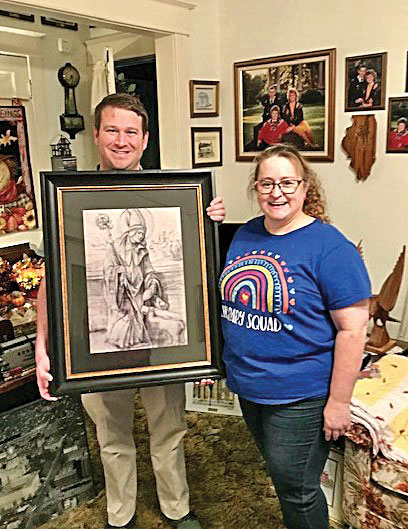 Father Steven Arisman, pastor of St. Francis of Solanus Parish in Quincy, graciously receives the framed image of St. Corbinian from Buhl, who is a parishioner at St. Aloysius Parish in Springfield. By MIKKI BUHL
Special to Catholic Times
About three months ago, I saw this framed art piece for sale at Hope Thrift Center in Springfield. I knew it was of a saint, but at the time, I was unsure who it was. I was intrigued by the drawing and purchased it, thinking I would use it at home or maybe my church or school could use it, as I have found other pictures at the thrift store and donated them to my church, St. Aloysius Parish, in Springfield.
After doing some searching, I found it was a picture of St. Corbinian (670-730), a bishop who traveled from Rome to Freising of Bavaria, Germany. The bear is often a symbol of St. Corbinian, who tamed a bear to carry his load while traveling. Corbinian's bear appeared on the coat of arms of Pope Benedict XVI.
My next mission was to find a church in our diocese with the saint’s name, but there was no luck. So, I then searched to find a church that had a German heritage. That is when I found St. Francis Solanus Parish in Quincy that met that requisite. The secretary had me connect Jake Terry, their youth minister.
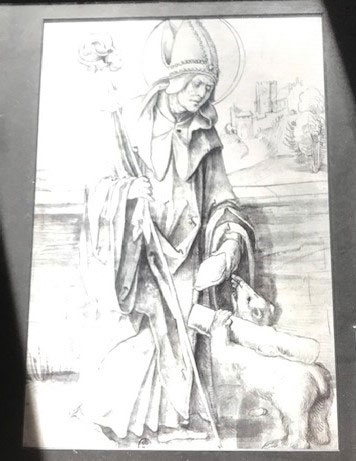 Now comes the exciting part! After speaking with Mr. Terry, I learned that their youth group had just selected this very saint to learn more about. It was a sign that the framed art piece had to go to this parish, but I wondered how to make arrangements. Mr. Terry and I communicated, figuring someone from their church would be in Springfield for a meeting.
I then received an email saying the pastor would be in town. It was then I looked up who the pastor was, and low and behold, it is Father Steven Arisman. I went on a retreat weekend a few years ago with him, and knew his hometown was Springfield. So, we made for arrangements to meet while he was in Springfield. In yet another God moment, the commemoration of the translation of St. Corbinian relics is Nov. 20. So, just in time for the feast day, I was able to give the picture to Father Arisman on Nov. 4.
Mikki Buhl is a parishioner at St. Aloysius Parish in Springfield
Submitted photos
Catholic Times special edition on the Eucharist

Christmas Mass Schedules across diocese

SPRINGFIELD
Cathedral of the Immaculate Conception
Christmas Eve, 4 p.m., 7 p.m.;
Midnight;
Christmas Day, 7 a.m., 10 a.m.
Blessed Sacrament Parish
Christmas Eve, 4:30 p.m., 8 p.m., 11 p.m.;
Christmas Day, 8:30 a.m., 10:30 a.m.
Christ the King Parish
Christmas Eve, 4 p.m., 6:30 p.m., 10 p.m.;
Christmas Day, 9:30 a.m.
Little Flower Parish
Christmas Eve, 4:30 p.m., 10 p.m.;
Christmas Day, 9 a.m.
St. Agnes Parish
Christmas Eve, 4:30 p.m., 8:30 p.m.;
Christmas Day, 10 a.m.
St. Aloysius Parish
Christmas Eve, 4 p.m.;
Midnight;
Christmas Day, 7 a.m.
St. Frances Cabrini Xavier Parish
Christmas Eve, 5:30 p.m.;
Christmas Day, 9:30 a.m.
St. Joseph Parish
Christmas Eve, 5 p.m., 9:30 p.m.;
Christmas Day, 9:30 a.m.
St. Katharine Drexel Parish
Christmas Eve, 4 p.m.;
Midnight;
Christmas Day, 7 a.m., 9 a.m. (St. Patrick Church), 10:30 a.m. (Latin), 12:30 p.m. (Spanish)
All Masses at Sacred Heart Church, except 9 a.m. Christmas Day, which is at St. Patrick Church.
(There is no Christmas Mass at St. Patrick now due to the laying of carpet at this time)
ALEXANDER
Visitation of the Blessed Virgin Mary Parish
Christmas Day, 10 a.m.
ALTAMONT
St. Clare Parish
Christmas Eve, 6 p.m.;
Christmas Day, 10 a.m.
ALTON
Immaculate Conception Parish (St. Mary)
Christmas Eve, 4 p.m., 6 p.m., 8 p.m.;
Midnight;
Christmas Day, 6:30 a.m., 8 a.m., 9:30 a.m., 11 a.m.
Ss. Peter and Paul Parish
Christmas Eve, 4 p.m., 8 p.m.;
Christmas Day, 10 a.m.
ARCOLA
St. John the Baptist Parish
Christmas Eve, 7:30 p.m.;
Christmas Day, 9:30 a.m.
ARENZVILLE
St. Fidelis Parish
Christmas Eve, 4 p.m.
ASHLAND
St. Augustine Parish
Midnight;
Christmas Day, 9 a.m.
ASSUMPTION
Assumption of the Blessed Virgin Mary Parish
Christmas Eve, 6 p.m.
ATHENS
Holy Family Parish
Christmas Eve, 6:30 p.m.;
Christmas Day, 10 a.m.
AUBURN
Holy Cross Parish
Christmas Eve, 4 p.m.;
Christmas Day, 8 a.m.
Overflow seating in the parish center.
BEARDSTOWN
St. Alexius Parish
Christmas Eve, 7 p.m. (Tri-lingual Mass);
Christmas Day, 10 a.m. (English), 11:30 a.m. (Spanish)
BENLD
St. Joseph Parish
Christmas Eve, 6 p.m.
BETHALTO
Our Lady Queen of Peace Parish
Christmas Eve, 4:30 p.m., 9 p.m.;
Christmas Day, 9 a.m.
BETHANY
St. Isidore Parish
Midnight
BRIGHTON
St. Alphonsus Parish
Christmas Eve, 7 p.m.;
Christmas Day, 9 a.m.
BRUSSELS
Blessed Trinity Parish
Christmas Eve, 6 p.m. (St. Mary Church, Brussels);
Midnight (St. Joseph Church, Meppen);
Christmas Day, 8 a.m. (St. Barbara Church, Batchtown)
CAMP POINT
St. Thomas the Apostle Parish
Christmas Eve, 6:30 p.m.;
Christmas Day, 9 a.m.
CARLINVILLE
Ss. Mary and Joseph Parish
Christmas Eve, 4 p.m.;
Christmas Day, 9 a.m.
CARROLLTON
St. John the Evangelist Parish
Christmas Eve, 4 p.m.;
Christmas Day, 9:30 a.m.
CHARLESTON
St. Charles Borromeo Parish
Christmas Eve, 5 p.m., 10 p.m.;
Christmas Day, 8:30 a.m.
CHATHAM
St. Joseph the Worker Parish
Christmas Eve, 4:30 p.m., 9 p.m.;
Christmas Day, 9 a.m.
COLLINSVILLE
Ss. Peter and Paul Parish
Christmas Eve, 4 p.m., 7 p.m.;
Christmas Day, 8 a.m., 10:30 a.m.
DECATUR
Holy Family Parish
Christmas Eve, 4 p.m., 9 p.m.;
Midnight;
Christmas Day, 9 a.m.
Our Lady of Lourdes Parish
Christmas Eve, 4 p.m., 6 p.m. (Spanish);
Midnight;
Christmas Day, 9 a.m.
Ss. James and Patrick Parish
Christmas Eve, 4 p.m. (St. James Church); 6 p.m. (St. Patrick Church), 11 p.m. (St. James Church);
Christmas Day, 10:15 a.m. (St. Patrick Church)
St. Thomas the Apostle Parish
Christmas Eve, 5 p.m.;
Christmas Day, 10 a.m.
DIETERICH
St. Isidore the Farmer Parish
Christmas Eve, 4 p.m. (St. Aloysius Church, Bishop Creek), 7 p.m. (St. Joseph Church, Island Grove), 10 p.m. (St. Aloysius Church, Bishop Creek);
Christmas Day, 10 a.m. (St. Joseph Church, Island Grove)
EDGEWOOD
St. Anne Parish
Christmas Day, 8 a.m.
EDWARDSVILLE
St. Boniface Parish
Christmas Eve, 4: 15 p.m., 9:15 p.m.;
Christmas Day, 8:15 a.m., 12:15 p.m. (Spanish)
St. Mary Parish
Christmas Eve, 4 p.m., 6 p.m.;
Christmas Day, 9 a.m.
EFFINGHAM
Sacred Heart Parish
Christmas Eve, 4 p.m., 9:30 p.m.;
Midnight:
Christmas Day, 9:30 a.m.
St. Anthony of Padua Parish
Christmas Eve, 4:30 p.m., 7 p.m.;
Midnight;
Christmas Day, 9 a.m.
FARMERSVILLE
St. Mary Parish
Christmas Eve, 4 p.m.
FIELDON
St. Mary Parish
Christmas Eve, 6 p.m.
FRANKLIN
Sacred Heart Parish
Christmas Eve, 4 p.m.
GILLESPIE
Ss. Simon and Jude Parish
Christmas Eve, 4 p.m.;
Christmas Day, 10:30 a.m.
GIRARD
St. Patrick Parish
Christmas Day, 9:30 a.m.
GLEN CARBON
St. Cecilia Parish
Christmas Eve, 4 p.m.;
Midnight;
Christmas Day, 10 a.m.
GODFREY
St. Ambrose Parish
Christmas Eve, 4 p.m., 6 p.m. and 9 p.m. (St. Ambrose), 7:30 p.m. (St. Michael, Beltrees);
Christmas Day, 8 a.m., 10:30 a.m. (St. Ambrose)
GRAFTON
St. Patrick Parish
Christmas Eve, 6:30 p.m.;
Christmas Day, 8 a.m.
GRANITE CITY
Holy Family Parish
Christmas Eve, 8 p.m.;
Christmas Day, 8:30 a.m.
St. Elizabeth Parish
Christmas Eve, 4:30 p.m., 11 p.m.;
Christmas Day, 8 a.m., 10:30 a.m.
GRANTFORK
St. Gertrude Parish
Christmas Eve, 7 p.m.;
Christmas Day, 8 a.m.
GREEN CREEK
St. Mary Help of Christians
Christmas Eve, 6 p.m.;
Christmas Day, 10:30 a.m.
GREENFIELD
St. Michael the Archangel
Christmas Day, 8 a.m.
GREENVILLE
St. Lawrence Parish
Christmas Eve, 5:30 p.m., 10 p.m.;
Christmas Day, 8 a.m., 10 a.m.
HARDIN
St. Francis of Assisi Parish
Christmas Eve, 4 p.m. (St. Anselm, Kampsville);
Christmas Day, 9:30 a.m. (St. Norbert, Hardin), 11 a.m. (St. Michael, Michael)
HIGHLAND
St. Paul Parish
Christmas Eve, 4 p.m., 11 p.m.;
Christmas Day, 8:30 a.m.
HILLSBORO
St. Agnes Parish
Christmas Eve, 4 p.m.;
Christmas Day, 10:30 a.m.
HUME
St. Michael Parish
Christmas Eve, 6:30 p.m.
ILLIOPOLIS
Resurrection Parish
Christmas Eve, 8 p.m.;
Christmas Day, 10:15 a.m.
JACKSONVILLE
Our Saviour Parish
Christmas Eve, 4 p.m., 6 p.m.;
Christmas Day, 9 a.m.
The 4 p.m. Christmas Eve and 9 a.m. Christmas Day Masses will be LIVE streamed and interpreted for the deaf.
JERSEYVILLE
Holy Ghost Parish
Christmas Eve, 4 p.m., 8:30 p.m.;
Christmas Day, 8 a.m., 10 a.m.
St. Francis Xavier Parish
Christmas Eve, 4 p.m. 8:30 p.m.;
Midnight;
Christmas Day, 10:15 a.m.
KINCAID
St. Rita Parish
Christmas Eve, 4 p.m.
LIBERTY
St. Brigid Parish
Christmas Eve, 7 p.m.;
Christmas Day, 8 a.m.
LILLYVILLE
Sacred Heart Parish
Christmas Eve, 6 p.m.;
Christmas Day, 8 a.m.
LITCHFIELD
Holy Family Parish
Christmas Eve, 10 p.m.;
Christmas Day, 8:30 a.m.
LIVINGSTON
Sacred Heart Parish
Christmas Eve, 5:30 p.m.
MADISON
St. Mary and St. Mark Parish
Christmas Eve, 4 p.m.;
Christmas Day, 10 a.m.
MARINE
St. Elizabeth Parish
Christmas Eve, 4 p.m.
MARYVILLE
Mother of Perpetual Help Parish
Christmas Eve, 4 p.m., 7 p.m.;
Christmas Day, 9 a.m.
MATTOON
Immaculate Conception Parish
Christmas Eve, 4 p.m., 9 p.m.;
Midnight;
Christmas Day, 8 a.m.
MEDORA
St. John the Evangelist
Christmas Eve, 4 p.m.
MENDON
St. Edward Parish
Christmas Eve, 4:30 p.m.;
Midnight
MONTROSE
St. Rose of Lima Parish
Christmas Eve, 5:30 p.m.;
Christmas Day, 9 a.m.
MORRISONVILLE
St. Maurice Parish
Christmas Eve, 4 p.m.
MOUNT OLIVE
St. Pope John Paul Parish
Midnight;
Christmas Day, 10:30 a.m.
MOUNT STERLING
Holy Family Parish
Christmas Eve, 4 p.m., 9 p.m.;
Midnight;
Christmas Day, 7 a.m.
MOUNT ZION
Our Lady of the Holy Spirit Parish
Christmas Eve, 4 p.m.;
Christmas Day, 9 a.m.
MOWEAQUA
St. Francis De Sales Parish
Christmas Eve, 4:30 p.m.
NEOGA
St. Mary of the Assumption Parish
Christmas Eve, 6 p.m.;
Christmas Day, 8 a.m.
NEW BERLIN
Sacred Heart of Mary Parish (St. Mary)
Christmas Eve, Music 5:30-6 p.m., Mass, 6 p.m.
NEWTON
St. Thomas Parish
Christmas Eve, 4:30 p.m., 11 p.m.;
Christmas Day, 8:30 a.m.
NOKOMIS
St. Louis Parish
Christmas Eve, 4 p.m., 10 p.m.;
Christmas Day, 9 a.m.
NORTH ARM
St. Aloysius Parish
Christmas Eve, 7 p.m.
OBLONG
Our Lady of Lourdes Parish
Christmas Eve, 6 p.m.
PANA
St. Patrick Parish
Christmas Eve, 4 p.m., 8 p.m.;
Christmas Day, 9 a.m.
PARIS
St. Mary Parish
Christmas Eve, 4 p.m., 10 p.m.;
Christmas Day, 9 a.m.
PETERSBURG
St. Peter Parish
Christmas Eve, 4:30 p.m.;
Christmas Day, 8 a.m.
PIERRON
Immaculate Conception Parish
Christmas Eve, 4:30 p.m.;
Christmas Day, 10 a.m.
PITTSFIELD
St. Mary Parish
Christmas Eve, 8 p.m.;
Christmas Day, 8:30 a.m.
POCAHONTAS
St. Nicholas Parish
Midnight
QUINCY
Blessed Sacrament Parish
Christmas Eve, 4 p.m., 5:30 p.m., 11 p.m.;
Christmas Day, 9 a.m.
St. Anthony of Padua Parish
Christmas Eve, 4 p.m., 6:30 p.m.;
Midnight;
Christmas Day, 8 a.m., 10:30 a.m.
St. Francis Solanus Parish
Christmas Eve, 4 p.m., 6 p.m., 8 p.m., 10 p.m.;
Midnight;
Christmas Day, 9 a.m.
St. Joseph Parish
Christmas Eve, 4:30 p.m.;
Christmas Day, 8 a.m.
St. Peter Parish
Christmas Eve, 4 p.m., 6 p.m., 8 p.m.;
Christmas Day, 8 a.m., 10 a.m.
St. Rose of Lima Parish
Midnight;
Christmas Day, 9:30 a.m., 11 a.m.
RAMSEY
St. Joseph Parish
Christmas Eve, 8 p.m.
RAYMOND
St. Raymond Parish
Christmas Eve, 6 p.m.;
Christmas Day, 9 a.m.
RIVERTON
St. James Parish
Christmas Eve, Carols, 3:30 p.m., Mass, 4 p.m.;
Christmas Day, 8:30 a.m.
ROBINSON
St. Elizabeth Parish
Christmas Eve, 9 p.m.;
Christmas Day, 9 a.m.
ROCHESTER
St. Jude Parish
Christmas Eve, 4 p.m., 6 p.m., 10 p.m.;
Christmas Day, 9 a.m.
SAINTE MARIE
St. Mary of the Assumption Parish
Christmas Eve, 4:30 p.m.;
Christmas Day, 8:30 a.m.
ST. ELMO
St. Mary Parish
Christmas Eve, 4 p.m.
ST. JACOB
St. James Parish
Christmas Day, 10:30 a.m.
SHELBYVILLE
Immaculate Conception Parish
Christmas Eve, 8 p.m.;
Christmas Day, 10:30 a.m.
SHERMAN
St. John Vianney Parish
Christmas Eve, 5 p.m.;
Midnight;
Christmas Day, 8:30 a.m.
SHUMWAY
Annunciation Parish
Christmas Eve, 4 p.m.;
Christmas Day, 8 a.m.
SIGEL
St. Michael the Archangel Parish
Christmas Eve, 4 p.m.;
Midnight;
Christmas Day, 10 a.m.
STAUNTON
St. Michael the Archangel Parish
Christmas Eve, 4 p.m., 9 p.m.;
Christmas Day, 8 a.m.
STONINGTON
Holy Trinity Parish
Christmas Day, 9 .m.
SULLIVAN
St. Columcille Parish
Christmas Eve, 6:30 p.m.;
Christmas Day, 10 a.m.
TAYLORVILLE
St. Mary Parish
Christmas Eve, 6 p.m.;
Midnight;
Christmas Day, 11 a.m.
TEUTOPOLIS
St. Francis of Assisi Parish
Christmas Eve, 4 p.m., 6 p.m., 10 p.m.;
Christmas Day, 9 a.m.
TROY
St. Jerome Parish
Christmas Eve, 4 p.m., 10 p.m.;
Christmas Day, 8:30 a.m.
TUSCOLA
Forty Martyrs Parish
Christmas Eve, 4 p.m., 5:30 p.m.;
Christmas Day, 8 a.m.
VANDALIA
Mother of Dolors Parish
Christmas Eve, 4 p.m.;
Midnight;
Christmas Day, 9 a.m.
VILLA GROVE
Sacred Heart Parish
Christmas Eve, Carols, 4 p.m., Mass, 4:30 p.m.;
Christmas Day, 9 a.m.
VIRDEN
Sacred Heart Parish
Christmas Eve, 4 p.m.
VIRGINIA
St. Luke Parish
Christmas Eve, 5:30 p.m.
WAVERLY
St. Sebastian Parish
Christmas Eve, 8 p.m.
WHITE HALL
All Saints Parish
Christmas Eve, 10 p.m.
WINCHESTER
St. Mark Parish
Christmas Eve, 5 p.m.;
Christmas Day, 10:30 a.m.
WOOD RIVER
Holy Angels Parish
Christmas Eve, 4 p.m.;
Midnight;
Christmas Day, 9 a.m.
Seven Sisters Apostolate in Pittsfield prays for pastor and bishop

 Jesus, present in the monstrance, during adoration at St. Mary Parish in Pittsfield. The Seven Sisters Apostolate at the parish commits to praying for one hour before the Blessed Sacrament one day per week, for the sole purpose of praying for their pastor, Father Mark Schulte and Bishop Thomas John Paprocki.More parishes in diocese joining apostolate, as group encourages other parishes to start one
By ANDREW HANSEN
Editor
Recognizing that priests need our constant prayers, a group of women from St. Mary Parish in Pittsfield started a Seven Sisters Apostolate. The apostolate has hundreds of local groups in parishes throughout the world, including our diocese. Each of the seven women in the apostolate commits to praying for one hour before the Blessed Sacrament one day per week, for the sole purpose of praying for the priest or bishop her apostolate is praying for. In the case of St. Mary in Pittsfield, they have two groups for a total of 14 women (one woman being from St. Mark Parish in Winchester). One group of seven women prays for their pastor, Father Mark Schulte, and the other group prays for Bishop Thomas John Paprocki.
“The action of taking time to go visit Jesus in the Blessed Sacrament is the powerhouse behind this ministry,” said Angela Lipcamon, anchoress and coordinator of The Seven Sisters Apostolate in Pittsfield. “There are no other obligations or meetings — just one hour per week with Jesus. It’s simple, beautiful, and abounding in graces for the priest and/or bishop and for the women praying the hour. It’s quite a gift!”
The Seven Sisters apostolate started at St. Mary in March of 2020 and the beginnings of the group has an interesting story.
“When I called to enroll our group, I was informed of it being St. Margaret Clitherow’s feast day,” Lipcamon said. “I knew it was divine inspiration that I was enrolling on her feast day because she is one of the patron saints of the Seven Sisters Apostolate.”
St. Margaret Clitherow was martyred in 1586 in England under the rule of King Henry VIII’s persecution of Catholics, for supporting and harboring priests in her home and for organizing secret Masses. She was a convert, deeply devoted to the holy Eucharist, and to supporting the priesthood in prayer and action.
“This apostolate is important because of the power of prayer before the Blessed Sacrament and because our priests and bishops are tremendously important to the life of the Church,” Lipcamon said. “They are a great gift to us from God, and our prayers are needed to help protect and sustain them. The most important gift we receive through them is the holy Eucharist, Jesus’ Body and Blood for the life of the world, along with providing us with the other sacraments that Jesus instituted for our wellbeing. Our priests and bishops lead us in the faith and are integral to the life of the Church.”
St. Mary’s apostolate added the Fasting Brothers men’s group as an adjunct ministry last year. Twelve men in the parish willingly accepted a call to fast one day per week in conjunction with the women’s prayer apostolate for Father Schulte and Bishop Paprocki.
“I believe there have been tremendous graces given through this ministry to our priest, the priesthood in general, our parishes, our bishop, the women dedicated to this ministry, and thus the diocese and Church at large, because we are one and intricately connected,” Lipcamon said. “Any time spent in the presence of Jesus in the Blessed Sacrament brings immeasurable blessings and graces. It is impossible to know or measure the profound effect or gain from this ministry, but I believe it to be tremendous.”
The Seven Sisters apostolate is not the first one in our diocese, and it continues to grow. Lipcamon, in her capacity as president of the Quincy Deanery Council of Catholic Women, has promoted this eucharistic devotion and ministry to her deanery and the other deaneries of our diocese.
Since starting this prayer ministry at St. Mary in Pittsfield, Lipcamon says several other parishes now have one or more of the Seven Sisters Apostolate, including parishes in Jacksonville, Jerseyville, Camp Point, Quincy, Arcola, and Edwardsville, with others embarking on starting an apostolate.
“I encourage the spread of this devotion for the extreme graces involved in the rebuilding of Christ’s Church through the prayers and sacrificial offerings for our priests and bishop,” Lipcamon said. “Adoration of the Blessed Sacrament is the key to the Eucharistic Revival. Through eucharistic adoration will come eucharistic revival! Anyone who fervently goes before Jesus in the Eucharist, never walks away empty. He fills you up. Be fervent in your commitment. One person can make a huge difference. Go forth with prayer and trust. It’s an easy, simple, humble, and sacrificial ministry with tremendous impact. May God continue to bless our diocese in this endeavor.”
For more information, go to sevensistersapostolate.org.
Submitted photo
Hey, Father! Explain all these priest and religious terms

What is the difference between nuns and sisters; what is a convent, monastery, motherhouse, and friary; and what is the difference between brothers, friars, monks, and monsignors?
- Rachel in Springfield
Dear Rachel,
Your questions about the various expressions and living arrangements of men and women religious is a good one. We Catholics love our lingo and sometimes that lingo can be confusing until we learn what the various words in our Catholic lexicon mean.
To begin our discussion, it is important to know that people who are called to enter religious life as nuns, sisters, brothers, friars, priests, etc., live a life that seeks to draw them closer to Jesus Christ and His people in and through their radical witness and service to the Church and to the world. As the Catechism of the Catholic Church offers us:
“The religious state is thus one way of experiencing a ‘more intimate’ consecration, rooted in Baptism and dedicated totally to God. In the consecrated life, Christ’s faithful, moved by the Holy Spirit, propose to follow Christ more nearly, to give themselves to God who is loved above all and, pursuing the perfection of charity in the service of the Kingdom, to signify and proclaim in the Church the glory of the world to come” (CCC 916).
This “religious state,” more commonly referred to as “religious life,” is lived out in different and unique ways. These unique differences are an asset to religious life, and they exist to bring about the Kingdom here on earth through witness and service.
For women, living life as either a nun or sister offers an opportunity for women to live out this “intimate consecration” as they seek to serve Christ and His Church. While certainly related, these are two very different expressions of religious life. In common parlance, we often use the term “nun” as a sort of umbrella term for all women who are called to religious life, however, this is not accurate. Nuns are women who choose to retreat from the world, join a religious order, live together in a cloistered setting, and devote their lives to praying for the Church and the world. A good example of nuns for us in the Diocese of Springfield in Illinois would be the Dominican Nuns of the Monastery of Mary the Queen in Girard.
Sisters on the other hand are women who choose to join a religious order, live and pray in community, and devote their lives to serving the Church through various charisms and apostolates in the world. Historically, sisters have worked as nurses, doctors, teachers, university administrators, in parish leadership roles, and in various ministries to the poor, to name just a few. Some good examples of sisters for us in our diocese are the Dominican Sisters of Springfield, the Sisters of St. Francis of the Martyr St. George in Alton, and the Hospital Sisters of St. Francis in Springfield. Depending on the religious order, nuns and sisters live in community in convents, monasteries, or motherhouses. A motherhouse is the home base or “headquarters” for a religious order of women. A convent is a home for religious sisters to live in community and is like a branch campus or satellite of the motherhouse. A monastery is a place where women who have entered a monastic order live, pray, and work.
For men, living life as a brother, friar, or monk offers an opportunity for men to live out the same “intimate consecration” as they seek to serve Christ and His Church. Brothers live lives which are very similar to sisters. Brothers are men who choose to join a religious order, live, and pray in a community and devote their lives to serving the Church through various charisms and apostolates in the world. Historically, brothers have worked as teachers, in various forms of health care, in homes for people with intellectual disabilities, and other diverse ministries. In our diocese, the Franciscan Brothers of the Holy Cross offer us a beautiful example of this way of life.
Monks and friars then are men who join particular types of religious orders.
Monks are men who live in monasteries, follow the monastic way of life, according to a particular rule or set of guidelines, by which they live in common. Typically, monks, like nuns, live a cloistered life in a monastery, though some do undertake work in the world. Historically, monastic communities have primarily served the Church through the example of their contemplative prayer, though they also operate schools, seminaries, and universities. While we do not have any monasteries in our diocese, monks can be found to the north of us at St. Bede’s Abbey in Peru; to the south of us at St. Louis Abbey in St. Louis; and to the east of us at St. Meinrad Archabbey in St. Meinrad, Ind.
Friars are men who join what’s called a “mendicant order.” Unlike a monastic order, a mendicant order serves in active ministries in the world, moving from place to place, embracing a life of poverty, and spreading the Gospel through evangelization. Here in our diocese, we are blessed with the presence of Franciscan and Dominican Friars in a number of our parishes, hospitals, and schools. In terms of where these various male religious live, monks live in monasteries and friars live in friaries.
Finally, a monsignor is simply an honorific title that the pope bestows upon a diocesan priest in recognition of his years of faithful service to a particular Church, service to the Church in some extra-ordinary way, or because of a position of leadership. We are blessed with the presence of eight monsignori among our diocesan presbyterate.
In their own unique way, nuns, sisters, brothers, monks, friars, and monsignori (oh my!), contribute to the building up of the Kingdom through their witness and service. Their way of life furnishes for us an example of Christ’s merciful love for all of us as they “signify and proclaim in the Church the glory of the world to come.”
- Father Zachary D. Samples is parochial vicar of St. Peter Parish in Quincy and is associate chaplain at Quincy Notre Dame High School.
DCJH - How you can help the needy in our diocese

How can Jesus Christ be truly present in what still appears to be bread and wine?

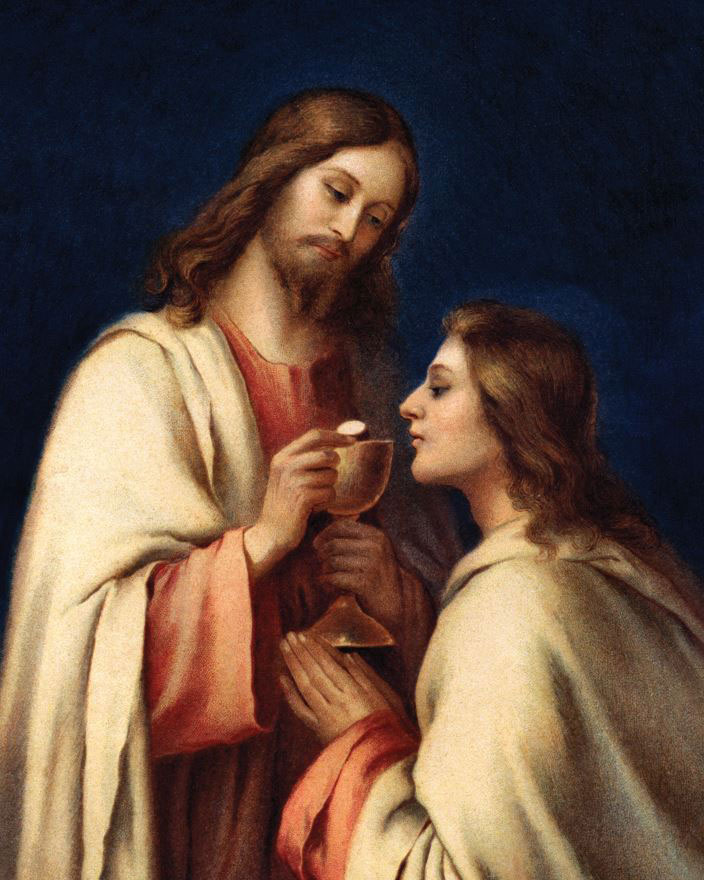 From the very beginning, the Church has believed and celebrated according to the teaching of Jesus Himself: “Whoever eats my flesh and drinks my blood has eternal life, and I will raise him on the last day. For my flesh is true food, and my blood is true drink. Whoever eats my flesh and drinks my blood remains in me and I in him” (Jn 6:54-56). It is not “ordinary bread and ordinary drink” that we receive in the Eucharist, but the flesh and blood of Christ, who came to nourish and transform us, to restore our relationship to God and to one another.
In the Eucharist, with the eyes of faith we see before us Jesus Christ, who, in the Incarnation became flesh (Jn 1:14) and who in the Paschal Mystery gave Himself for us (Ti 2:14), accepting even death on a cross (Phil 2:8). St. John Chrysostom preached that when you see the Body of Christ “set before you [on the altar], say to yourself: ‘Because of this Body I am no longer earth and ashes, no longer a prisoner, but free: because of this I hope for heaven, and to receive the good things therein, immortal life, the portion of angels, [and closeness] with Christ.’”
How can Jesus Christ be truly present in what still appears to be bread and wine? In the liturgical act known as the epiclesis, the bishop or priest, speaking in the person of Jesus Christ, calls upon the Father to send down his Holy Spirit to change the bread and wine into the Body and Blood of Christ, and this change occurs through the institution narrative, by the power of the words of Christ pronounced by the celebrant.
The reality that, in the Eucharist, bread and wine become the Body and Blood, Soul and Divinity of Christ without ceasing to appear as bread and wine to our five senses is one of the central mysteries of the Catholic faith. This faith is a doorway through which we, like the saints and mystics before us, may enter into a deeper perception of the mercy and love manifested in and through Christ’s sacramental presence in our midst. While one thing is seen with our bodily eyes, another reality is perceived through the eyes of faith. The real, true, and substantial presence of Christ in the Eucharist is the most profound reality of the sacrament. This mysterious change is very appropriately called by the Church transubstantiation.
Though Christ is present to us in many ways in the liturgy, including in the assembly gathered, the presiding minister, and the word proclaimed, the Church also clearly affirms that “the mode of Christ’s presence under the Eucharistic species is unique.” As St. Paul VI wrote, “This presence is called ‘real’ not to exclude the idea that the others are ‘real’ too, but rather to indicate presence par excellence, because it is substantial and through it Christ becomes present whole and entire, God and man.” In the sacramental re-presentation of His sacrifice, Christ holds back nothing, offering Himself, whole and entire. The use of the word “substantial” to mark the unique presence of Christ in the Eucharist is intended to convey the totality of the gift He offers to us.
When the Eucharist is distributed and the minister says, “the Body of Christ,” we are to look not simply at what is visible before our eyes, but at what it has become by the words of Christ and the gift of the Holy Spirit — the Body of Christ. The communicant’s response of “Amen” is a profession of faith in the Real Presence of Christ and reflects the intimate personal encounter with him, with His gift of self, that comes through reception of holy Communion.
Taken from The Mystery of Eucharist in the Life of the Church, produced by the United States Conference of Catholic Bishops in 2021
Incredible eucharistic miracle story involving Pope Francis has science baffled

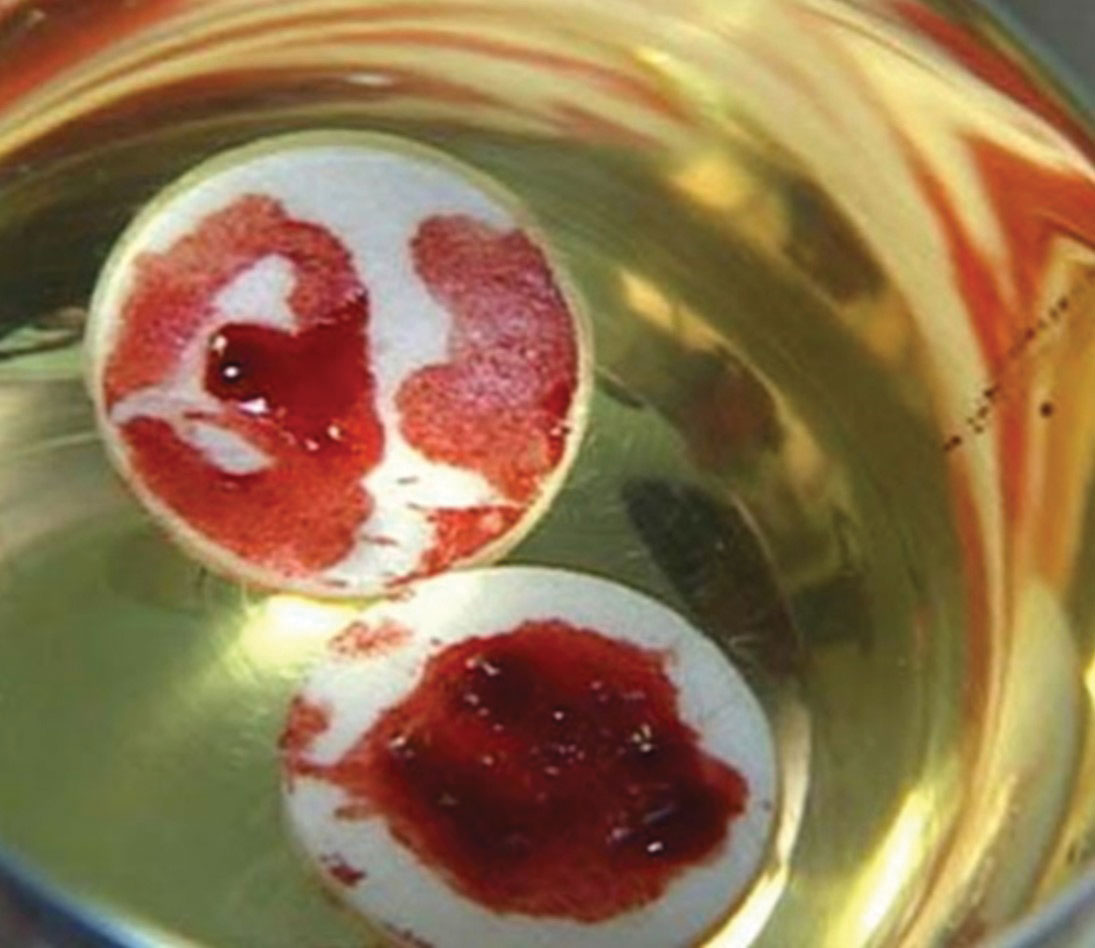 Results from miracle are match to another eucharistic miracle hundreds of years earlier
By ANDREW HANSEN
Editor
After Mass on Aug. 15, 1996 at a parish in Buenos Aires, Argentina, a woman approached the priest saying that she found a consecrated Host in the church. The priest — following proper procedures in such a case — placed the Host into a glass of water so it would dissolve and put the Host into the tabernacle. Days later, to the priest’s amazement, the Host appeared bloody and had a flesh-like appearance.
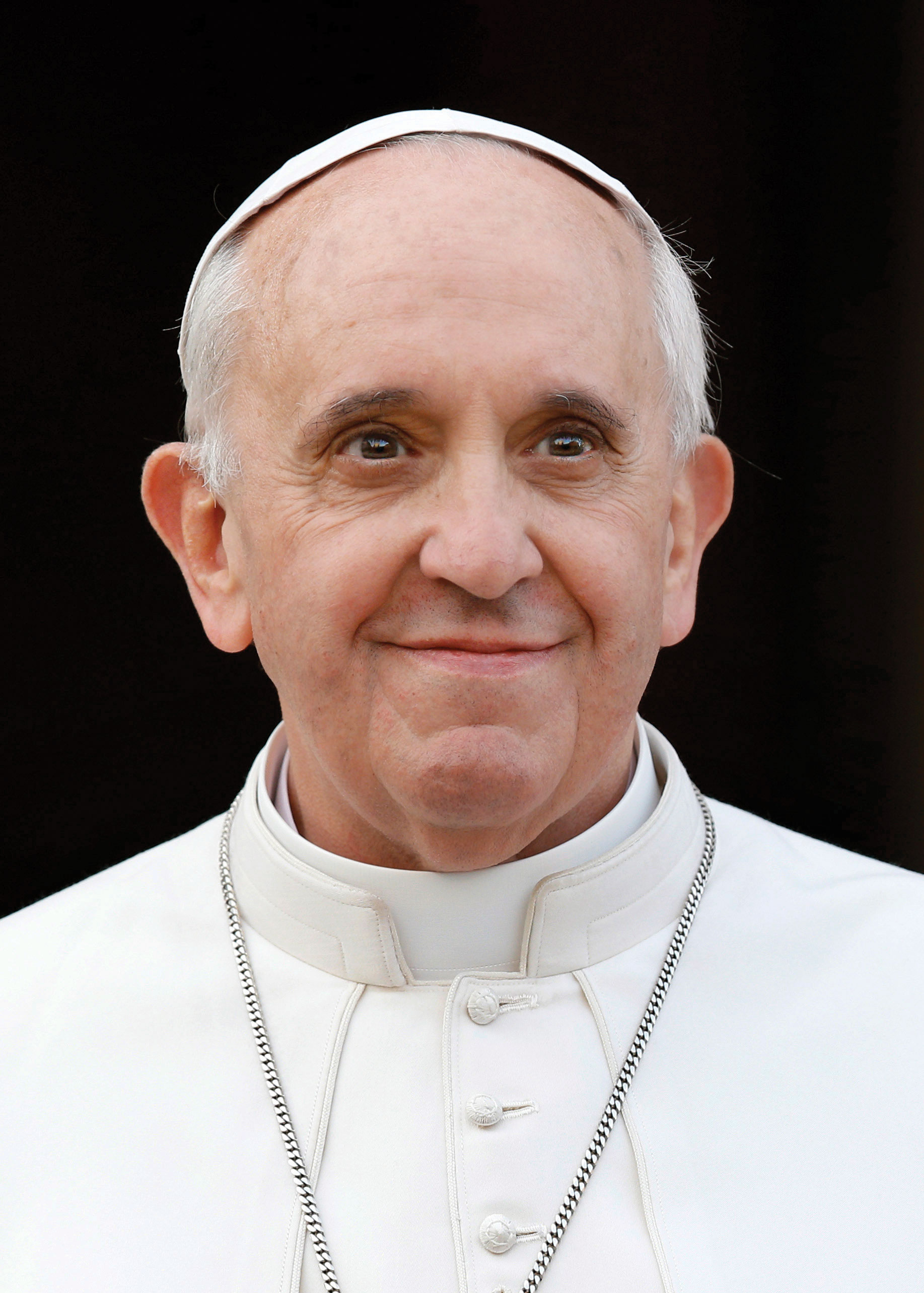 Then-Cardinal Bergoglio, now Pope Francis, who was Archbishop of the area at the time, was notified and had the host photographed, which clearly showed bloodied flesh that had somehow grown larger than the original Host. It was then placed back in the tabernacle and after several years, with no sign of decay, Cardinal Bergoglio officially opened an investigation. A sample of the blood was sent to scientists and doctors in the United States.
The experts, without knowing where the sample came from, issued their results that it was human flesh and blood. Moreover, cardiologist and forensic pathologist, Dr. Frederic Zugibe said that it was “a fragment of the heart muscle found in the wall of the left ventricle close to the valves.” In addition, it was concluded that “the heart had been under severe stress, as if the owner had been beaten severely about the chest.”
Perhaps most fascinating about the findings, Dr. Zugibe said, “The heart muscle is in an inflammatory condition and contains a large number of white blood cells. This indicates that the heart was alive at the time the sample was taken. It is my contention that the heart was alive, since white blood cells die outside a living organism.”
It’s important to note that after blood is drawn from a person, the white blood cells disintegrate after 15 minutes. Therefore, it’s scientifically unexplainable that in 2005, white blood cells were found in a blood sample from 1996.
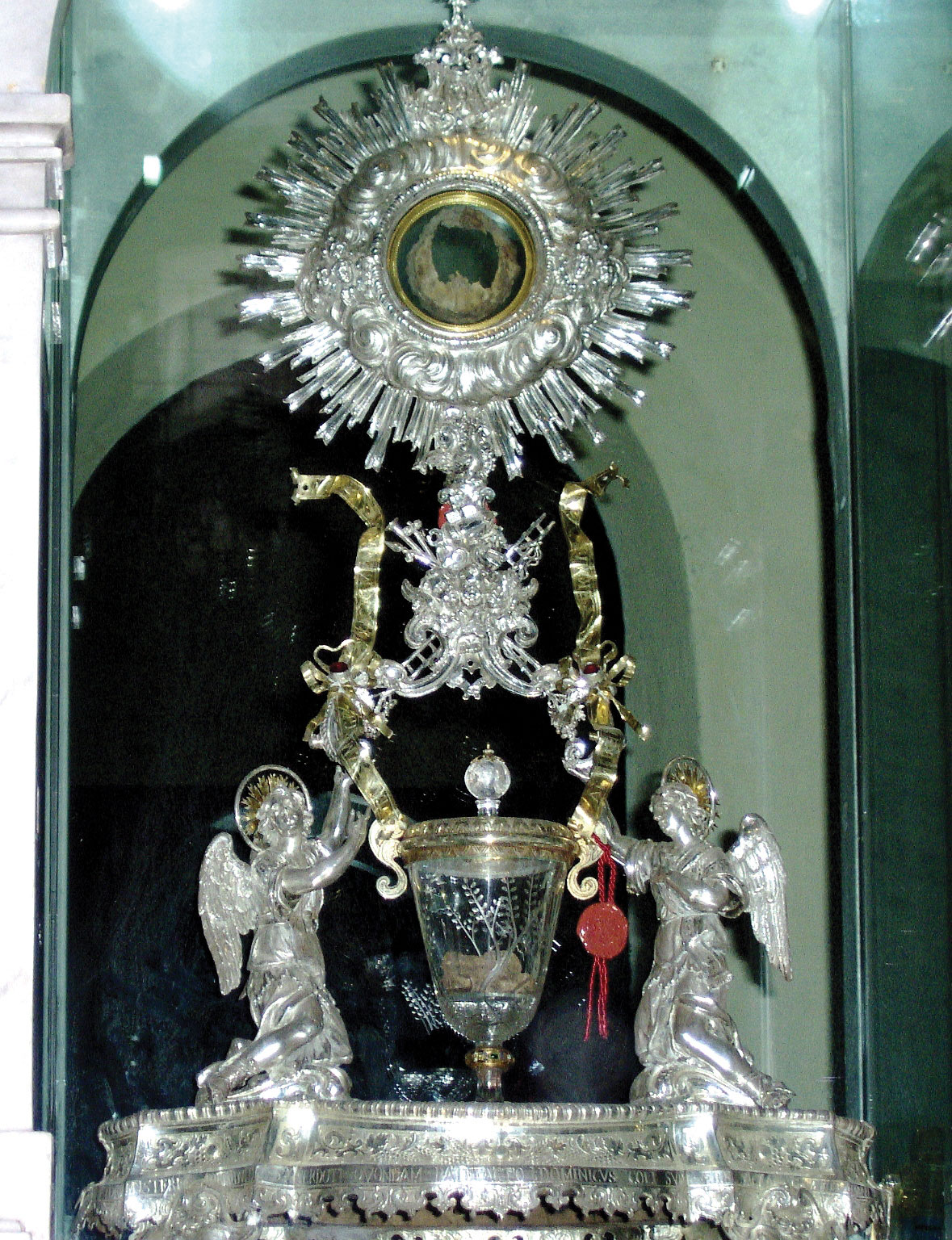 Another Eucharistic miracle occurred in Italy in the eighth century when a consecrated Host physically changed into flesh and the wine physically changed to blood before the eyes of a priest who had doubted the true presence of Christ in the Eucharist. Those present at Mass also witnessed this. Today, despite no form of preservative, that host, which changed physically into flesh and blood is still present at a church in Lanciano, Italy and can be viewed.
What do these eucharistic miracles have to do with us today?
In 2019, the Pew Research Center conducted a survey and found with self-identified Catholics that 69 percent do not believe that during the consecration at Mass, the bread and wine become the Body and Blood of Christ. On the other hand, only 31 percent of Catholics believe Jesus is truly present in the Eucharist, something the Church joyfully teaches, and has taught from day one. The Church also says that the “Eucharist is the source and summit ecclesial life.” It’s worth noting the survey found that most Catholics who believe the bread and wine are only symbols don’t know that the Church teaches they are transformed into the very Body and Blood of Jesus Christ by the power of His own words.
“While the survey results are troubling, they are not all that surprising,” said Father Daren Zehnle, director of the Office for Divine Worship and the Catechumenate for the Diocese of Springfield in Illinois. “Even some of Jesus’ first followers questioned His credibility when He spoke about the necessity of eating and drinking His Body and Blood. He did not lessen the strength of His words but doubled down. The difference between some people today and those early followers of Christ, is that the early ones who did not believe Him had the integrity to stop following Him. They knew they had to follow Him on His terms, or not at all. Some people today, however, try to follow Jesus on their own terms and ignore what He says.”
Consider the evidence of the Church’s teaching on the Eucharist:
Jesus said: “Amen, amen, I say to you, unless you eat the flesh of the Son of Man and drink his blood, you do not have life within you. Whoever eats my flesh and drinks my blood has eternal life, and I will raise him on the last day. For my flesh is true food, and my blood is true drink. Whoever eats my flesh and drinks my blood remains in me and I in him” (John 6:53-56).
At the Last Supper, Jesus was also quite clear:
“While they were eating, Jesus took bread, said the blessing, broke it, and giving it to his disciples said, ‘Take and eat; this is my body.’ Then he took a cup, gave thanks, and gave it to them, saying, ‘Drink from it, all of you, for this is my blood of the covenant, which will be shed on behalf of many for the forgiveness of sins’” (Matthew 26:26-28).
Notice, Jesus said that this is my body. This is my blood. He didn’t say that this is a symbol of His body or blood. He also told his Apostles to “do this” in remembrance of Him.
“From the beginning of the Church, Christians have taken Jesus’ words at face value,” Father Zehnle said. “If we look at the writings of the Church Fathers, we find people like St. Ignatius of Antioch speaking bluntly about the Eucharist as the Body and Blood of the Savior. People who disagreed with them, they knew to be outside the communion of the Church.”
The Catechism of the Catholic Church is helpful in breaking this teaching down, saying, “The Eucharist is the memorial of Christ's Passover, that is, of the work of salvation accomplished by the life, death, and resurrection of Christ, a work made present by the liturgical action. It is Christ himself, the eternal high priest of the New Covenant who, acting through the ministry of the priests, offers the Eucharistic sacrifice. And it is the same Christ, really present under the species of bread and wine, who is the offering of the Eucharistic sacrifice” (CCC 1409-1410).
If what Jesus said 2,000 years ago doesn’t get the attention of non-believers, perhaps that’s why God allows these Eucharistic miracles to occur — a “wake up” call to the Gift in front of them.
“The challenge for all of us is to believe what Jesus says because He is the Way, the Truth, and the Life who cannot deceive us,” Father Zehnle said.
Receiving the Eucharist for the first time – it can get quite the reaction

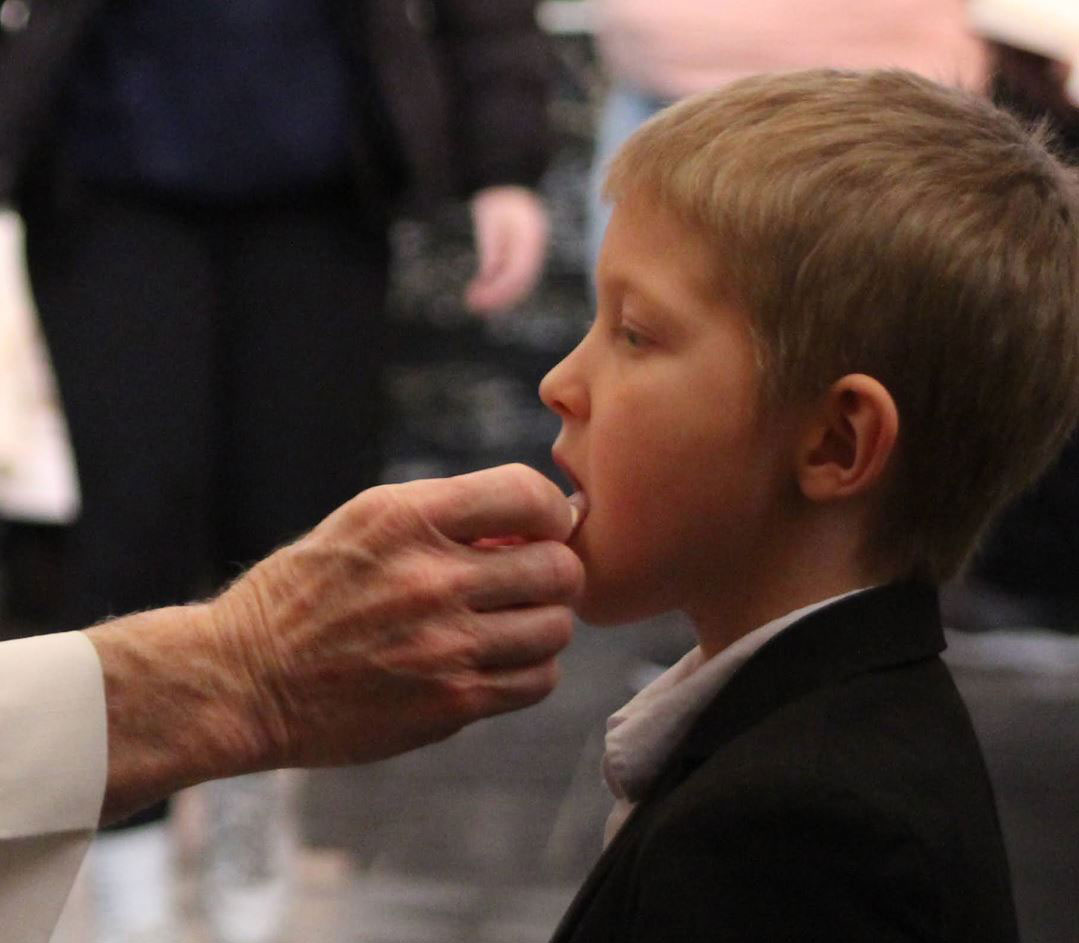 Catholics in our diocese who converted to the faith shared with Catholic Times what it was like receiving the Eucharist for the first time. Their responses will inspire you.
“I remember thinking, ‘This is it! This is it! And, you’re home. No matter what happens now, the most important thing in your life is now open to you and the rest in God’s hands.’”
- Father John Titus, pastor of Immaculate Conception Parish in Mattoon and St. Columcille Parish in Sullivan
“The first time I went to Mass with my spouse who is Catholic, I didn’t know what to do with myself. My husband said to fold my arms and the priest would say some kind words giving me a bit of grace to carry on through the week. After I became Catholic, I thought, ‘Finally!’ I can fully participate in Mass. I was overwhelmed with the spirit of Christ and felt I had pleased Him with the direction I had chosen for my life. I was incorrect in thinking this was the end of my journey in coming to Christ. Each time I partake of the Eucharist, I know it draws me closer to God and gives me focus to continue His work in serving those in most need.”
- Deegee Kienstra, St. Mary Parish in Edwardsville
“It was … April 2019, at the Easter Vigil that I joined the Catholic faith and received the Eucharist for the first time. I was finally able to take part in what Christ requested, ‘Do this in remembrance of me.’ I became more and more aware throughout RCIA what it really meant to be part of such a union with other Catholics throughout the world. I was so excited and deeply aware of what it meant to take part in what was truly one bread and one body — Christ’s body. I was finally able to physically, mentally, and spiritually receive with each Communion a renewal, as well as a reminder the deep love Christ has for all who take part.”
- Rebecca McIntire, St. Anthony of Padua Parish in Effingham
“Incredible. Receiving the Eucharist for the first time—knowing that I was truly receiving the Body and Blood of Jesus Christ—those feelings and emotions are just impossible to describe. What I experienced that day is something that will stay with me forever.”
- Gerald Broadwater, St. Elizabeth Parish in Granite City
“It was a very personal experience. At that time, I felt like the world was at peace, and I truly felt united with Christ. Being baptized and receiving the Eucharist on the same day was an overwhelming experience filled with love, joy, and happiness for me. “
- Makenzie Miles, St. Francis Solanus Parish in Quincy
“It was a point of letting my guard down and accepting that I didn’t have it all figured out and that God and I were going to get to know each other better.”
- Nathan Grider, St. Agnes Parish in Springfield
“I was very nervous at the 2001 Easter Vigil when receiving the holy Sacraments as a convert, but I remember feeling peace come over me as I exclaimed what my pastor taught me to increase my faith in the holy Eucharist, ‘My Lord, and my God.’"
- Alex Foster, St. Francis Xavier Parish in Jerseyville
“As a born southern Baptist, Christianity never made any sense to me. I could never figure out what the big deal was. After learning about the Eucharist, things slowly began to make more and more sense, and when I actually received the Eucharist for the first time, I had this feeling of clarity. I almost felt as if my brain had been rewired. I don’t know that it was miraculous but, in my mind, suddenly life and more importantly the Scriptures made sense.”
- Calvin Bell, Blessed Sacrament Parish in Springfield
“When I received the Eucharist for the first time, two things came to mind: First, was an overwhelming sense of peace. I felt closer to Christ than I ever had before. The other feeling or thought I had was that I was finally home. I had waited a long time to be a part of Christ's church and I was so grateful to now be His own. I prayed for the feeling to never subside. I remember the song they played, 'How Beautiful,’ and that I cried.”
- Bret Ware, St. Elizabeth Parish in Granite City
“As I approached Father Joe (Ring) to receive my first Communion, I felt completely humbled and most reverent of the great sacrifices Jesus Christ made for me. After receiving the Body and Blood of Jesus, I was overwhelmed, emotionally and physically, with the love of the Holy Spirit. So, in total gratitude, I knelt down to pray that I would be a vessel for His light to shine through me.”
- Pamma Kaufmann, Our Saviour Parish in Jacksonville
“I entered the Catholic Church in a humbling manner. I never thought that I would have a conversion. I had been raised in the Baptist church and my entire family was of Protestant faith. I had taken communion throughout my life as a ‘symbolic gesture.’ As I attended the Catholic church with my future husband, many times I would be moved to tears. Watching the faithful partake in Communion, there was something special about this, something that I had never experienced. At the Easter Vigil when I received my first Communion it was a feeling of gratitude and renewal. I knew that Jesus was in the Eucharist. I am so appreciative of the Eucharist and what it means to my life, and I look forward to growing in my Catholic faith.”
- Lynda Wrigley, Blessed Trinity Parish in Brussels
“Coming from a Protestant background, receiving the holy Eucharist for the first time felt like stepping into a world I had never encountered before. I feel as though I have truly joined the marriage Supper of the Lamb and received the fullness of the faith.”
- Joseph Smith, St. Francis Solanus Parish in Quincy