
Diocesan Administrator Account
Hey, Father! Since St. Patrick's Day is on Friday during Lent, can we eat meat?

I see that St Patrick's Day falls on a Friday during Lent again this year. So, I assume Bishop Thomas John Paprocki will not give us permission to enjoy corned beef in our Irish celebrations. Would it be a mortal sin to travel to a nearby diocese where their bishop grants a dispensation, allowing Catholics to enjoy their corned beef that day?
- Nancy in Springfield
Dear Nancy,
You must be quite the devotee of American custom that you would be willing to drive outside of our diocese to enjoy corned beef on St. Patrick’s Day. Would it be a mortal sin to do so? I would argue no, but one could make an argument that it is still sinful, though less sinful, to attempt to circumvent the Church’s Lenten disciplinary laws in such a manner. That being said, you may not need to go to such lengths to licitly get your corned beef on St. Patrick’s Day.
No, Bishop Paprocki is not granting a diocesan-wide dispensation for St. Patrick’s Day. Granting a dispensation from an ecclesiastical law is seen as a “wounding” of the law so there needs to be a proportional reason for doing so, especially such a broad action as dispensing an entire diocese. If we were the Archdiocese of Boston, filled with Irish Catholics, there would be greater reason to justify the dispensation, but that is not so much the case here. However, you may approach your own pastor who has authority to dispense his own parishioners in such matters on a case-by-case basis. He may grant you the desired dispensation or he may commute your observance of abstinence from meat to another day such as the day before or the day after St. Patrick’s Day. Pastors can find this in canon 1245 in the Code of Canon Law.
Earlier I referred to the custom of eating corned beef on St. Patrick’s Day as being American. I remember a conversation with a buddy of mine in college about the Irish and corned beef and St. Patrick’s Day. Mark, whose parents came over from Ireland to the United States before he was born, told me that in Ireland the Irish would never dream of eating corned beef in honor of St. Patrick. Beef was never a staple of food in Ireland, like pork or lamb, and beef was completely unaffordable for most of the Irish population after the nation was subjugated by England. The custom of eating corned beef comes from the arrival of the Irish in America in 19th and early 20th centuries and the fact that they could afford some beef when they came to the United States, but mostly only corned beef.
Whatever we choose to do or not do in honor of St. Patrick’s Day, I would encourage all of us to remember the man himself. History tells us that Patrick was devout, very determined, and rather austere. Let us ask the great Apostle of Ireland to pray for us that, like him, we might seek to bind ourselves to the Blessed Trinity in all that we do.
- Father Christopher House is pastor of Christ the King Parish in Springfield and is vicar judicial and director of the Department for Canonical and Pastoral Services.
New St. Mary House in Mattoon shining example that the Church doesn't stop being pro-life after birth

House opened in November 2022 and welcomes women/children in need
By ANDREW HANSEN
Editor
 MATTOON — It was a dark, cold night in Mattoon last December. For a mother of four girls living in the city, the night represented her year.
“I’ve had an extremely difficult year,” the mother, who wished to remain anonymous, said. “I’ve lost everything. I need help getting into my own place.”
Another young woman, also living in Mattoon, who also wished to remain anonymous, felt empty.
“I moved to Illinois in 2022,” she said. “I didn’t have much and was struggling to find a secure, safe, and stable place. I was staying with a friend for a couple of months and then was asked to leave due to ‘life happening.’”
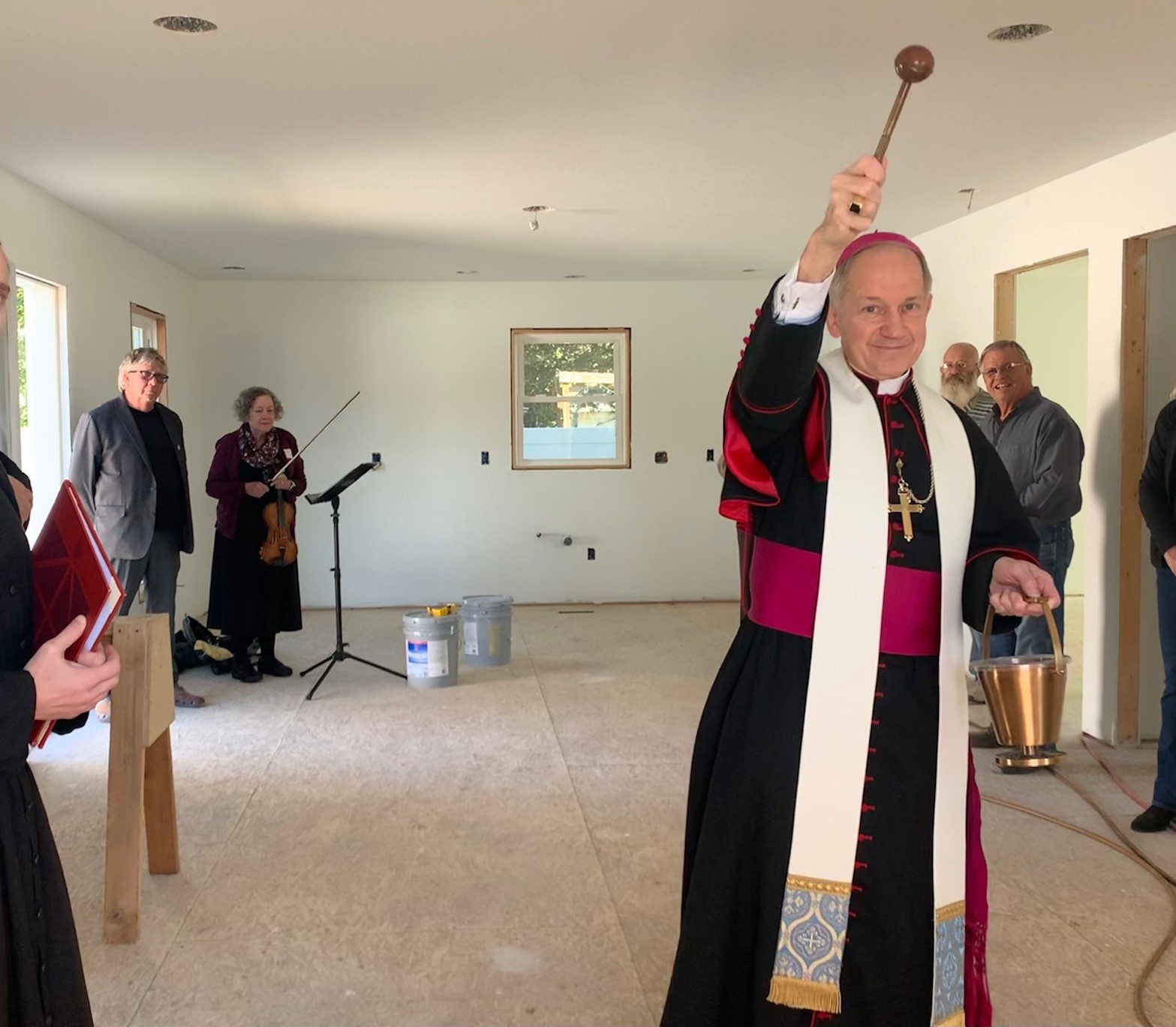 All hope seemed lost for these women until the Catholic and pro-life community in Mattoon stepped in and offered these women things they desperately needed: love, support, resources, and a warm, comfortable place to live. That place, the St. Mary House, which opened in November of 2022, has become the symbol of hope for these women and future women who will live there.
“Having been a part of the community effort in Charleston that brought together St. Charles Borromeo Parish, the Newman Center at Eastern Illinois University, and the St. Vincent de Paul Society that walked with people in need, we saw an opportunity to provide a transitional home environment in Mattoon for women and children on the Catholic worker model,” said Father John Titus, pastor of Immaculate Conception in Mattoon and St. Columcille in Sullivan.
 When a home across the street from the Immaculate Conception Church parking lot opened, the Catholic and pro-life community acted. Money was raised, the home was demolished, and the new, three-bedroom St. Mary House was built in one year.
“As Catholics, we embrace the spiritual and corporal works of mercy,” Father Titus said. “The St. Mary House is a manifestation of both, caring for body and soul and helping make it possible for women to regroup. We affirm that every life has value — born and unborn. We want to help mothers make good choices for themselves and their children at the dawn of life and in the shadows of life. When a cynical world scoffs and says as Catholics we do not care about what happens to moms and their children after birth, we can invite them to join our efforts to serve even more women and children in our community.”
 For these two women, the St. Mary House has become a beacon of light in their lives.
“The home is beautiful,” the young woman said. “It’s homey and safe, and you feel nothing but love when you walk in. Physically and emotionally, this home has helped me become more OK with spending time with myself, and it has helped me create a healthy routine. I was able to find a job within walking distance so maintaining that means saving money will be a lot easier.”
For the mother of four, the St. Mary House is also giving her a new, refreshing outlook.
“You have your own private bathroom which is a plus for me,” she said. “My youngest and I love that it’s safe. There’s also a code for entry into the home. The home has given me hope that there are people out there that still care.”
Those caring people include the Springfield Dominican Sisters who offered a grant, generous individual donations, including from area businesses, and one family that gave $25,000, all which contributed to the construction of the home. The Springfield Dominicans also donated furniture. Proceeds from fundraisers in the area and more donations keep the home in operation for women and their children.
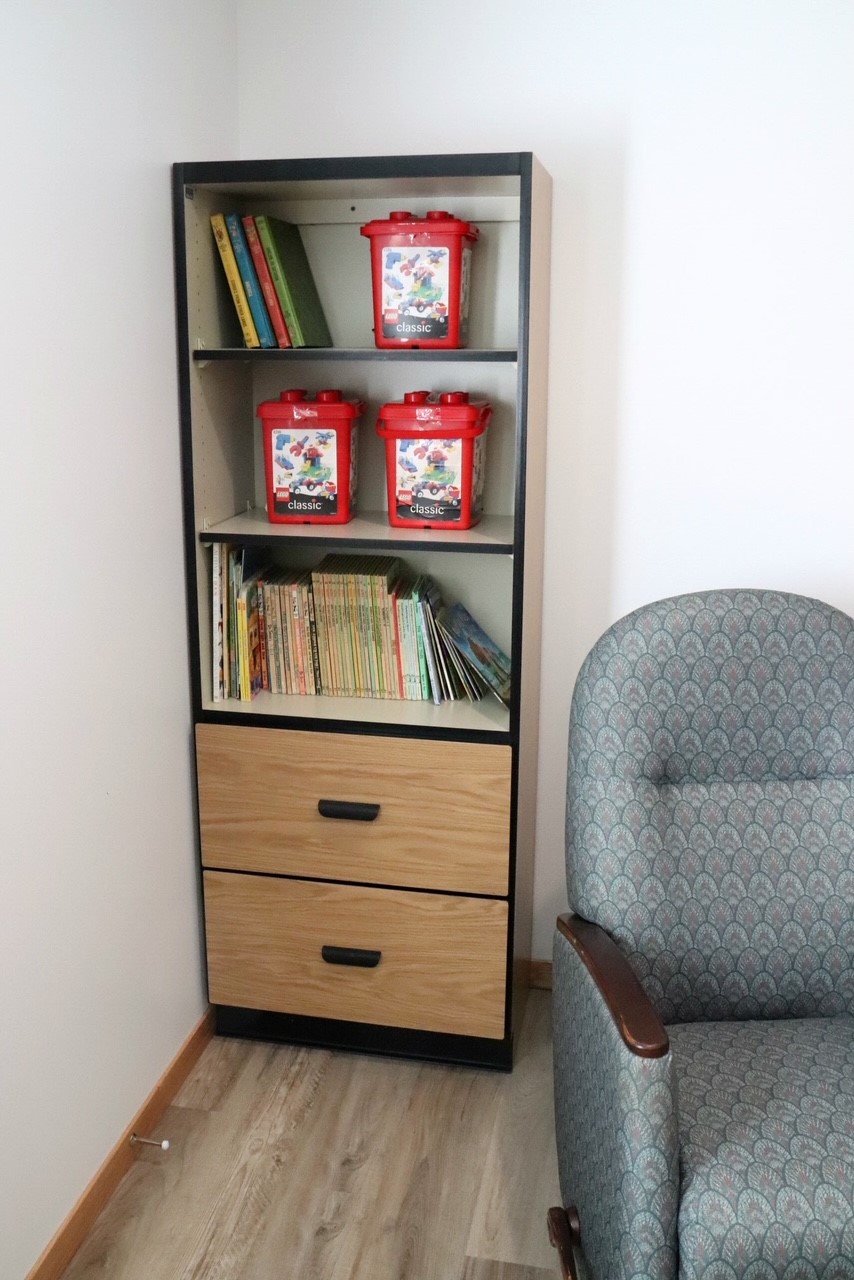
 Guests of the home sign off on the “Expectations of Guests” policies and agree to a background check. The home is communal living with shared house responsibilities. The food is shared and the home offers commonly used items. The home has a washer and dryer, and volunteers are “on the house” throughout the week, which means while they are not babysitters, Uber drivers, cooks, or housekeepers, they may voluntarily come to assist in any of those capacities, and they are a caring presence who visit and help the guests to become acquainted with the larger community and often help guests plug into community resources. Each guest has a volunteer contact person who meets regularly with them to discuss personal and financial goals. There is no charge for rent or utilities, and there is no expiration date for a guest’s stay, but they need to develop an exit strategy. This is part of their regular discussion with their contact person. The St. Mary House is run by an independent board and is registered as a not-for-profit. While there is no formal or financial relationship with Immaculate Conception Parish, the faithful play an active role.
 “When you give people the opportunity to be generous and do good things according to the Catholic principles of subsidiarity and solidarity, then you will change hearts and lives in time and for eternity,” Father Titus said.
“I am extremely thankful to the Catholic community,” the mother of four said. “It has put my faith back that people still help and that there are angels among us still.”
“This is the first time in my life that I’ve been able to care for myself solely and learn that it is OK to be alone,” the young woman said. “Staying at the St. Mary House has helped me in so many ways, and I am beyond thankful to everyone that was involved in the making of this beautiful home.”
Want to support the St. Mary House?
Mail checks made out to “St. Mary House” to: St. Mary House, 320 N. 21st St., Mattoon, IL 61938.
Dieterich mom and new Catholic has deep connection to St. Gianna - The conversion story of Allison Jayne Meinhart

By ANDREW HANSEN
Editor
As a child, Allison Jayne Meinhart of Dieterich remembers attending Baptist and Methodist churches. Despite that non-Catholic background, Meinhart says that she had always been intrigued by the Catholic faith especially the structure and prayers. Little did she know that her marriage to her husband, Anthony, and two children would be a catalyst for her joining the Catholic faith.
“I watched my son (Gavin) be baptized and confirmed in the Catholic Church,” Meinhart said. “We then had our daughter (Mabri) and again baptized her in the Catholic Church. I went to sign my daughter, Mabri, up for religion classes at St. Rose of Lima Parish (Montrose) and talked with Lisa Probst, who was very helpful I might add about joining the Church. At this point, I knew we were going to be raising our children in the Catholic Church and wanted to be able to understand everything they were doing and be able to take them to church and participate with them.”
Going through the process of learning and accepting all the Church teachings can sometimes be a daunting experience for people going through a conversion, but for Meinhart, it was anything but.
“I didn’t struggle with anything that I can recall,” she said. “Matter of fact, I felt like things became much clearer for me once joining the Catholic Church, and I feel so much closer to God.”
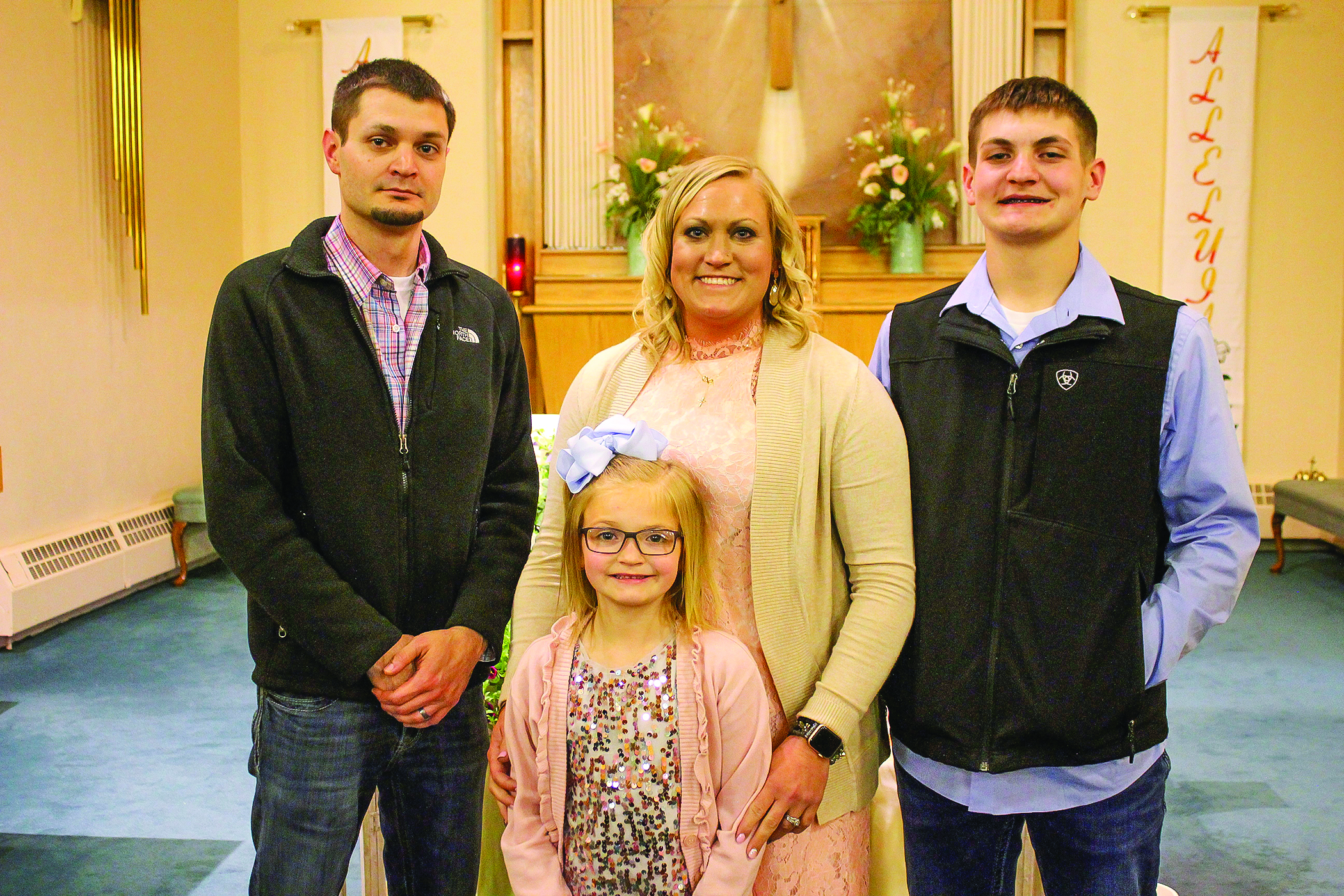 In 2022, Meinhart was baptized, confirmed, and received first holy Communion at St. Rose of Lima Parish in Montrose. It’s a day she’ll remember forever, especially receiving the Eucharist for the first time.
“It was so different from what I was used to growing up,” Meinhart said. “Growing up when we would do communion, we would get a broken-up cracker and grape juice and just pass it down the pew on the first Sunday of every month. I love that you receive the Body of Christ at every Mass.”
As a 34-year-old wife and mother who works in the medical field as a respiratory therapist, Meinhart says she chose St. Gianna Baretta Molla as her confirmation saint for several reasons.
“St. Gianna is known as the patron of mothers, physicians, and unborn children,” Meinhart said. “St. Gianna was a loving wife, a working mother, and worked in the medical field as I do. St. Gianna chose the gift of life for her daughter when she was told she had a tumor in her uterus. I could relate to this in a couple of different ways. When I was conceived, my mother was told that I would have Down Syndrome and the doctors recommended that she have an abortion. My mother also chose the gift of life and here I am today with no development delays. I also was told a few years after having my son that I had pre-cancerous cells, and it was strongly recommended that I have a hysterectomy. I knew that I wanted more children and refused to have the hysterectomy at that time and am glad I did because many years later I was blessed with my daughter.”
One year into her conversion to the Catholic faith and Meinhart says she loves every bit of it, most especially the Mass.
“I love being able to arrive at church early and get the Breaking Bread Missal out and being able to read to over the Scripture before church starts so that I can take it all in during Mass,” Meinhart said. “I mostly love being able to sit in church on the weekends with my whole family and having those bonding moments.”
The impact of Catholic Charities


Lenten Regulations/Lenten calendar

Lent, a holy time of preparation, begins Feb. 22
By DIANE SCHLINDWEIN
Managing Editor
Lent is the 40-day penitential season of preparation for the celebration of the Lord’s Resurrection at Easter, which falls this year on April 9. It begins on Ash Wednesday (Feb. 22) and ends at sundown on Holy Thursday with the beginning of the paschal Triduum (Holy Thursday, Good Friday, and Holy Saturday — April 6-8).
Pope Francis has said, “Lent is a path: it leads us to the triumph of mercy over all that would crush us or reduce us to something unworthy of our dignity as God’s children.”
Lent is a time to read Scripture, attend daily Mass, and practice self-control by giving alms, fasting, or doing an act of charity. Moreover, Lent is not totally about abstaining from certain foods and luxuries, but is about seeking a true inner conversion of heart.
Here, therefore, are the Lenten regulations:
All the Christian faithful are urged to develop and maintain a voluntary program of self-denial (in addition to the Lenten regulations that follow), serious prayer, and performing deeds of charity and mercy, including the giving of alms.
Abstinence — Everyone 14 years of age and over is bound to abstain from meat on Ash Wednesday (Feb. 22) and all Fridays of Lent.
Fasting — Everyone 18 years of age and under 59 is required to fast on Ash Wednesday (Feb. 22) and on Good Friday (April 7). On these two days of fast and abstinence, only one full meatless meal is permitted. Two other meatless meals, sufficient to maintain strength, may be taken according to each person’s needs, but together these should not equal another full meal. Eating between meals is not permitted, but liquids (including milk and fruit juices) are allowed.
Remember, to disregard completely the law of fast and abstinence is seriously sinful.
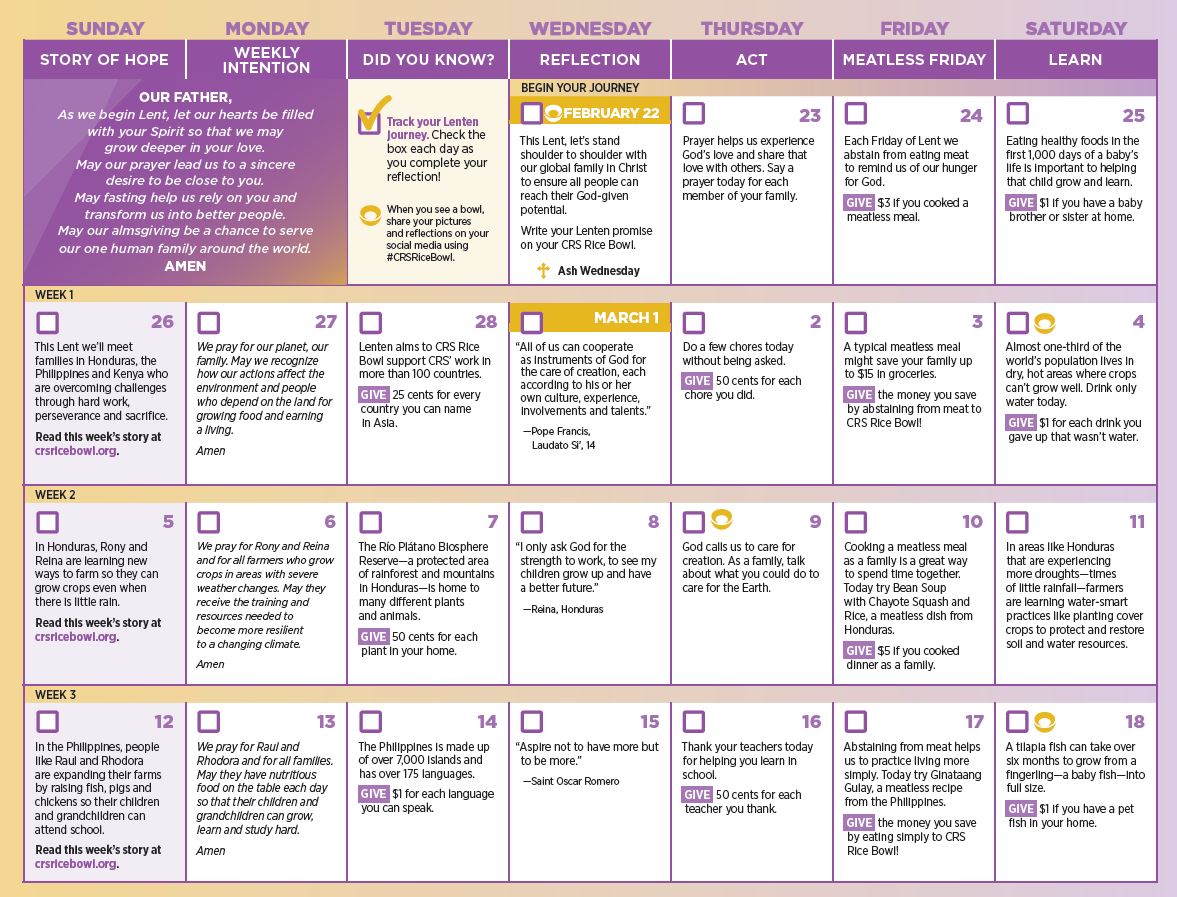
2023 Lenten calendar - Please support the Rice Bowl and Catholic Relief Services (CRS)

Hey, Father! What does it feel like celebrating Mass?

What does a priest feel during Mass?
Anonymous in Jerseyville
Humility is what priests surely feel most when presiding at Mass — their sense of unworthiness to fill this role in The Lamb’s Supper. We, who often preach about God’s unfathomable mercy, rely on this mercy ourselves as we stand at His holy altar. There, we echo His consecration words: “This is my Body … . This is my Blood … .” Nothing captures what a privilege this is — so yes, humility is key.
Humility is also involved as a priest homiletically sheds light on Sacred Scripture and preaches on unspeakably beloved figures such as our Blessed Mother. The insights shared can lift hearts to Heaven and potentially carry eternal ramifications for some souls in the pews. What a responsibility! What a gift!
“Say each Mass like it is your first Mass, and your last Mass.” This advice came from my first rector in seminary, Msgr. Ross Shecterle, who repeatedly emphasized focus, and not getting distracted.
Yet distractions happen. Babies move from sweet cooing and gentle laughter, to outright screaming. Cell phones go off. A pillar-light over the ambo flickers. An organist forgets a musical cue. A server rings the consecration bell too early, or too late. End-of-Mass announcements prematurely pop into the head. In other words, among a presider-priest’s thoughts is the need to stay focused! This is often, also, where gratitude enters, for God’s patience, and for His guiding Spirit, and for the wealth of supportive prayer coming the priest’s way.
Gratitude, then, like humility, is central to what a presider feels. We know Eucharist means “thanksgiving,” which carries a strong component of joy. A priest celebrating Mass should always convey gratitude and joy! Indeed, his bearing and manner contribute considerably to the celebration and are noticed by his flock.
I know this in part after decades of Mass participation from the pews before entering seminary with a second-career vocation. I had witnessed hundreds of priests celebrate Mass and noticed how some conveyed joy and appreciated reverence more than others. These observations even now sometime enter my thoughts as I prepare for, and preside at, liturgy.
Finally, as goes what a priest feels during Mass, he stays aware of his in persona Christi role. Although a humble and distracted sinner, the priest is called to represent — or at least to strive to represent — Jesus. The priest can succeed in the striving, but never adequately in the representation — hence, more humility. Always humility!
Father David Beagles is pastor of St. Elizabeth in Robinson and Our Lady of Lourdes in Oblong.
Hey, Father! What if I am physically unable to attend Mass?

Does one complete the Sunday Mass and holy day obligation by attending by watching via TV or computer? I am handicapped. I walk with a cane and have partial use of my right leg and arm due to a stroke. There is always the fear of falling. I cannot drive. The Masses have a Spiritual Communion Prayer, and my wife brings holy Communion to me on occasion.
- Mike in Troy
The Code of Canon Law states, “On Sundays and other holy days of obligation, the faithful are obliged to participate in the Mass” (canon 1247). The faithful are those who “are incorporated into Christ through baptism” (canon 204 §1). Consequently, baptized Catholics are required to attend Mass on every Sunday and every holy day of obligation.
This obligation to attend Mass “is satisfied by one who assists at Mass” — that is, by one who attends Mass — “wherever it is celebrated in a Catholic rite, either on the holy day itself or on the evening of the previous day” (canon 1248 §1). This is a grave obligation and purposefully failing to honor it is mortally sinful (see Catechism of the Catholic Church, 2181).
Because humans are a union of body and soul, the Lord Jesus established the sacraments as composed of both words and material things. While watching the Mass on television or via the internet may bring some comfort, it does not technically fulfill the obligation to attend Mass, which must be fulfilled in person.
While it is important to remember the gravity of this obligation, it is also important to keep in mind the fact that the Church does not oblige us to do what is physically or morally impossible, which is why the Catechism of the Catholic Church says the obligation binds “unless excused for a serious reason (for example, illness, the care of infants) or dispensed by their own pastor” (no. 2181).
Consequently, those who legitimately cannot attend the Holy Mass — whether because of a lack of transportation, a serious illness, immobility, etc. — are excused by the Church from the obligation to attend Mass. If there is a question about whether an individual member of the faithful is excused, he or she should speak with his or her pastor who can best judge the particular situation.
Those who cannot attend Mass for a serious reason should make a Spiritual Communion and even request the Blessed Sacrament be brought to them. Therefore, it is good, Mike, that you are still watching the Mass on television and still receiving the Eucharist, and when you are unable to receive the Eucharist, you are making an Act of Spiritual Communion.
Father Daren Zehnle is pastor at St. Augustine in Ashland; parochial administrator of St. Alexius in Beardstown, St. Fidelis in Arenzville, and St. Luke in Virginia; and is the director for the Office of Divine Worship and the Catechumenate for the Diocese of Springfield in Illinois.
Contraception, dating, relationships, marriage, transgenderism, and purity

 How do we navigate these tough topics as parents and grandparents? What should we be saying to our children?
Many young people are wanting straight answers to tough questions about love, dating, and relationships, but they struggle to find the answers. Parents and grandparents oftentimes don’t even know where to begin when it comes to talking to their children about dating and chastity. No matter the issue, living a life of virtue and holiness is challenging. It’s also becoming more difficult communicating a message of purity to young people with a culture that promotes promiscuity and living a life of “If it feels good, do it.”
Jason Evert, an international Catholic speaker and author, has a mission to tackle these subjects head-on, providing answers rooted in Catholic truth. Evert has a master’s degree in theology and degrees in counseling and theology. He and his wife run Chastity Project and its website, chastity.com, the podcast Lust is Boring, and lead an international alliance of young people who promote purity in more than 40 countries. Evert spoke at the SEEK23 Conference for college students in St. Louis in January and is giving two talks on Feb. 6 at St. Mary Parish in Alton starting at 6 p.m. (go to chastity.com/purified for tickets). Catholic Times Editor, Andrew Hansen, spoke with Evert last month.
Let’s start with contraception and the Church’s position against it. This is one teaching that not only does the culture disagree with the Church’s position, but so many Catholics as well. Explain why the Church teaches what she does, and how do we convince young people to not use contraception?
A lot of people want to know why the Church is against contraception. It’s not so much the Church is against something as the Church is for something, for God’s plan for human love. The Church’s teaching on sex is pretty simple: Love, marriage, sex, and babies go together and in that order, and when we start to flip those around and change them, civilization starts to crumble, and so God has joined together life and love, babies and bonding.
The Church is not saying that parents shouldn’t plan their families. But sometimes responsible parenthood means being open to more children. So, what contraception does in a certain sense is saying, “I want bonding with you, but I don’t want babies with you.” But, what if we did the opposite? “I want babies with you, but I don’t want bonding with you.” We’d obviously see there is a distortion there like, “I would like to make love to you, but I don’t want to look at you because I want to avoid any emotional entanglement that might ensue from this because I want to use you as an incubator for my offspring”… (We’d say), “OK, that guy is weird.” What contraception is doing is saying that I want the bonding, but I don’t want the lifegiving potential.
So, God has already created in a woman’s body seasons each month, the fertility and infertility. It’s not necessary to shut down the woman’s fertility with chemicals and barriers. What is needed is for us to understand the woman’s body. What Natural Family Planning taught me is that my wife’s body is perfect. She doesn’t need drugs, pills, or shots. She needs to be understood because if we can understand her fertility, then instead of suppressing it with chemicals to conform to our desires, we can conform our desires to the perfect way her body has already been created.
 Jason Evert appeared on Dive Deep, the official podcast of the Diocese of Springfield in Illinois. Go to dio.org/podcast to listen or search Dive Deep on all the major podcast platforms.Society, especially young people, paint the Catholic Church as the church of “no” when it comes to sex, certain dating things, IVF, living together before marriage, and we just discussed contraception. How do we respond to that and teach young people that what the Church teaches is actually freeing?
God’s plan for human love is not a litany of prohibitions. How we can communicate this is to ask people, “What do you really want in a relationship? Do you want a love that is free or coerced?” “I want a love that is free.” “Do you want a love that is total or half-hearted?” “I want total love.” “Do you want a love that is faithful or one with hooking up and friends with benefits?” “I want a love that is faithful.” “Do you want a love that is life giving?” “Yeah, yeah.” “OK, so you want a love that is free, total, faithful, fruitful — those are the wedding vows.”
The total gift of the body should correspond to the total gift of the person. The total gift of the person is marriage, and your body should correspond with that. So, all the Church is trying to give you is what you want! So, what we are doing when we disagree with the Church is we’re disagreeing with the desires of our own heart.
You have said, “I think for young people, they are being told everything they are not supposed to do when it comes to dating and relationships, but nobody is talking to them about what they are supposed to do when it comes to dating.” What are they supposed to do?
What we have to teach is dating etiquette. What is the purpose of dating? It’s to find a spouse. It’s like getting on a freeway with only two exits: breakup and marriage. If that is the reality, what is the point of committing to anybody unless you can see this relationship potentially going the distance? So, having more intentionality with dating. I find that young people, they love to hear this stuff. What are the specifics? How do I ask her out? And all that stuff because it’s not enough to tell them what not to do. The reason they don’t know how to date is because when you look at the culture, we have this culture of single people who pretend like they’re dating, the dating people behave like they’re married, and the married people seem to think they are single. Everything is out of order, and it’s because the parents forgot how to date each other. So, they (children) never saw their own parents pursuing each other in love, going on weekly date nights.
This is why parents should put their marriage first, before their children?
Putting your marriage first is putting your kids first. As much as it gags them out to see Mom and Dad kiss, or hug, or be affectionate, they need to see it. It is so good for their mental health to see that, the safety and stability that creates in their hearts of knowing that Mom and Dad are a united front. They often say the best thing you can do for your kids is to love your spouse.
Parents don’t even know where to begin when it comes to talking to their kids about dating and chastity. What should they be saying?
One, get over your insecurities about talking to your kids about sexuality because if you do not speak up, the world will fill the void of your silence with a very contrary message. Obviously, it needs to be age appropriate. But there is going to stuff the world throws at your kids and you got to see that this is a teachable moment. I took my kids to an NBA basketball game and one of the cheerleaders was male, dressed up as a female doing all the female dance moves and my boys are like, “What’s going on there?” I’m like, “Well, I didn’t expect to have to address gender dysphoria on the way home from the basketball game, but let’s go there,” — and pastorally and lovingly explaining that situation.
So, see those teachable moments, dive into them, and give the kids formation even in subjects you didn’t want to cover yet. Be bold and age appropriate.
What is a grace of the sacrament of marriage that you never expected, or one you discovered many years into marriage?
One of the functions of marriage is the sanctification of the spouses and one of the ways God does that is He brings your faults to the surface, like oil and water. Before you’re married, you’re thinking, “I’m a pretty good catch. I’m patient, I’m forgiving.” Then, you get married, and you realize, “I’m a jerk. I’m unforgiving, impatient.” So, one of the surprises is the sanctification that comes through the sacrament because the children and the spouse, they’re like a sandpaper of sanctity constantly rubbing off those rough edges.
What’s one thing you want someone struggling with an addiction to pornography to hold onto in the midst of that struggle?
Whether it is male or female, because I am meeting more and more young women who are struggling with the same things too, realize this isn’t what you ultimately want. I heard of one guy who was addicted to all this stuff, and he finally confessed this to a Christian brother, and the Christian guy said to him, “Well, if what you want to do is look at pornography and all that stuff, then go ahead and do it.” And he said, “No, that’s not what I really want to do.” And his friend looked at him and said, “Exactly.” It was this watershed moment for him that maybe there is still something good in him that desires something noble, sacrificial, beautiful, and pure.
So, pornography is this counterfeit to the desires that we really long for. So, get accountability. Get some software on your computer, be able to find a good spiritual director, talk to some brothers and sisters about this stuff. Don’t try to go lone ranger to win this thing. On our website, chastity.com, we’ve got books for the guys and girls, resources, apps, software, router recommendations — all kinds of stuff. This is a battle you cannot afford to lose. Your whole vocation is at stake here. I know it’s difficult, but it’s more difficult envisioning your life 10 years from now still stuck in the same stuff. Trying to beat this thing on your own and winning it isn’t working. It’s because you aren’t supposed to beat this on your own. Find some accountability, and you’ll have the victory.
When it comes to transgenderism, as people of Catholic faith, how do we communicate with people who do think they are the opposite sex?
A lot of times we think, “What do we need to say? What is the silver bullet that can explain to them why puberty blockers, cross-sex hormones, and top surgery is not the answer for them.” What we need to do is listen to these individuals, meaning enter into their lives, go to the movies, have a beer, have a coffee, get to know these people and know their story because what we need to do is enter this conversation with a posture of reverent curiosity about this dysphoria. When did you start feeling this? Thank you sharing that with me. I’m sure that must have been really hard. What has that been like? Where is this coming from?
The reason I say we have to listen is because a boy came to me, and said he’s trans. We had a long conversation. It turns out he has two older sisters and two younger sisters who can do no wrong. They are loved, and everything he does for his mom and dad is not enough. He’s always the black sheep. I said to him, “Do you think if you were born a girl, you would be loved the way your sisters are loved?” He said, “I know I would have.” You can see that there is this unmet legitimate need that has found an outlet through this expression of gender dysphoria. Everyone has their own story. Our job is to make these individuals understand that the Church sees them, we realize they didn’t choose to feel this way, God loves them, He has a plan for them, and then we have to hold one hand to them, one holds onto reality, and not let go of either one. Walk with them. Accompany them. Not only with the love, but also with the truth.
What about speaking with people who do support transgenderism? How do we talk to them that this isn’t God’s plan?
A lot of times they are given this idea of false compassion like, “If you don’t accept these people, you’re rejecting them, and they’re going to commit suicide.” Well, look at the suicide rates of people who go through puberty blockers, cross-sex hormones, and surgeries. About 10 years after the surgery, their suicide rate is 19 times higher than the general population. If you isolate out the female to male transitioners, the suicide rate is 40 times higher than the general population. It’s because surgery is not the answer to these deeper mental health issues. We need to be affirming the person, not the dysphoria.
We just came out with a book called Male, Female, Other — A Catholic Guide to Understanding Gender. Whether they experience dysphoria, a kid who wants top surgery, or you’ve got a nephew with this, this book will help to explain where is this coming from. How do I give solid answers, but most importantly, how do I pastorally accompany these people with sensitivity giving them the truth that this is not the answer? This is not a left versus right issue. You look right now, there are 43,000 de-transitioners on the Reddit website screaming from the rooftops that “I did this, it was not the answer, hit the brakes.” Lawsuits are on the way, and I think things are going to change, but there is going to be a lot of damage done, unfortunately.
Answers taken from Andrew Hansen’s interview with Jason Evert on Dive Deep, the official podcast of the Diocese of Springfield in Illinois. To hear more from their conversation, including what gives Evert hope and inspiration about the future, go to dio.org/podcast or search Dive Deep on all the major podcast platforms.
Norbertines arrive in Springfield

The Norbertine Fathers of St. Michael's Abbey based in Orange, Calif., have announced six of the seven priests who will open and run the new Evermode Institute in Springfield. The Evermode Institute will be a center for Catholic spiritual and intellectual formation and these Norbertine Fathers will form a new community there.
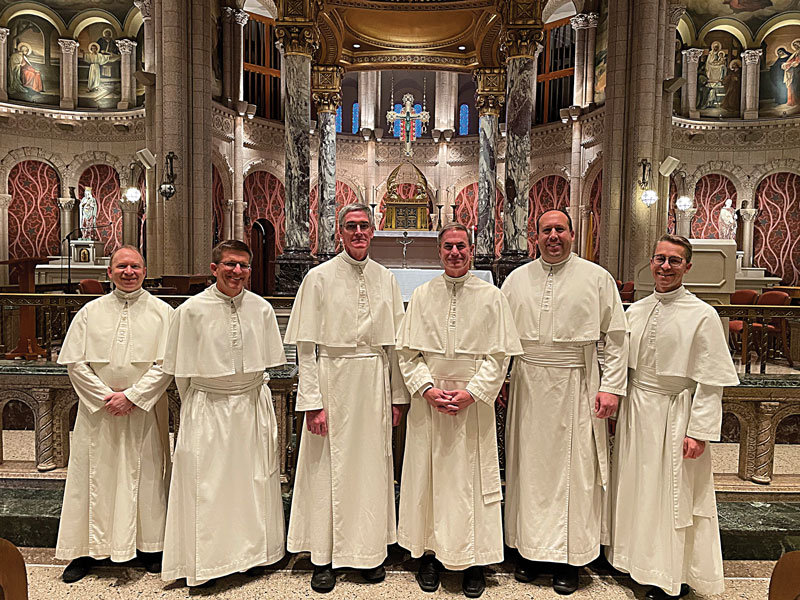 Standing in front of the altar at St. Francis of Assisi Church are Father Godfrey Bushmaker, O. Praem.; Father Gregory Dick, O. Praem.; Father Stephen Boyle, O. Praem.; Father Augustine Puchner, O. Praem., Prior; Father Anselm Rodriguez, O. Praem.; and Father Ambrose Criste, O. Praem., Director of the Evermode Institute. A seventh priest is expected to be announced in the coming weeks.
Located on Springfield’s northeast side on the grounds adjacent to the convent of the Hospital Sisters of St. Francis, the Evermode Institute includes St. Francis of Assisi Church, a large conference room, other large meeting rooms, and beautiful outdoor prayer trails, Stations of the Cross, and grottos.
“The Evermode Institute will be a place where we form and instruct in the faith all those good people in the Church whose responsibility it is to teach the faith,” Father Criste said. “So, Catholic school teachers, the catechists and religious education instructors in the parishes, eventually, hopefully, the permanent deacons, and trickling out to anybody like parents — people who are responsible to teach the faith. We want to help them to understand the faith better so they can impart the faith to those people in their sphere of influence. There will be some in-person teaching happening at the Evermode Institute, and then we’ll ramp up a robust online presence.”
When the Nobertine community opens the Evermode Institute this July, the public will be welcome to come to Mass at the stunning St. Francis of Assisi Church, go to confession, and participate in the prayer life of the Norbertines.
Hey, Father! Can lay people create novenas?

Can novenas be created by lay people or do they come from the magisterium?
Jake in Springfield
The word novena takes its origin from the Latin word novem, meaning “nine.” Consequently, a novena is a series of nine prayers prayed for a specific intention either individually or with a group of the faithful. While the origin of novenas is traditionally seen in the nine days between the Ascension of the Lord and Pentecost, a novena can be prayed over nine days, nine weeks, nine months, or presumably even over nine years (though such a novena might be hard to keep track of).
The Church does not have, so far as I am aware, any specific legislation governing novenas. Because a novena can be as simple as praying nine Our Fathers, it is possible for a layperson to create a novena for his or own purposes, provided, of course, that the prayers used or in the intention behind the novena are not contrary to the faith. Such a novena would be for private use.
If a layperson creates a novena and intends it to be for public use, such a novena should be presented to the local bishop for his consideration and approval. He may grant permission for its private use or for its public use, as he judges fit.
Father Daren Zehnle is pastor at St. Augustine in Ashland; parochial administrator of St. Alexius, Beardstown, St. Fidelis, Arenzville, and St. Luke, Virginia; and is the director for the Office of Divine Worship and the Catechumenate for the Diocese of Springfield in Illinois.