
Beauty Series - QU Chapel


 St. Francis Solanus Chapel – Quincy University
The St. Francis Solanus Chapel at Quincy University has been a gem in the “Gem City” for over a century, when Brother Anselm Wolff, OFM, designed the glorious church as a miniature of his masterpiece, St. Anthony of Padua Church in St. Louis. Today, the chapel, which is bigger than many parish churches in our diocese, continues to offer students at Quincy University a foretaste of Heaven during the Holy Sacrifice of the Mass as they are surrounded by dozens of images of saints, beautiful artwork, and the Eucharist.
Father Daren Zehnle, pastor of St. Augustine Parish in Ashland, grew up in Quincy and attended Quincy University and says he is “struck by the sheer beauty of the space.”
“It’s really a unique place in the diocese and probably in the country,” Father Zehnle said.
Stretching 123 feet in length, only the finest materials were used when the chapel was designed in 1910 and finished in 1912 including marble pillars, oak pews, and steel beams. The impressive stained-glass windows were created by a company in St. Louis and were imported from Germany.
The chapel has gone through many changes over the decades. Years of neglect during the Great Depression resulted in damage. In 1956, the chapel was redesigned using the Byzantine style, which portrays figures of Jesus, Mary, angels, and the saints in more of a heavenly theme. Father Tom Brown, OFM, one of the Franciscan Friars at the university, was the creator of the changes.
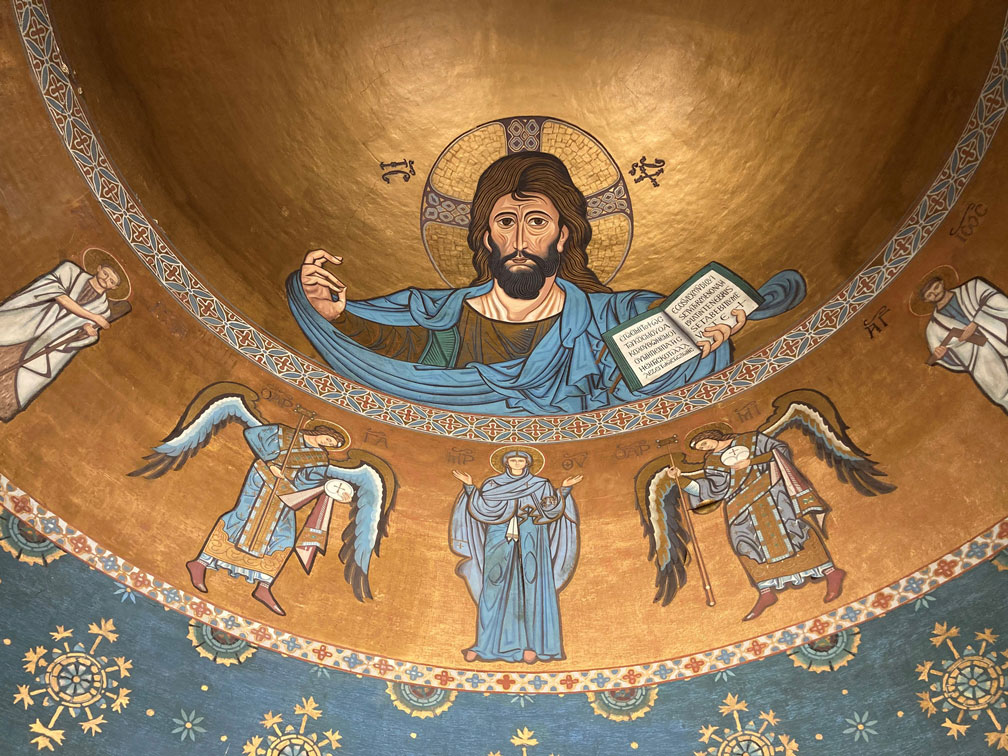 “He modeled it after the church of San Apollinare in Classe in Ravenna in the north of Italy,” Father Zehnle said. “When it was built there, it was the seat of the Roman empire, and the church still stands today. Over there, it was built in mosaic, but here he painted the various images on some sort of a canvas, and glued them up to the wall, but it’s a pretty faithful replication of what you see in Ravenna.”
One of the most decorative features of the chapel are the images of 70 saints that encircle the chapel. With male saints on one side and female saints on the other, each saint carries a symbol pertaining to their life.
“The depictions of them always serves as a great reminder that we are all processing with them toward Christ the Savior,” Father Zehnle said. “They also serve as a reminder to us that if they can live a holy life, if they can be saints, then each of us can as well.”
Another image that draws people’s attention is a copy of the famous the Good Shephard, a mosaic that is in the Mausoleum of Galla Placidia in Italy. The most striking piece of artwork, however, hits you right when you walk in — a 16-foot painting of Christ the Pantocrator, the title of Christ as ruler of the universe.
While Quincy’s Venerable Father Augustine Tolton, who escaped slavery to become the nation’s first black priest in Quincy never stepped foot inside this chapel, dying in 1897, he did attend Quincy University in 1878, which at that time was called St. Francis Solanus College. Today, Father Tolton is honored with a one-of-a-kind painting in the chapel.
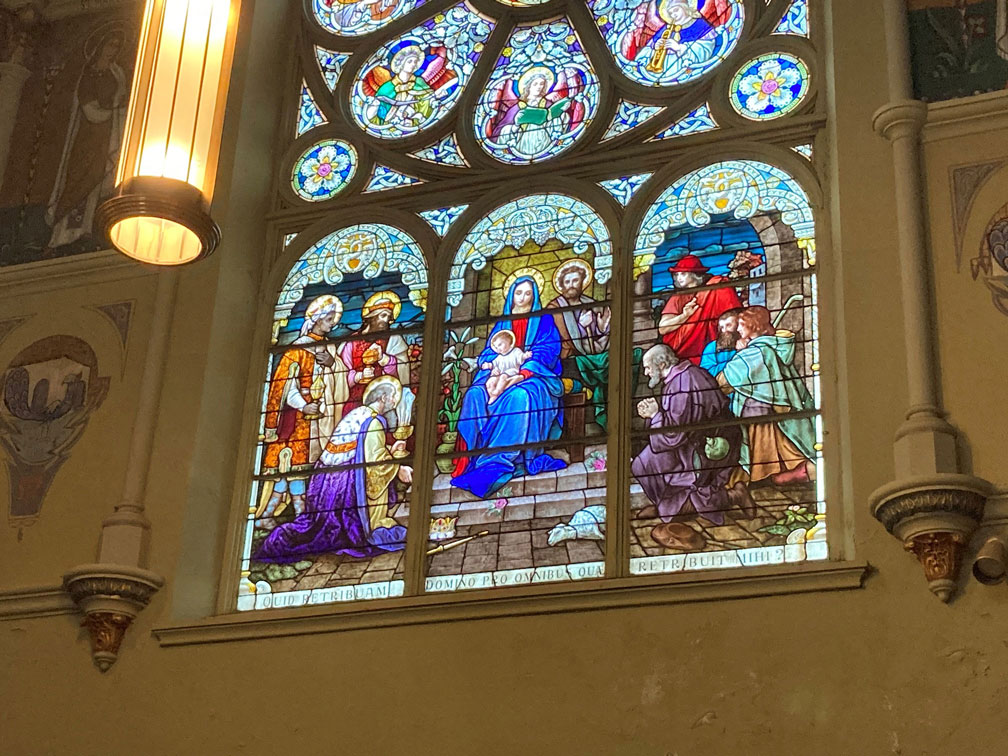 “It’s a newer addition to the chapel, just a few years ago, and it was painted by Isabelle Armengol Lewis,” Father Zehnle said. “It depicts Father Tolton’s first Mass which he celebrated at St. Peter’s Basilica in Rome. She didn’t intend for it to be housed at the QU Chapel, but it found its way here. It mixes really well with the colors already present which I think is a great sign of Providence. She painted it a few years ago, and I think it’s a great way to have a greater connection to Father Tolton who not only grew up in Quincy as a boy after he escaped slavery in Missouri but also attended Quincy University before going off to Rome to study in the seminary, and then he was sent back to Quincy by Rome to be a priest here. He stayed in Quincy for three years, and then he went up to Chicago for seven years before he died. Now, he is buried in Quincy.”
To think of the all the students who prayed inside these walls, 14 of whom became bishops throughout the United States and several others who are now serving as priests in our diocese, this chapel at the only Catholic University in our diocese, has played a major role in the history of our Church and in the faith life of countless of souls who came from different walks of life and different parts of the world.
“In that sense, this chapel serves in a real physical reminder of the universality of the Church that you wouldn’t most likely see in most parish churches in our diocese but because of the university involvement here, I think that all just sits right home,” Father Zehnle said.
Eight women to make next step in religious life for Sisters of St. Francis of the Martyr St. George

 Shown are the eight women who will take next steps in religious life for the Sisters of St. Francis of the Martyr St. George on Aug. 2 in Alton. Back row: Kathleen McMullin (Sister Mary Kolbe), Sister M. Xavier Schulze, Sister M. Pieta Keller, Elizabeth Buckley (Sister M. Gloria). Front row: Sister M. Annuntiata Gangl, Sister Maria Christi Delaney, Sister M. Veronica Kennedy, Sister Bethany Marie Burnham.ALTON — The Sisters of St. Francis of the Martyr St. George will celebrate the final profession of four junior sisters, the first profession of two novices, and the reception into the novitiate of two postulants during Mass at 10 a.m. on Tuesday, Aug. 2. Bishop Thomas J. Paprocki will be the main celebrant of the Mass, held at St. Mary Catholic Church in Alton.
The four juniors who will make final profession are Sister Maria Christi Delaney, daughter of Kathryn Delaney and the late Thomas Delaney of Williamsville, N.Y.; Sister M. Xavier Schulze, daughter of Mr. and Mrs. Mark Schulze of Anna, Ohio; Sister M. Annuntiata Gangl, daughter of Mr. and Mrs. Michael Gangl of Brainerd, Minn.; and Sister M. Pieta Keller, daughter of Mr. Philip Keller of Loveland, Ohio, and Ms. Cynthia Janson of Cincinnati, Ohio.
The novices who will make first profession are Sister M. Veronica Kennedy, daughter of Mr. John Kennedy of Chicago, and Ms. Nancy Kennedy of Parker, Colo.; and Sister Bethany Marie Burnham, daughter of Mr. and Mrs. James Burnham of Lake Charles, La.
The postulants who will receive their habit and veil and their new religious names are Kathleen McMullin (Sister Mary Kolbe), daughter of Mr. and Mrs. Scott McMullin of Brandon, Miss.; and Elizabeth Buckley (Sister M. Gloria), daughter of Mr. and Mrs. Martin Buckley of St. Louis.
The Sisters of St. Francis of the Martyr St. George invite you to participate and share in their joy via watching the Mass on livestream at www.altonfranciscans.org/feastday .
Photo courtesy of the Sisters of St. Francis of the Martyr St. George
Springfield area Dominican Associates make commitment

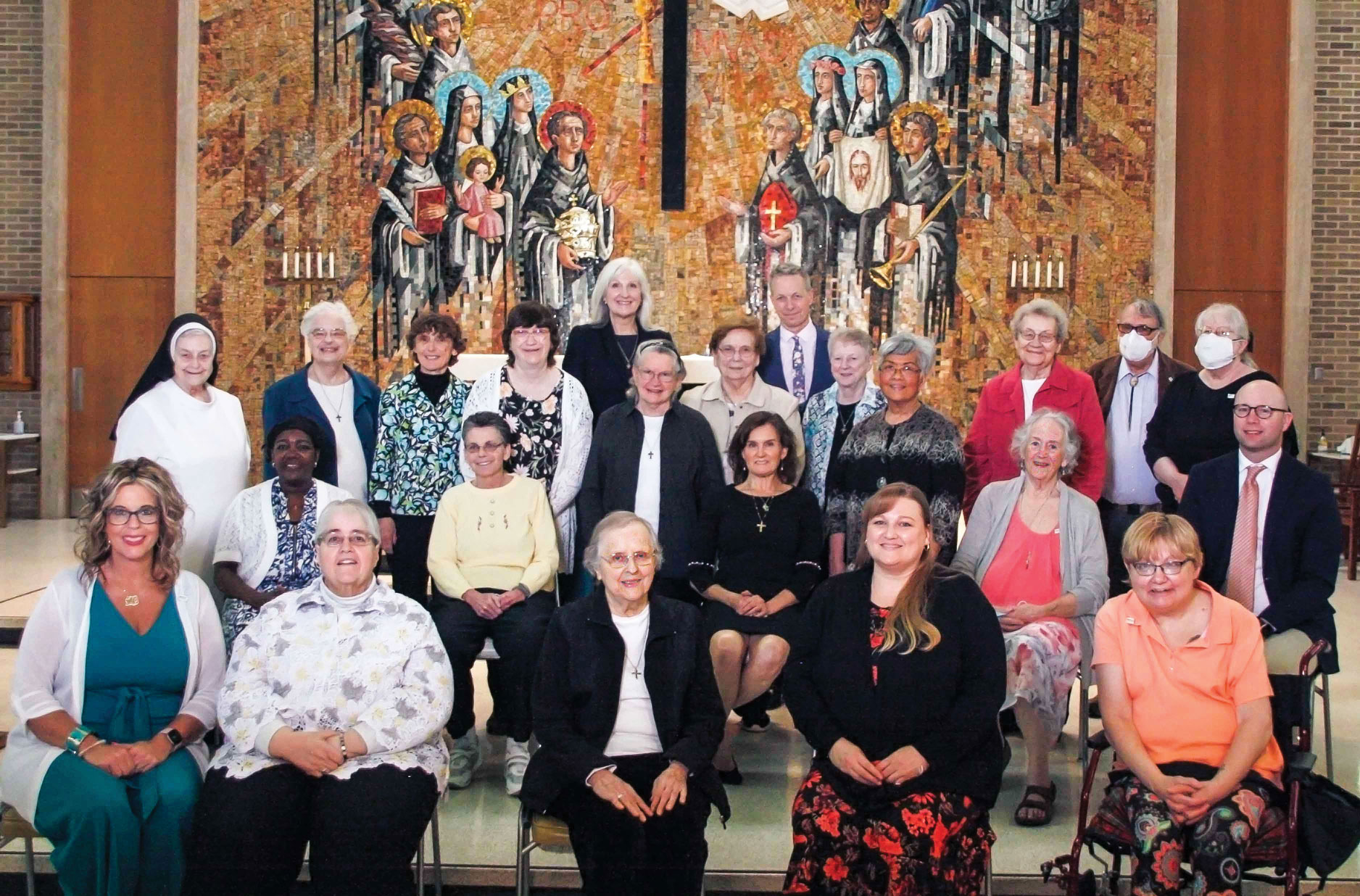 Shown are members of the 2022 Dominican Associate class with associate sponsors, and Dominican Sisters. Row 1: Molly Murphy, Sister Martha Carmody, Sister Agnes Ann Pisel, Lisa Barnett, Jan Montgomery. Row2 (seated): Stella Shaw, Sister Teresa Marron, Cyndi Goeahl, Margaret Greco, Jantzen Eddington. Row 3: Sister M. Joan Sorge, Sister Georgiana Stubner, Charlotte Vollmer, Ann Moroff, Sister Patricia Stark, Delia Lising, Sister Bernice Juip, Peter Ellersten, Debbie Ellersten. Row 4: Lucinda Buescher, Sister Marilyn Jean Runkel, Keith Buescher, Sister Judith Pfile. For the first time since 2019, the commitment ceremony for a Springfield Dominican Associate class was held in-person at Sacred Heart Convent Chapel last May.
The new associates prepared for commitment by participation in nine monthly sessions of prayer and study about the history of the Order of Preachers and the Springfield Dominican congregation, about the theology of mission and ministry, Catholic Social Teaching, and liturgy and prayer. Each candidate was accompanied by a sponsor — a sister or an associate — who answered their questions and offered encouragement during their period of discernment before commitment.
Dominican associates embrace the Dominican traditions of prayer, study, community, and ministry. They respond to God's call to share the Gospel by preaching it through the witness of their lives.
Each associate was called forward by the associate program director, Sister M. Joan Sorge, OP. They stated publicly their commitment to “preach the Word and witness Gospel values,” and received an associate pin from Sister Rebecca Ann Gemma, OP, prioress general of the congregation.
The new associates include:
- Lisa Barnett, parishioner at the Cathedral of the Immaculate Conception, whose commitments include volunteering for the homeless and at Jubilee Farm.
- Keith Buescher, parishioner at St. Joseph Church, Springfield, whose commitments include study of the Bible and using his voice to speak against injustice.
- Lucinda Buescher, parishioner at St. Joseph Church, Springfield, whose commitments include sharing her faith with her family and helping at Jubilee Farm.
- Jan Montgomery, parishioner at the Cathedral of the Immaculate Conception, Springfield, whose commitments include serving in RCIA ministry at Cathedral, fighting racial injustice and human trafficking, and working for the right to life for all.
- Ann Moroff, parishioner at Christ the King, Springfield, whose commitments include being a compassionate presence in her work, supporting members of the Cor Unum community with her prayer, and engaging in study and spiritual reading.
- Molly Murphy, parishioner at the Cathedral of the Immaculate Conception, Springfield, whose commitments include continuing study of the Gospel and of Catholic teaching, and witnessing to her students through acts of service and discipleship.
- Charlene Vollmer, member of the Church of the Little Flower, Springfield, whose commitments include serving as a volunteer and eucharistic minister at Springfield hospitals and volunteering at St. Martin De Porres Center.
- Margaret Greco, parishioner at St. Joseph the Worker Parish, Chatham, whose commitments include co-chairing the Right to Life ministry at her parish and studying her faith.
The first Springfield Dominican associates made commitments in 1991. Since then, hundreds of women and men, baptized Christians in the United States and Peru, have become associates.
Dominican associates undertake individual volunteer ministries in their own parishes and communities. They may also join the sisters on committees and boards, work side-by-side with the sisters in their ministries, or provide logistical support for the congregation’s public events. To learn more about becoming a Springfield Dominican Associate and other ways you can participate in their mission visit Springfieldop.org/dominican-mission or call Sister M. Joan Sorge, OP, at (217) 787-0481.
Photo courtesy of the Dominican Sisters of Springfield
Hey, Father! Whose responsibility is it to teach the rosary to children?

As my grandchildren receive the sacrament of confirmation and first holy Communion, we have been letting them pick out a rosary. It concerns us that they didn't know what a rosary was. Whose responsibility is it to teach children how to use/pray the rosary? Should parents do this or does the Catholic schools include it in their teachings? I plan to take them to the next rosary at their church.
- Anonymous in the diocese
As a priest, I always find one of the most powerful parts of the Order of Baptism of Children is the blessing over parents reminding them that they are the first teachers of their children in the ways of faith, and that they “may, by word and example, prove to be the first witnesses of the faith to their child.” I do not believe this blessing is intended to “lay more guilt” on our parents but rather a reminder to be open to God’s ever-present grace in fulfilling their vocation. How wonderful that grandparents are also ready, willing, and able to assist with our young people’s faith formation as well. As the late Father Don Meehling used to say, “Our children should never remember a time when they didn’t come to Mass.”
Coming into the Catholic Church in my 20s, I can say learning to pray the rosary, the meditative prayer of the Gospel, was an important part of my journey.
Even with their limited time constraints, I hope every Catholic school and faith formation program is able to introduce the rosary to our students. The Catholic schools/faith formation programs that I am familiar with in our diocese does this. But, like every other teaching and practice of our faith our schools and faith formation programs attempt to impart on children, the teaching of the prayers, mysteries, and form of the rosary will have minimal impact unless our young people see it lived in their own homes and in the lives of the people they love the most. As Roy Lanham, director of Campus Ministry for our diocese, likes to say, “This is not a question of an either/or but a very Catholic both/and.” Children “learn” what they are taught at school when they experience it being modeled for them at home.
One of the great benefits of the growing Family of Faith model of religious formation in our schools/parishes is children are not simply “dropped off” at Catholic school or religion class, but parents are actively engaged in ongoing formation and working with their children themselves. This provides an opportunity for this new generation of parents, who may not be familiar or comfortable praying the rosary themselves, to learn more about this biblical prayer and to learn how to incorporate the mysteries of our faith in the life of Christ and Our Lady in their own lives.
Searching online for “How to teach children to pray the holy rosary?” will produce a wealth of suggestions and resources to assist parents and grandparents. Taking the time to help our children learn the prayers, to become familiar with the stories of each of the mysteries, to think about similar experiences in their own lives, and perhaps naming someone to pray for on each bead, will help children embrace what can become the practice of a lifetime. I always like to remind students they do not need to have an actual rosary to pray the rosary. Just praying with our 10 fingers is an amazing way as Pope St. John Paul II pointed out “to contemplate with Mary the face of Jesus Christ.”
Father John Titus is pastor Immaculate Conception Parish in Mattoon and St. Columcille Parish in Sullivan.
Sacred Heart Church in Oconee celebrates 150 years

 By ZETTA WOLF
Special to Catholic Times
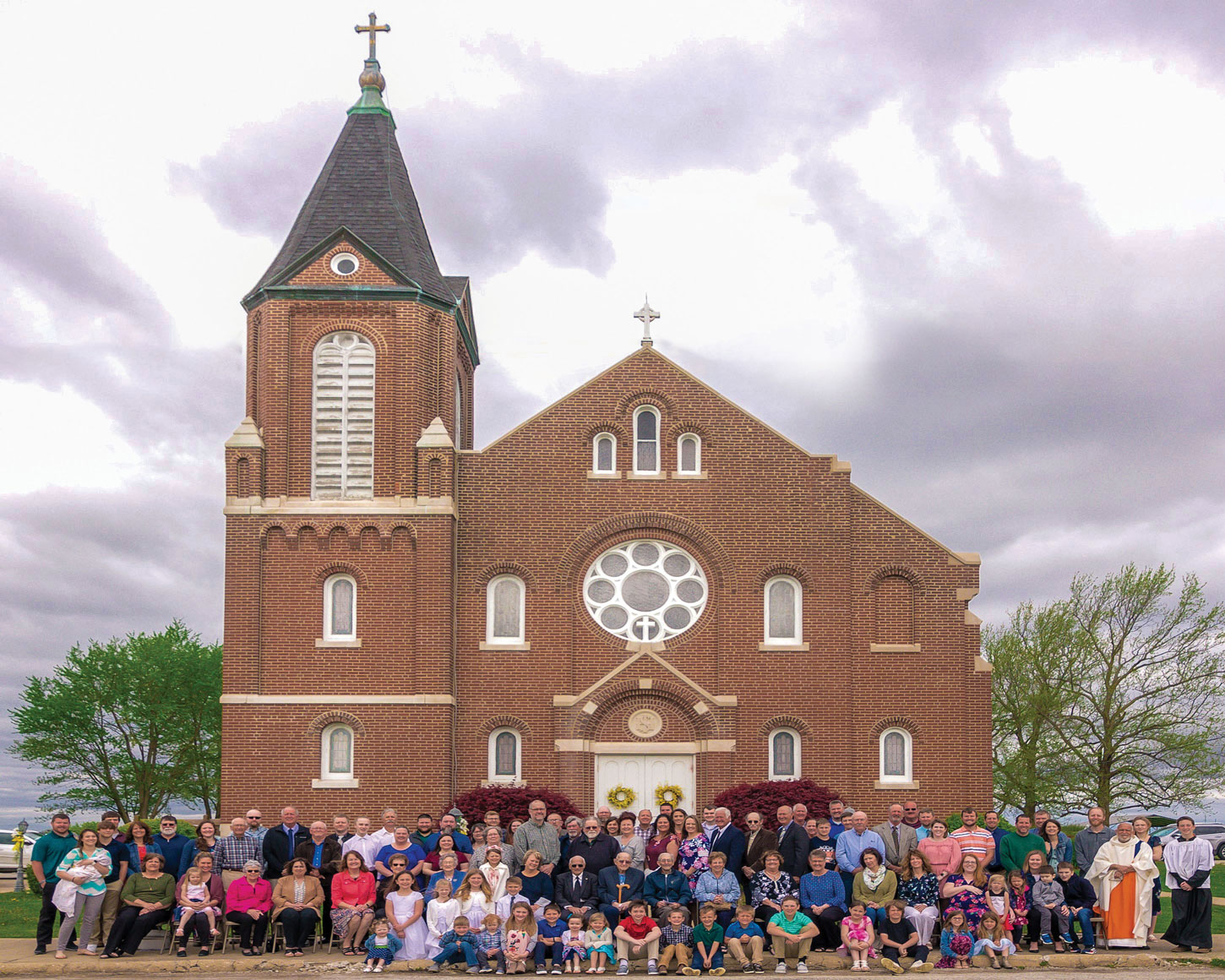
OCONEE — Sacred Heart of Jesus Catholic Church in Oconee is celebrating a special milestone in 2022— 150 years as a parish.
Most of the current parishioners are descendants of the pioneers who worked hard to establish and build the parish. As German settlers began to open fields and farm the land around Oconee in the 1860s, they likewise started to search out any German-speaking priest who traveled through the area, to invite him to say Mass in various homes in the Oconee area.
In 1868, Gerhardt Herman Rakers Sr. and his family came to Oconee and Rakers was instrumental in finding a German-speaking priest. Father Weis (stationed in Vandalia) would say Mass and distribute the sacraments when he could. He urged the men to build a small but modest chapel. The congregation could gather there each Sunday to pray the rosary together and the children could be instructed by a layman. With a priest visiting on a regular basis, the congregation grew, and a wooden structure measuring 18 feet by 36 feet was built. This church had no pews; the parishioners brought chairs or buckboard benches to sit on during Mass.
The church and parish were dedicated to the Sacred Heart of Jesus on May 9, 1872. In June 1888, Bishop James Ryan came to Sacred Heart of Jesus and confirmed a class of 23 young people. By the 1890s the little church was outgrown and the plans for a 60 feet by 36 feet wooden structure with a 65-foot bell tower were planned. The brick for the foundation was bought and hauled by the parishioners from north of Ramsey. The cornerstone was laid in October 1891 and the new church was dedicated a year later. In early 1900, the bishop offered to supply a resident priest if proper housing could be provided. (Before the rectory could be built, the priest used the sacristy as an office, took meals, and roomed with the William Eckholt family.)
The first resident priest, Father Francis Harbe, arrived in 1903. Work on the church was delayed due to lack of funds, but began again in 1904 after the rectory was complete. In early 1909 lightning struck the church causing damage mostly to the front and vestibule. Labor and money were again invested in the church, from concrete floors in the basement to a heating system, an altar, the communion rail, and ceiling redecorating.
Sadly, In September 1911, at 1:30 one morning, the church spire was struck by lightning and the church and rectory burned to the ground. When it was apparent that they would not be able to save the buildings, Father Pachlhofer and parishioners courageously saved the Blessed Sacrament and any items they could. The parishioners worked diligently to clear the remains and begin again. During the rebuilding process, the first church was used for services. Father Pachlhofer stayed at the Turner house.
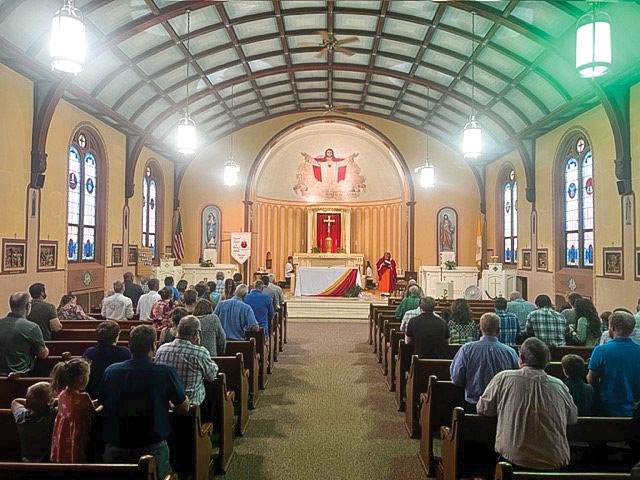 The loss of the church and rectory was only partially covered by insurance. With parishioners, friends, and neighbors supplying labor, donations, and furnishings, the present church was a labor of faith and love. The design is in the Roman style of architecture, constructed of steel skeleton with red brick foundation and lining. The cornerstone for the current church was laid on Sept. 8, 1912. The first Sunday Mass was celebrated on Palm Sunday of 1913.
Many changes have taken place in the decor of the church but the steadfast devotion to the Sacred Heart and our Blessed Mother remains strong within the parishioners of today. An outdoor eucharistic procession is observed each year on the feast day of the Sacred Heart of Jesus. The annual May crowning of the Blessed Mother dates to 1915. From 1922 to 1978, the parish provided a Catholic education for eight grades being instructed by the Ursulines of Decatur.
Fall is a busy time for the parish. For almost 90 years, it has been hosting an annual Trap Shoot on the first Sunday in November. Additionally, the popular Family Fall Festival is held the last Sunday of September and the first two Sundays of October.
Parishioners are grateful for each priest who has served the parish, especially the beloved current priest, Father Rodney Schwartz. Sacred Heart Parish of Oconee is truly a family through our labors of love and dedication to our faith.
Zetta Wolf is the parish secretary for Sacred Heart Parish in Oconee.
Statewide grassroots effort calls for prayer, fasting on bread and water on Fridays for Illinois to become more pro-life

 Governor wants more pro-abortion laws passed in special session
By ANDREW HANSEN
Editor
When the U.S. Supreme Court overturned Roe v. Wade in June, it was a monumental victory not only for the pro-life movement, but for babies in the womb and mothers across the country. At the same time, however, the decision meant Illinois would play an even larger role in the Midwest for abortion access.
In Illinois, abortion is a “fundamental right” under the law, there is taxpayer funding for abortion, minors can get an abortion without even notifying their parents, and abortion is legal throughout the nine months of pregnancy. Now, the spotlight is on Springfield, as Governor J.B. Pritzker and some legislators are wanting even more pro-abortion laws including, among other things, having non-doctors perform abortions, and passing these laws during a special legislative session.
On that note, enter a statewide grassroots effort to stop Illinois from becoming the Midwest’s abortion hub, organized by a group of women from the Diocese of Joliet.
“When the Supreme Court announced the reversal of Roe V. Wade, there was hope again,” said Sarah Turk of Joliet who is spearheading the effort. “We have a long way to go but we have hope! We realize the pressure on this state to become the Midwest abortion provider, and we must try to stop it. We also realize that this evil is so massive that only God can stop it. That is why this group of lay Catholics are making the effort to spread the prayer and fasting on Fridays message.”
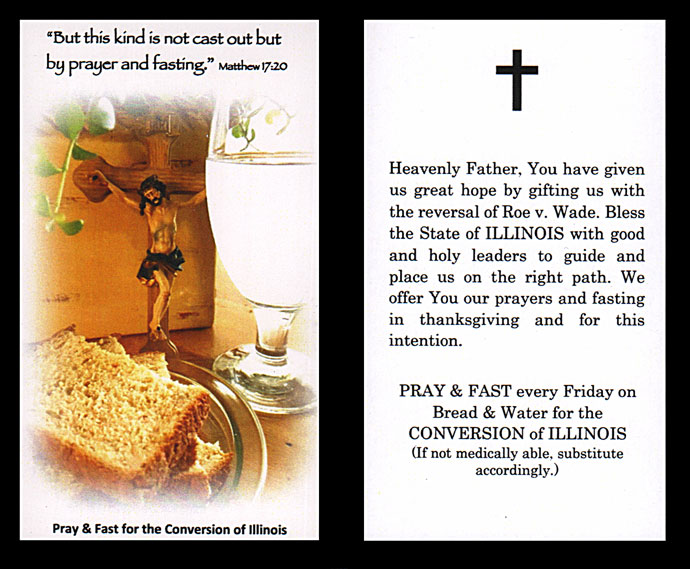
Turk and several other lay Catholics have teamed up to contact all six dioceses in Illinois to spread the word as quickly as possible, asking Catholics, if they are able, to pray and fast every Friday on bread and water alone for the conversion of Illinois. They are hoping to reach 800 or more parishes in the state. Several parishes in the Diocese of Springfield in Illinois are participating by hanging posters and having prayer cards available for people to take home.
“Fasting strengthens and helps us to focus on prayer,” Turk said. “When we fast, we are saying we are serious that we need this evil (abortion) to be cast out. Fasting isn’t easy especially today when we have every kind of food and drink available to us 24/7. While it can be most powerful to fast only on bread and water, there are many ways to fast. It can be giving up a meal, sweets, alcohol, coffee, etc. You could also pray a rosary or go to Mass on Friday if this is something you would not normally do.”
The prayer card starts with a Scripture passage from Matthew 17:21, which says, “But this kind is not cast out but by prayer and fasting.”
The prayer reads:
Heavenly Father, You have given us great hope by gifting us with the reversal of Roe v. Wade. Bless the State of Illinois with good and holy leaders to guide and place us on the right path. We offer You our prayers and fasting in thanksgiving and for this intention.
“We are simply thanking God thereby acknowledging His part in this and petitioning Him, recognizing there is more to be done to satisfy His law,” Turk said. “We are extremely grateful to these brave justices and to all the individuals and organizations who have been in this fight to protect these precious lives. This battle is just short of 50 years — It needs to end!”
The call to prayer and fasting from this grassroots effort is also a good reminder for Catholics that every Friday (unless the Friday is a solemnity), Catholics must abstain from meat, even outside of Lent, unless some other form of penance or work of charity is done on that Friday (canon 1251).
Catholics commemorate 125th anniversary of Quincy’s Father Tolton’s death

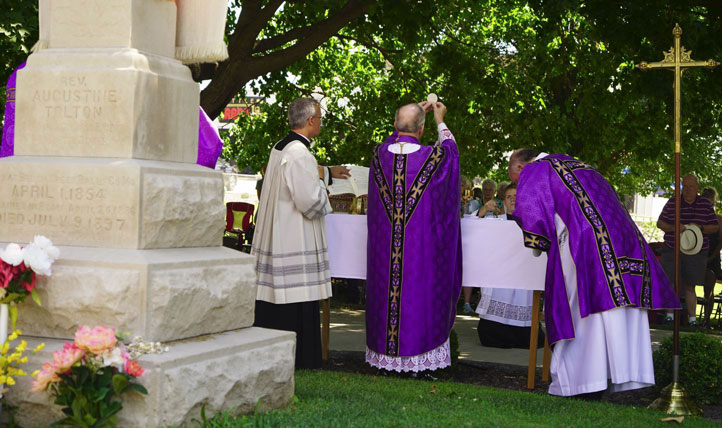 Photo by Jay Niles, The Catholic MissourianQUINCY – About 150 Catholics devoted to the Venerable Servant of God Father Augustine Tolton who grew up in Quincy, ministered in there, and is buried in there, commemorated the 125th anniversary of his death with a pilgrimage procession on Saturday, July 9 in Quincy. Father Tolton is recognized as the first black priest in the United States and the Cause for his beatification and canonization of sainthood is ongoing in Rome.
The mile-long pilgrimage procession began at the statue of Father Tolton outside St. Peter Catholic Church. After a few words of welcome and explanation, followed by a prayer, the pilgrimage procession processed to St. Peter Catholic Cemetery where Father Tolton is buried. The celebration of Holy Mass then took pace with Bishop Thomas John Paprocki as the celebrant.
The pilgrims also prayed for an end to hatred and violence, greater respect for life, and for more priests through Father Tolton’s intercession, as well as for Father Tolton’s canonization as a saint. The pilgrimage procession concluded with the singing of “Holy God, We Praise Thy Name,” Father Tolton’s favorite hymn.
“When he left Quincy for Rome, Father Tolton promised not to forget the people of the Gem City, so we must not forget him either,” said Father Daren Zehnle, pastor of St. Augustin in Ashland and who organized the event. “It is fitting to remember him on the anniversary of his death to pray for his canonization, to ask his intercession, and to strive to emulate his virtues.”
 Photo by Scott Stadler“If we are to imitate the virtue of Father Tolton, we, too, must seek to be united to the sufferings of Christ throughout our lives so that we might also be glorified with him,” Bishop Paprocki said in his homily. “A most important way for us to be united to sufferings of Christ is to imitate the courageous patience of Father Tolton, especially in a society that is so quick to rage. There is unquestionably no shortage of occasions for each of us to practice this same virtue of courageous patience in our own lives. Opportunities for long-suffering abound in our families, in our places of employment, in our schools, and in society generally. What is needed for us is that we be stout-hearted and wait for the Lord, as Augustine did.”
Father Tolton was born into slavery in 1854. In 1862, his mother and siblings made a daring escape across the Mississippi River to Illinois. After settling in Quincy, he went to school at St. Peter’s Catholic School. Tolton later went to seminary in Rome because no American seminary would accept a black man. Thinking he would minister in Africa, once he was ordained, he was instead sent back to Quincy, where he arrived to thousands of supporters. Known for his incredible singing and homilies, Tolton spent several years in Quincy before transferring to Chicago. He died of heatstroke at the age of 43 on July 9, 1897 and is buried at St. Peter’s Cemetery in Quincy. Pope Francis declared him “Venerable” on June 12, 2019, the second step of four to becoming a saint in the Catholic Church.
2 tank Catholic trips

How does one dispose of blessed objects?

How does one dispose of blessed objects? Is there a place in the diocese that will accept these? If not, I need guidance on what to do with them.
Kathy in our diocese
It is not an uncommon experience for a Catholic to acquire blessed objects, be they books, statues, pictures, medals, rosaries, etc. After a time, some of these accumulate in great number or may no longer be needed or wanted. This leads to Catholics to wonder what they can do with these blessed items.
Traditionally, the Church recognizes three options: They may be given away to another person who may benefit from them; they may be buried; or they may be burned. Blessed items are not to be sold; if they are sold, they automatically lose their blessing.
Blessed items should not be given away simply to be rid of them and to clear up space in the closet. When considering giving away a blessed object, it should be considered who might actually benefit from this item.
When burying blessed objects, they may be buried in a place where they are unlikely to be accidentally dug up. While the diocese does not have a program to accept blessed objects, some Catholic cemeteries or funeral homes may have reserved space for the burial of these items.
When burning blessed items, it should done quietly and reverently, in a way so as not to draw attention to what is done. Also, the same fire not ought to be used for roasting hot dogs or making s’mores. Should a blessed object unintentionally be broken, it may simply be discarded, though this should be done quietly.
Father Daren Zehnle is pastor at St. Augustine in Ashland and is the director for the Office of Divine Worship and the Catechumenate for the Diocese of Springfield in Illinois.
He saw Communion as purely symbolic but when he received the Eucharist for the first time, it left him stunned

By DEACON ADAM COX
Special to Catholic Times
Many Catholics across the country are starting a three-year journey. This journey is about Eucharistic Revival, and it is intended to wake up that inner longing for Jesus in the most intimate way possible by placing the proper emphasis on the Blessed Sacrament.
Coming from a Protestant background, I saw Communion as purely symbolic, and this view is held by many denominations still today. The Eucharist is still a mystery to me in some respects, but as a deacon, I can’t imagine my life without it and the wonderful graces I receive from it. I will be the first to say that it wasn’t always this way. In fact, I was somewhat skeptical when I went through the RCIA program and all the way up to when I received holy Communion for the first time.
From that very moment at the Easter Vigil, my life changed, and I didn’t take holy Communion for almost another year. I experienced something and it scared me. I felt love, not just any love, but something that welled up from deep inside my inner being. I won’t get into why that scared me because I have a long and complicated past, but for once in my life, I was accepted for who I am.
My love for the Eucharist has only grown stronger over the years, and I am saddened by how in some places, it has been taken for granted. To receive the Eucharist, is to receive a friend, a friend who will give anything for your wellbeing. This is not something to take lightly but should always be respected and something we should always be grateful for. The Eucharist should never be part of a “list” of items that we will get to for the week, but in some cases, it is treated as such.
The Eucharist is an experience and once you feel that experience, it will shake you to your soul. That experience will vary from person to person, but in the end, you cannot help but be changed for the better.
When I assist at Mass, I always have the upmost respect for the Eucharist, and there is always a moment of grief when I place the ciborium back in the tabernacle because I’m closing the door on my Lord. As I genuflect, I need to remind myself that Jesus is always present, and it’s not “Goodbye,” but, “See you next time.” It may sound ridiculous to some, but once you are touched by the love of Jesus, you will continue to crave that connection.
Over the next three years, the goal of the nationwide Eucharistic Revival is to spread a devotion to the Blessed Sacrament that for some reason has diminished. We need to rekindle the love and respect for the Eucharist because Christ is truly and unequivocally present in all tabernacles of the world. Next time you are at Mass, and you present yourself for holy Communion, that is not some altar bread from a supply house but a King, a friend, and our Savior Jesus Christ. Amen.
Deacon Adam Cox serves at Mother of Perpetual Help in Maryville.
Beauty Series - St. Mary in Madison

 By ANDREW HANSEN
Editor
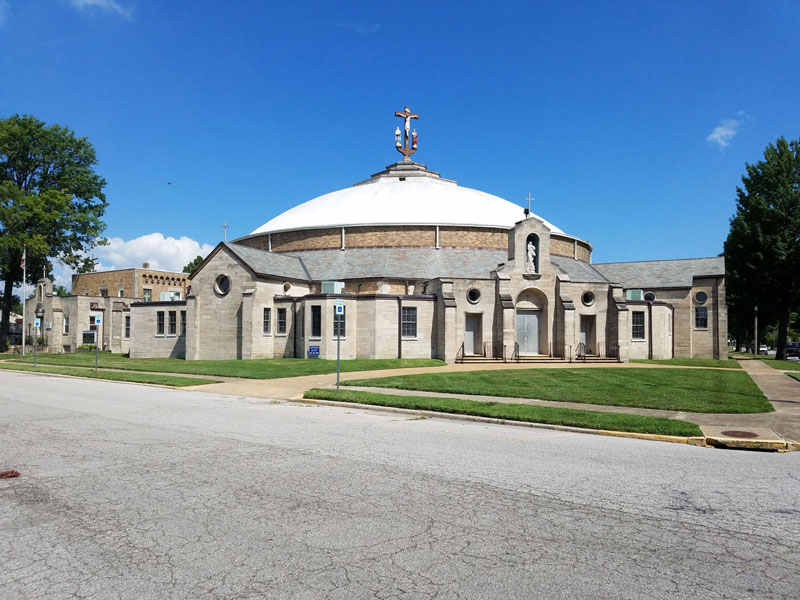
The honor of being one of the most unique churches in the Diocese of Springfield in Illinois belongs to St. Mary Church in Madison, mainly because of its domed structure. People who visit here say it reminds them of the Pantheon in Rome because that historic church is known for its dome. The dome at St. Mary spans 93 feet in diameter, much larger than what appears on the outside.
“Being where the location was picked to build the church, because of the location itself and the property, it fit better to have a dome rather than a traditional rectangle or square building,” said Father Stephen Thompson, pastor.
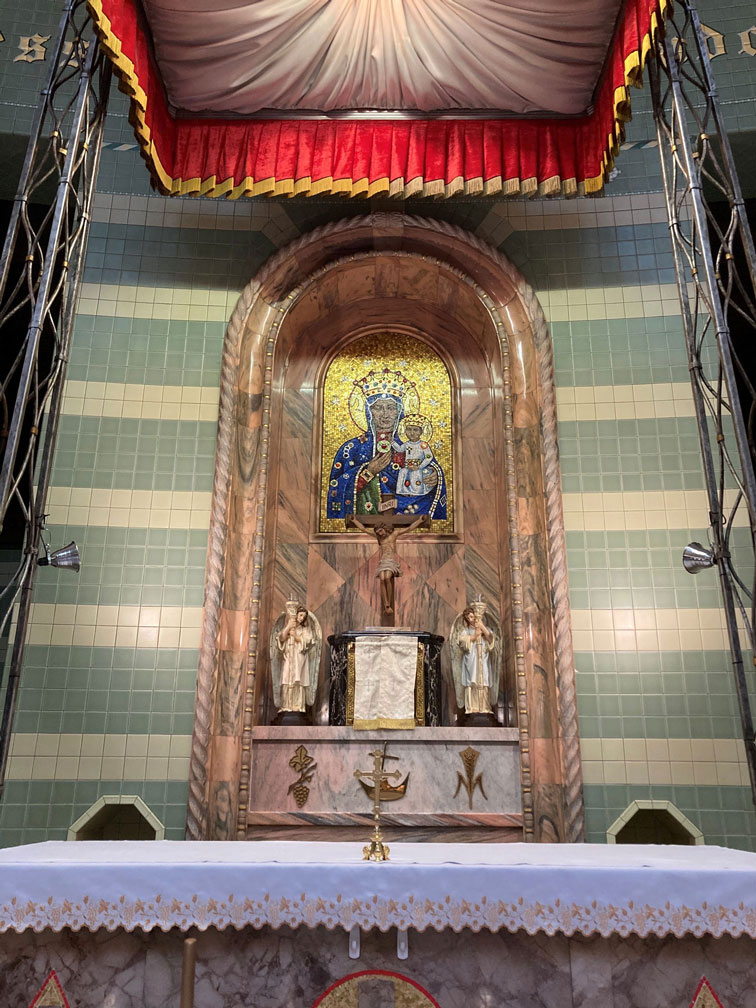
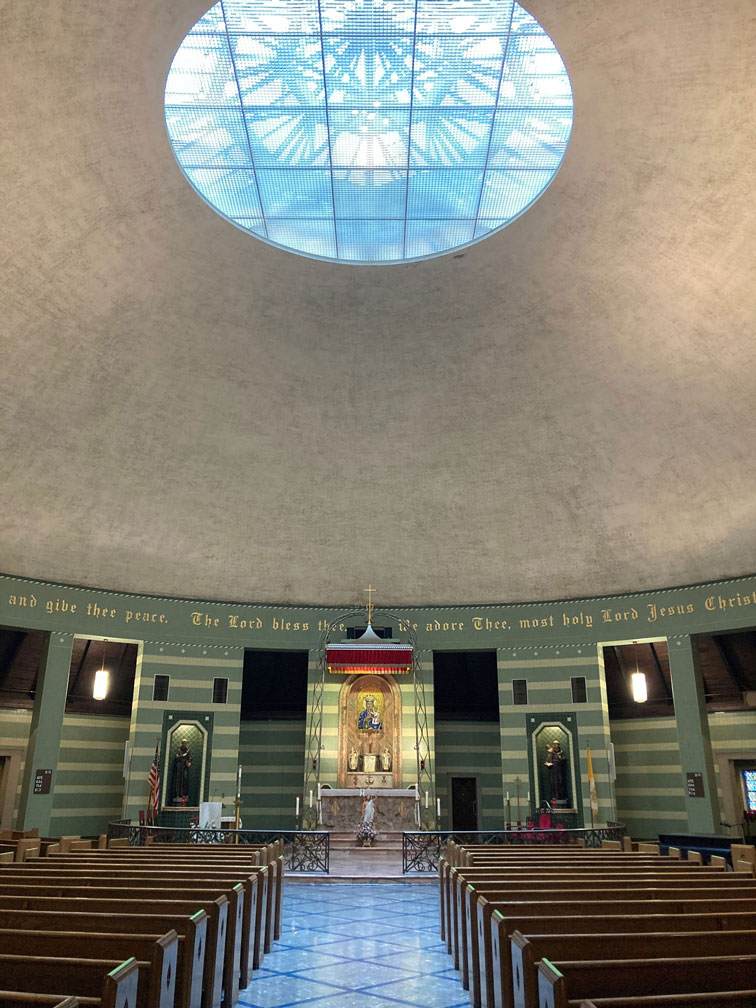
Completed in 1954, the church is dedicated to the Blessed Virgin Mary, the Mother of God, under the intercession of Our Lady of Czenstochowa. Beyond the rarity of having a dome, the church has other beauty not found in many churches. The church has three side chapels: the Chapel of the Sacred Heart, the Chapel of the Blessed Virgin Mary, and the Chapel of St. Joseph. Suspended over the altar is a baldachin or canopy on great iron bents tipped with gold and aluminum. Situated under that is a valuable mosaic of our Lady of Czenstochowa, a gift of a parishioner. The walls of the church are covered in glaze tile to prevent maintenance of a plaster interior. The Stations of the Cross are mosaic, designed by a French artist and various statues of saints can be seen throughout the church, surrounding the faithful attending Mass. The interior of the church is lighted mostly be a 25-foot diameter skylight, sitting 45 feet above the floor.
 “The first thing that strikes me when I walk in is the focus on the altar,” said Father Thompson. “The statues and the chapels that we have, it just has that old feel and Franciscan feel. You feel the Franciscan mark on this church, which they had a lot of influence here.”
 The first Catholic church built in Madison opened to the faithful in 1912. In 1925, St. Mary School opened with an enrollment of 265 students. The Franciscan influence Father Thompson talks about began in 1936 when the Franciscan Fathers of the Sacred Heart Province assumed charge of the parish, led by Father Engelbert Bienek, OFM. He had such a profound impact on the parish and its growth, his image can be found in the back of the church today. In 1952, plans began for erecting the new church. On Thanksgiving Day in 1954, St. Mary Church opened to the faithful.
“In the design of the church, the whole focus was to be on the altar, so even though you have the circular building, if you notice how the pews are facing, it’s all focused on the altar,” Father Thompson said.
The history of this parish has a heavy influence from Eastern Europe, with many of the parishioners having family histories that come from places like Croatia, Serbia, and Poland. Father Thompson describes the people here as “very warm and very welcoming.”
“I think part of that is the immigration of people here of them trying to find a home themselves, so making this a home for others,” Father Thompson said.
Hey, Father! How does one dispose of blessed objects?

How does one dispose of blessed objects? Is there a place in the diocese that will accept these? If not, I need guidance on what to do with them.
- Kathy in our diocese
It is not an uncommon experience for a Catholic to acquire blessed objects, be they books, statues, pictures, medals, rosaries, etc. After a time, some of these accumulate in great number or may no longer be needed or wanted. This leads to Catholics to wonder what they can do with these blessed items.
Traditionally, the Church recognizes three options: They may be given away to another person who may benefit from them; they may be buried; or they may be burned. Blessed items are not to be sold; if they are sold, they automatically lose their blessing.
Blessed items should not be given away simply to be rid of them and to clear up space in the closet. When considering giving away a blessed object, it should be considered who might actually benefit from this item.
When burying blessed objects, they may be buried in a place where they are unlikely to be accidentally dug up. While the diocese does not have a program to accept blessed objects, some Catholic cemeteries or funeral homes may have reserved space for the burial of these items.
When burning blessed items, it should done quietly and reverently, in a way so as not to draw attention to what is done. Also, the same fire not ought to be used for roasting hot dogs or making s’mores. Should a blessed object unintentionally be broken, it may simply be discarded, though this should be done quietly.
Father Daren Zehnle is pastor at St. Augustine in Ashland and is the director for the Office of Divine Worship and the Catechumenate for the Diocese of Springfield in Illinois.
SDCCW honors four young women with scholarships

By DIANE SCHLINDWEIN
Managing Editor
The Springfield Diocesan Council of Catholic Women (SDCCW) recently announced the names of four young women from the Diocese of Springfield in Illinois who will be recognized at the Women of Distinction Mass and luncheon on July 23. These young women were selected from 46 applicants and will receive $1,000 from SDCCW.
“These young ladies, along with all the other outstanding applicants, are fruit of the earth and hope for all,” said Mary Ann Sullivan, the SDCCW scholarship chair. “Tribute goes to their parents and all those in their lives that have taught them their faith by word and example. They are a witness and inspiration to all of us.”
The 2022 winners are:
 Ava Kessler, daughter of Dan and Kim Kessler of Newton, is a member of Holy Cross Parish in Wendelin. She is a graduate of Newton Community High School.
She is president and an active member of her parish youth group, attended March for Life in Washington, D.C., two times, and has gone on three mission trips with Catholic HEART Workcamp. Active in sports and band, Ava was also named captain of the girls’ basketball team. She was teacher assistant in the fifth-grade classroom and volunteered at the COVID vaccination drive-thru. She is also a volunteer umpire for local Little League games. Ava will be attending the University of Illinois where she will be enrolled in General Studies. “I am thankful for my parish and family that have formed me into the young lady I am today,” she said.
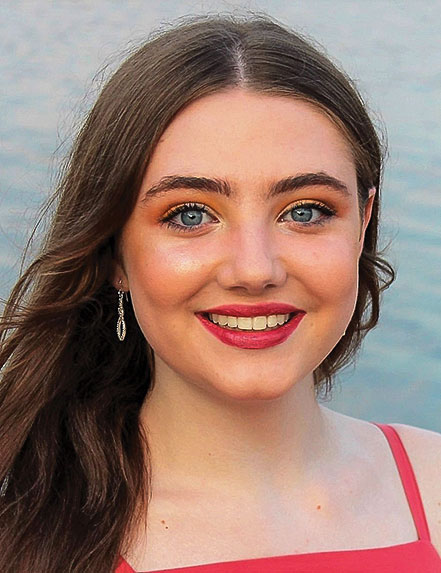 Grace Lynch, who is from Sullivan and a member of Holy Family Parish in Decatur, is a home school graduate. She is the daughter of Melissa and Brian Lynch. Her Church-related activities include being a church organist/pianist, a lector, a Vacation Bible School volunteer, and a Catholic Charities volunteer for five years. Grace is a dance teacher at Sullivan Dance Studio and created her own dance classes for under resourced home-schooled students, inventing her own curriculum and marketing the program across Central Illinois. She is now teaching over 25 classes using Zoom for homeschoolers and for other students, as well during COVID. She received the Girl Scout Gold Award, has been a house manager for professional theater, and dance captain for multiple productions. She is also founder of non-partisan group Teens in Politics and is active in Right to Life activities. Grace will be attending University of Notre Dame studying political science toward a career as lawyer.
 Jenna Ochs is from West Liberty, is a member of St. Mary’s Assumption Parish in Sainte Marie, and graduate of Newton Community High School. She is the daughter of Jeff and Lisa Ochs. At her parish she is an altar server, lector, parish Youth Group member, and a Living Stations participant. She also attended the March for Life for three years. Jenna was also captain of her school volleyball team and volunteers as a junior volleyball coach. Additionally, she is an active member and officer in FFA earning a State degree, and is a long-time 4-H member. Jenna will attend Illinois Central College to study sports medicine/physical therapy. “I strive to lead by example and by my faith to others,” she said.
 Monica Wendle is from Godfrey, is a member of St. Mary Parish in Alton, and is a graduate of Marquette Catholic High School. She is the daughter of Eric and Marci Wendle. She reads Scripture daily, is a eucharistic minister, cantor, and lector. Monica created a nail painting booth for parish picnic fund-raiser and organized a prayer group for eight-grade students in the parish grade school. She was a member of Campus Ministry Club at her high school where she created a project that included making biblical message cards with candy attached for students. She organized caroling and the collection of Christmas cards for local nursing homes. Monica donated 11 inches of her hair to Children With Hair Loss. She also enjoys sewing and made 16 lap quilts for hospice patients. Monica will attend Lewis and Clark Junior College and then move onto Ave Maria University to study education and communications. “I am so humbled and blessed to receive the SDCCW scholarship award,” she said.
Catholics invited to join Bishop Paprocki in commemorating 125th anniversary of Quincy’s Father Tolton’s death

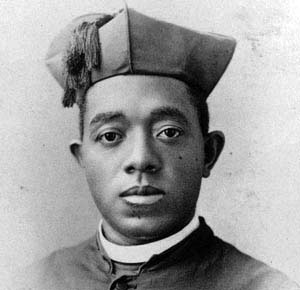 QUINCY — Area Catholics and others devoted to the Venerable Servant of God Father Augustine Tolton who grew up in Quincy, ministered in Quincy, and is buried in Quincy, will commemorate the 125th anniversary of his death with a pilgrimage procession on Saturday, July 9 in Quincy. Father Tolton is recognized as the first black priest in the United States and the Cause for his beatification and canonization of sainthood is ongoing in Rome.
The mile-long pilgrimage procession will begin at 10 a.m. at the statue of Father Tolton outside St. Peter Catholic Church at 2600 Maine St. After a few words of welcome and explanation, followed by a prayer, the pilgrimage procession will process along the south side of Maine Street where it will cross onto the east side of South 33rd Street. It will then process along the east side of South 33rd Street until it reaches St. Peter Catholic Cemetery where Father Tolton is buried.
Upon entering the cemetery, the procession will stop at the grave of Father Tolton for the celebration of Holy Mass at 11 a.m., with Bishop Thomas John Paprocki, Bishop of the Diocese of Springfield in Illinois, as the celebrant.
Following Mass, the pilgrims will pray for an end to hatred and violence, greater respect for life, and for more priests through Father Tolton’s intercession, as well as for Father Tolton’s canonization as a saint. The pilgrimage procession will conclude with the singing of Holy God, We Praise Thy Name, Father Tolton’s favorite hymn.
Those who wish to participate in the Mass but cannot walk in the procession are invited to park near the cemetery to meet the procession at the grave. Due to the small size of the cemetery, no one should park in the cemetery itself. Chairs and bottled water will be provided at the cemetery for those who wish to participate in the Mass.
Father Tolton was born into slavery in 1854. In 1862, his mother and siblings made a daring escape across the Mississippi River to Illinois. After settling in Quincy, he went to school at St. Peter’s Catholic School. Tolton later went to seminary in Rome because no American seminary would accept a black man. Thinking he would minister in Africa, once he was ordained, he was instead sent back to Quincy, where he arrived to thousands of supporters. Known for his incredible singing and homilies, Tolton spent several years in Quincy before transferring to Chicago. He died of heatstroke at the age of 43 on July 9, 1897 and is buried at St. Peter Cemetery in Quincy. Pope Francis declared him “Venerable” on June 12, 2019, the second step of four to becoming a saint in the Catholic Church.
For more information about this event, please contact: Father Daren J. Zehnle at (217) 321-1109 or .
Hey, Father! Administering drugs to terminally ill patients at death - where does the Church stand?

What is the doctrine of the Catholic Church in regard to administering drugs to terminally ill patients at, or near end of life, to end suffering and pain? If one is designated with others as a Health Care Power of Attorney for a terminally ill person and allows a Hospice nurse to administer drugs such as morphine and muscle relaxers, are they guilty of helping with euthanasia?
-Louise in Alton
A person who is caring for a terminally ill or an actively dying person or is their Health Care Power of Attorney may find himself or herself in a situation where he or she is consulted by those treating their loved one about which treatments he or she might wish to receive or how to alleviate pain. This can be a very intimidating role and two basic principles that are found within this question may appear to be at odds.
Firstly, we understand the dignity of every human life in every stage of its existence and can never morally act to end or shorten it. Secondly, we wish to help alleviate the pain and suffering of the person.
The United States Conference of Catholic Bishops have assisted us in making such decisions in accord with our Catholic faith. Their Ethical and Religious Directives for Catholic Health Care Services (Sixth Edition #62), helps us understand the validity of both of the principles here:
“Patients should be kept as free of pain as possible so that they may die comfortably and with dignity, and in the place where they wish to die. Since a person has the right to prepare for his or her death while fully conscious, he or she should not be deprived of consciousness without a compelling reason. Medicines capable of alleviating or suppressing pain may be given to a dying person, even if this therapy may indirectly shorten the person’s life so long as the intent is not to hasten death. Patients experiencing suffering that cannot be alleviated should be helped to appreciate the Christian understanding of redemptive suffering.”
Great advances in what is called “palliative care,” such as Hospice, where we are caring for while unable to treat or heal a dying person, allow us to balance the dignity of life and address their pain. While we never actively intend to shorten life, a dying person’s pain can morally be managed so long as we are not intending to hasten their death. One could ask for the minimal amount of medication required to keep the patient comfortable. One is not engaging in euthanasia if one is attempting to alleviate pain with this intention in mind.
Father Peter Harman holds a Doctorate in Moral Theology from the Catholic University of America and is rector of the Pontifical North American College in Rome.
Beauty Series | St. Anthony of Padua – Effingham

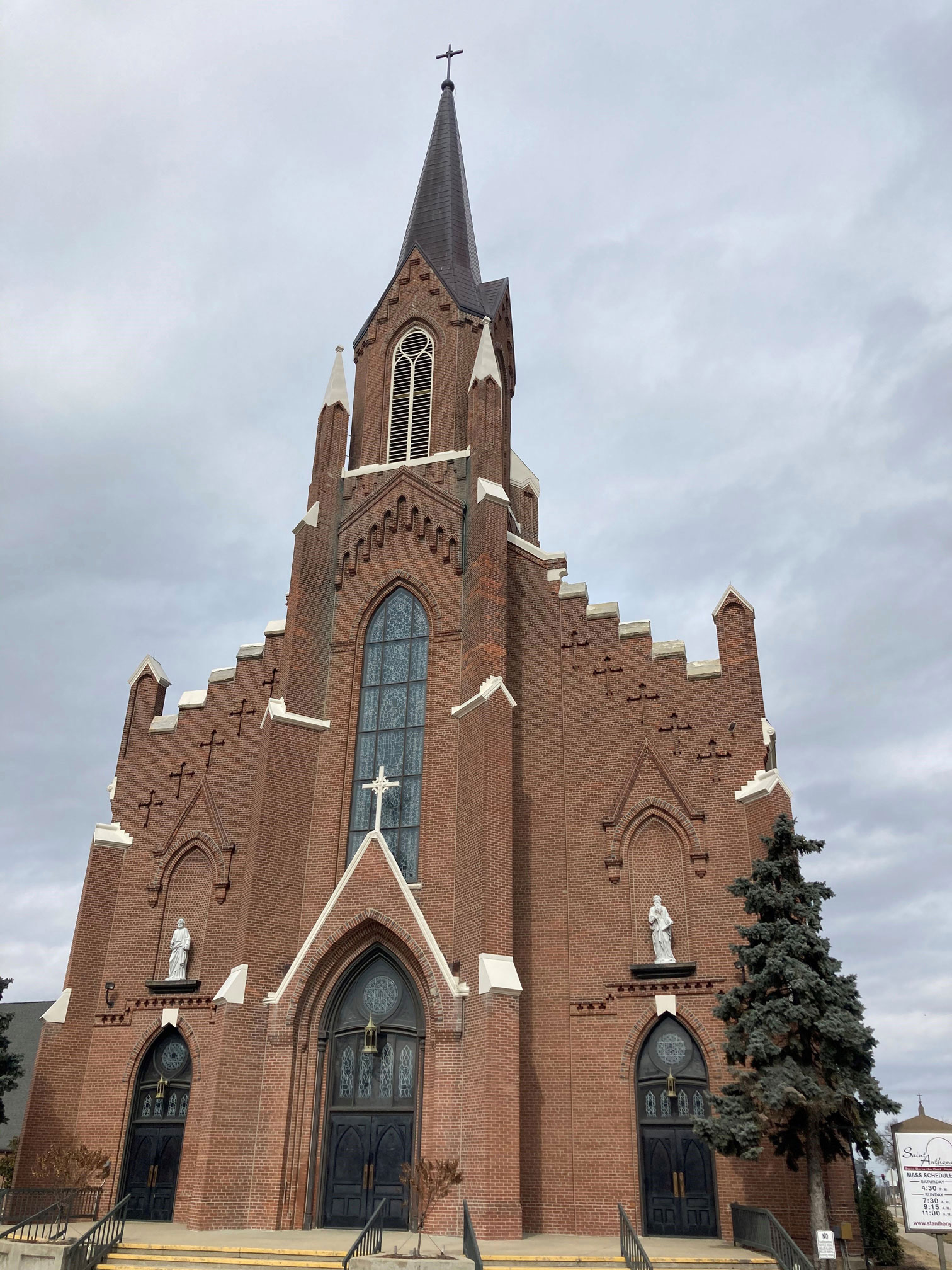 The history of St. Anthony of Padua Parish in Effingham is about as deep as any in our diocese. It all started in 1858 with a brick church on what is now the site of Goff Gym with the first Mass taking place on Christmas day. It was the first church in Effingham, a city known for its religious heritage. St. Anthony was a mission parish when it began, served by priests from the neighboring villages until 1871. Today’s church, built in 1875, is one of the most prominent structures in Effingham, attended by several generations of Catholics.
“They have all this history, and many are so willing to tell it to you, and it is such a rich history,” said Father Al Allen, pastor of St. Anthony of Padua Parish. “You can tell a lot of that by looking at the beautiful stained-glass windows and the memorials that are on the windows that mention the families. Most of them are in German it goes back that far. To talk to these people and they will say, ‘This was my great-great-great grandparent,’ it’s overwhelming at times. It is just beautiful.”
Inside the church, your eyes will be drawn to the immense ceilings and beautiful woodwork seen throughout. Like several churches in our diocese, the stained-glass windows are probably the most striking feature, which were installed in 1911. Images of saints, Mary, Jesus, and scenes from Salvation history line the walls, all displaying fine details and rich colors, which pour into the church on sunny days. A more recent window, installed in 1958, is behind the choir loft. It beautifully depicts St. Anthony holding the baby Jesus. For Father Allen, his favorite thing about the church is the baptismal font.
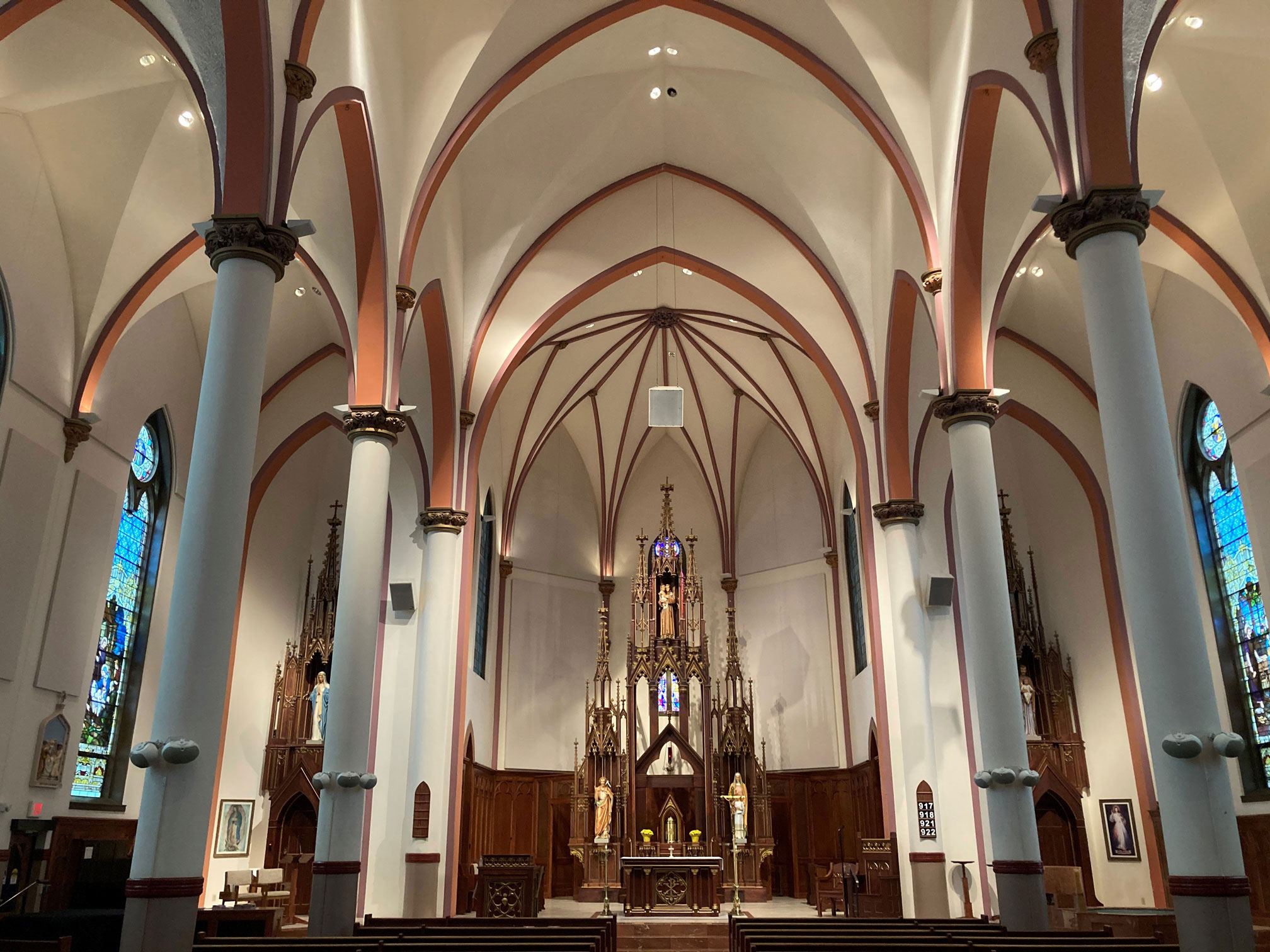 “You can hardly find someone who hasn’t been in a long line of family members who have been baptized here,” Father Allen said. “I think this beautifully designed font, coordinating with the church itself, is just so great, and it makes the baptisms just warm and a very familiar feeling.”
The church has undergone several renovations over the past century and a half, including one in 1996. That renovation removed the old wallpaper, and the statues and Stations of the Cross were completely restored and repainted.
One place that Father Allen says is “well-kept secret,” even though the parish does not want it to be secret, is a prayer area behind the tabernacle.
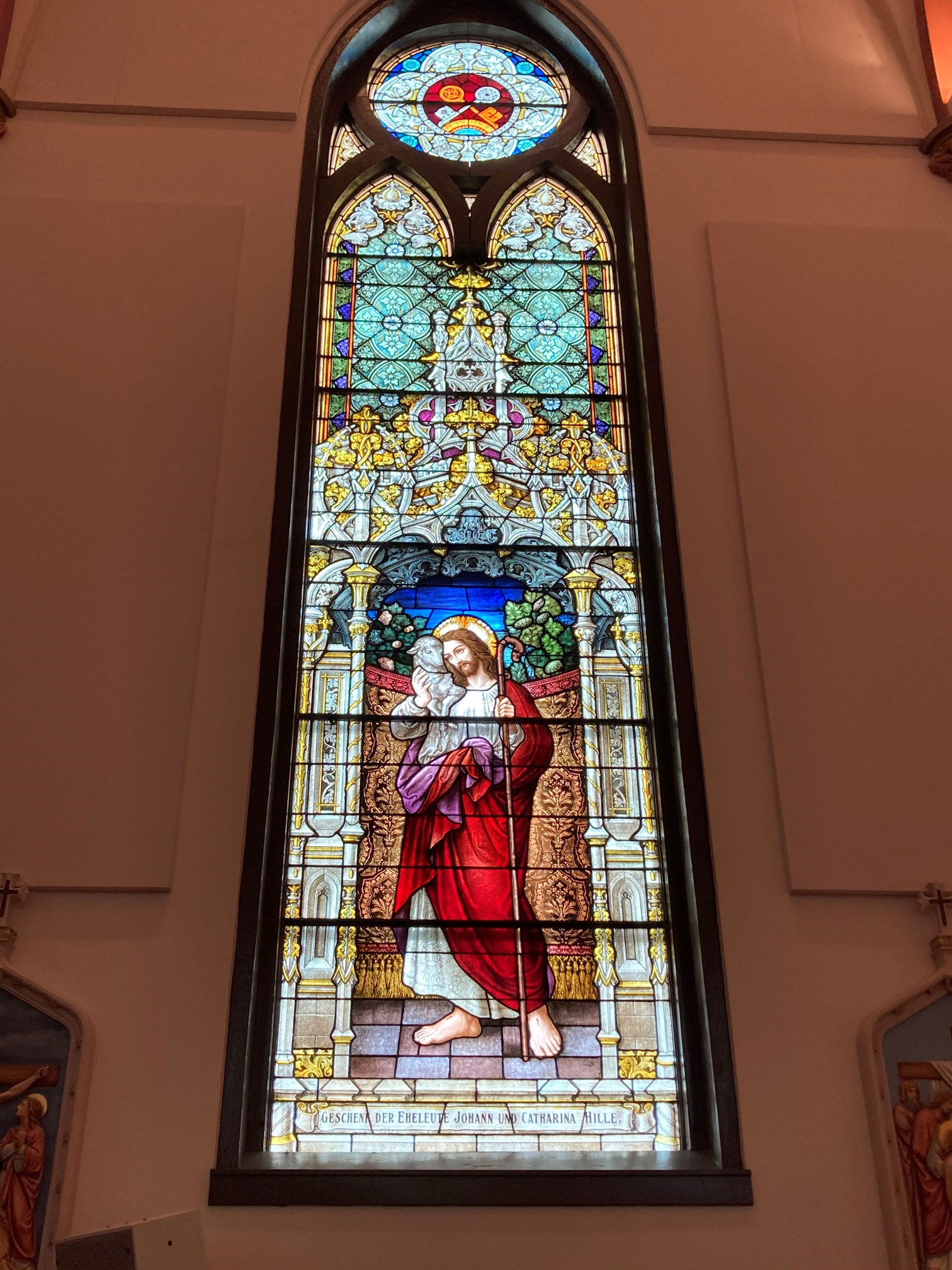 “I call it a meditation chapel because it has a lot of the things a chapel would have like the sanctuary light which serves the chapel and the church,” Father Allen said. “We have a lot of people who dedicate themselves to the Sacred Heart of Jesus and Mary, and we have those images on the wall. So, it affords people a place to come and meditate whenever they want to. It’s a quiet place and normally the lights are off in the church, so it gives the adorer a private and nice place to be. It’s one of things you just don’t think about until you experience it. I find it very handy during the day and when there is a little tension, you can come relax and pray and spend some time with the Lord.”
Serving the Catholic community in Effingham for more than 160 years, the history here is profound, something the 1,300 current families at the parish recognize and honor every time they step inside.
“One of the things that really gets me when you walk into St. Anthony is the peace,” Father Allen said. “The peace and the calm. You can be as tense as you can, but when you walk into the church, as big as it is, which is kind of odd — you would think it would be intimidating, but when you walk in, there is a certain peace. You can feel the grace. As I like to tell people, that is the spirit that is in this church. The spirit of the years and years of rich history that help you become calm.”
Mt. Zion student receives Bishop's Scholarship at QU

 Quincy University (QU) has announced Jack Driscoll as the 2022 Bishop’s Scholarship recipient. Driscoll graduated this spring with honors from Mt. Zion High School and will begin at QU this coming fall.
“I am thrilled for both Jack and Quincy University to award the Bishop’s Scholarship to a student who is striving every day to live authentically for Christ,” said Bishop Thomas John Paprocki of the Diocese of Springfield in Illinois. “Jack not only has a strong academic record, but his commitment to building up the Kingdom of God in our diocese is an example of his faithfulness. He has been a constant volunteer at Our Lady of the Holy Spirit Parish in Mt. Zion, helping children better understand the faith in PSR classes. He has served at the table of the Lord as an altar server and as an usher, and he was his brother’s confirmation sponsor. He is also involved in building up a culture of life and helps distribute holy Communion to those in nursing homes. I was struck by his active involvement in the Church, and with the joy he carries out his mission as an intentional disciple.”
The university awards the $10,000 Bishop’s Scholarship to one student on the recommendation of Bishop Paprocki. To be eligible for consideration, a candidate must belong to a parish in the Diocese of Springfield in Illinois and have applied to QU. Candidates must be admitted to QU, choose to enroll, and submit a statement describing their involvement in their local parish, the diocese, or the Catholic Church.
“I am so thankful for the opportunity to attend QU in the fall as the Bishop’s Scholarship recipient,” Driscoll said. “I would like to thank my family, OLHS Catholic Church, Dr. McGee, and Bishop Paprocki, who played integral roles in me receiving this scholarship. I am excited to attend QU as my parents, aunts, and uncles did. For many years, I have listened to my family tell story after story of their experiences at QU. I am excited to finally be able to chime in with my own QU stories.”
Hey, Father! Explain the Church's teaching on suicide

During my 12 years of Catholic education in the 50s and 60s, we were taught that those who committed suicide were guilty of the sin of despair and could not have a Catholic funeral Mass or be buried in consecrated ground. At some point, the Church realized that those who died by their own hands were probably mentally ill and not fully responsible for their actions. Are these souls entitled to a Catholic service these many years later if requested by their loved ones?
- Mary A. in Springfield
Thank you for taking the time to write your question, as I am sure that it is something that many people have wondered about, but were not sure how to ask it.
The Church teaches that the act of taking one’s own life is gravely wrong because it violates God’s own love of the individual, just love of self, and the good of others who will suffer because of the act (Catechism of the Catholic Church 2281). However, as you alluded to in your letter, the Church also recognizes that in many, many cases, if not all, one might argue, the person who commits such an act does not do so freely because it goes against the natural inclination of self-preservation.
The Catechism states that “Grave psychological disturbances, anguish, or grave fear of hardship, suffering, or torture can diminish the responsibility of the one committing suicide” (CCC 2282). The Church teaches and believes that “We should not despair of the eternal salvation of persons who have taken their own lives. By ways known to Him alone, God can provide the opportunity for salutary repentance. The Church prays for persons who have taken their own lives” (CCC 2283). Sadly, many Catholics do not know this aspect of the Church’s teaching. The Church has come a long way in her understanding of suicide; in fact, there are specific prayers in the Order of Christian Funerals for those who die by suicide. Sadly, many among the faithful still do not know that the Church has come to this deeper understanding of the tragedy of when someone takes his or her own life. I am sorry for the pain, suffering, and fear that many have experienced because of this.
Prayers can always be offered for the faithful departed and in various ways. The most efficacious prayer that can be offered for someone who has gone before us in faith is to have a Mass offered for him or her. In cases like you mentioned, a loved one’s grave can always be blessed by a priest or deacon along with other prayers being offered on their behalf that God will grant that person light, joy, and peace forever in heaven with all his saints.
- Father Christopher House, S.T.L., J.C.L. is pastor at Christ the King Parish in Springfield and is the Vicar Judicial for the Office for Tribunal Services for the Diocese of Springfield in Illinois
Good News! Two new priests ordained for Springfield diocese

 Father Zach Samples and Father Paul Lesupati are all smiles after their ordination.By DIANE SCHLINDWEIN
Managing Editor
It was a beautiful Easter season day both outside and inside the Cathedral of the Immaculate Conception May 28 as Bishop Thomas John Paprocki ordained Father Paul Lesupati and Father Zachary Samples to the priesthood for the Diocese of Springfield in Illinois.
Over 65 priests, a number of deacons, and hundreds of family members and friends were at the Cathedral as the two men, who both attended Saint Meinrad Seminary and School of Theology but came from quite different backgrounds, took their vows to the priesthood, were ordained, and then shared a common joy that day.
In his homily, Bishop Paprocki called the ordination Mass “a glorious occasion for all of us and for the entire Church.” He explained that Father Lesupati came to the Diocese of Springfield in Illinois after Father Jeff Grant, pastor of Blessed Sacrament Parish in Springfield, met the young social worker while he was on sabbatical in Kenya. Smiling, Bishop Paprocki gave credit to Father Grant and said, “Note to priests, if you ever go on sabbatical, you will be expected to bring back at least one seminarian!”
Zach Samples, the younger of the two men, was a “home-grown” seminarian, born in central Illinois and baptized by Father Dan Bergbower at Our Lady of Lourdes in Decatur. Speaking once again with a smile, Bishop Paprocki said, “Good job, Father Bergbower, it stuck!”
On a more serious note, Bishop Paprocki noted that as a priest a man offers himself to Christ, so Christ can use him as an instrument of salvation. “Every priest is a missionary,” he said, “because every place is a missionary place.” He said that now, as priests, the two men are “standing where Christ stood.” “It is an adventure and a sublime destiny.”
As a priest, Father Lesupati said, “I am so excited and I am looking forward to celebrating the sacraments, especially the sacrament of reconciliation, the sacrament of mercy, and celebrating the Eucharist. I am also excited to serve the people of God as a priest, journeying with them by listening and accompanying them in their day-to-day struggles.”
Father Samples had a similar statement. “I often joke that it is ‘company policy’ for a future priest to say that he is most excited to celebrate the Mass. This is obviously not a joke — it’s a reality. Without question, I am most excited to celebrate Mass, to confect the Eucharist, and to bring Christ to his people in a very real way. I’m also excited to celebrate the sacrament of reconciliation, to meet people in the midst of their struggles and pain, and to bring Christ’s light into that darkness. Finally, I am just ready to fully invest in parish life, and to put into action all that I have learned during these years of seminary formation.”
Beginning July 1, Father Lesupati will be a parochial vicar at Cathedral of the Immaculate Conception in Springfield, while Father Samples will be parochial vicar at St. Peter Parish in Quincy and associate chaplain Quincy Notre Dame High School.
Decades old homily on the real presence in the Blessed Sacrament perfect for us today
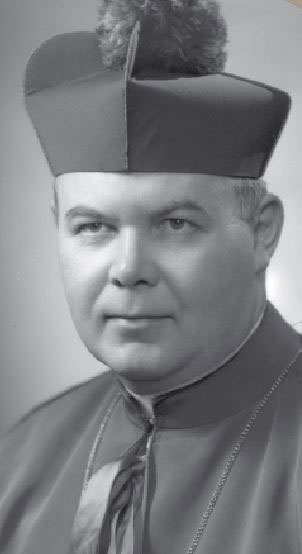 The following is an undated homily given by Bishop William O’Conner, who served our diocese from 1949-1975. This was provided to Catholic Times by the Office for Archives and Record Management for the Diocese of Springfield in Illinois.
Tonight, my dear friends, when darkness shall have once again triumphantly descended, routing the light of the day and claiming the city as his own, to reign unchallenged through the silent hours while the tired city sleeps, a taint red glow will faith fully and valiantly defend the altar of this church against the night-long siege of the surrounding shadows. Tonight, in all the Catholic churches of the city, in all the Catholic churches of the land, other vigilant sentinels will keep the altar bright, though the rest of the church be enveloped in impenetrable darkness. Why is this unusual custom so universally observed? Why has each church such a luminous sentry ever on guard; as a guard of honor, it would seem, tor it is evidently a futile protector? And why is this tiny flame so distinctive of our churches? For each of us would know with satisfying certainty that he was in a Catholic church, were he to see scarcely anything else but this little red flame on guard before the altar. And why is it that at night this tiny light should help to produce in men the same feeling of reverence and awe which the characteristic holy stillness of a Catholic church brings during the day?
These are questions which any observant non-Catholic might ask. He would naturally say to him self that this unusual custom must have a meaning, that this strange impression of his in Catholic churches must be due to some definite and constant cause. Surely every Catholic could answer these questions. He need but state this one basic truth, that a Catholic church is in a true and most wondrous sense the house of God. Yet how strange to his own ears may sound these words that express the truth to which he has assented all his lite. Perhaps only then will the vivid realization of just what this tremendous truth means and implies flash across his mind and hold him entranced and fearful. He is asked to explain why the light of the sanctuary lamp is never extinguished. He is asked to explain the strange impression of vitality and of awe that a non-Catholic feels when he enters a Catholic church. He answers, but his answer cannot but provoke the curious interest of the inquirer. The resultant questions and answers must force upon the Catholic himself the realization of the practical meaning of this wondrous fact. He answers, "The light of this lamp burns night and day, because it signifies that God is really present in this church." Then the flow of question and answer begins, "Is not God present everywhere?"
"Yes, but on our altars, God is present in a different manner. Jesus Christ, the God-man, now gloriously reigning in Heaven, is really, actually, physically present in this church, as truly as when in Galilee he went about among men, doing good."
"But where on that altar is the God-Man, Jesus Christ?"
"He is in the tabernacle, behind that bright metal door."
"But how can anyone believe that a man could get into a small chamber such as that?
"Our Lord is there present under the appearance of bread."
"How is that possible?"
"By the power of the words which the priest says over the bread, the substance of bread ceases to exist, although the appearances of the bread remain, and Our Lord becomes present under those appearances.
"Who gave the priests this power to bring God from Heaven to earth?"
"Christ Himself, and He not only gave them this power, but He commanded them to use it."
"Is that why this light is always burning?"
"Yes. When a Catholic sees this light, he knows that Christ is present on the altar. He genuflects to adore Him."
"Is it in this that Catholic churches differ so much from other churches?"
“Yes, that is the reason of that curious double impression of a real though mysterious presence and of reverence."
"Can the Catholic Church prove her teaching about Christ's real presence?"
"Yes, the Church proves her teaching by the testimony of Infallible Truth, Christ Himself.”
You see my dear friends, how quickly our habitual belief in Christ's real presence in the Blessed Sacrament can be sharpened into a practical, conscious realization of its actual significance, now, at this moment, in this very church. The questions of a non-Catholic force us to bring our minds to think of this truth of our faith, force us to understand clearly what we believe in order to explain such Catholic customs as genuflecting and the sanctuary lamp. It is at such times of clear advertence that we rebuke ourselves for growing accustomed to the presence of Our Lord, so accustomed that we are scarcely conscious of what we mean when we genuflect, so accustomed that entering the church no longer means coming into the house of God, into the dwelling-place and audience chamber of Our Lord Jesus Christ. But we must not be discouraged.
Our Lord does not demand this actual and clear realization at all times. He knows how prone to habit is our human nature and how inclined to became absorbed in tangible, material realities. But surely, we owe at least an occasional reflection to Him Who gives Himself as our spiritual food, Who stays with us here on earth that we may never feel God is far away and does not think of us. Nor need we wait until the questions of some inquirer force on us such reflection on the reality of Christ's presence. Sunday Mass, Benediction, any service of unusual meaning and interest, such as the sight of children making their First Communion, or a newly ordained priest celebrating his first Mass, should serve to bring home to us anew the tremendous truth that our God is not far from us, that He has in a most marvelous manner taken up His abode with the children of men.
But, my dear friends, this realization of Christ's real presence, even with its consequent renewed fervor of love and devotion, is not all that we owe to Our Lord in the Blessed Sacrament. Our duty is only partially fulfilled when we have made this effort to pay Our Lord the conscious homage of our mind and heart. It is equally our duty to know the reason why we can and must, as reasonable men, believe in Christ's presence in the Blessed Sacrament. For the proof of this doctrine is as strong and solid and satisfying to the reason as her doctrine itself is satisfying to the religious yearnings of the heart. Christ's infallible Church has defined as a truth to be believed by all Catholics, that Christ is present in the Blessed Sacrament truly, really, and substantially. For the Catholic, that is enough; that is the best possible proof. But we must not forget that there are other solid and certain proofs of this doctrine whose force even they must admit who do not acknowledge the claim of the Catholic Church to divine institution and to infallibility in matters of faith. It is this rational justification for his faith in the Blessed Sacrament that a Catholic should be prepared to explain to seekers after the truth. Does he not owe it to our Lord to wish to make known this greatest gift and expression of His love and of His generosity?
"And whilst they were at supper, Jesus took break and blessed, and broke and gave to His disciples and said, ‘Take ye and eat. This is My Body.’ And taking the chalice, He gave thanks, and gave to them, saying, ‘Drink ye all of this. For This is My Blood of the New Testament, which shall be shed for many unto remission of sins’” (Matt. XXVI,26-28).
In these words from St. Matthew's gospel, the Church finds a clear proof of Christ's real presence. This same solemn institution of the Holy Eucharist is narrated by St. Luke and St. Mark likewise. St. John provides an independent and equally strong argument when he tells at great length in the sixth chapter of his gospel, how Our Lord foretold and promised to give Himself as the "Bread of Life" about a year before His passion.
Then it was that He said so plainly in order to prepare the minds of His apostles for the actual institution, "I am the living bread which came down from Heaven. If any man eat of this bread, he shall live forever; and the bread that I will give is My flesh for the life of the world." And then it was that the Jews understood His words in their literal meaning, for St. John tells us how "the Jews murmured at Him because He had said I am the living bread which came down from Heaven.’"
Other strong proofs of the teaching of the Church are to be found in Holy Scripture, to say nothing of the argument from the clear and unanimous testimony of the Fathers of the Church, who witness the unbroken tradition and faith of the ages. But we will center our attention on Christ's words as given to us by St. Matthew. Let us see how clearly they show that Our Lord really gave His Apostles His Body to eat and His Blood to drink.
On what occasion were these words, "This is my Body, This is My Blood," uttered by Our Lord? They were spoken the last night of Our Lord's life on earth, only a few hours before He was captured by the Jews. Surely then if Our Lord wished to deliver an important message to His Apostles, a message He wished them to remember throughout their lives and to teach all men, He would use the simplest and the clearest possible language. Any other style of speech might be misunderstood; only plain speech would be understood clearly. In these solemn moments, then, Our Lord takes bread and says, "This is My Body." He could not mean these words to be understood in any other than their natural and obvious sense. For He knew the implicit faith and trust of His Apostles in Him; they would most readily believe His every word. He knew that they were not highly educated scholars, but humble, unlettered fishermen, who were not inclined to look for any hidden meaning in such plain speech. Further, He foresaw that they would understand Him literally; that they would believe that they were to eat not bread, but His very Body and that, fulfilling His command to do themselves in commemoration of Him exactly what they had seen Him do, they would teach this literal meaning of His words to all men. Now, if Christ did not mean just what His words clearly signify, He would have had to correct His apostles then and there. He, the God of Truth, could not allow or permit His Church to err in such a matter. But does He correct the Apostle's interpretation?
No, He rather insists the more that He means exactly what they understand. For He takes the chalice of wine and says, "This is My Blood, which is shed. Drink it." It is impossible that the apostles would have understood these words in any sense but their natural sense. It is equally impossible for our Lord to have expressed more simply or more clearly His real presence in the Blessed Sacrament.
These are the points to be remembered clearly. Just as we know Jesus Christ is God, because He said that He was God, and proved it by His miracles, so we believe that this same Jesus Christ, true God and true Man, is present under the appearances of bread in the Blessed Sacrament, because He said so. Who can say that we have not true proof for this marvelous doctrine when we have the words of Jesus Christ Himself?
This then should be our resolution. To reawaken our realization of what Our Lord’s presence among us means and to renew our intellectual grasp of the reasons for our faith in this mystery. Then, by our living faith and fervent devotion, shall we give Our Lord the perfect service of our minds and hearts, and, perhaps, bring to His love, new souls for which He hungers.
Eucharistic Revival - a mission for you and your family begins NOW

 Join the National and diocesan movement to revive devotion and belief in the Real Presence of Jesus in the Eucharist
By Andrew Hansen
EDITOR
Launching on the Feast of Corpus Christi on June 19, Catholics across the United States and our diocese, will begin a movement to invite Catholics into a deeper understanding and devotion of the holy Eucharist. This movement of Catholics is about healing, conversion, formation, and becoming a unified Body of Christ by focusing on encountering the real Body of Christ, present to us in the Eucharist.
In 2019, a Pew Study indicated what many had long suspected. Few Catholics, approximately 30 percent, fully believe in the Real Presence of Jesus in the Eucharist. This stark reality inspired the bishops of the United States to action. More than an event or a program, they envisioned a true revival to rediscover the Eucharist through a deep commitment of prayer, pilgrimage, and worship on the part of the entire Church in the United States. The advent of the pandemic only accelerated these plans, revealing their urgency and importance. Too many Catholics still have not returned to Mass to celebrate the central mystery of the Church.
Over three years and beyond, every Catholic diocese, parish, school, apostolate, and family is invited to be a part of renewing their faith to the Church by enkindling a living relationship with the Lord Jesus Christ in the Holy Eucharist.
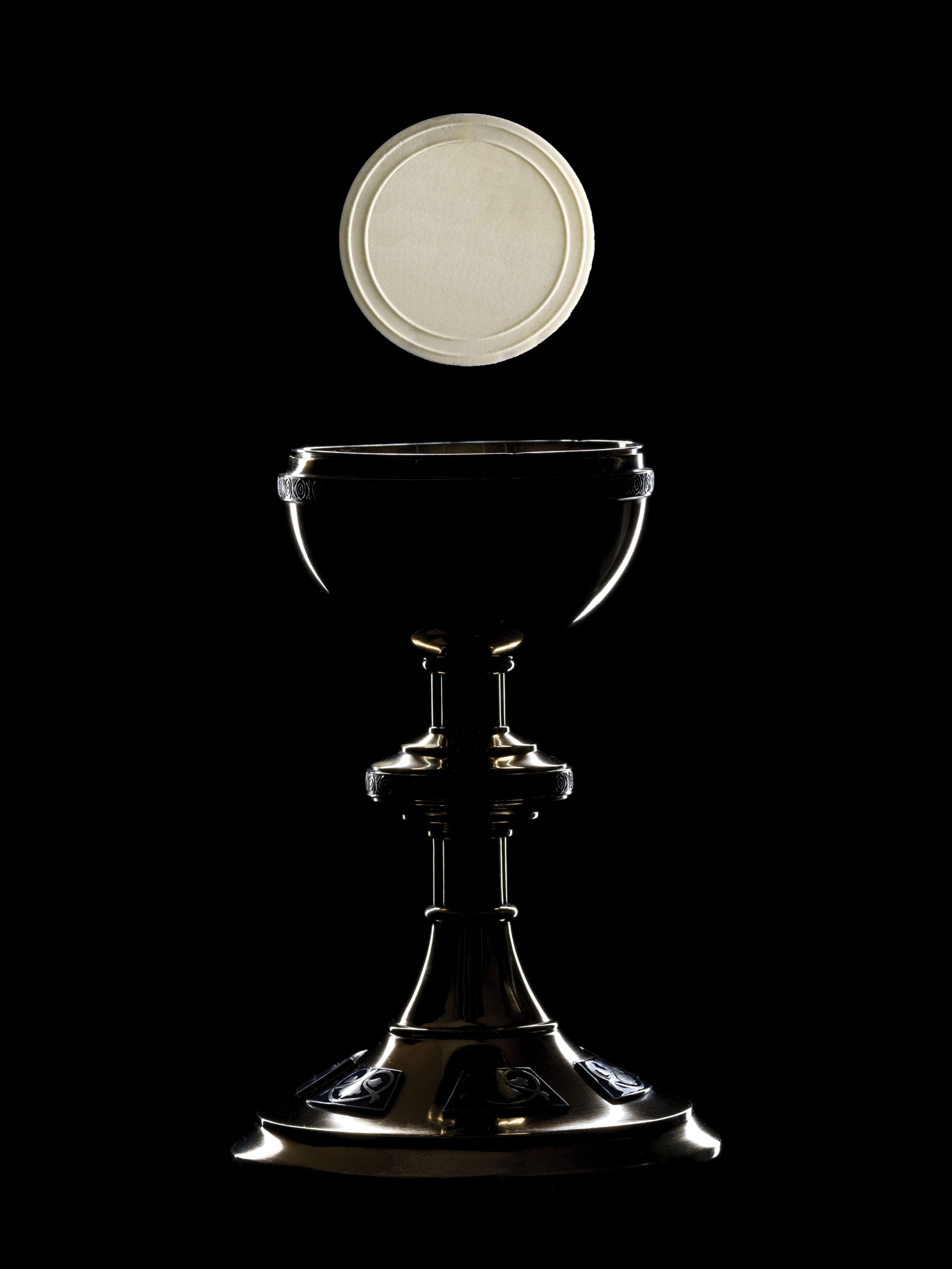 In our diocese, here are just some of the things the Eucharistic Revival will entail over the next several years (mark your calendars for some of these!):
- Corpus Christi Eucharistic processions on June 19 at your parish or a parish near you;
- Catholic Times’ Build a Church Lego Contest happening now for students (www.dio.org/buildachurch);
- Launching Eucharistic adoration or expanding Eucharistic adoration at parishes;
- Parishes hosting the traveling Eucharistic Miracles of the World display;
- Video series on the Eucharist and national speakers coming to parishes;
- A diocesan Year of the Eucharist starting Dec. 8. This Year of the Eucharist coincides with the celebration of the 100th year of the transfer of our diocese from Alton to Springfield. A special Mass at Ss. Peter and Paul in Alton kicks off the diocesan Year of the Eucharist Dec. 8 with the concluding Mass at the Cathedral of the Immaculate Conception Dec. 8, 2023;
- A diocesan Eucharistic Congress at the BOS Center in Springfield on Oct. 28, 2023. National speakers, Bishop Robert Barron and Scott Hahn, will give talks in the arena. Other events focusing on the Eucharist and other topics will also take place at the BOS Center before a special Mass in the arena where nearly 8,000 Catholics from our diocese will attend;
- The first National Eucharistic Congress in the United States in almost 50 years will take place July 17-21, 2024 in Indianapolis.
Archbishop Cordileone’s Statement In Regard To Speaker Pelosi & Bishop Paprocki's Statement of Support
May 20, 2022
I fully support and earnestly commend Archbishop Cordileone’s action in regard to Speaker Pelosi. All politicians who promote abortion should not receive holy Communion until they have repented, repaired scandal, and been reconciled to Christ and the Church.
Full Letter to Public
New Catholic adventure apostolate to help families grow in their family bond and faith life

 By Andrew Hansen
EDITOR
Families looking for a unique Catholic adventure that combines scripture, prayer, and climbing in nature’s beauty now have an opportunity to do so in Central Illinois. Mercy Tree Adventures, which launched this spring, is taking families to new heights literally and spiritually.
“Adventure isn’t a part of life that we grow out of or benefit by leaving behind us,” said Carlos Tejeda, who co-founded Mercy Tree Adventures with his wife, Elena, and who are parishioners at the Cathedral of the Immaculate Conception in Springfield. “When properly understood, adventure is actually part of God’s plan for living a fully human life – and it’s an ingredient in how one matures as a disciple of Jesus Christ. Events like these are important because they help strike the right balance of calculated risk for the sake of growth while in real, not fabricated, relationship. When was the last time your family smiled, laughed, worked, prayed, and talked together without screens, comfort, and consumption being prominent? Come check out what gets sparked in your heart, mind, and soul when you’re trusting your family, surrounded by the majesty of creation and vulnerable before God!”
Mercy Tree Adventures specializes in technical tree climbing, using ropes and harnesses, like arborists do, but the kinds of adventures don’t stop at tree climbing. They also facilitate rappelling in caves, go-kart racing, radio-controlled car challenge courses, jet-skiing, kayaking, hiking, relay races, geocaching, digging pits, marksmanship, paintball, bonfires, explosives, directional tree felling, and log splitting. Tejeda says the point of these activities is to make it easy for a man to extend or receive an invitation from a friend or acquaintance that he respects, and they strive to host unique events that make men grin on their face and in their heart.
 “This opened heart stance is fertile soil for conversion to take root in a man because we foster encounters in God’s creation and read Scripture,” Tejada said. “We call it ‘Lived Lectio.’ Lectio Divina is Latin for ‘divine reading,’ the practice of prayerful meditation on sacred Scripture. Lived lectio is about encounters with God's Word so that participants become fully alive in Christ for their own sake, their spouse, children, the Church, and the world.”
In 2019, the vision for Mercy Tree Adventures started for Tejeda, who is trained and certified to help people climb trees, has a degree in forest science, and has worked as a climbing arborist for 16 years. One verse from Scripture in particular kept popping in his mind, "Turn the hearts of fathers to their children" (Luke 1:17). The verse became a prominent part of his prayer life. Tejeda says that Mercy Tree Adventures “then became a doubling down on this promise of the Lord - namely, that everything rides on the degree to which fathers turn their hearts to their children.”
“We started Mercy Tree Adventures in order to specialize in setting men up for success in their prayer life, married life, and family life,” Tejeda said. “We are eager to become a favorite tool in the evangelical arsenals of parishes, schools, retreat centers, fraternal organizations, seminaries, campus ministries, and homeschool coops.”
The Tejedas will drive to communities so their events are always local and accessible. They offer half-day, full-day, and weekend long events. To book an adventure, go to mercytreeadventures.org.
Two to be ordained to diocesan priesthood May 28

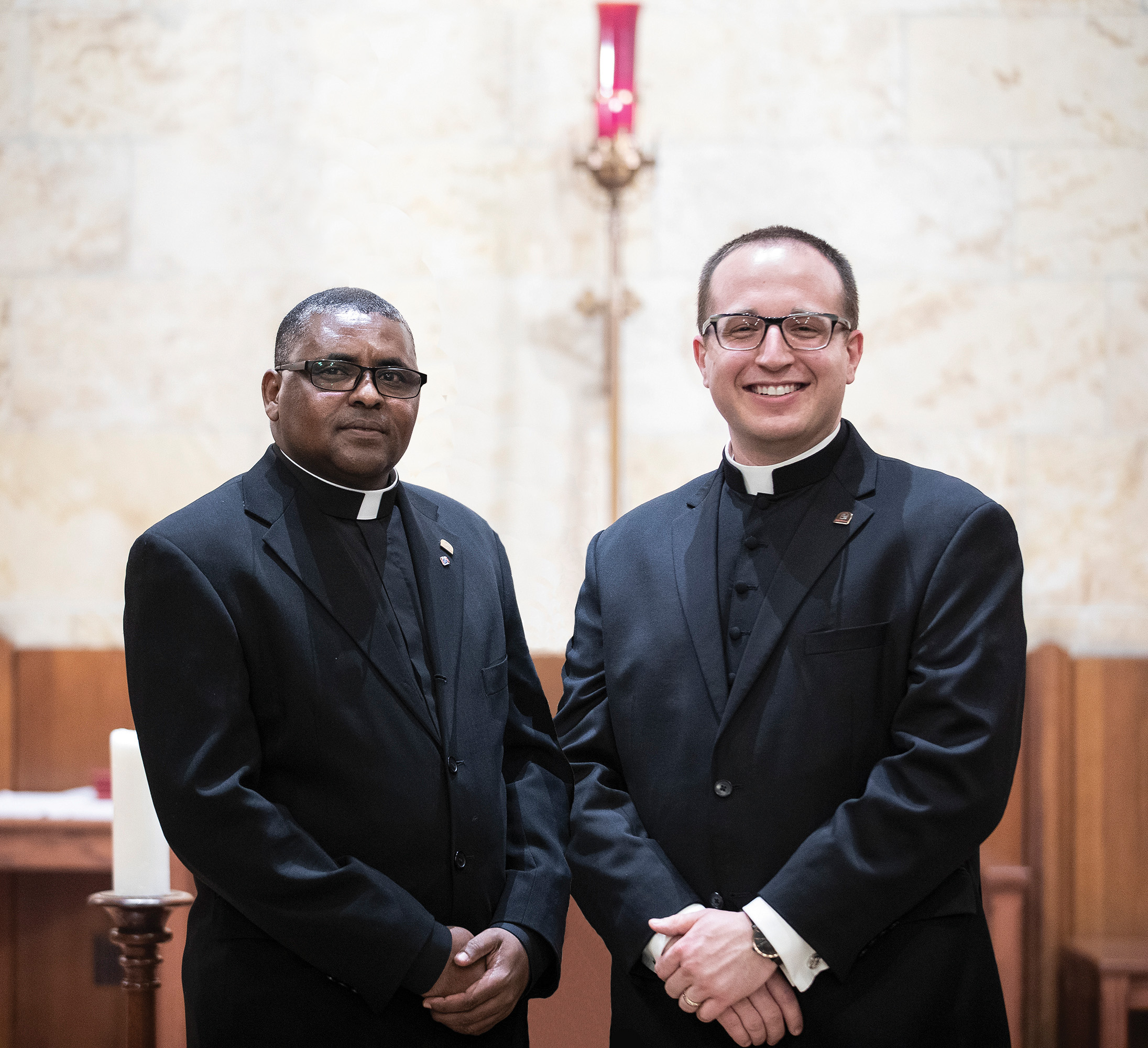 By DIANE SCHLINDWEIN
Managing Editor
On Saturday, May 28, Bishop Thomas John Paprocki will ordain two men as priests for the Diocese of Springfield in Illinois during a Mass at the Cathedral of the Immaculate Conception. The ordination will be attended by their individual families and friends as well as the rector, vice rector, and associate director of spiritual formation from Saint Meinrad Seminary and School of Theology, where both men attended seminary.
Earlier in May, soon to be Fathers Paul Lesupati and Father Zachary D. Samples took time to share thoughts on their ordination and vocation to the priesthood. (Editor's note: So as to avoid confusion, we are listing both men as "Father," even though they will become priests on May 28.)
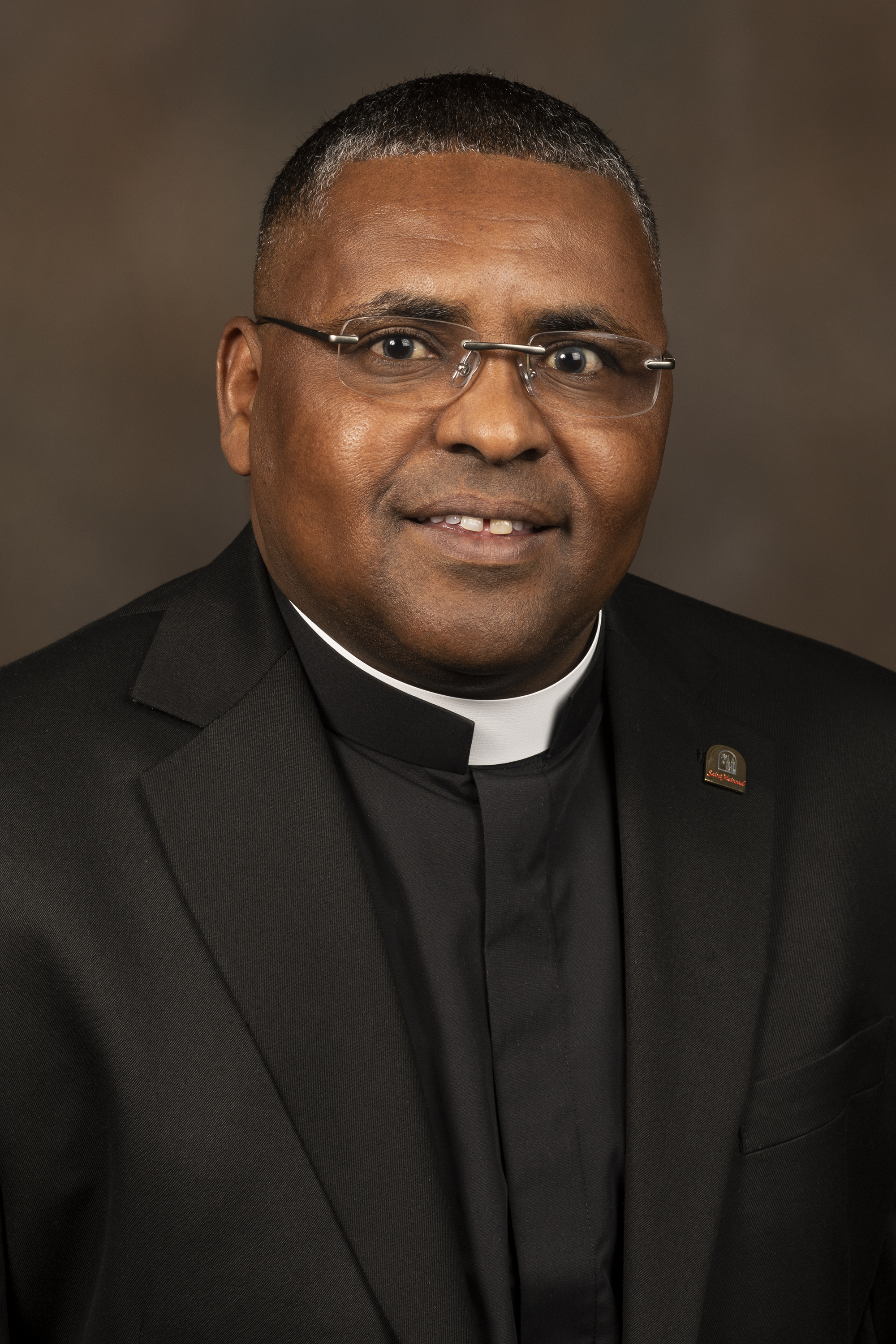 Father Paul Lesupati
A Kenyan by nationality who came to America at the invitation of Father Jeffrey Grant, Father Lesupati now calls Father Grant’s parish, Blessed Sacrament in Springfield, his home.
Because of COVID restrictions, Father Lesupati’s immediate family will not able to travel to his ordination, but some Kenyans from his home diocese who live in Wisconsin will be able to come to Springfield, along with some other Kenyans from North Carolina, Virginia, and St. Louis.
Father Lesupati, who will celebrate his 44th birthday in June, will choose Father Grant to vest him at his ordination. “He was a great influence in my vocation as a priest,” Father Lesupati said. “He is my mentor. He has influenced me in many ways — with his prayer life, compassion, kindness, and zeal for pastoral care of the soul. His parishioners always come first. He is a role model priest for me. He is always at the service of the people of God.”
The parishioners at Blessed Sacrament are also dear to Father Lesupati, and he has felt welcomed by them. “I appreciate the people of God who through their prayers and support have helped me reach the altar of God. I have learned a lot from Blessed Sacrament; the parishioners have their own unique way to give witness to Christ. I welcome their hospitality.” He has particularly been impressed by one parishioner who always greets as many people as he can before Mass, during the Sign of Peace, and outside the church. “George is a witness of this great hospitality I have seen in Blessed Sacrament,” he said.
“I am also so grateful for Bishop Thomas John Paprocki, for ordaining me and for his fatherly care he has shown by accepting me as a diocesan priest. I appreciate the many priests who have supported me in my summer assignments and those who have encouraged me to focus on my vocation. Many thanks go to Father Brian Alford, Father Jeff Grant, Father John Titus, and Father Dean Probst. I want to thank all the people of God for your support and prayers. God bless you and know that you are in my prayers.”
The newly-ordained Father Lesupati will celebrate his first Mass of Thanksgiving at Blessed Sacrament on May 29. In June, he will be traveling to Kenya to celebrate a Mass of Thanksgiving with his family members and parishioners of St. George Parish in Laisamis. Father Grant and Father Probst will accompany him. When Father Lesupati returns to Springfield, he will be parochial vicar at Cathedral of the Immaculate Conception.
“I am excited to work at the Cathedral as parochial vicar. It is a new experience for me,” he said. “Cathedral is the womb of the diocese. I trust in God’s providence to always guide me to shepherd his flock. I am looking forward to being a shepherd among the flock the Lord has entrusted to me. I am excited to serve the people of God, accompany, and advocate for them.”
 Father Zach Samples
More than anything right now, Mt. Zion native Father Samples, who is 30 years old, feels overwhelming gratitude at his ordination to the priesthood. Primarily, he says he is thankful for his parents, David and the late Lori Samples. “Both my father and my mother have loved and supported me in countless ways. They instilled strong values, morals, and faith into me at a very young age, and have guided me along the path of my life every step of the way,” he said. “My late mother was especially instrumental in helping to form me in the faith. My father has proven to be a steadfast supporter of me during these years of seminary formation. From the bottom of my heart, I am grateful to them, and to the rest of my family, more than I can adequately put into words.”
Father Samples is thankful for Bishop Thomas John Paprocki, Msgr. David Hoefler, Father Brian Alford, Father Chris House, and other diocesan leaders “for the countless ways they have supported me over these years of seminary formation.” “They have opened countless doors, have been good sounding boards, and have become mentors that I know I can count on moving forward.”
He is also most appreciative of the people in the many parishes he’s been involved with. “Their prayers, words of encouragement, and support have really sustained me during the highs and lows of these last six years. I could not have done it without them.
“Finally, I have to thank Saint Meinrad Seminary and School of Theology, especially our rector, Father Denis Robinson, OSB. Father Denis and the entire faculty and staff that comprise Saint Meinrad provide an invaluable service to the Church universal, and to our local Church. The formation they provide is simply exceptional and has prepared my brother seminarians and I for a life of priestly service. It is not an understatement to say that my years at Saint Meinrad changed the directory of my life by helping me to come to a better understanding of who the Lord has called me to be … leading me to fall deeper in love with Jesus Christ, His people, and His Church.”
Father Sample’s father, sister Meghan Roberts and her husband Tyler Roberts, his grandmother Lois DiMarzio, aunts, uncles, friends, priest mentors, men, and women religious, and friends from various parishes he’s been involved with, were all invited to the ordination.
Father Samples will choose Father John Titus, pastor of Immaculate Conception Parish in Mattoon and St. Columcille Parish in Sullivan, and dean of the Mattoon Deanery, to vest him at his ordination. “Father John was chaplain of the Newman Catholic Center at Eastern Illinois University during my time there and was the first person to really help me see that the priesthood was a very real possibility in my life. He helped me to stop and ask what it is that God might be asking of me and calling me to. It’s not only about what ‘we’ want, it also about what God wants for us. Once I started asking that question, it became very clear that He was calling me to priesthood. Father John helped to reveal that to me, and I am grateful for that beyond measure.”
Father Samples will celebrate his first Mass of Thanksgiving on May 29 at St. Patrick Church in Decatur. He will spend the month of June celebrating Masses of Thanksgiving at various places around the diocese and traveling to the ordinations of his classmates from Saint Meinrad. He will take a short vacation with a few of his seminary friends before beginning his first assignments as parochial vicar at St. Peter Parish in Quincy and as associate chaplain of Quincy Notre Dame High School.
Editor’s note: See the June 12 issue of Catholic Times for more coverage of the ordination of these two new priests.
Come experience the power of God with a Night of Healing at the Cathedral June 4

By FATHER MICHAEL TRUMMER
Special to Catholic Times
Are you need of healing, any kind of healing? All are welcome to attend The Night of Healing at the Cathedral of the Immaculate Conception in Springfield on Saturday, June 4.
A Healing Prayer Workshop kicks off the day from 9 a.m. to noon in the Cathedral atrium that is open to anyone. Participants will learn about why and how to pray for healing. The Night of Healing prayer service begins at 6:30 p.m. All are invited to be prayed with for healing. People can stay as long as they wish that night.
Why a Night of Healing?
As Christians, we often offer prayers for one another at a distance, which is good. However, there is a real power when we gather together in person to prayer for one another. We often avoid praying with one another in person because we are less familiar with it, and sometimes we have a hard time being vulnerable. However, when we have the courage to be vulnerable, prayer becomes more powerful and we experience the love of God in a way that doesn't happen when we pray for one another at a distance. When we come together to pray at a healing service, there is a higher level of expectant faith in God's power. Prayer for healing is abundantly present in the life of Jesus and his disciples. The early Church fathers, such as St. Justin Martyr, St. Irenaeus, and St. Augustine, talk about the healing miracles present at their time. St. Francis Xavier sent newly catechized children in small villages to share the Gospel and perform healing miracles. St. Catherine of Siena, a laywoman, raised the dead. Healing prayer is part of our tradition but not everyone is aware of this.
Who Is It for?
Really, it is for anyone who wants to come. Primarily, we focus on praying for physical healing, although people often experience emotional healing. It is intended for an individual in need of prayer to actually be there, although one can stand in proxy for a loved one that needs prayers. Even if one is not in need of prayer, it is still a beautiful service to go to. The healing service is at a Catholic Church, but anyone is welcome, not just Catholics. The Night of Healing is not a healing Mass, but a healing prayer service.
What Happens at a Night of Healing?
The Night of Healing begins with a time of singing and praising God. Praise increases the power of our prayer and reminds us of how good God is, which helps us believe in God's healing power. After praise, there is a reflection/homily. Then, we address common questions about healing prayer and obstacles to healing. The prayer team will then share conditions that we believe God is going to heal during the healing service. Before prayer teams, we pray for everyone as a larger group, because it is our firm belief that God works through every believer because of the Holy Spirit, not just special or talented prayer leaders. After praying as a group, prayer teams will spread out throughout the church to offer prayers for individuals. The prayer teams have experience in praying with people for healing. If you have not been prayed over by a prayer team before, it is a really powerful way to experience God's presence and love. There is no official end time. The prayer leaders will stay as it takes to pray with everyone.
Hey, Father! Can our gravesite be hallowed by a priest?

While visiting the gravesites of several deceased loved ones recently, my wife came up with a question involving ours. I purchased a gravesite near my parent’s site, in a non-Catholic cemetery, in the 1980s, before I married and became Catholic. Can our gravesite be hallowed by a priest?
- Charles in Granite City
Yes, it is possible for your grave in a non-Catholic cemetery to be blessed either by a priest or by a deacon. This would typically occur when the mortal remains of either you or your wife are placed in the grave, whichever one of should fall asleep in the Lord first. The Order for Christian Funerals provides for the blessing of a grave in the Rite of Committal (cf. no. 218A).
Indeed, not only may your grave be blessed, but it should be blessed. The Church blesses graves because, as we pray over unblessed graves, when the Lord Jesus spent three days in his tomb, He “hallowed the graves of all who believe in you and so made the grave a sign of hope that promises resurrection even as it claims our mortal bodies.
Father Daren Zehnle is pastor at St. Augustine Parish in Ashland and is the director for the Office of Divine Worship and the Catechumenate for the Diocese of Springfield in Illinois.
Dealing with death. Springfield author's new book explains the right and wrong ways

Springfield Catholic grief therapist authors new book to help people grieve healthier and better comfort those who lost loved ones
By ANDREW HANSEN
Editor
Losing a loved one is painful. How we handle that loss depends on each person. But are we grieving in a healthy way? What should we do if the pain is still just as apparent today than when the loss occurred? And what about comforting others who have lost a loved one — what should we be saying and not saying?
Because it can be so challenging to handle grief well, whether it is our own grief or someone else going through a loss, Dr. Dee Stern of Springfield published a book in January to help. The book — Comforting the bereaved through listening and positive responding, What are the bereaved trying to tell us? — tackles a variety of topics from how we can better deal with a loss of a loved one to better understanding what someone who has lost a loved one is feeling.
Dr. Stern’s credentials on this topic are comprehensive. She has a doctorate in psychology, has a master’s degree in psychology and pastoral studies, is a licensed clinical professional counselor, a certified grief therapist, and a certified hospital chaplain. She is also a part-time parish/bereavement minister at the Church of the Little Flower in Springfield where she is a parishioner, and she also a chaplain at HSHS St. John’s Hospital where she facilitates three grief support groups.
Catholic Times Editor Andrew Hansen interviewed Stern to get advice for all of us.
As a society, we don’t seem to be handling loss too well. What are we doing wrong?
A century ago, people were born, lived, and died in the same communities. Everyone in the community knew everyone. Neighbors watched children grow up, get married and have their own children. Then as they grew older, they died and were buried. When someone in the neighborhood died, everyone knew it, and it affected the whole community. Today, we don’t seem to have that same connection. When someone dies, we may not know them or perhaps even make an effort to contact the family of the deceased. That support that used to be there, today is just not present.
Today, people are more involved in a “me and I” attitude and spend more time texting, emailing, and calling each other rather than talking face to face with the bereaved to offer their sympathies. Why does this happen? Could it be people don’t know what to say or are afraid the bereaved will talk about their loved one and begin to cry and others will not know what to do or say to them? We are not in a society today where a lot of people lend a hand to their neighbor, but rather care only about themselves and not the consequences that occur because of their decisions.
What advice do you have for people so when a loss of some kind comes, they are better prepared to grieve in a healthier way?
If you are talking about a death, or any kind of a loss, it is good to have a plan. In fact, have plan A, B, and maybe C. If A doesn’t work, try B or C. For a death, have a good insurance plan, a will, and power of attorney for health care and finances. Have a funeral home in mind, a prearrangement for a funeral, cremation, or grave side burial. If you have a lot of things already taken care of before a death, it is much easier on the family left behind to deal with all these decisions.
As for as grieving, everyone grieves differently and what works for one person doesn’t mean it will work for another person. Sometimes, it helps to fall back on what helped in the past to get you through a stressful situation. If you have something that has helped you in the past, it could very well help you again when a death occurs. No one can predict when a death will occur, even if the doctor says the person has only hours to live, they could live for weeks, months, and even years. It is also important to have someone to talk to about what you are experiencing — not to get advice, but simply to support and listen to you.
There is the saying “time heals all wounds.” Is there truth to that?
The saying you are referring to, “time heals all wounds,” is not really true. It is not time that heals wounds, it is what you do with your time. If you do nothing, your healing will take much longer. Think of a cut. If you don’t take care of it, it could get infected, and you could have multiple problems. However, if you do take care of the cut, healing takes place. Grief is like that. If you don’t deal with it, there can be many complications. If you talk with someone who will listen and not give you advice, you will be helped as you grieve.
What if someone feels like they just can’t get over a loss despite it happening a long time ago. Does that mean they are grieving wrong?
First of all, you never get “get over a death,” rather you get through it. Remember, everyone grieves differently and what works for one person doesn’t necessarily work for someone else. It does not mean that someone is grieving wrong if they are struggling with grief even if has been a long time ago.
Going back to the last question, what has the person been doing to get through the loss of their loved one. If they have not been doing anything and thought they could grieve without help, they may need to talk with someone or get some help from a grief therapist or even attend a grief group. However, there is no time limit on grief. Grief takes as long as it takes. For some people, grief takes several years, for others, a lifetime. Remember, it is in the telling of the story that the healing takes place. In other words, when you talk about your loved one, healing takes place, but when you keep all that inside, your healing takes longer and could have complications along the way.
Part of your book addresses better understanding what someone who has lost a loved one is feeling. What should one say and not say to a person who has lost a loved one to comfort them?
There are so many things not too say to the bereaved that usually causes them pain and a great deal of hurt and that they may never forget. It is interesting that most people remember the negative things people say to them and not always the positive things, because the negative things are always so hurtful.
Some examples of what not to say, are these real comments that were made to the bereaved:
- “Don’t you feel better to know that God needed another flower in His garden, and He chose your child?”
- “You are young enough to have another baby anyway.” (This person suffered a miscarriage.)
- “Aren’t you glad your baby died, because you don’t know what it would have grown up to be like.”
- “You are young enough that you can find another fish in the ocean.”
- “Now that Bob died, you can have some free time and not have to go over to the nursing home, so we can go shopping again.”
- “It was God’s will that you daughter killed herself.”
- “He was always in pain, and was going to die anyway, but now he is in a better place.”
- “It was only an animal; you can always get another one.”
- “You have to get over it, and stop being so sad all the time.”
Things to say to the bereaved:
- “I was so sorry to hear that you husband died. He was a wonderful man.”
- “If you ever need to talk, I am a good listener.”
- “You and your family are in my thoughts and prayers.”
- “I can’t begin to imagine how you must feel since your wife died.”
- “I will always remember her smile. She could light up any room.”
- “Your son was a wonderful guy, and I will never forget him.”
- “Your husband was sure a hard worker and everyone really liked him at work.”
- “Your mother was such a wonderful person and always so welcoming to everyone she met.”
The bereaved want to hear positive things and stories and memories about their loved one who died, not anything negative.
If a friend or family member is going through a loss, what actions should we do and what should we not do to help that person grieve better?
A good thing to do to help the bereaved is to listen to them and allow them to tell their story over and over again. Another thing is to mention their loved one in a conversation or relate a memory or story to them of their loved one. This is very important and helps them realize their loved one has not been forgotten.
Something that you should not do is to give unsolicited advice to them. Also, do not rush them through their grief and don’t push them to do something they are not ready to do such as go out to eat, go to a party, go to a grief group, or get help, etc.
Never ask them how they are because many times they really don’t know themselves. Rather, ask them how their week is going.
How important are rituals to help people grieve better?
Rituals are important because they bring God, family, and the deceased together. Special prayers can be said, and people can offer their sympathies to the family in a quiet and sacred environment. It is a time to remember and reflect on the life of the deceased and a chance to say goodbye to a friend, family member, or colleague and tell the bereaved family stories and their memories of the deceased that they might not know about.
Sadly, many Catholics are choosing to not have a funeral Mass. From the perspective of a healthier grieving process, how important is that funeral Mass?
I believe a funeral Mass is really important, especially if the deceased was someone who went to church and was devoted to God and the Church. If the body is not present, it is called a Memorial Mass, which is also important, especially if the deceased or family has requested it. (These Masses) are a time of prayer, remembering, and reflecting. Before or after the Mass and the burial, it is a good time to talk with family and friends or colleagues of the deceased and tell them stories or memories about the deceased.
For some, there might be the inclination to “show strength” by not crying or keeping things bottled up after suffering a loss. Can that be harmful?
Not everyone cries when there is a death, yet there are some people who cannot stop crying, while others cannot seem to cry. That is OK because that is where you are at that particular time. It does not mean something is wrong with you. However, sometimes when you least expect it, tears will come. It could happen at any time, now or months later.
When someone is grieving, there seems to always be someone who thinks the bereaved should be strong. That is not true. Your loved one has died and now you are on your own. When a death occurs, your whole body can be depleted —physically, mentally, and socially — and for some, spiritually. Sometimes, people tell the bereaved to be strong for their children and not cry in front of them. That is so wrong! You cannot be strong for others when you are grieving. You must first take care of yourself, then others. Remember in an airplane when the mask is lowered for oxygen, you are to put the mask on your face first, then your child. If you are not OK, you cannot help others. It is OK to cry in front of your family because it gives them permission to cry with you instead of keeping that inside and being afraid to cry in front of you.
To those who are bereaved, never apologize for how you feel. It is not you that is concerned about strength, it is everyone around you. They simply do not know what to say or do with you when you are sad. So, down the road when you are able, take some of that control back and tell those around you what you need and want from them. It may be just to listen to you or for a hug, or a shoulder to cry on. Only you know what you need. Do not allow others to tell you how you should feel or what you should do, because it is up to you.
To purchase Dr. Stern’s book, Comforting the bereaved through listening and positive responding, what are the bereaved trying to tell us?, go to archwaypublishing.com.
Teacher at St. Mary Catholic School in Brussels wins 2022 St. Elizabeth Ann Seton Award

 By ANDREW HANSEN
Editor
She received a standing ovation. Her family, including her husband, siblings, and children made sure they were there to see it. Every student gave her a hug. That was the scene at St. Mary Catholic School in Brussels after Maureen Tepen, the third/fourth grade teacher and fifth/sixth grade language arts teacher in the small, rural school, was announced as the winner of the 2022 St. Elizabeth Ann Seton Award in the Diocese of Springfield in Illinois during a surprise celebration and award presentation at the school May 4. Bishop Thomas John Paprocki presented Tepen with the award.
“God is so good, God is so good,” Tepen said, as she fought back tears from the podium during the event. “I decided to be a teacher when I was in first grade, and I had this little seed in my heart that I wanted to teach kids, and to have a spot they knew they could come to be encouraged and grow.”
Then, looking at all the students in the room, Tepen said, “I just love every single one of you students. You have done so much for me. You helped me to grow, and every day I get to see growth in you. You say that I help you become the best version of yourself, but it’s you guys that help me be the best version of myself. God has given each of you so many talents. I want you to find that talent and live it in your life. Keep God first and foremost in your heart and mind.”
 The St. Elizabeth Ann Seton Award recognizes one Catholic teacher who is making a big difference in the classroom, who authentically lives out what it means to be Catholic and instills the Catholic faith into her students, and who embodies St. Elizabeth Ann Seton, who founded Catholic schools in the United States.
Tepen has taught for 27 years in Catholic education, including 21 years at St. Mary in Brussels, five at St. Francis Xavier in Jerseyville, and one at St. John in Carrollton.
The Office for Catholic Schools and Office for Communications for the Diocese of Springfield in Illinois, organizers of the award, received a record number of nominations — 72 teachers in all — from principals, teachers, parents, priests, previous students, and current students this year. A team consisting of former educators in the diocese poured through the nominations and read all the stories of impact about each teacher, narrowing the list to five finalists. In the end, Tepen rose to the top.
 A common theme throughout the nominations for Tepen, who belongs to St. Joseph Church in Meppen, part of Blessed Trinity Parish, is she is “Christ-like” and inspires her students to become the “best versions” of themselves.
“Mrs. Tepen is a loving person, and one time when I did not know how to do my work, and I was getting mad, she came over and said everything would be OK,” said Riley Pohlman, a current student of Tepen. “She spent a long time helping me, and I finally got it. She was so patient and calm the whole time. I was happy that she took time to help me. At church, she reads, sings, and she goes to church every single weekend, and she does it all for Christ.”
“Mrs. Tepen treats everyone like her own family and is someone you should go to if you’re having a rough day,” said Dayton Brundies, a previous student of Tepen. “She is very selfless and loves donating to the less fortunate. Mrs. Tepen is truly a saint and is dedicated to her religion. She has inspired me to take my religion more seriously.”
 “Her knowledge of the Bible and the Catholic faith is infinite,” said Rachel Wilschetz-Hartman, a colleague of Tepen. “Her dedication to God and her faith is exemplary. Her love for God is witnessed at Mass, in school, and with her family. She volunteers for all the extra activities, is in charge of our missions collections, and she handmakes collection boxes and successfully encourages students to donate money for the less fortunate. I am appreciative of her patience, uplifting advice, and support throughout the years. She has influenced me to examine my relationship with God and deepen my faith.”
“The genuine love Mrs. Tepen has for being a teacher shines through in the heart-felt projects she incorporates into her lessons, like the Christmas angels, self-portraits, and Mother’s Day yarn flowers,” said Becky Lorts, principal at St. Mary School. “She infuses faith-filled activities throughout all subjects she teaches. Her classroom is warm and nurturing. She inspires others to grow in their faith and spirituality. She is an excellent role model to others, not only in words but actions. She is a witness through her faithful participation in the sacraments. As her administrator, I look to her when I need guidance and even reassurance if I’m having a difficult day, because she is the epitome of kindness. St. Mary School is very blessed to have her as a veteran teacher, and I am so blessed to call her my friend.”
There are 43 Catholic schools in the diocese (36 elementary, seven high schools). Stay tuned in early 2023 as Catholic Times will announce how to submit a teacher for the 2023 St. Elizabeth Ann Seton Award.
Hey, Father! What is the origin of Purgatory

What is the origin of the concept of purgatory? Some Catholics and Protestants insist that purgatory is absolutely never mentioned in the Bible or by Jesus Himself.
Nancy in Springfield
Witnessing the majestic revelation of the new and heavenly Jerusalem, the visionary John foresees the nations of the earth passing through its gates while explicitly noting, “nothing unclean will ever enter it, nor will anyone who does abominable or deceitful things … ” (Revelation 21:27).
No sin will be allowed into the presence of all-holy God. Yet we sin, and so will need to be purified in order to pass through the gates of Heaven. The Catechism of the Catholic Church confirms this: “All who die in God’s grace and friendship, but still imperfectly purified, are indeed assured of their eternal salvation; but after death, they undergo purification, so as to achieve the holiness necessary to enter the joy of heaven. The Church gives the name purgatory to this final purification of the elect, which is entirely different from the punishment of the damned” (CCC 1030–1).
While the term “purgatory” is not mentioned in Sacred Scripture, the concept of a post-death purification of sin and its effects can be found in both the Old and New Testaments. The Book of 2 Maccabees, 12:41–45, for example, tells of deceased Jewish soldiers found to be wearing amulets of a pagan god, and thereby breaking the First Commandment. The surviving soldiers first pray for their dead comrades and then take up a collection to send to the Temple in Jerusalem to pay for sacrifices to expiate the sins of the dead.
Interestingly, Second Maccabees was written about 100 years before Christ, and so the idea of purification after death would have been known and believed in by many Jews during Jesus’ lifetime. While our Lord never mentions this notion explicitly, neither does He deny or correct it.
The Gospel of Matthew, in fact, may be cited to show Jesus supported the teaching of purification of sin after death. In 12:32 He says, “And whoever says a word against the Son of man will be forgiven; but whoever speaks against the Holy Spirit will not be forgiven, either in this age or in the age to come.” Setting aside the question of the unforgivable sin, Jesus discloses that some sins may be forgiven in “the age to come.” Considering the way Jesus uses this term in other places (Mark 10:30, 13:39-40; Luke 18:20, 20:35; Matthew 28:20), He is certainly referring to a time of life after death and so provides a divine foundation for the Church’s current teaching on purgatory.
The concept of purgatory originates in our need to be absolutely free from sin to enter into Heaven. Yet, people do die imperfectly purified, as witnessed to in the Scriptures. It is necessary, then, for God to provide a way of purgation, or purgatory, for those souls to enter into His presence. Such is found explicitly in the Old Testament and implicitly in the teachings of Jesus Himself. So, make sure to pray for the souls in purgatory so that they may more quickly gain admittance to Heaven.
Father Seth Brown is pastor of Mother of Dolors Parish in Vandalia and St. Joseph Parish in Ramsey. He is also chaplain of Our Sorrowful Mother’s Ministry, chaplain of the Vandalia Correctional Center, and research theologian for the Diocesan Curia.
New priests coming to parishes across diocese.
Effective July 1, 2022
(unless noted otherwise)
Pastor Emeritus
Reverend John P. Beveridge is appointed Pastor Emeritus of Saints Peter and Paul Parish, Collinsville, Illinois, from Pastor of Saints Peter and Paul Parish, Collinsville, Illinois.
Reverend Monsignor David S. Lantz is appointed Pastor Emeritus of Christ the King Parish, Springfield, Illinois, from Pastor of Saint Mary Parish, Taylorville, Illinois; Saint Rita Parish, Kincaid, Illinois; and Holy Trinity Parish, Stonington, Illinois; from Chaplain, Taylorville Correctional Center, Taylorville, Illinois; and from Chaplain, Springfield Chapter of the Catholic Physicians Guild/Catholic Medical Association.
Pastor
Reverend Albert F. Allen is appointed Pastor of Saint Mary Help of Christians Parish, Effingham (Green Creek), Illinois, while retaining his appointment as Pastor of Annunciation Parish, Shumway, Illinois, from Pastor of Saint Anthony Parish, Effingham, Illinois, effective August 10, 2022.
Reverend David Beagles is appointed Pastor of Saint Elizabeth Parish, Robinson, Illinois, and Our Lady of Lourdes Parish, Oblong, Illinois, and Chaplain of the Robinson Correctional Center, Robinson, Illinois, from Parochial Vicar of Saint Francis Solanus Parish, Quincy, Illinois.
Reverend Michael B. Haag is appointed Pastor of Saints Peter and Paul Parish, Collinsville, Illinois, from Pastor of Saints Mary and Joseph Parish, Carlinville, Illinois; Saints Simon and Jude Parish, Gillespie, Illinois; and Saint Joseph Parish, Benld, Illinois; Parochial Administrator of Saint Louis Parish, Nokomis, Illinois, and from Chaplain of Blackburn College, Carlinville, Illinois; while retaining his duties as a Member of the Diocesan Finance Council.
Reverend Peter C. Harman is appointed Pastor of Saint Anthony Parish, Effingham, Illinois; Bishop’s Delegate for Health Care Professionals; and Chaplain, Springfield Chapter of the Catholic Physicians Guild/Catholic Medical Association; from Rector of the Pontifical North American College, Rome, Italy, effective August 10, 2022.
Reverend Piotr Kosk is appointed Pastor of Saint Mary Parish, Taylorville, Illinois; Saint Rita Parish, Kincaid, Illinois; and Holy Trinity Parish, Stonington, Illinois, and Chaplain, Taylorville Correctional Center, Taylorville, Illinois; from Parochial Vicar of Saint Paul Parish, Highland, Illinois.
Reverend Florent Emmanuel Kanga, S.A.C., with the assent of his religious superior, is appointed Pastor of Saint Mary Parish, Farmersville, Illinois; Saint Maurice Parish, Morrisonville, Illinois; and Saint Raymond Parish, Raymond, Illinois; from Parochial Vicar of Saint Louis Parish, Nokomis, Illinois; Saint Mary Parish, Farmersville, Illinois; Saint Maurice Parish, Morrisonville, Illinois; and Saint Raymond Parish, Raymond, Illinois.
Reverend Joseph Koyickal, S.A.C., with the assent of his religious superior, is appointed Pastor of Saints Mary and Joseph Parish, Carlinville, Illinois; Saints Simon and Jude Parish, Gillespie, Illinois; and Saint Joseph Parish, Benld, Illinois; and Chaplain of Blackburn College, Carlinville, Illinois; from Provincial Superior of the Society of the Catholic Apostolate (Pallottine Fathers and Brothers), and is granted the faculties of the Diocese, effective August 1, 2022, and continuing for the duration of his residence in this Diocese.
Reverend Michael Meinhart is appointed Pastor of Saint Louis Parish, Nokomis, Illinois, from Parochial Vicar of Saint Boniface Parish, Edwardsville, Illinois, and Associate Chaplain of Father McGivney Catholic High School, Glen Carbon, Illinois.
Reverend Paul C. Stein, a priest of the Archdiocese of Chicago, with the permission of his Archbishop, is appointed Pastor of Saint Alexius Parish, Beardstown, Illinois; Saint Fidelis Parish, Arenzville, Illinois; and Saint Luke Parish, Virginia, Illinois; from Pastor of Saint Frances of Rome Parish, Cicero, Illinois and is granted the faculties of the Diocese, effective July 1, 2022, and continuing for the duration of his residence in this Diocese.
Reverend Christopher Uhl, O.M.V., upon presentation by his religious superior, is appointed Pastor of Saint Mary (Immaculate Conception) Parish, Alton, Illinois, and is granted the faculties of the Diocese, effective July 1, 2022, and continuing for the duration of his residence in this diocese.
Parochial Administrator
Reverend Ervin Pio M. Caliente, a priest of the Diocese of Rockford, with the permission of his Bishop, is appointed Parochial Administrator of Saints Mary and Joseph Parish, Carlinville, Illinois; Saints Simon and Jude Parish, Gillespie, Illinois; and Saint Joseph Parish, Benld, Illinois, from July 1 to 31, 2022, from Parochial Administrator of Saint Alexius Parish, Beardstown, Illinois; Saint Fidelis Parish, Arenzville, Illinois; and Saint Luke Parish, Virginia, Illinois, to begin a period of discernment with the Norbertine Community in Silverado, California, August 1, 2022.
Parochial Vicar
Reverend Paul L. Lesupati, newly ordained, is appointed Parochial Vicar of the Cathedral of the Immaculate Conception, Springfield, Illinois.
Reverend Paweł Łuczak is appointed Parochial Vicar of Saint Thomas the Apostle Parish, Newton, Illinois, and Saint Mary of the Assumption Parish, Sainte Marie, Illinois, from Parochial Vicar of Saint Peter Parish, Quincy, Illinois.
Reverend Ramesh Babu Matta, a priest of the Diocese of Vijayawada, India, with the permission of his Bishop, is appointed Parochial Vicar of Saint Aloysius Parish, Springfield, Illinois, and Saint Francis Xavier Cabrini Parish, Springfield, Illinois, effective upon arrival in the United States with the required immigration visa and is granted the faculties of the Diocese at that time, continuing for the duration of his residence in this Diocese.
Reverend Wayne Stock is appointed Parochial Vicar of Our Lady of Lourdes Parish, Decatur, Illinois, and Saint Thomas Parish, Decatur, Illinois; and Chaplain, Saint Teresa High School, Decatur, Illinois; and Associate Chaplain, Millikin University, Decatur, Illinois; from Medical Leave of Absence and Pastor, Saint Alexius Parish, Beardstown, Illinois; Saint Fidelis Parish, Arenzville, Illinois; and Saint Luke Parish, Virginia, Illinois.
Reverend Christopher A. Trummer is appointed Parochial Vicar of Saint Agnes Parish, Springfield, Illinois; and Associate Delegate for Health Care Professionals; and Associate Chaplain, Springfield Chapter of the Catholic Physicians Guild/Catholic Medical Association; from Graduate Studies for the Licentiate in Sacred Theology (S.T.L.) in Moral Theology at the Pontifical University of the Holy Cross, Rome, Italy, and residence at the Pontifical North American College, Rome, Italy.
Reverend Michael Trummer is appointed Parochial Vicar of Saint Boniface Parish, Edwardsville, Illinois; and Associate Chaplain of Father McGivney Catholic High School, Glen Carbon, Illinois, from Parochial Vicar of Our Lady of Lourdes Parish, Decatur, Illinois, and Saint Thomas the Apostle Parish, Decatur, Illinois; Chaplain, Saint Teresa High School, Decatur, Illinois, and Associate Chaplain, Millikin University, Decatur, Illinois.
Reverend Zachary D. Samples, newly ordained, is appointed Parochial Vicar of Saint Peter Parish, Quincy, Illinois; and Associate Chaplain of Quincy-Notre Dame High School, Quincy, Illinois.
Reverend Patibandla Zechariah, from the Diocese of Guntur, India, with the permission of his Bishop, is appointed Parochial Vicar of Sacred Heart Parish, Effingham, Illinois, from Saint Mary Parish, Taylorville, Illinois; and Saint Rita Parish, Kincaid, Illinois; and Holy Trinity Parish, Stonington, Illinois.
Graduate Studies
Reverend Peter Chineke is appointed to Graduate Studies in Canon Law at the Catholic University of America, Washington, D.C., from Parochial Vicar of the Cathedral of the Immaculate Conception, Springfield, Illinois, and Co-Chaplain of Sacred Heart-Griffin High School, Springfield, Illinois.
Reverend Dominic Vahling is appointed to online Graduate Studies in Canon Law at Saint Paul’s University, Ottawa, Canada, and part-time teaching as a member of the Theology Faculty of Sacred Heart-Griffin High School, Springfield, Illinois, while retaining duties as Chaplain of Sacred Heart-Griffin High School, Springfield, Illinois, with residence at the Cathedral of the Immaculate Conception, Springfield, Illinois, from Parochial Vicar of the Cathedral of the Immaculate Conception, Springfield, Illinois.
Chaplain
Reverend Paul Kallal, O.M.V., with the assent of his religious superior, is appointed Chaplain of Marquette Catholic High School, Alton, Illinois, while retaining duties as Campus Minister of Marquette Catholic High School, Alton, Illinois, with continued residence at Saint Mary (Immaculate Conception) Parish, Alton, Illinois.
Senior Priest
Reverend Stephen J. Pohlman is appointed to Senior Priest status, from Leave of Absence.
Appointment Concluded
Reverend John C. Burnette concludes his appointment as Parochial Administrator of Saint Mary Parish, Farmersville, Illinois; and Saint Maurice Parish, Morrisonville, Illinois; and Saint Raymond Parish, Raymond, Illinois, while retaining his appointment as Pastor Emeritus of Saints James and Patrick Parish, Decatur, Illinois.
Reverend Sunder Ery concludes his appointment as Pastor of Saint Mary Help of Christians, Effingham (Green Creek), Illinois, while retaining his assignments as Pastor of Saint Michael the Archangel Parish, Sigel, Illinois; Saint Mary of the Assumption Parish, Neoga, Illinois; and Sacred Heart Parish, Lillyville, Illinois, effective August 10, 2022.
Reverend Christudasan Kurisadima, S.A.C., concludes his appointment as Parochial Administrator of Saint Louis Parish, Nokomis, Illinois; Saint Mary Parish, Farmersville, Illinois; Saint Maurice Parish, Morrisonville, Illinois; and Saint Raymond Parish, Raymond, Illinois; to return to the Society of the Catholic Apostolate (Pallottine Fathers and Brothers) in India.
Reverend Suresh Sambaturu concludes his appointment as Parochial Administrator of Saint Elizabeth Parish, Robinson, Illinois; Our Lady of Lourdes Parish, Oblong, Illinois, and Chaplain of the Robinson Correctional Center, Robinson, Illinois, to return to the Diocese of Cuddapah, India.
Reverend William F. Kessler concludes his appointment as Chaplain of Marquette Catholic High School, Alton, Illinois, while retaining duties as Pastor of Saint Alphonsus Parish, Brighton, Illinois, and Saint John the Evangelist Parish, Medora, Illinois.
Reverend Paul Nguyen, O.M.V., upon notification from his religious superior, concludes his appointment as Parochial Administrator of Saint Mary (Immaculate Conception) Parish, Alton, Illinois, for reassignment to serve as Pastor of Holy Ghost Parish with the Oblate Community in Denver, Colorado.
Consultant
Deacon William E. Kessler is appointed Consultant for Health Care Ministry, from Bishop’s Delegate for Health Care Professionals, while retaining his appointment for Diaconal Ministry at Saint Ambrose Parish, Godfrey, Illinois.