
Family tragedy plants seed of religious life

 Ursuline Sister shares her ‘adventure’ as the Church celebrates National Vocations Week Nov. 7-13
By ANDREW HANSEN
Editor
Aug. 26, 1959 is a date that will forever be in the mind of Sister Mary Ellen Backes, OSU.
“When Janet (her identical twin sister) and I were 14 years of age, a car accident took the lives of our parents and left Janet and myself with serious injuries,” Sister Mary Ellen recalls. “A tragic event such as this changes the course of one’s history. The feeling of helplessness, not being able to awake from a bad dream, ironically became a source of blessing. Amidst the tragedy, I came to know God’s nearness and presence in the human family, in the strangers who appeared to help mend our brokenness. I believe the sudden loss of my parents, the suffering of me and my twin, of my entire family, became the seed that nourished my faith.”
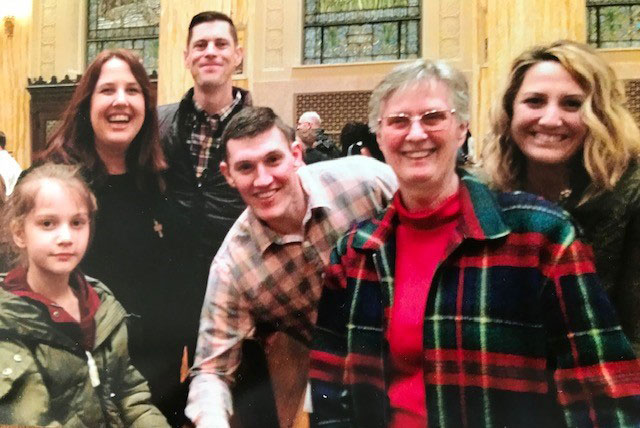 Fast forward to today, and that seed of faith has blossomed into a life-giving tree. Sister Mary Ellen has been ministering at St. Joseph Parish and previously the school before it closed for 27 years, but that is only half her life as a sister. She made her first profession as an Ursuline of Belleville in 1965. She has been an Ursuline Sister now for 60 years come 2023 (since 2005, she has been an Ursuline of Mt. St. Joseph Maple Mount, Kentucky, when the order merged).
“I thought religious life would provide a straight highway to Heaven with no conflicts or distractions,” Sister Mary Ellen said with a laugh. “Eventually I came to understand that it is God who does the choosing, that religious life is one of service, of carrying God’s presence into the lives of others. God chose me first and opened my life to learning what it is to follow in the footsteps of Jesus, to be a servant, to carry the light of God’s love, goodness, joy, and peace to others.”
Born in 1944 in North Dakota, Sister Mary Ellen says her parents and grandparents deeply influenced her faith life.
“They always attended church, never missed Mass, and lived their faith,” Sister Mary Ellen said. “They worked long and hard to cultivate crops of wheat, barley, mustard, and corn, and trusted in a higher power to produce the fruits of their labors. I remember well an often-repeated story that on Sunday mornings, at the exact time most ripe for harvesting the crop, the German pastor would remind them that Sunday ‘is the day of rest.’ Their prayer was unspoken as they walked into the crops to check the health of the wheat and to check to see if insects were present that might destroy the crops. They often looked into the North Dakota skyline for possible coming storms or damaging winds.”
 In high school Sister Mary Ellen met the Ursulines, saying that she found them to be welcoming, relational, fun, humorous, and joyful.
“They shared their humanity,” she said. “I found this to be much more appealing. They invited us into their lives and their stories.
Sister Mary Ellen ended up choosing the name “Ellen,” as that was her mother’s name. Over the decades, she has lived in several places in Illinois and for nearly the last 30 years, in Springfield. Saying that she wanted to minister to children and adults in parish life, she received a master’s degree in theology along her journey to today.
“In 1995, I was offered a pastoral associate and director of religious education position at St. Joseph in Springfield,” Sister Mary Ellen said. “I was interviewed for this position by Father Pat Render, CSV, and remember telling him during the interview that I’m a long-time employee and would remain in this parish for years to come. I have loved the parish since the very beginning.”
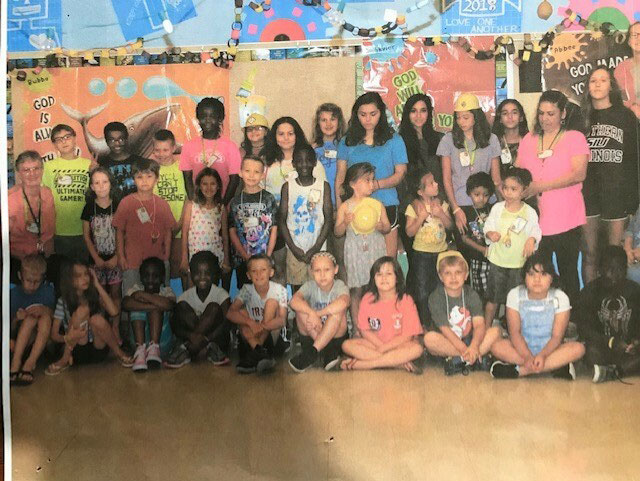
At St. Joseph, Sister Mary Ellen has touched the lives of so many people, from children to older adults. With her vast knowledge of the faith and joy-filled spirit, her ministry has been a true witness of what it means to be a disciple of Christ. She was responsible for sacramental preparation when the school existed and continued that into the PSR program. Currently, she facilitates faith formation from birth to death, directs the Catholic Faith Formation program for children and those in RCIA, facilitates Scripture classes, and is involved in some way in several other ministries at the parish.
 “Sister is incredibly inspirational to me,” said Amy Voils, executive director at Mercy Communities, which is next door to the parish. “We share a wall, so I see her almost on a daily basis. She is incredibly kind. Everything she does, I see her do it through Christ, and it’s very inspirational to me and my faith.
“When she does a program, she completes it, and she does it very good,” said Gary Schmidt, a parishioner at St. Joseph. “You name it, and she is doing it. She spends a lot of her time on building her classes on all these stages people go through to join the Church. I think people appreciate it, and they remember her.”
“It has been a joy to know and journey in faith, life, and death with so many sisters,” Sister Mary Ellen said as she looks back over the decades. “And, it has been a privilege to meet and accompany so many wonderful people who have come into my life through the Church, through my ministry, to struggle with them in their pain, and celebrate with them in their joys.”
Sister Mary Ellen describes her life as a sister as “an adventure.” With National Vocations Week Nov. 7-13, she offers this advice for parents and grandparents who see a vocation to the religious life in their daughter or granddaughter.
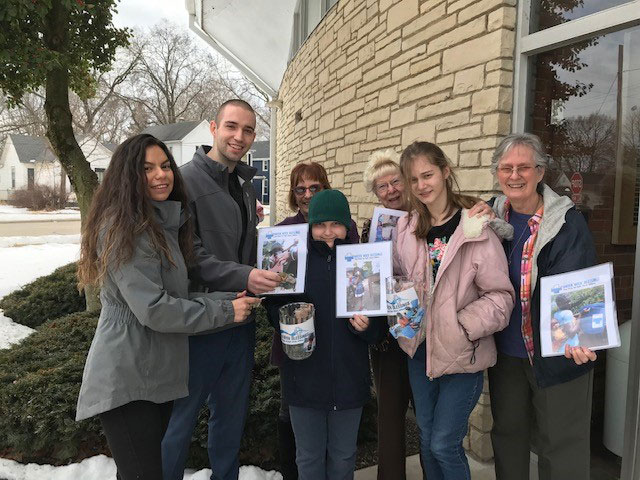 “I think the first thing parents and grandparents must do is practice and cultivate their own relationship with God so they themselves can begin to understand what a religious vocation is all about. In this way parents and grandparents can take a more realistic look at religious life.
“Religious life at this time is being transformed into something new and different. We, religious and laity alike, must remain open to the power and movement of the Holy Spirit.”
After her decades of experience being there for others, teaching others, and witnessing so much, she says that she has learned that “it’s more about what God is doing in my life than what I’m accomplishing or experiencing.”
“I would encourage young people to take Jesus as their model first and foremost, to be true to themselves, to live their lives with purpose,” Sister Mary Ellen said. “I’d tell them to give the best of themselves in all that they do, and to trust that life has meaning. I would advise them to be authentic and open to God’s presence and the action of the Holy Spirit in their lives. If they do, they will experience joy! I’ll close by saying I believe this is what it means to be religious.”
Who is God calling you to be? Go to dio.org/vocations.
Hey, Father! Where can the American flag be placed in church?

Why do we not have an American flag in our church? We are "one nation, under God." We sing patriotic songs on July 4, etc., but the flag of our great nation is nowhere to be seen.
Nancy in our diocese
The practice of placing the national flag somewhere inside churches seems to be an American custom. In my travels, I cannot recall seeing a national flag in the churches I have visited in Italy, Scotland, England, Spain, Turkey, Greece, or Australia; I have only seen a national flag in some churches in the United States of America.
Neither the General Instruction of the Roman Missal — which governs the celebration of the Mass and certain aspects of churches — nor the Code of Canon Law addresses the topic of flags within churches, presumably because such a practice is unforeseen by the Bishop of Rome. The United States Conference of Catholic Bishops, however, has provided some guidance on the placement of flags within churches:
“The Bishops' Committee on the Liturgy has in the past encouraged pastors not to place the flag within the sanctuary itself, in order to reserve that space for the altar, the ambo, the presidential chair and the tabernacle. Instead, the suggestion has been made that the American flag be placed outside the sanctuary, or in the vestibule of the Church together with a book of prayer requests. It remains, however, for the diocesan bishop to determine regulations in this matter.”
Why might this be?
The sanctuary is meant to be a representation of the heavenly Jerusalem and, ideally, represents in various means the worship given to God by the angels and saints, that same worship and life to which we aspire and for which we long. Just as in the life to come, there will be no marrying, neither will there be any national differences among humanity (cf. Matthew 22:30; Galatians 3:28). Consequently, nothing representing national boundaries has a place within the sanctuary because it is not — and will not be — part of the heavenly Jerusalem.
That said, it is permissible to display flags in the vestibule or parish hall, or some other such space, at the discretion of the pastor, unless the local bishop determines otherwise. As far as I know, none of the bishops of the Diocese of Springfield in Illinois has issued a policy on the displaying of flags in parish buildings. The displaying of flags outside of the sanctuary is a possibility, but it is nowhere required.
Father Daren Zehnle is pastor at St. Augustine Parish in Ashland; parochial administrator of St. Alexius Parish in Beardstown, St. Fidelis Parish in Arenzville, and St. Luke Parish in Virginia; and is the director for the Office of Divine Worship and the Catechumenate for the Diocese of Springfield in Illinois.
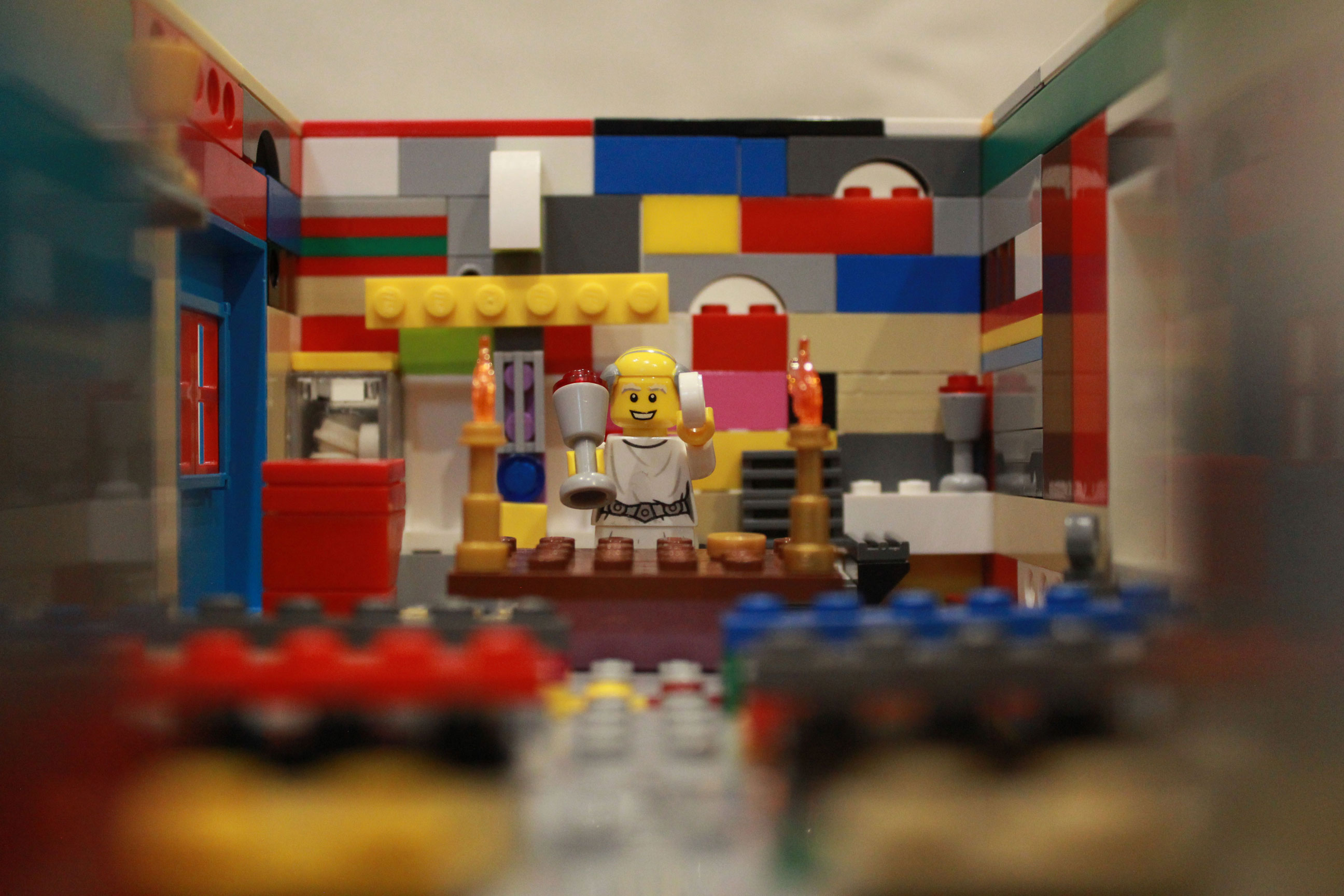
Build a Church LEGO Contest - see winners/all creations

The missions: how you can help people around the world

Inside the mind of former abortionist

 ‘You no longer consider that this is a human being that you are killing’
After performing hundreds of abortions, this doctor is sharing the lies of the abortion industry so truth can prevail
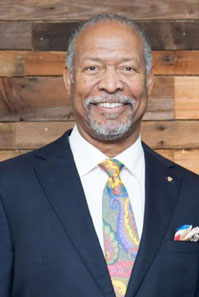
Dr. Haywood Robinson grew up in Southern California and received specialty training in family practice medicine in Los Angeles. He learned how to perform abortions in 1978, after Roe V. Wade legalized abortion in the United States. (This year, the U.S. Supreme Court overruled that decision.) During his residency training, Robinson met his wife and the two started performing abortions together. After performing hundreds of abortions, he and his wife had a conversion, ending their practice of performing abortions after converting to Christianity.
Now, Robinson advocates for life and travels the country speaking the truth about abortion and the lies the abortion industry proclaims. Earlier this year, he was in Granite City as the keynote speaker at the 40 Days for Life kickoff rally next to the abortion facility there.
Catholic Times Editor Andrew Hansen interviewed Robinson to learn about the mind of an abortionist and how manipulation is fooling people into thinking abortion is simply “health care.”
When you were in medical school, what made you think that you wanted to perform abortions?
That’s an excellent question because it really doesn’t quite work out that way. What the abortion mentality or philosophy has been successful at is the mindset of making abortion seem like it is medicine. So, it wasn’t like I decided, “Oh, I think I will go see what abortion is like and go do an abortion today.” Abortions were performed in the hospital I trained in as part of “normal medical practice.” So, I started doing abortions because I thought it was normal. But, abortion is not medicine. Medicine’s purpose is to comfort, to heal, and to make an individual better. There is nothing about an abortion that improves the life of a woman. It kills the baby and damages the mother psychologically and many times, physically.
 What is it like performing an abortion?
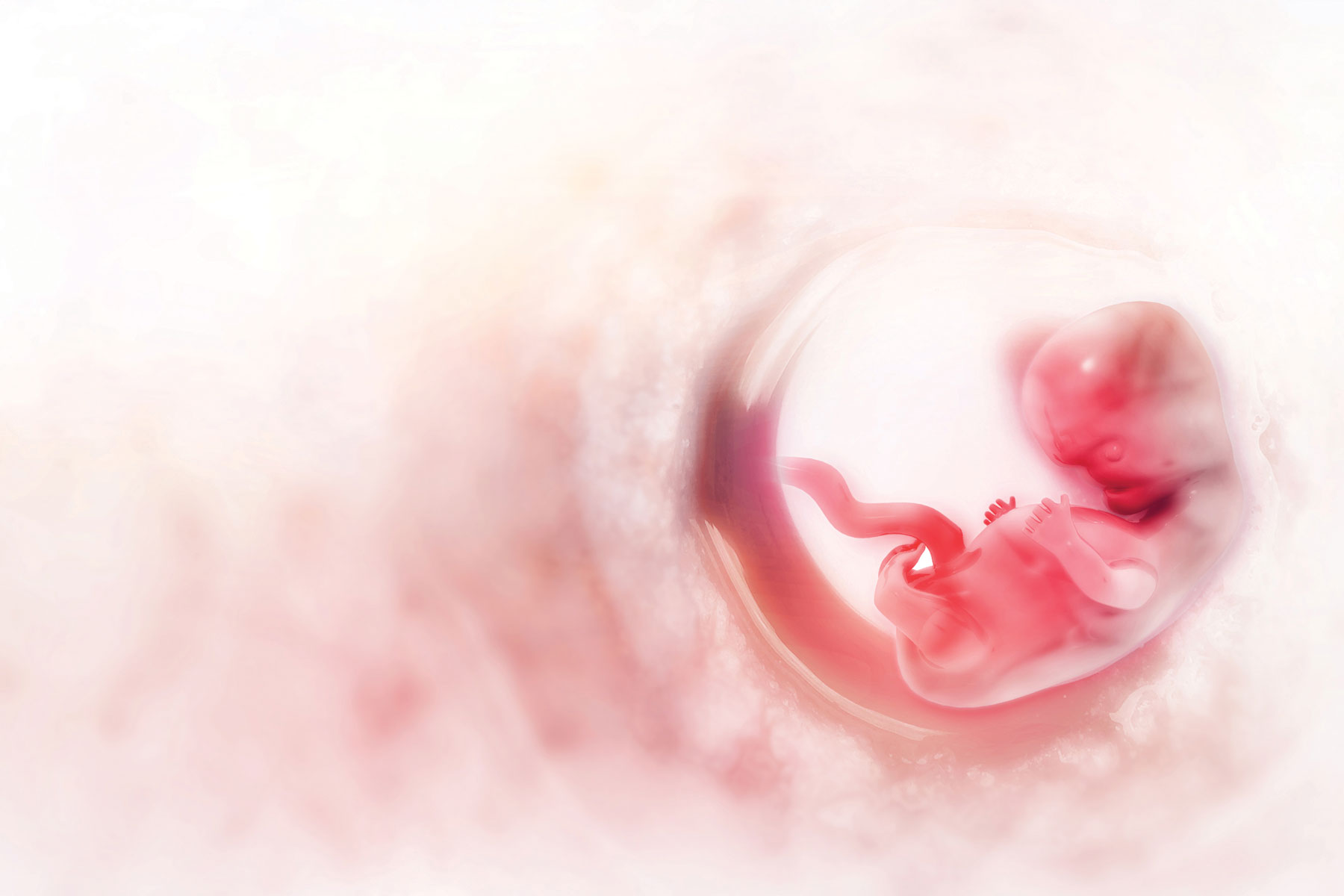
When I first saw my initial abortion, watching over the shoulder of another resident, I will say that there was something about it that made me queasy. God gives us this conscience that He puts in us, which lets us know when something just isn’t right. What the enemy is able to do, is the same thing he has done from scene one, act one in the Bible. That is deception. If he can deceive you to think, “The woman is getting an abortion anyway and this is legal and you need to know how to do this procedure,” you tend to fall for it.
Here is what happens: You have this progressive desensitization and dehumanization that happens, not only in the doctor, but the nurses, and the entire medical team, where you no longer consider that this is a human being that you are killing.
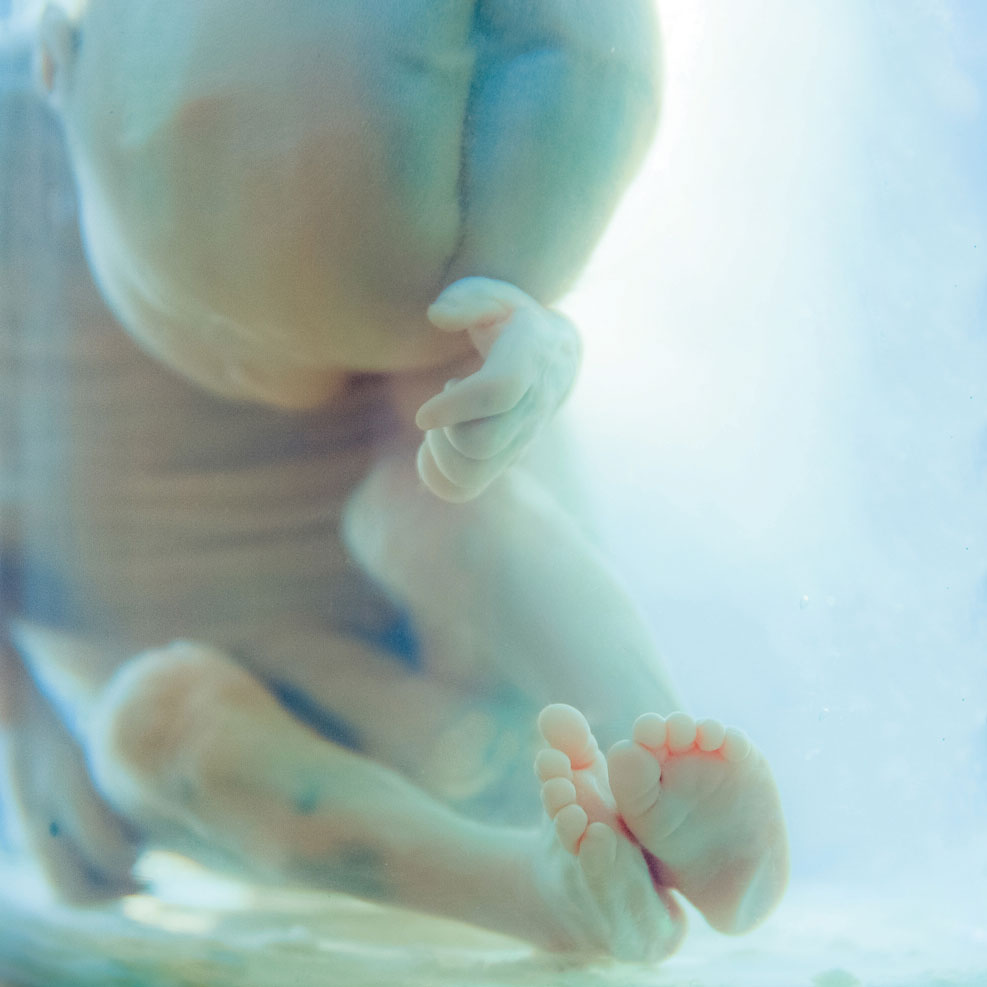 You mentioned when you first saw an abortion that it didn’t seem right. So, when performing these abortions, taking these now lifeless human beings out of the mother, was there still anything inside of you saying that this is wrong or were you just numb?
You tend to suppress that because you have to remember you are in a setting where your evaluation is looked at how professionally you handle situations like this. If you act like the way you probably should act, then you will possibly be labeled “not professional” or “not being sensitive to the patient’s needs.” So, you treat the abortion just like you treat any other medical procedure. But no, you can’t change that gut feeling that something is wrong.
We totally ignore the humanity of the preborn child, but on the flipside, we admit when a woman has a miscarriage, you’re supposed to handle that a totally different way, being sensitive that there has been a loss in the family, get counseling, etc. But, you can’t have it both ways. It’s a baby no matter what.
How much did money play a role in you doing abortions?
I will say right off, I never enjoyed doing an abortion. I’ve never talked to a doctor who said, “That was a fun abortion.” Abortions are done for money. The fuel for the abortion industry is simply money. If the variable of money was removed from the abortion equation, we wouldn’t be having this conversation because it is a very lucrative and easy business, you don’t have to file insurance, it’s cash, you never have to worry about patients being dissatisfied because once a woman has an abortion, they really don’t want to have anything to do with the facility anymore.
Then, there is the lie you hear of “this is a choice between a doctor and a woman.” I can tell you, it’s not. The doctor doesn’t see the woman until right before the time of the abortion. These abortionists are what we call transient doctors. They just move around to several different venues making their cash.
 What are some other big lies about abortion?
Forty years ago, they said it was “just a blob of tissue.” But babies have become more humanized simply by technology. It happened (recently) where a 20 week (baby in the womb) survived in the neonatal intensive care unit and went home. Back in 1973, that didn’t happen. That’s halfway through a pregnancy. So, technology has helped.
Scott Peterson (of California) received life in prison for two murders. One for the murder of his wife and for the murder of the preborn child when his wife was 20 weeks pregnant. So, we have laws that recognize a preborn child is human in certain instances, but then if you flip the coin, they are no longer human (abortion).
In malpractice, if an obstetrician gives his patient, the mother, a drug that adversely affects the preborn child, that doctor is held responsible for the injury of that child. If a doctor suspects a woman is using crack or heroine, by law, that doctor has to report that to the state because the state has an interest of the child to not become drug addicted or harmed. So, we have this abortion distortion where you try to have it both ways, but it doesn't work that way.
You eventually stopped performing abortions after just a few years because first, the city you moved to with your wife, in your words, had this “community standard where they didn’t perform abortions.” But, then you converted to Christianity and that really changed you?
The Lord told me and my wife and said, “It’s time for us to talk about the past and abortions.” That’s where He really revealed the magnitude of that sin. The Lord really allowed us to see how wrong killing these preborn children are and soon thereafter, I launched into the pro-life ministry, and for me, my first pro-life ministry was pregnancy resource centers.
 On March 7 this year, you were in Granite City in our diocese as the keynote speaker at the 40 Days for Life kickoff rally by Hope Clinic, the abortion facility there. What was your message?
That facility, they call it Hope, but it’s really hopeless. I know what it’s like to work in a building like that. All they do is bring women in and hurt them. That’s all they do. They do late term abortions there. The place looks hard, it looks cold. My message was thanking them for being a part of 40 Days for Life.
40 Days for Life started in Bryan, Texas (by College Station). Planned Parenthood opened a facility there and this was a facility many knew about — Abby Johnson was the director. She walked out after having a revelation about the sanctity of life and what abortion is. After that, the Planned Parenthood closed down because 40 Days for Life, (people) standing in front of the facility, fasting, and praying. It’s very interesting, when we as believers, when we do things that the Lord says we are supposed to do, like prayer and fasting, we are sometimes surprised when we get results when we shouldn’t be.
The science proves that it is a human life at the moment of conception but for those who support abortion, that doesn’t seem to resonate with them. What is your message to those who still believe abortion is OK?
I would ask them, when do think their life began? Was it two weeks after conception? A month? Have them consider their life personally.
Questions and edited answers taken from Andrew Hansen’s interview with Dr. Robinson on Dive Deep, the official podcast of the Diocese of Springfield in Illinois. Hear more from Robinson by going to dio.org/podcast.
My twin brother and I could have easily been aborted. So, why did I ride a bike 700 miles in six days?

 By NATHALIE CORBETT
Special to Catholic Times
March 4, 1993, 11:53 p.m. and March 5, 1993, 12:12 a.m. Those are the dates and times marking when my twin brother and I were born. But here's what they do not mark: they do not mark the beginning of our lives, nor do they mark the beginning of our stories.
Our stories begin with a brave woman named Cindy, our biological mother. A one-night stand resulted in her unplanned pregnancy, with not one but two babies. This is what Cindy was facing. She was alone and only 22 years old. I'm sure she was faced with a lot of concerns. She was probably scared and had numerous reasons for not wanting to bring my brother and I into the world, but she made the brave decision to keep us and to put us up for adoption once we were born.
This, however, is only the beginning of how brave Cindy was to make this decision. A normal pregnancy was not intended for her. Early in her pregnancy, she was diagnosed with cervical cancer. The doctors encouraged her to abort the two of us to give her a better chance at success in her treatment against the cancer. Instead, Cindy chose to give us a better chance at surviving and made the decision to keep us in her womb for as long as she could.
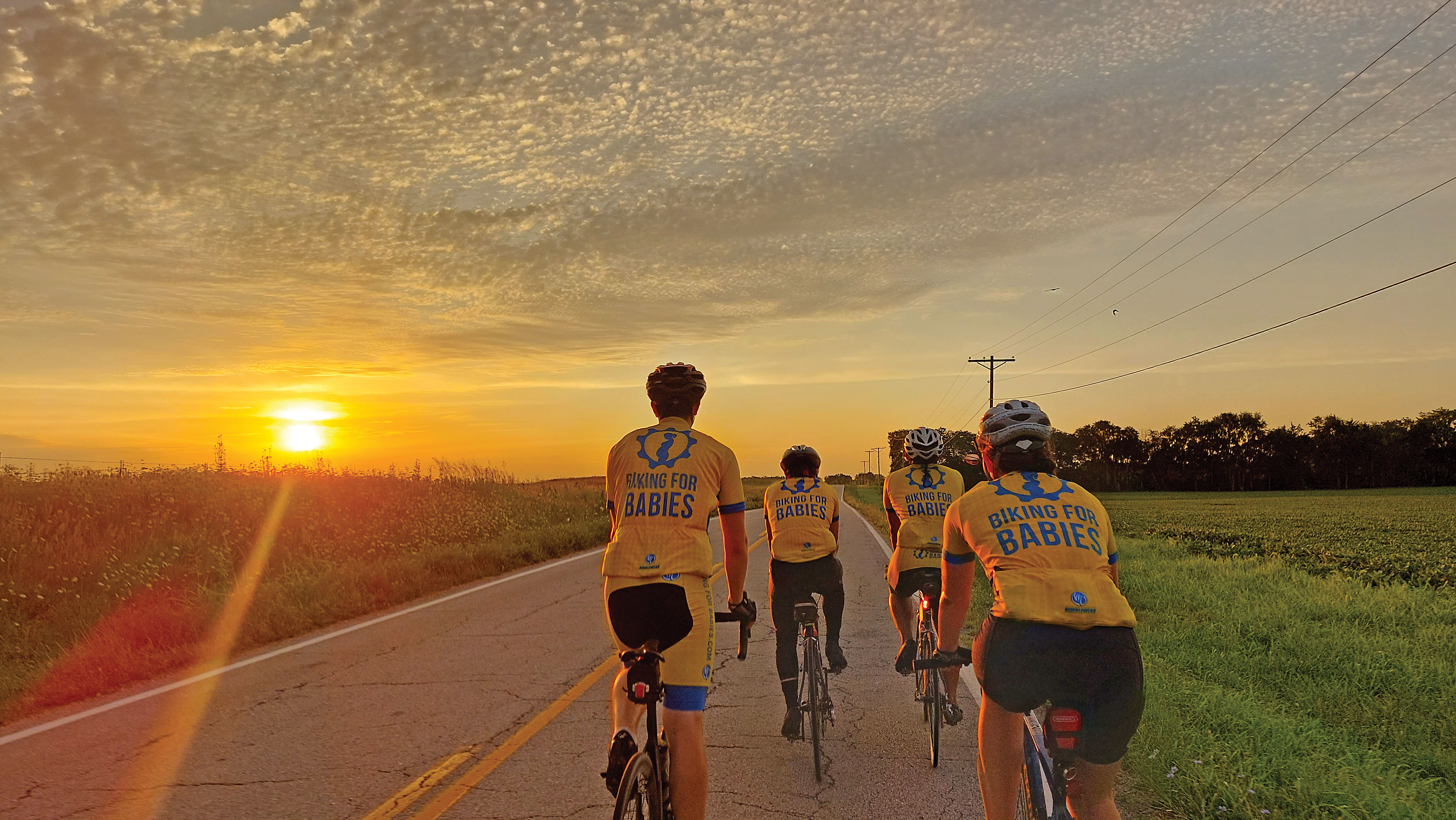
I heard this story for the first time when I was 18 years old. From that moment, my pro-life mission had more focus, and it couldn’t resonate more than with what Biking for Babies achieves every summer. The mission of Biking for Babies is to renew the culture of life one pedal stroke and one pregnancy resource center at a time. Every Biking for Babies missionary partners with a Pregnancy Resource Center (mine was First Step Women’s Center in Springfield), and we raise funds collectively to help these centers and the women entering them by teaming up with other missionaries and bike about 700 miles in six days. Different groups start in various places in the country, but everyone finishes in St. Louis.
In returning to Biking for Babies this year, I thought I knew what to expect when signing up a second time around, but I couldn’t have been more wrong. Several curveballs in both my training and my experience during the national ride came my way. There were several moments where I wanted to give up, but the mission kept calling me back.
Due to injuries to my elbow and muscles to my left leg as well as getting COVID, I was unable to start training until a month before the national ride. I pushed through and managed to get an 80-mile bike ride in before the national ride, which is what I needed to assure the team that I could do this.
I met my fellow “western route’ missionaries in Dodge City, Kan., our starting point for our 700-mile ride to St. Louis. We were excited for the long week ahead of us, but our first day of biking, July 10, gave us an idea of what we would be dealing with the entire week: 106-degree weather and humidity. We had cooling towels to cool us off during breaks and an amazing support crew that would spray us with cold water every two miles, but it was quite a challenge.
My leg injury then started flaring up on day two of biking, which meant that I couldn’t do the entirety of the mileage. I started looking for ways to get back home. The week wasn’t going as I had planned. Whenever I started looking for a way home, I would always come to the following conclusion: This wasn’t about me, and it wasn’t about the mileage I was getting in. It was about supporting my fellow missionaries, being a witness to life on the roads, communities, and families we encountered during the week, and ultimately, helping mothers and their unborn children.
After the ride was finished on July 16, we were asked, “What was a ‘God-send’ moment for you and your team this week?’” For me, it was our last day of biking.
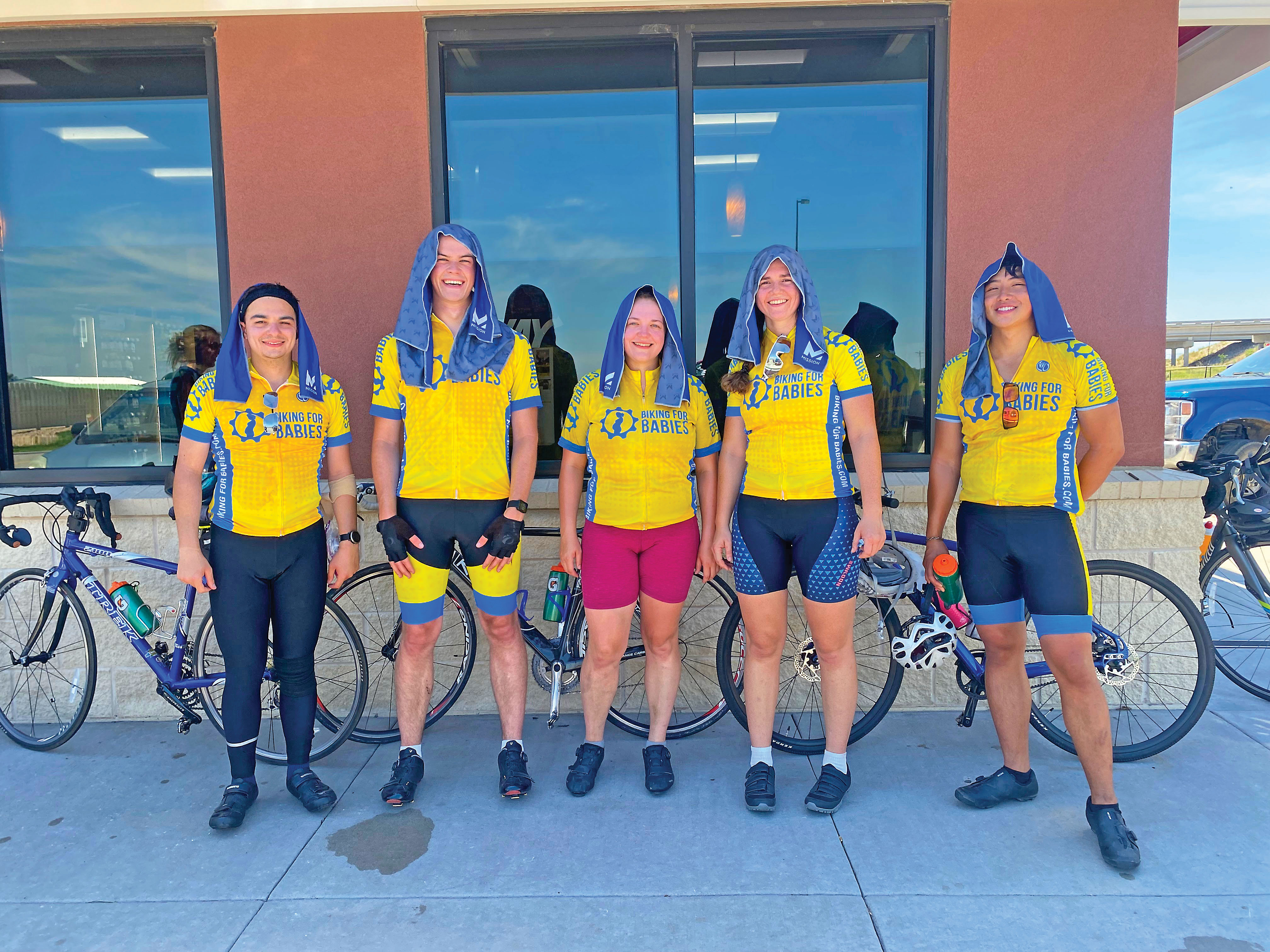 Two of our bikers had to leave that morning, which meant that only four bikers were left, including myself. I was worried at the news because I knew that at some point, I would be getting off the bike. So, at 4:30 a.m., we started on the Katy Trail which runs along the Mississippi River. I managed to do 70 miles before hopping off and giving my leg a break. While taking a break, I went to a bike shop with two of the support crew members to get additional inner tubes since we were completely out and biking on a gravel surface. When we got back to the group, another biker, Ryan, was out due to heat stroke.
I decided to get back on the bike because it was too dangerous for only two people to be biking. After biking five miles, we reached a support crew vehicle and were told to stop. Jimmy, the co-founder of Biking for Babies, came out of a van with a bike and said, “I heard you guys needed another biker.” The three of us were so relieved. Once we were getting closer to St. Louis, the hills got steeper and my leg couldn’t handle it, but I knew that the team was in good hands with Jimmy being there. Ryan and I re-joined the team for the last five miles and then continued to bike the final mile with all the Biking for Babies missionaries.
Our team went through a lot of hurdles that day, and Jimmy showing up when he did was exactly what we needed. It’s that moment that reminded me of my faith in God. He will show up exactly when you need help, so turn to Him and embrace Him.
Nathalie Corbett attends St. Katharine Drexel Parish in Springfield.
Hey, Father! Explain the Church's teaching on birth control

Given the Catholic Church’s teaching on abortion, is the use of birth control pills considered an abortion? If so, does it prevent those who use birth control pills from receiving the Eucharist
Anonymous in the diocese
To answer your questions, we have to make several important distinctions. Briefly put, the Church’s moral evaluation of abortion is distinct from that of using birth control (contraception) because these are very different acts. Abortion is the “direct and voluntary killing of an innocent human being” (John Paul II, Evangelium Vitae, n. 57). Contraception is “any action which either before, at the moment of, or after sexual intercourse, is specifically intended to prevent procreation” (Humanae Vitae, n. 14). Abortion destroys life, contraception prevents it. If chosen freely and knowingly, both abortion and contraception constitute serious sins (see Pius XI, Casti Connubii, n. 56).
In the case of abortion, a new human life is already present, and therefore the only “birth control” possible would be to destroy the human embryo or fetus, a clear violation of the Sixth Commandment, “You shall not kill.” In the case of contraception, fertilization is prevented in some way, and so there is no question of destroying a human life. However, contraception violates the nature of marital love, in which the spouses should give themselves to each other unreservedly. Openness to new life is an essential element of every sexual expression of marital love, even when natural methods like Natural Family Planning (NFP) are used to avoid pregnancy for some legitimate reason (illness, spacing births for serious financial reasons, etc.).
When it comes to contraception, we have to be precise, because the term is often used to describe a variety of drugs with very different effects. The most common contraceptive drug is a combination of estrogen and progestogen known colloquially as “the pill.” The pill alters a woman’s menstrual cycle and prevents ovulation (the release of egg cells), rendering her temporarily infertile. This is contraception in the proper sense of the word because conception is prevented altogether.
However, other drugs advertised as “contraceptives” can actually allow conception (fertilization) to occur and then cause the death of the embryo afterwards. Such drugs are not really contraceptives but “abortifacients” (abortion causing drugs). This is especially the case for drugs sold as “emergency contraceptives.” The so-called “morning after pill,” Plan B (levonorgestrel), is the most popular of these. When taken after sexual intercourse (as advertised and instructed), the only remaining way for this drug to “work” is by preventing the embryo’s attachment to the uterus. This ultimately kills the embryo and is thus an abortion. Of course, given the typical woman’s fertility window of about six days per month, so-called “emergency contraceptives” certainly do not cause an abortion every time they are used. This does not diminish the moral evil of using them, but it does reduce the number of human lives destroyed.
There are also drugs that are explicitly advertised as abortion drugs. The most common one is RU-486 (mifepristone), openly called “the abortion pill.” It is usually used together with the drug Cytotec (misoprostol). These drugs are used throughout the first and second trimesters of pregnancy. They first cause the death of the embryo or fetus and then its discharge. This is called a “chemical abortion.”
So, to your question about whether the Church considers “birth control pills” to be a form of abortion, the answer is that it depends on which drug is used. The most common form of contraception, “the pill,” is taken daily and prevents fertilization itself rather than killing embryos post-fertilization. It is possible for the pill to make the uterine wall less hospitable to the embryo’s attachment. But this would be an indirect abortive effect and not an abortion properly speaking (many medications can have indirect effects on fertility and pregnancy). Recall that abortion is the “direct and voluntary killing of an innocent human being,” not a rare, indirect, and unintended side effect of some other action. On this note, it is important to acknowledge that some women are prescribed the pill for therapeutic reasons, for example, to treat endometriosis, severe acne, and certain forms of cancer. This use of the pill is morally permissible provided that the contraceptive effect is not the intention of the woman, and she is still open to life (in the context of marriage, of course) (see Humanae Vitae, n. 15).
It is possible and perhaps even likely that someone could be ignorant of the abortion-causing effects of so-called “emergency contraceptives” like Plan B. After all, they are advertised as “contraceptives,” not abortifacients. This ignorance would reduce the person’s moral culpability for using the drug. However, it would be difficult for someone to claim ignorance about a drug like RU-486, which is openly advertised as an abortion pill.
Regarding worthy reception of the Eucharist, abortion and contraception are not unique: All Catholics who are conscious of committing any serious sin are obliged to refrain from holy Communion until they receive absolution in the sacrament of reconciliation (see 1 Cor 11:27–30 and Code of Canon Law, n. 916). Anyone who has been involved in an abortion in any way should ask for God’s forgiveness and come to the sacrament of reconciliation to receive mercy, grace, and healing. Anyone who has used contraceptives for the purpose of preventing new life should do the same. Behind every “no” in the Church’s teaching is a life-giving and liberating “yes” to authentic human love and flourishing.
Father Christopher Trummer, S.T.L, is parochial vicar at St. Agnes Parish in Springfield, associate delegate for Health Care Professionals, associate chaplain of the Springfield Chapter of the Catholic Physicians Guild/Catholic Medical Association, and has a license in Sacred Theology in Moral Theology at the Pontifical University of the Holy Cross in Rome, Italy.
Diocese’s newest pregnancy opens in Newton

 The Newton Family Life Center is the newest pregnancy center in the diocese. It provides pregnancy testing, limited OB ultrasounds, parenting classes, educational pregnancy classes, adoption information and referrals, post-abortion support, and baby supplies (as part of the Client Cash Program). By BRIAN BIERMAN
Special to Catholic Times
NEWTON — On June 24, the U.S. Supreme Court overturned Roe v. Wade ending federal protection of the right to abortion. Now, individual states will get to decide whether or not to allow abortion in their state. It was a tremendous victory for the pro-life movement, but there is still much more work to be done, especially in the state of Illinois. On the day of the ruling, Illinois Gov. JB Pritzker promised the state would remain a “safe haven” for women seeking an abortion and called for a special session of the General Assembly to further expand and protect those rights in the state.
As many in Illinois fight to expand abortion rights, people who support life in Newton are standing up to support men, women, and families experiencing pregnancy, parenting, and other related issues. The small city in Jasper County is now home to the diocese’s newest pregnancy center, the Newton Family Life Center.
In addition to the Family Life Center, a new thrift store, The Silk Purse, has also opened in Newton. The Silk Purse Thrift Store carries a full range of items for the public’s shopping experience. All items are donated and all net proceeds from the store go to support the ministries of the Family Life Center.
The Newton Family Life Center and Silk Purse Thrift Store are expansions of the locations already located in Effingham that have been operating for 27 years. So many clients were coming from Jasper County and the surrounding area that the board of directors thought there was a need to expand the Effingham pregnancy center to Newton to help those people. After several months of searching for locations in Newton, in April, two suitable locations were found for the pregnancy center and the thrift store.
Thanks to the generosity of one individual, the cost of the pregnancy center building was covered and the thrift store building and land it sits on was donated by the neighboring concrete plant. Both buildings required some renovations, and a capital campaign was started to raise an estimated $290,000. To date, The Moving Forward in HOPE Campaign has raised more than $240,000, so there is still work to be done. If you would like to get involved, you can find information at the Friends of Newton Family Life Center Facebook page or donations can be mailed directly to Moving Forward in HOPE Campaign, 605 Eden Ave., Effingham, IL 62401.
The Family Life Center is a NIFLA affiliated Christian not-for-profit ministry that provides practical assistance, education, and support to empower and equip women, men, and families experiencing pregnancy, parenting, and related issues, to live healthy productive lives. The Newton Family Life Center provides pregnancy testing, limited OB ultrasounds, parenting classes, educational pregnancy classes, adoption information and referrals, post-abortion support, and baby supplies (as part of the Client Cash Program). Participants in parenting classes earn incentives of diapers and Client Cash for use at the Silk Purse Thrift Store with each monthly visit. With the completion of six visits, a mom earns a basket of new items for the baby and a car seat. The Family Life Center has several employees that are all trained to deal with clients as needed as well as many volunteers who help with many of the center’s events throughout the year. You can learn more about the Newton Family Life Center at their Facebook page, Friends of the Newton Family Life Center.
The Silk Purse Thrift Store will be a huge asset to Newton and the surrounding area by providing a wide array of various household items and clothing at low prices. All of its inventory is donated by the public and most of the workers are volunteers keeping operating costs low. Countless area businesses and individuals volunteered labor and donated material to turn the building into a beautiful space the community can be proud of. Donations of clothing and household goods are accepted Tuesday through Saturday 10 a.m.-6 p.m. (closed Sunday and Monday). You can find more information about the store on Facebook at the Silk Purse Thrift Store – Newton.
The Newton Family Life Center and Silk Purse Thrift Store could not be possible without all of the amazing community support. Countless individuals, churches, and area businesses have gone above and beyond to help make these facilities a reality. Together, we can all create a positive environment where families stay strong, and society respects the dignity of life from conception to natural death. If you would like to learn more about the Family Life Center, please visit familylifepcc.org.
Brian Bierman is a board member of Family Life Center and a St. Thomas the Apostle parishioner in Newton.
The Silk Purse Thrift Store provides a wide array of various household items and clothing at low prices. All of its inventory is donated by the public and most of the workers are volunteers keeping operating costs low. Participants in parenting classes earn incentives of diapers and Client Cash for use at the Silk Purse Thrift Store with each monthly visit. With the completion of six visits, a mom earns a basket of new items for the baby and a car seat.
Submitted photo
Respect Life Month

Long married couples celebrate together at Sept. 18 Mass
 Rita and Fred Greenwald, long-time members of Cathedral of the Immaculate Conception Parish, have been married 71 years. They raised seven children together. By DIANE SCHLINDWEIN
Managing Editor
If you added up the years of wedlock represented by the couples at the Sept. 18 Mass celebrating 50 or more years of marriage that number would exceed well over 2,500 years of love, commitment, and fulfillment of sacramental vows. That’s because not only were many couples there at the Cathedral of the Immaculate Conception celebrating the vows they took in 1972, but also the vows that many of them took in the 1960s and the 1950s.
The evidence of staying together in sickness and in health was obvious among the couples. Some were accompanied by family members, some arrived with one or both of the spouses using canes or walkers, and a few rode in wheelchairs while their loved one pushed them along. In sweet demonstrations of celebration, some even wore corsages or boutonnieres, reminding them of their special day so many decades ago.
All the couples were acknowledged by Bishop Thomas John Paprocki who gave “thanks to Almighty God” for the opportunity to celebrate the annual Mass hosted by the Diocese of Springfield in Illinois. The Mass was concelebrated by Vicar General Msgr. David Hoefler, whose own parents, Deacon Ben and Leona Hoefler, were at the Mass.
One of those couples who were married in the early 1950s were Fred and Rita Greenwald, long-time members of Cathedral of the Immaculate Conception Parish in Springfield. The couple raised seven children at Cathedral and saw all of them attend and graduate from the grade school. “Most of our children worked here at Cathedral (while growing up) and several of them were married here,” Rita said. As for their 71 years of marriage, Rita says she believes couples just must put their minds to it. “It takes work,” she said. “But we are still here!”
Another couple, Jim and Pat Nevins from Our Saviour Parish in Jacksonville, were at the Mass to celebrate 66 years of marriage. The couple, who have four children and eight great-grandchildren, gave their own good advice. “Never go to be angry,” Pat said, to which her husband, Jim, added, “Pray together before you go to bed. That way you can’t go to bed angry. It doesn’t work that way.”
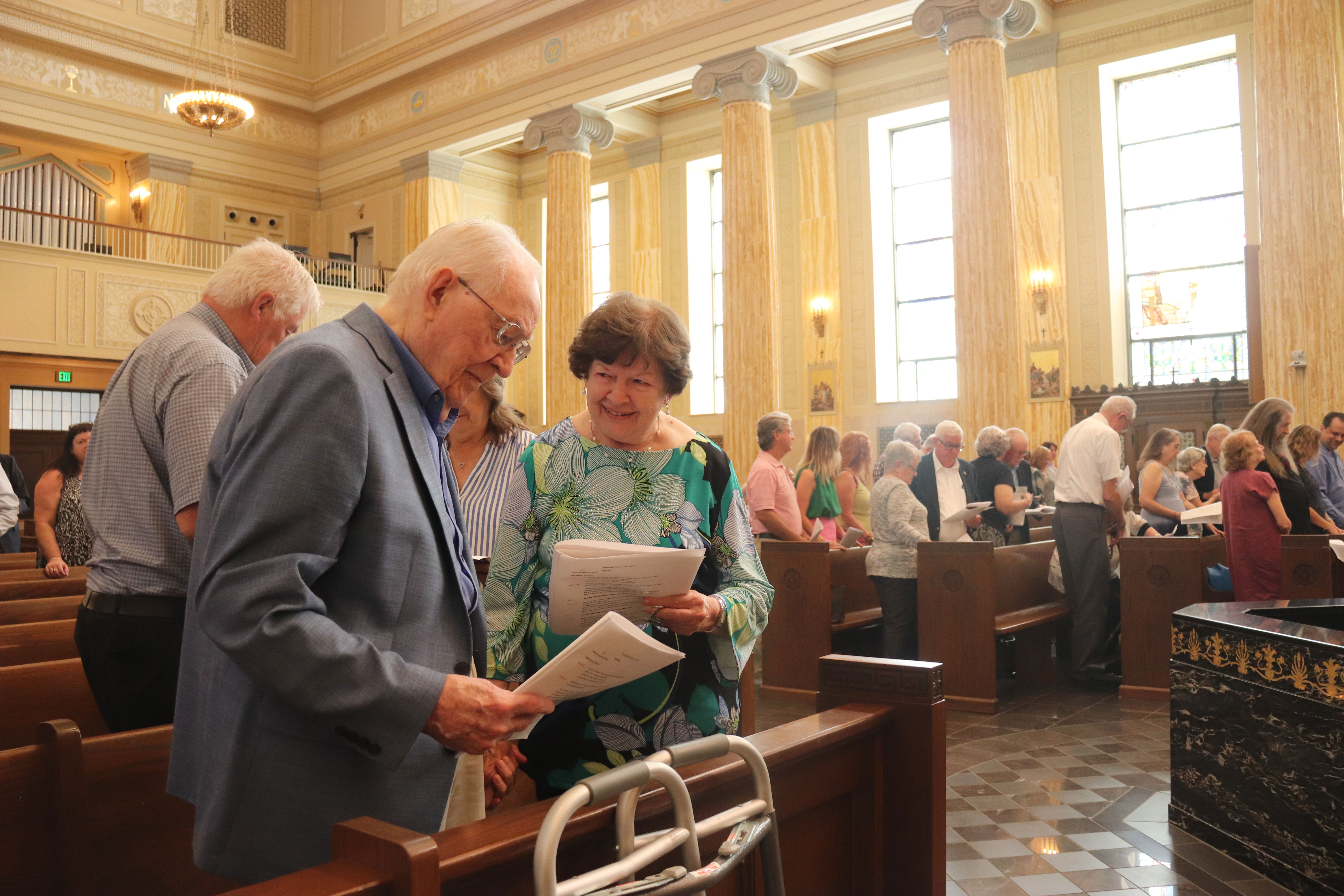 Jim and Pat Nevins of Our Saviour Parish in Jacksonville renew their vows to one another at the Mass for couples married 50 years or more. They have been married 66 years.In his homily Bishop Paprocki spoke about the sacrament of marriage and how long-married couples are mentors to others. “Today I want to step back with all of you to that life-changing exchange at your own marriage. I invite each of you to recall that moment, that day, that Mass — to remember the joy and grace that came as you made that vow to God together,” he said. “You have all lived out those promises for 50 years or more, promises to be faithful, to love, to honor.
“Today I want to thank you personally for your witness to the world, to the Church, and to me, of fidelity in your vocation. Holy marriages are a great reminder and inspiration to the people of God as we see how you have fought for your marriages day by day, through good and bad, sickness and health, carrying together the sorrows and joys of giving your lives in commitment to one another.
“How happy we are to know and love you,” he said, “to see your strength and commitment, to see the fruit and beauty of the sacrifices that your married love has entailed, to have before us your witness of what lasting forgiveness, patience, gratitude, and commitment look like.”
Photos by Diane Schlindwein
Recycled trash becomes cushy mat, warm blanket through Mats for the Homeless ministry in Macon County

 By ANDREW HANSEN
Editor
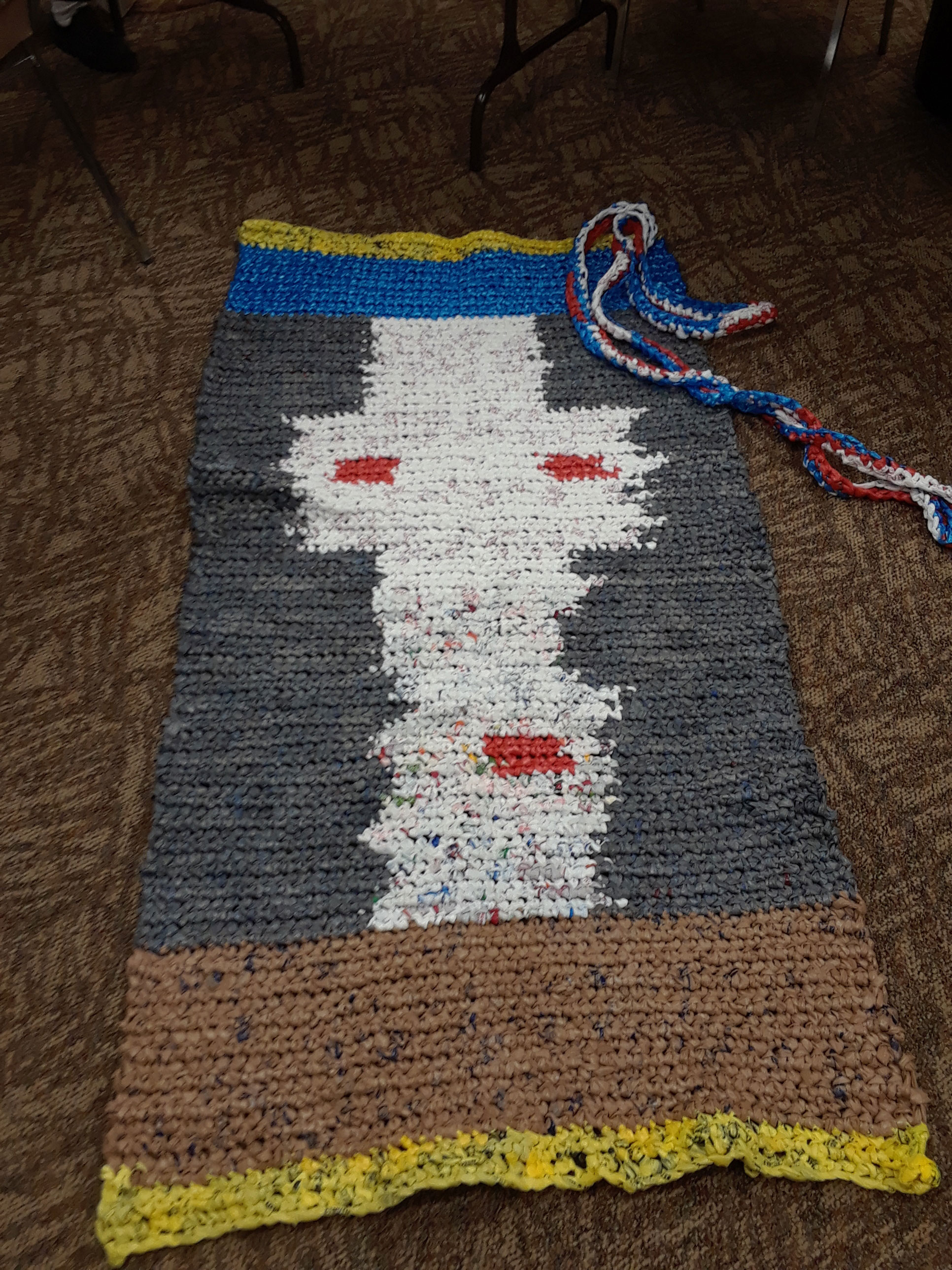
It’s a cold night in Decatur. For those who are living on the streets and cannot find a roof over their head this night, some turn to something else to keep them warm or something soft to sleep on. What they have is made from plastic bags, but not just a few bags, but 700 bags. Most importantly, it’s made with love and compassion, telling the homeless that people do care about them.
Ed and Pat Cirks of Our Lady of the Holy Spirit Parish in Mt. Zion started Mats for the Homeless in 2016. Using their time and talent, the married couple have about 20 people helping now and have recruited about 100 people over the years to take on an intricate and time-consuming ministry, but one that has a big impact and embodies the Gospel message of helping strangers in need.
Here’s how it works: The group collects plastic bags then flattens them, cuts them into three-inch strips, loops the strips into balls, and then crochets it all together into a 3 feet by 6 feet sleeping mat, which can be used as a cushion to sleep on or as a blanket.
“We feel that we are providing some comfort to the poorest of the poor,” Pat Cirks said. “We feel that our time is well spent doing this ministry.”
Each mat of 700 plastic bags takes 40 hours to complete. The group of volunteers will meet typically on a Monday to process everything at the parish and the crocheting is done in each person’s homes. So far, the ministry has made 770 mats for the homeless, which means they have not only helped provide comfort to so many but have helped reuse 539,000 plastic bags.
 Cirks is also pleased to see more people in the community getting involved. This summer, several young girls set up a lemonade stand to raise money for the ministry to buy cutters, rulers, quilting mats, and safety handles.
“Our equipment was getting rundown, especially our blades,” Cirks said.
The girls raised $280. Cirks says any money that is left over will be used by the ministry to purchase towels and winter clothing.
“We desperately need crocheters,” Cirks said as the demand for these mats continues to be there. That also includes plastic bags people can collect and drop off.
“We have collection boxes for plastic bags at Our Lady of the Holy Spirit in Mt. Zion, St. Isidore Parish in Bethany, and the VFW Post 99 in Decatur,” Cirks said. “We deliver the mats to VFW POST 99, Oasis Day Center, The Salvation Army Men’s Homeless Shelter, Northeast Community Fund, Good Samaritan Inn, and Dove.”
Editor’s Note: If you are interested in volunteering to be a crocheter, please contact the Our Lady of the Holy Spirit Parish office in Mt. Zion at (217) 864-3467.
Hey, Father! Do guardian angels really exist?

As one who attended Catholic elementary schools, I was taught The Guardian Angel Prayer and prayed it daily. Do they really exist? Given events like the school shooting in Texas, if they really do exist, they certainly aren't doing their jobs!
Nancy in Springfield
Much of the general public’s knowledge and understanding about angels comes from popular media sources such as movies and television programs. Some of it is accurate while some of it is not. Still, there are those who wonder if angels really exist and if they have any impact in our lives.
The Catechism of the Catholic Church (CCC) tells us that the existence of angels is a truth of faith which is based upon Sacred Scripture and Church tradition (CCC 328). As Catholics, we profess this faith on a weekly basis when we proclaim our Nicene Creed at Sunday Mass. The Creed does not mention angels specifically, but it does allude to them when it states that God created all things that are visible and “invisible” (CCC 331).
Angels are those beings that are unseen and so for the most part, we do not see the angels. However, angels have made their appearance from time to time in Sacred Scripture. Even certain saints such as Padre Pio claimed to have seen their guardian angel. The children of Fatima were addressed by an angel.
The word angel means “messenger,” and there are numerous instances in Sacred Scripture that involve the presence of angels. Sometimes they come under the appearance of human beings, even though angels themselves do not have bodies. They are pure spirits.
There are good angels and bad angels. Satan, the devil, is an angel. He and many other angels of their own free will rebelled against God and were then cast into Hell (Isa 14:12, Lk 10:18, CCC 392-393). They are called demons. Most of the angels, however, remained faithful to God. God sends His good angels to assist, warn, and guide His people (CCC 331-333). Demons, on the other hand, do have the ability to tempt people to do evil things (CCC 395).
These are just a few examples from Scripture regarding the presence of angels (CCC 331-333):
- Angels came to inform Abraham that he would have a son (Gn 18:10);
- An angel guided the Israelites from Egypt into the desert (Ex 14:19);
- Satan tempted Jesus during His 40-day fast in the desert (Mt 4:1-11);
- Angels ministered to Jesus at the end of His fast in the desert (Mt 4:11);
- Jesus cast out demons from possessed persons (Lk 8:26-33);
- The Archangel Gabriel was sent by God to the Virgin Mary to seek her willingness to be the mother of His Son (Lk 1:26-38);
- In a dream, angels guided Joseph to take Mary and the Child Jesus to Egypt (Mt 2:13);
- Angels came to comfort Jesus in the Garden of Gethsemane (Lk 22:43);
- An angel freed Peter from jail (Acts 12:7);
- Jesus said that the angels of children gaze upon the face of God, therefore affirming that each person has a guardian angel (CCC 336, Mt 18:10);
- In Revelation, the Archangel Michael does battle with Satan and the demons (Rev 12-7).
It is sometimes said that if angels are real, and they are meant to help us, why do they not intervene when evil things are about to happen such as murders and suicides? This touches on the mystery of the presence of evil in the world (CCC 309, 385). All evil has its origin in sin, particularly the original sin of Adam (CCC 386-389). This sin was instigated by the evil angel, Satan. The original nature of man was damaged by this first sin and thus the consequent tendency to commit sin, which is referred to as concupiscence is passed on to successive generations down to our present day (CCC 2514-2516). Couple the tendency to sin with free will and you have a precarious combination.
God has given both angels and men the gift of free will (CCC 311, 1704, 1731). Some human beings choose to serve God by obeying his Commandments and living holy lives. The choice to serve God and do what is good brings peace to society, generally speaking. Other human beings out of weakness choose to do bad things which brings about disorder, chaos, and suffering. Good human beings and bad human beings live among each other for the most part. Jesus described this reality in the parable about the wheat and the weeds (Mt 13: 24-30). We can see this reality in our own communities. God respects our free will to make choices. He does not force us or our neighbor to do that which is good. Being a good person and doing what is good is a deeply personal decision. Just like being a bad person is a personal decision.
So, where do the angels come in here? The devil and other evil angels encourage people to do that which is evil, because they hate us and want our souls in Hell with them. God gives the good angels the mission of encouraging people to do good things. But angels, good or bad, cannot force our free will. They can only encourage us one way or the other.
We must be careful not to attribute our decisions to do good or evil entirely to the influence of angels. The individual person must make their own free will choice and unfortunately, some people choose to do bad things and, in some instances, very bad things like starting wars and murdering innocent people.
The spiritual life is a spiritual battle and God has given us good angels to help us in this battle, but the angels respect our personal freedom to choose, even when we make bad choices. The angels are God’s gift to us. We should seek their guidance each day (cf. www.stmaryspittsfield.dio.org, Homily Archives).
Father Mark Schulte is pastor of St. Mary Parish in Pittsfield and St. Mark Parish in Winchester.
Illiopolis woman looks back at 35 years teaching PSR

 Says working with children enriched faith, gave joy
By DIANE SCHLINDWEIN
Managing Editor
When it comes to leading PSR classes, only a few people in the Diocese of Springfield in Illinois can match the years Cathy Mitchell has been teaching in Illiopolis. Whether assisting at a class, teaching, or acting as DRE of Resurrection Parish, Mitchell has been involved with PSR since the early 1980s.
In the beginning, Mitchell was an assistant when her son was in classes at what used to be known as Visitation Parish in Illiopolis. She had decided the best way to get to know people was to get involved with the parish. “I thought I’d like working with the religious ed program,” she said. “I started as a helper in the classes on Wednesday evening. The first class I taught solo was my daughter’s first Communion class. The teacher had retired, and no one wanted to do sacramental prep, so I said I would try.”
Since those early days, she has seen a lot of changes. “When I started teaching the three parishes (Visitation in Illiopolis, St. Joseph in Buffalo, and St. Ann in Niantic) were all separate and doing their own programs,” she explained. “When the parishes combined as a tri-parish, but each had their own church, we still did everything in our own parishes until the three parishes came together under one church. There were some activities we might do together, but classes and sacraments were held in each separate parish.” She says in “the old days” everything was done with workbooks. “Now we use a variety of resources to engage the children more,” she said.
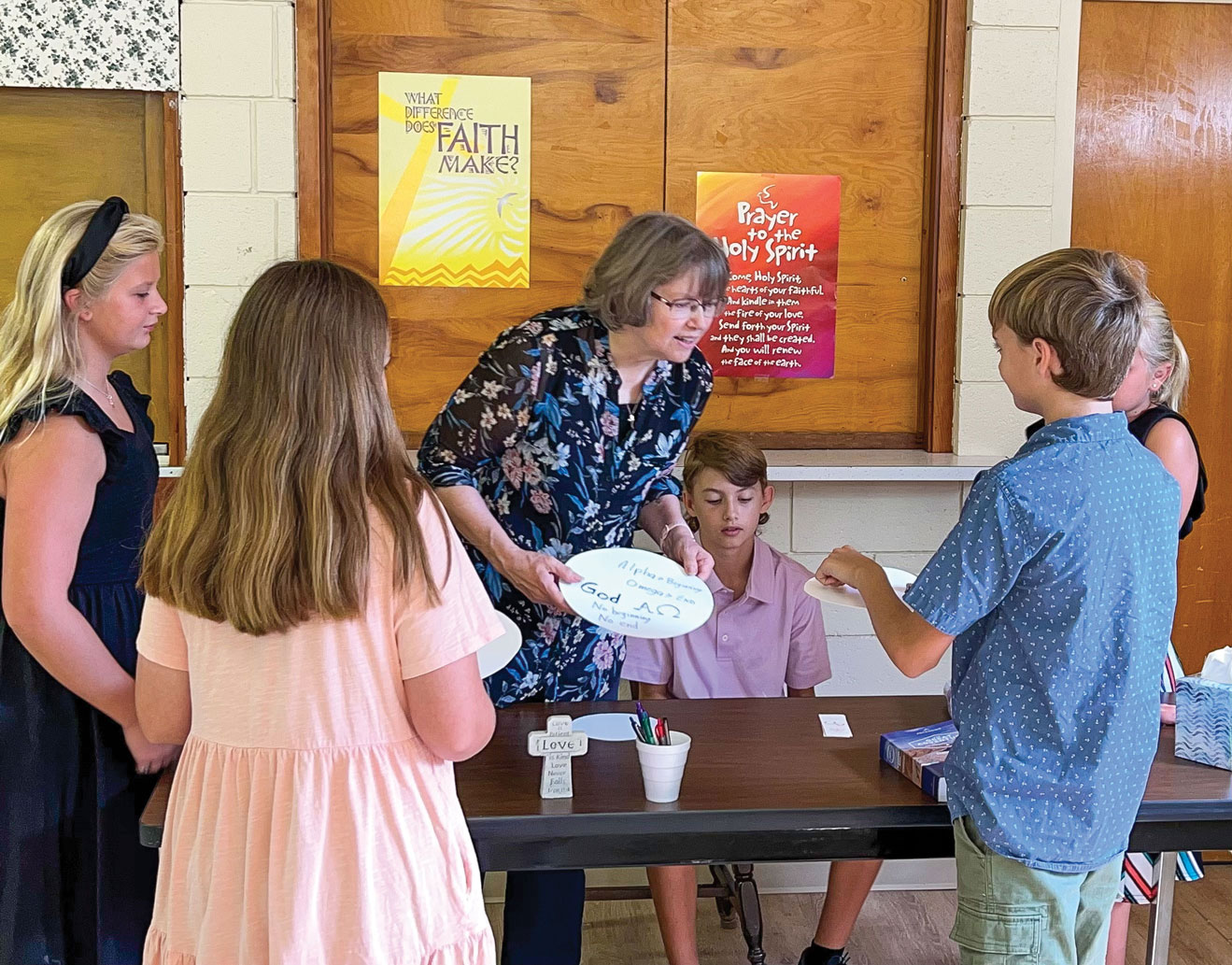 At Resurrection Parish, students now attend PSR classes during the hour before Sunday Mass. The program is small, with 10 to 12 children in grades 1-6. “Right now, we don’t have any junior high students and only one in high school,” she said. “At this time, I am teaching the third- and fourth-grade class, which is three students. This is my second year with this class, and they are doing the Restored Order of Sacraments. We had one receive the sacraments last year and another one set for this year and one in RCIC. The ones going through the sacraments are given additional time with me outside of class.”
In addition to Sunday classes, each year the PSR students take part in opening and closing events, and a Christmas party. “We try to include fun in their learning experiences,” she said. “I also do Rice Krispie Advent wreaths with my class every year. The children learn discipleship by helping with food pantry collections, socks for the homeless, and most every year they assist in the making of sandwiches for the homeless when our parish provides the meal.”
However, Mitchell doesn’t limit her parish participation to teaching PSR. “Being a member of a small parish allows you to be able to get involved in almost all aspects of parish life,” she said. “I am currently on the Pastoral Council and DRE in addition to teaching PSR and RCIA. When our parishes combined, they wanted to keep a few people who know the parishes history on the council. I am also head of the kitchen for the chicken dinner … for so many years I can’t remember. My newest duty is working part-time as parish secretary, which I started in March. One of the best parts of working in a small parish is getting to know everyone personally. We are like one big family, and we become that way by worshipping and working together.”
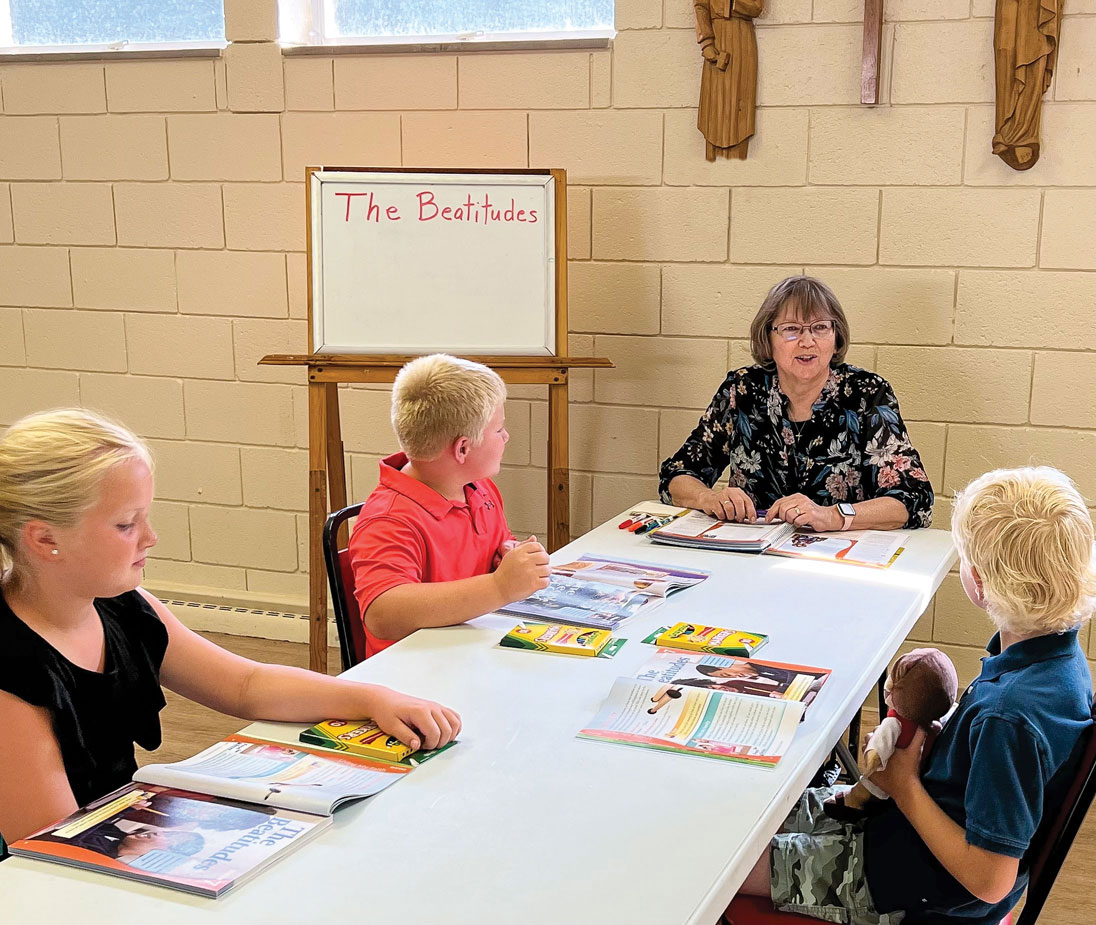 As DRE, Mitchell says she oversees finding people to volunteer. “Every time I ask for volunteers to help teach PSR, I am told, ‘I don’t know enough to teach’ or ‘I don’t feel qualified to answer the children’s questions.’ I respond that if you start with the younger students, you can learn along with them. Every year I teach I learn something. We are here to teach the children that God loves them and cares for them. No matter what. … There is nothing that warms my heart more and shows it’s all worth it than sitting in the back of church and watching my class receive reconciliation, first Communion, or confirmation. Somehow those energetic students become little angels ready to experience God’s love in the sacraments.”
She has several other reasons for continuing her teaching ministry. “I guess I have kept coming back to teach PSR partially because the need is there, partially because it is a fun and new experience each time, and mostly because I believe it is what God wants me to do,” said Mitchell, who has been married 48 years and has two grown children and three grandsons. “I took a year off now and then, and during those times it seemed like something was missing. I think it was the sharing of my faith with the children —and they shared their faith with me. I love to see the children grow spiritually and know that I am helping them on their journey with God.
“When I am working with the students, I get to see the simplicity of faith and how sometimes we make it so much more complicated than it needs to be. They have such a different perspective on things,” she said. “The young ones are little sponges eager to hear about God. The older ones challenge me with questions that sometimes I need to research — and in the process learn more about my faith. As they learn, I also learn, deepening and growing my faith and helping me see just how blessed I am.”
Emergency responders, public invited to Blue Mass at Cathedral

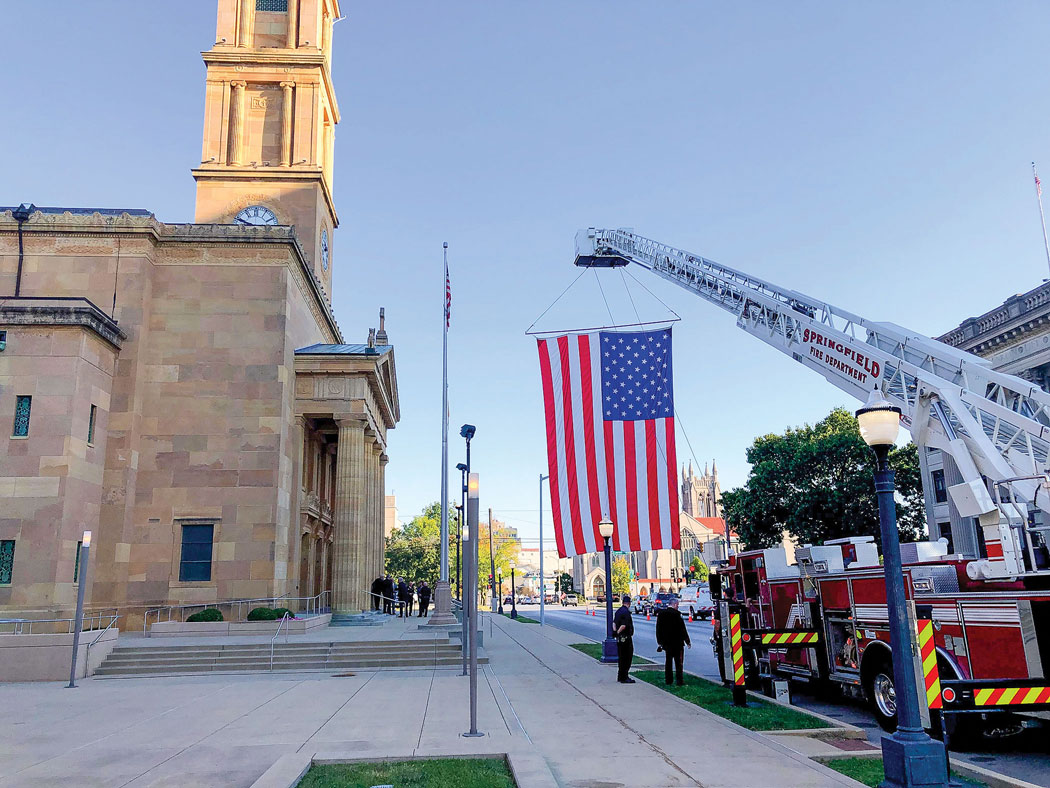 First responders risk their lives daily to provide services for their community. This risk is done with commitment and admiration. Out of sincere respect and appreciation for the sacrifices made by these committed public safety officials, the Blue Mass is being held to celebrate the service of first responders and to pray for their safety and continued diligence in all their good work. The Blue Mass is to provide spiritual assistance to these men and women of all faiths who consistently put their lives on the line to ensure the rule of law and safe society.
Bishop Thomas John Paprocki will celebrate the Blue Mass for first responders Sept. 27 at the Cathedral of the Immaculate Conception in Springfield at 9:30 a.m.
First responders and their families are invited to attend as well as the lay faithful to show their support and pray for our brothers and sisters on the front lines.
Following the Blue Mass, Brendan Kelly will be the featured speaker at the Cathedral, presenting his talk, “The most important tool.” Kelly is the Director of the Illinois State Police, a former St. Clair County State’s Attorney, a former Surface Warfare Officer for the U.S. Navy, and graduate of the University of Notre Dame and the St. Louis University of law.
International Catholic speaker, Chris Stefanick, coming to Effingham

 By ANDREW HANSEN
Editor
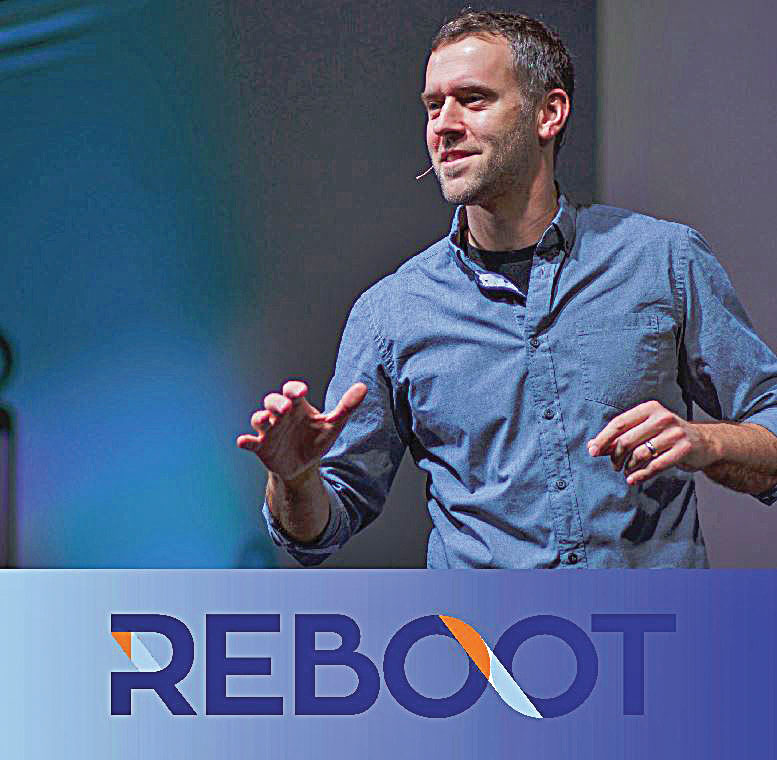
Chris Stefanick, an internationally acclaimed Catholic speaker, author, and TV host will present REBOOT!, an experience of learning how to better apply the beauty and genius of the Gospel to every aspect of life at the Effingham Performance Center Nov. 2 at 7 p.m.
It won’t be Stefanick’s first appearance in the Diocese of Springfield in Illinois. A packed crowd of more than 700 people welcomed him to the Cathedral of the Immaculate Conception in Springfield in 2019.
“A lot of people associate Catholicism with a particular issue, a particular teaching, or our beautiful rituals,” Stefanick said. “All that stuff is part of it. But, the heart and center of this faith and of life itself is the love that God the Father has for us and our call to respond to that in the way we live our everyday lives.
“Jesus didn’t come to say, ‘To make them boring.’ He said, ‘I came so they might have life and have it to the full. And I told you these things so my joy may be in you and your joy may be complete.’ When we rediscover our Catholic faith as that love story, that makes life beautiful, and honestly, it’s the most attractive thing in the world. It’s the best thing ever,” Stefanick said.
You can purchase tickets ($30-39) at reallifecatholic.com.
Women of diocese invited to October one-day retreat to experience the power of Christ in scripture and sacrament

All women of the diocese are invited to a day of reflection, relaxation, and rejuvenation as the Diocesan Women’s Ministry hosts another one-day retreat for women who want to deepen their spiritual lives by coming to receive God in Scripture and the sacraments. Called “Vessels,” the one-day event will take place at the Villa Maria Retreat Center on Lake Springfield on Oct. 8 from 8:30 a.m. to 4 p.m.
The Diocesan's Women's Ministry is hosting the day recognizing that women need time away to not just refresh but to receive sustenance by focusing on helping women discover their identity in God and what He wants to give to women in the seconds, minutes, and hours of their days.
The Oct. 8 event is the second of three in the Vessels retreat series this year, although if you did not attend the first retreat, you can still attend this one. The Oct. 8 retreat, “Vessels: Filled,” features speakers Janet Kehoe and Msgr. David Hoefler. You can also mark your calendar for Dec. 3 as the third installment in the Vessels retreat series, “Vessels: Poured,” features speakers Sister M. Karolyn Nunes, FSGM, and Father Brian Alford.
Through talks, reflections, individual prayer time, Mass, confession, and social time, the October retreat will touch on a woman's journey of becoming filled with the Holy Spirit. The December retreat focuses on pouring it all out for the glory of God.
Women who attended the first retreat described the day as “definitely a God send, (where I) met new friends and enjoyed the fellowship,” and, “It was an experience of joy, holiness, and goodness!”
The cost is $35, which includes materials, drinks, coffee, snacks, and lunch. To register, go to www.dio.org/vessels. For questions, contact Sister M. Clementia Toalson, FSGM, at or call (217) 698-8500.
Hey, Father! When did plenary indulgences start in the Catholic Church?

When did plenary indulgences start in the Catholic Church? Where in the Bible can plenary indulgence be found?
- Stan Obert, Liberty, IL
Stan, if you’re willing, I would like to answer your question about when indulgences started, and where their background can be found in the Bible, by means of a quick walk-through of salvation history. To begin with a basic definition: indulgences are a gift, and grace, that remits the temporal punishment due to a sin, which has already been forgiven but not rectified, that the Church gives for some pious action.
To explain the first part — about sin’s temporal punishment — we take our time machine back four or five thousand years. Humanity decided to disobey God. It wasn’t our best moment, and we’ve kept up the terrible practice ever since, with horrible consequences for ourselves and pretty much the entire cosmos. Sin, the name we give to this constellation of selfishness, distrust, imprudence, and hatred, has left its damage on the world around us, and the world within us (and we don’t seem much closer to a homegrown solution than we were then). Notice that this sin needs to be forgiven, absolved, but it also needs to be fixed, healed, and justice needs to be restored. This second reality is what Christ accomplished on the cross and gives through His Church in what we call indulgences.
Now, this claim — that the Church has been given this authority — needs to be demonstrated, and for that we turn to about 3,000 years ago. God’s favorite insignificant gaggle of tribes recently returned to the fertile crescent after a few hundred years eating onions and making bricks in Egypt. They are not particularly unified and are often governed by unsavory warlords, but they claim, unprecedently, that there is only one God, and that they are in a covenant relationship with Him. After Saul, David, Solomon, and a handful of other good and bad kings, Hezekiah, a decisively good king, fills us in on the secret to being a king faithful to this one God: choose virtuous stewards. Seriously! Saul fell into witchcraft and Solomon into idolatry, because they didn’t listen to good advisors, whereas when David sinned, Nathan the prophet called him out for it, and he repented. Hezekiah at first had a selfish, ungodly, steward named Shebna, but removed him to choose a good and righteous man named Eliakim, and the king and kingdom were then holy, as they were supposed to be.
Now, 1,000 years later, only 2,000 years before today, Jesus stood in Capernaum and taught his Apostles about forgiveness, a radical forgiveness that must begin brother to brother, must be extended again and again, and a forgiveness He entrusted to them as the leaders of the Church so that His Kingdom would be holy:
“Truly, I say to you, whatever you bind on earth shall be bound in heaven, and whatever you loose on earth shall be loosed in heaven” (Matthew 18:18).
Christ, the King, uses the language of stewardship from Hezekiah to entrust to His Apostles His own authority: to reconcile people to God when they have repented of their sins. It is this authority that the Church has carried ever since, using it through the sacrament of confession and in indulgences, unbinding people from the weight of their sins by the healing mercy and justification of Christ.
OK, we’re now left with the final part of our definition, and a final trip back through time and Scripture. We have seen the consequences of sin, God’s response of mercy, and the authority of the Church, but what about the pious actions the Church links to indulgences? Is this just the Church putting up the merits of Christ and His saints for sale? Let us return to a scene right after the one in Capernaum. Jesus shows his Apostles how to give His merciful love to someone.
“If you would enter life, keep the commandments.” ... The young man said to him, “All these I have kept. What do I still lack?” Jesus said to him, “If you would be perfect, go, sell what you possess and give to the poor, and you will have treasure in heaven; and come, follow me.” When the young man heard this he went away sorrowful, for he had great possessions” (Matthew 19:17, 20-22).
Forgiveness/mercy is a gift for the sake of communion. If someone rejects communion with Jesus, even the Lord Himself cannot force mercy into their heart, and neither can His Apostles. For this reason, from the earliest ages of the Church, those given Christ’s mandate to forgive looked for signs of interior openness on the part of the penitent to live in accord with that re-gifted friendship with Christ. What are some of those exterior evidences? Going to confession, receiving holy Communion, and any number of particular devotions, pilgrimages, works of mercy, and reading the Bible (the Church has hundreds of these so you could do a pious act every day).
Bear with me on a final trip back 1,000 years to see when the word “indulgence” was first coined. It was a fall afternoon in Clermont, France, when Pope Urban II stepped out before an excited crowd after the conclusion of a Church council. On top of everyone’s mind was the split between the Eastern and Western Church of 40 years before and the capture of Jerusalem and all the holy sights associated with Christ’s life only 20 years before. To heal the divide and recover the Holy Land, Urban proclaimed a relief mission that would traverse the Eastern empire and make its way all the way to Jerusalem. This tremendous effort would, he announced, replace any other penance then weighing on someone for sins they may have committed. So, let us take advantage of these tremendous gifts for our own walk with the Lord, and for those that have passed on before us.
Father Dominic Rankin is Master of Ceremonies and priest secretary for Bishop Thomas John Paprocki, is Vocations Promoter for the Diocese of Springfield in Illinois, and has a license in Theology of Marriage and Family from the John Paul II Institute in Rome.
Family day retreat in Quincy Oct. 22 to help families better connect with God

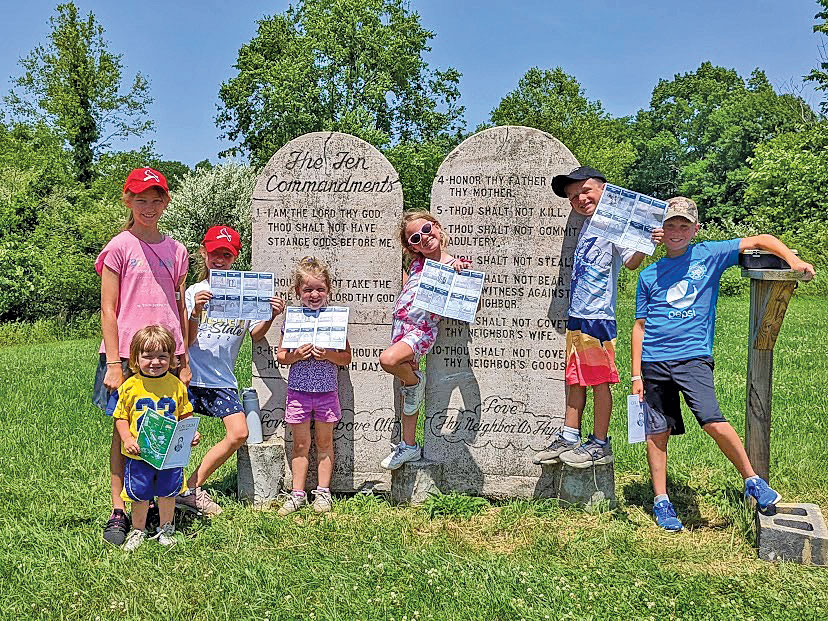 Several Quincy families attended the Holy Family Fest in Ohio last year. This photo was taken during a scavenger hunt taking place throughout the campus of Catholic FamilyLand. The families' positive experience led them to bring a similar experience to our diocese. Quincy Holy Family Fest, a day retreat for families, takes place on Oct. 22 at the Quincy Knights of Columbus campus in Quincy.Families! Looking to connect with God, have fun, and create memories?
Attend family day retreat in Quincy Oct. 22
By ANDREW HANSEN
Editor
QUINCY — Mike Young, a Blessed Sacrament parishioner in Quincy, has attended the Apostolate for Family Consecration's Holy Family Fest in Ohio the past several summers. The grace-filled and fun-filled experience his family enjoyed has led him, his wife, Mandy, and two other families in Quincy to bring a similar experience to Quincy. Quincy Holy Family Fest is a day retreat on Oct. 22 and is geared toward any families wishing to take a day out of the busyness of life to reconnect with God and have fun together.
“There is a daily rhythm to each day of the retreat in Ohio, and we have modeled our day after that rhythm,” Young said. “It's a rhythm of prayer, especially the sacraments, and family fun. Our family has attended the Holy Family Fest in Ohio the past four summers. Our kids have consistently said they would rather return there each year than go on a trip to Disney World! I believe the reason for that is that all kids, and adults for that matter, crave time with God and time with family and friends. As a dad, I know I get too busy and the craziness of everything life throws at me keeps me from reconnecting with God and with my family as much as I should. This forces me to set time aside from the craziness to intentionally do both of those things. And, it has been an incalculable blessing to our family and the families who have attended with us the past three years.”
The day in Quincy will consist of Mass together as families, and then programming/talks geared toward various age levels. After lunch, there will be a variety of activities and games available such as a bounce house, sand volleyball, board games, kickball, bags, and more. During the recreation time, confessions will also be available. The day will end with a family holy hour, including exposition of the Blessed Sacrament, and a family rosary.
“We can look around and see the world is getting crazier and crazier,” Young said. “In particular, the family is really under attack. We need all that the Church has to offer to grow in strength to resist those forces and deepen our relationship with our Lord.”
Quincy Holy Family Fest takes place from 9 a.m. to 5 p.m. on Sat., Oct 22 at the Quincy Knights of Columbus campus (700 S 36th St., Quincy). It’s $40 per household, which includes lunch and a T-shirt for each parent. To sign up, go to tinyurl.com/48hm5xuk. For questions, call (217) 257-0186 or email . The deadline to sign up is Oct. 9.
Photo by Aaron Kerkhoff
What's in a church (Part 2)

What’s in a church?
Objects you’ve seen before but didn’t know the name or rich history/symbolism behind them (part 2)
By RYAN KEHOE and GRANT WILSON
Special to Catholic Times
Photos by Andrew Hansen taken at the Cathedral of the Immaculate Conception in Springfield.
There are dozens of objects used during Mass, seen on the walls of our churches, and found in the sanctuary. Whether it is the name of the object, the history, the symbolism behind why it is used, or how it came about, Catholic Times presents to you interesting facts about objects found in our churches that may make you say, “I didn’t know that!”
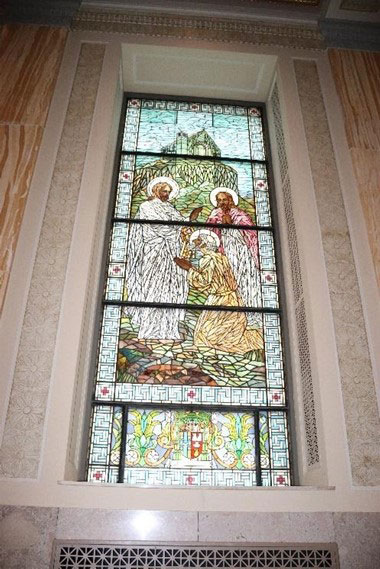 Stained glass windows — These often depict scenes from the Bible, the lives of saints, or some other aspect of salvation history. Primarily, there are three reasons we use this glass in churches. The first reason is functional. Windows allowed the church to be well lit in the ages before lightbulbs. Secondly, stained glass is helpful in catechesis. Before reading was common, depictions were an easy way to provide catechesis. Finally, these windows are meant to be beautiful additions to the space we worship in. The Temple of Jerusalem from the Old Testament was filled with beauty, and it drew the people of God to Him in wonder and awe. Like the Temple, our churches are to be filled with beauty and, in this case, the beauty of stained-glass windows is meant to inspire us and draw us deeper into the divine mysteries.
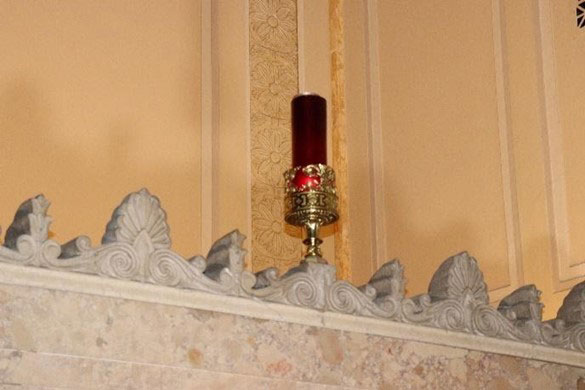 Sanctuary lamp — The Church teaches and believes that Jesus Christ is truly present Body, Blood, Soul, and Divinity in the Eucharist. In Catholic churches, Jesus is therefore present to us in the tabernacle for our prayer and adoration. The sanctuary lamp points to his true presence in the tabernacle. Historically, lamps were used to give light to help people find their way or to convey information by signaling to another person. The sanctuary lamp does the same for us. It is meant to signal to us that Jesus is present in the tabernacle, and He is the light that will guide our path to Heaven. This lamp also has connections to the Old Testament (Exodus 27:20-21) when God prescribed that a lamp burn visibly in the Temple to signify His presence.
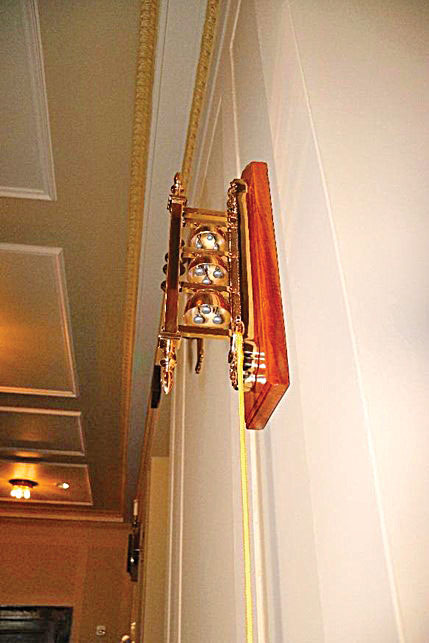 Bells — These bells found on some church walls are rung to signal to the congregation that Mass is starting. Bells have a long history in the Catholic Church. In monasteries and towns, large tower bells would be rung to announce the time for Mass. This was especially important since there were no watches or clocks to announce the time.
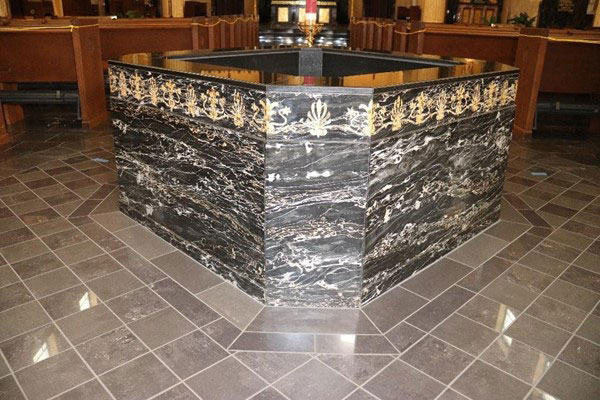 Baptismal font — Baptism is the first of three sacraments of initiation, through which men and women become incorporated into the mystical body of Christ. This sacrament comes directly from the commission of Jesus to the Apostles when He sent them out to the whole world to spread the good news of his saving love (see Mark 16:15-16, Acts 1:1-5, 8). Baptism is performed when water passes over the brow of a person’s head and the minister of the sacrament says the words “I baptize you, in the name of the Father, and of the Son, and of the Holy Spirit.” Once a person is baptized, he or she is a member of the Body of Christ (1 Corinthians 12:12-13), a child of God, and an heir to the Kingdom of Heaven (CCC 1213). From the earliest days of the Apostles, we hear that Christians were baptized by use of water (Acts 8:36, 1 Peter 3:20-21). Many fonts always have holy water in them which we use to bless ourselves by making the Sign of the Cross. When we do this, it should remind us that we are children of God and members of Christ’s Body who are called to become saints.
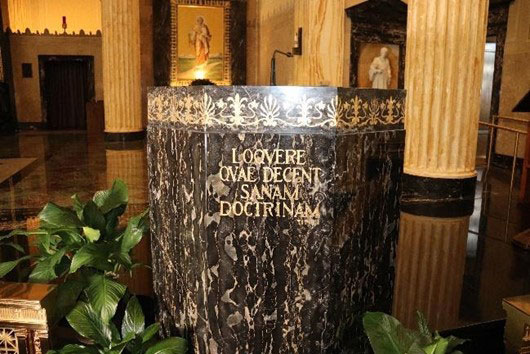 Ambo — During Mass, the readings from Sacred Scripture are done from the ambo. The word “ambo” comes from Greek meaning “high place.” At Mass, the readings, Psalms, and the Gospel are proclaimed from this small “mountain.” Matthew 5:1-2 tells us that Jesus went up the mountain and taught his Disciples from there. Likewise, Moses brought the Word of God to the people from Mount Sinai, and the priest then, like Jesus, teaches from the “mountain” through his homily.
 Tabernacle —The word “tabernacle” comes from the Latin word tabernaculum meaning “tent.” This is in reference to the meeting tent of the Old Testament where the Ark of the Covenant was kept, where Moses would speak with God (Exodus 33:7-9). In Exodus, we read that the meeting tent was in another area, away from the rest of the camp. Anyone who wished to speak with God would go near it and pray. Similarly, the tabernacle is where Jesus in the Blessed Sacrament and is kept for our prayer and adoration. This is why Catholics genuflect toward the tabernacle. The Blessed Sacrament is the Body, Blood, Soul, and Divinity of Jesus Christ and by genuflecting toward Him, we are showing reverence. Although the use of a tabernacle goes farther back, it was the Fourth Lateran Council in 1215 which required that the remaining Hosts from Mass be kept in a secure well fashioned receptacle.
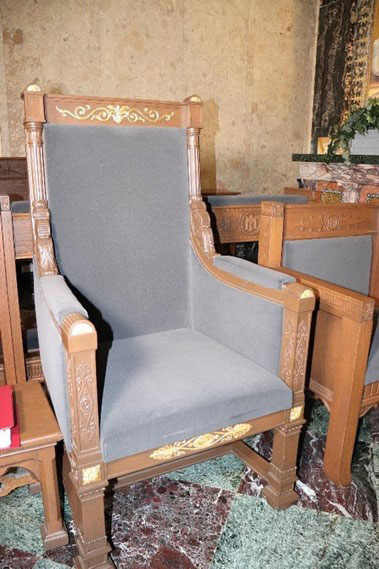 Presider’s chair — The presider’s chair is located in the sanctuary. It is from there that the priest begins and concludes Mass. It is separated from the rest of the community to show that the priest is the leader at the Mass because he stands in persona Christi capitas, in the person of Christ. The chair for the main celebrant of the Mass should be distinct from any others in the sanctuary, but not ostentatious or throne-like.
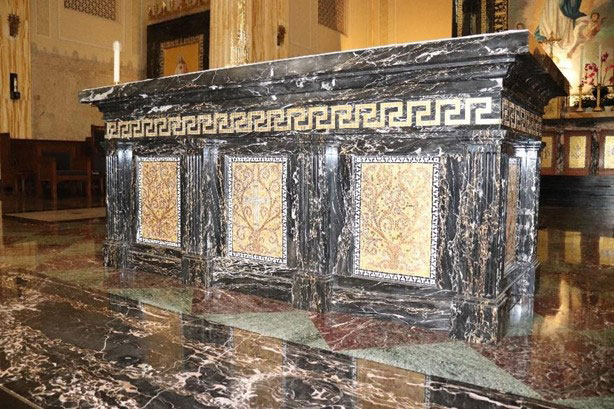 Altar — The altar is where the main action of the Mass happens during the Liturgy of the Eucharist. The Catholic Church has used altars to offer the Holy Sacrifice of the Mass since Apostolic times and their use demonstrates a continuity in our worship and in our understanding of sacrifice as stemming from worship in the temple.
Altars are to be consecrated since they are not normal tables but become the “Table of the Lord” as Paul says in 1 Corinthians 10:21. Some altars contain the relics of saints. When the first Christians worshipped in secret, the altars they used were the stone tombs of the martyrs. To this day, many churches continue to offer the Sacrifice of the Mass on top of the relics of those who have offered their lives to God to imitate the early Christians.
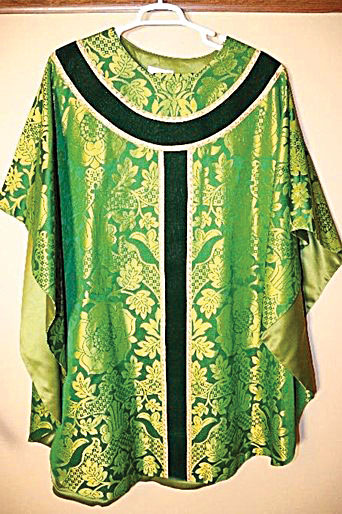 Chasuble — The chasuble is one example of vestments that are worn by ministers at Mass and the celebration of the sacraments. Each vestment at one time had a practical societal use but are now adopted by the use of the Church and given symbolic meanings. The chasuble worn by a priest or bishop at Mass is the outermost garment worn and is symbolic of charity which is put on over all other things.
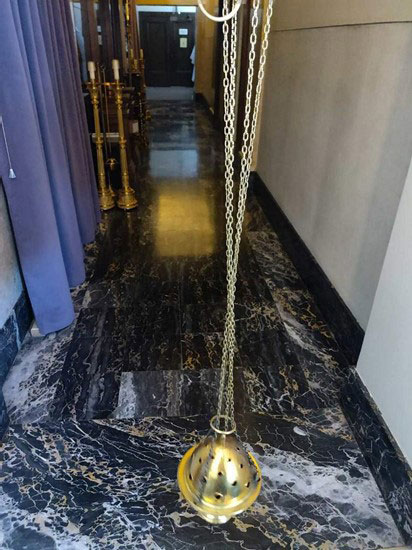 Thurible and incense boat — A thurible is a sturdy metal container on the end of a chain of which inside, are burning coals used to melt and burn the incense, creating smoke and a pleasant fragrance. The priest, deacon, or altar server will swing the thurible during certain parts of liturgies, such as before the reading of the Gospel or during the Consecration. The smoke symbolizes the prayers of the faithful being taken up into Heaven.
Incense adds an element of mystery to the Liturgy. For example, when the incense is burned, it fills the church with a smokey mist that hangs in the air. This is connected to the vision of Isaiah (Isaiah 6:1-4) in which he “saw the Lord sitting upon a throne” with angels in attendance filling the room with praise of Him and smoke. The whole scene described by the prophet is mysterious, and when incense is used in the Mass, we should recall this scene and the opening words of the priest at Mass where he calls the Mass “the Sacred Mysteries.”
Finally, incense has been used over the centuries as part of sacrifices and offerings. In Psalm 141:1-2, it says, “Lord, I call to you; hasten to me; listen to my plea when I call. Let my prayer be incense before you; my uplifted hands an evening offering.”
Hey, Father! Can I take communion at a non-Catholic church?

As a Catholic, if I were to attend another church service that is not Catholic and they distribute communion, is it OK if I receive communion there? Can my Christian friends receive Communion at a Catholic Mass, for example, at a wedding?
Paul in Springfield
Whereas many Protestant denominations allow Christians who are not members of their denominations to receive communion in their services, the Catholic Church does not. Because many do not understand the reasoning behind this, some people feel offended by the Church’s insistence that only Catholics (and, in some instances, Orthodox Christians) receive the Eucharist.
The Most Holy Sacrament of the Altar is called by several different names, as considered in paragraphs 1328-1332 in the Catechism of the Catholic Church. One of these names is holy Communion “because by this sacrament, we unite ourselves to Christ, who makes us sharers in his Body and Blood to form a single body” (CCC, 1331). After all, the word communion itself means “union with.” The Catholic Church only allows those who are her members — those either baptized into the Catholic Church or those who have been received into her through the profession of faith — to receive the Eucharist. If she allowed those who are not united with or in the Church to receive the Eucharist, she would seem to acknowledge something that is not true.
As Catholics, we know that the Eucharist is the very Body and Blood, Soul, and Divinity, of Jesus Christ. We know that the Real Presence of Christ effected in this sacrament does not cease once the celebration of the Mass is finished. This is why we worship the Eucharist, “genuflecting or bowing deeply as a sign of adoration of the Lord” (CCC, 1378). When a Catholic says, “Amen” to “The Body of Christ” and/or “The Blood of Christ,” he or she acknowledges the Eucharist to be the very Body and Blood of Christ — and not a mere symbol. At the same time, a Catholic acknowledges and accepts the teachings of the Church and maintains communion — unity — with the Church. This is something a non-Catholic cannot honestly say.
Most Protestants (even non-denominationals) do not believe that holy Communion is the very Body and Blood of the Savior. If one of them said, “Amen” to “The Body of Christ,” he or she would commit a lie. Even if a Protestant does believe that holy Communion is the very Body and Blood of Christ, he or she could still not honestly say, “Amen” to “The Body of Christ,” because he or she has no real intention of maintaining unity with the Catholic Church. If he or she did, one would either be taking part in the Rite of Christian Initiation of Adults or would already be Catholic. Because the Catholic Church respects the beliefs of our non-Catholic brothers and sisters in Christ, we do not share Communion with them because we want them to remain men and women of integrity.
The same discipline applies when a Catholic attends a non-Catholic service at which a communion ritual is celebrated. Just as non-Catholics cannot receive Communion in the Catholic Church, Catholics cannot receive communion in non-Catholic services (regardless of what the Protestant denomination teaches). The only exception to this is in the Orthodox Churches, who have maintained a valid priesthood, something no Protestant community has done. If a Catholic received communion in a Protestant service, the Catholic would be professing unity with that religious body, something that is not true.
It is because the Catholic Church loves and respects all people that we do not share Communion with those who are not in union with us. This discipline derives, in part, from the clear teaching of St. Paul, who says, “Whoever, therefore, eats the bread and drinks the cup of the Lord in an unworthy manner will be guilty of profaning the body and blood of the Lord … . For anyone who eats and drinks without discerning the body eats and drinks judgment on himself” (I Corinthians 11:27-29).
If a non-Catholic does believe what the Church believes about the Eucharist, the Church would gladly share holy Communion with him or her. All such a person needs to do is enter into the full communion of the Church established by Christ the Lord.
- Father Daren J. Zehnle, JCL, KCHS, is pastor at St. Augustine Parish in Ashland, director of the Office for Divine Worship and the Catechumenate, and judge in the diocesan Tribunal.
Dominican nuns of the Monastery of Mary the Queen move into new home in Girard

 Bishop Thomas John Paprocki stands with the Dominican Nuns of the Monastery of Mary the Queen on Aug. 15, the day he celebrated Mass and dedicated the church and alter at their brand-new monastery in Girard.
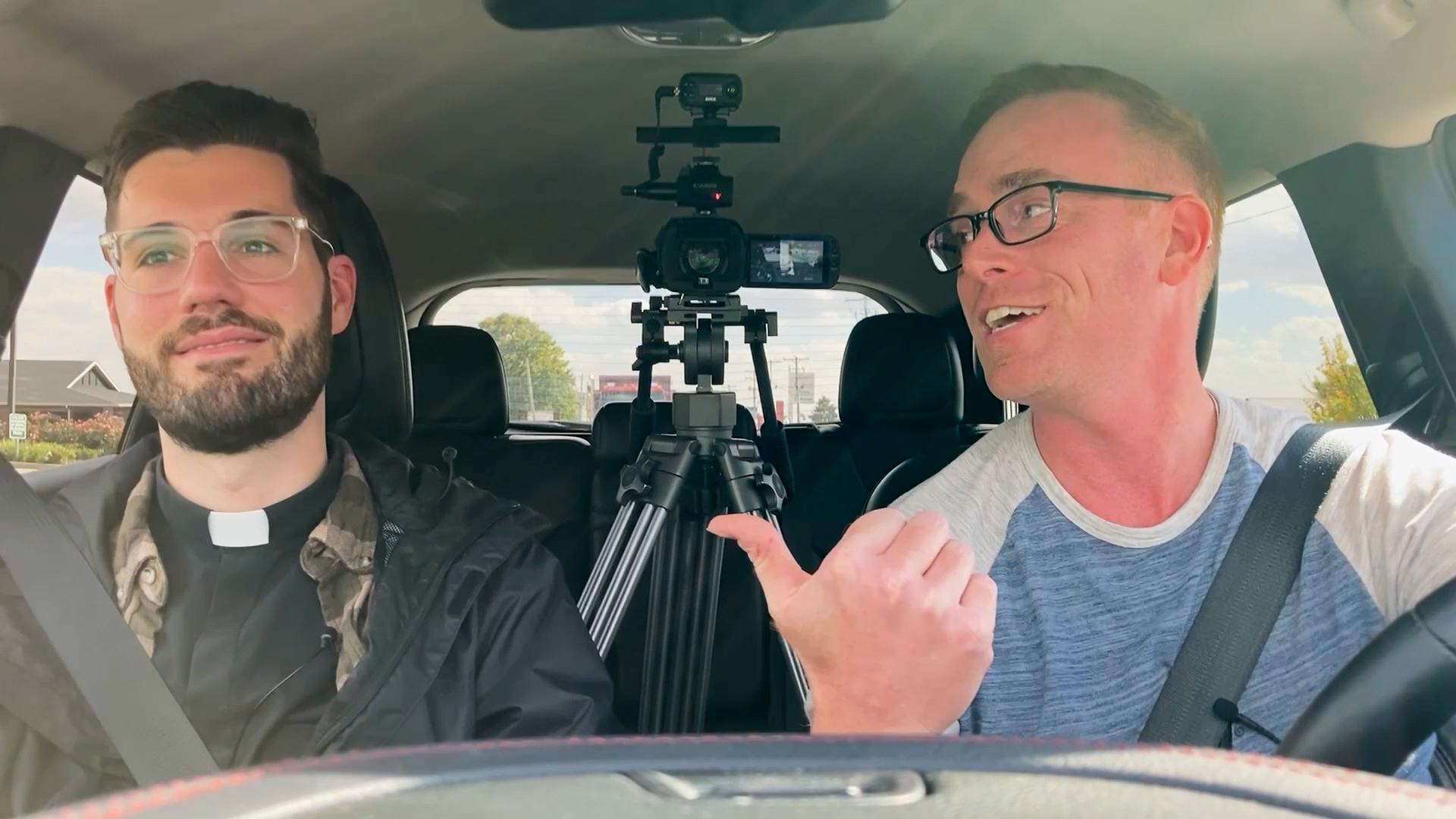 Dominican nuns of the Monastery of Mary the Queen move into new home
Guests are welcome to visit monastery, attend Mass, walk the grounds, talk with the sisters
By ANDREW HANSEN
Editor
GIRARD —Tucked away in the silence of corn fields and beautiful woods in rural Macoupin County outside Girard, sits the new home for the Dominican Nuns of the Monastery of Mary the Queen. Years in the making, the nuns have been praying, waiting, and trusting to get to this joyful day. It’s the first Dominican monastery in Illinois.
“I am very grateful that the Lord chose this spot for us,” said Sister Anna Marie Pierre, OP, the prioress of the community. “It’s just quiet and calm, and the fact that it is so far away from the hustle and bustle, yet people can get to us.”
In July, the community hosted public tours of their new monastery and on Aug. 15, the feast of the Assumption of Mary, they welcomed Bishop Thomas John Paprocki to celebrate Mass and to dedicate the church and altar.
“My dear Dominican Nuns, the Lord has given Himself to you in many ways, not least of which are the blessings of this glorious day,” Bishop Paprocki said in his homily. “Truly, this day is a gift to all of us from Our Lord! My simple reminder is that the greatest of all God’s gifts is when He gives Himself to us, and that every moment of His silence is a treasured occasion when He renews that gift. Never underestimate how much of a gift this is! Creation was brought into being with a thought of love. The Incarnation happened with a whispered ‘yes.’ Our redemption was accomplished when Christ bowed His head and laid down His life. The consecration at Mass occurs with the silent outpouring of God’s Spirit upon the bread and wine. Finally, God’s plan for all of us, to carry us body and soul into everlasting friendship with Him, was marvelously, but mutely, prefigured when He assumed His mother into eternal glory. God’s greatest works in our hearts will also happen in silence. The simple question that He asks us each day: ‘Will you let my silent Love dwell in your heart?’”
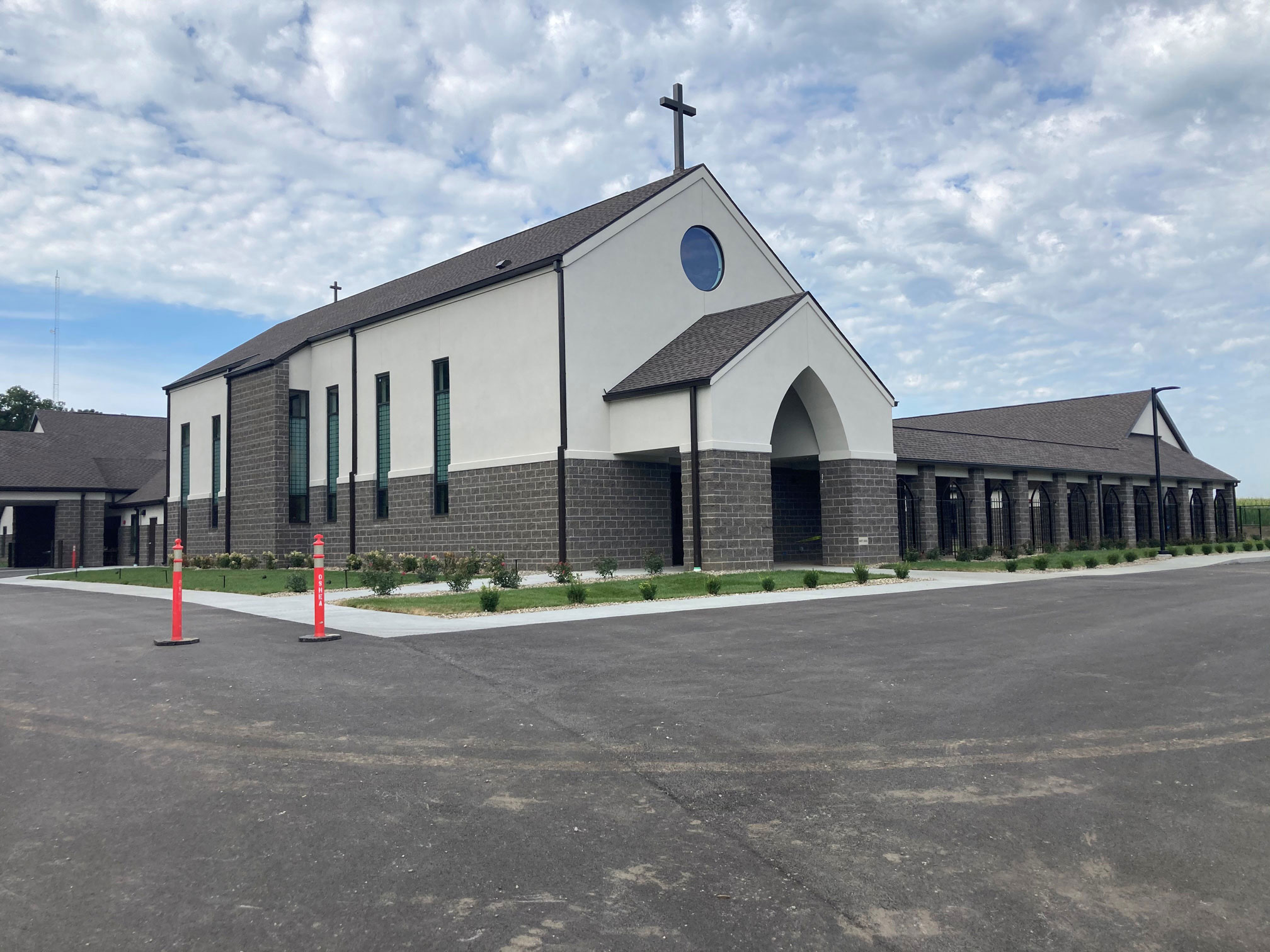 “What we want to do is encourage the faithful to take the daily demands of their lives and take time away from that and just come here,” Sister Anna Marie said. “We can create such a fellowship with them, even their kids. We can encourage the kids to learn the faith properly just by witnessing to them, the art of being silent, and probably engage with different schools to bring the kids to the parlor to teach them and bring them to the chapel with their teachers — have that kind of rapport where they come in contact with nuns again.”
The Dominican nuns have 16 sisters who now call this new monastery home, which was built by O’Shea Builders of Springfield. Sister Anna Marie says they are thankful to the Dominican Sisters of Springfield who have allowed them to live as guests at their motherhouse on Monroe Street over the past several years.
“With the Dominican Sisters, that bond that we created there with them, they have become such an integral part of our lives that we feel — we always talk about the Dominican family — we have created that,” Sister Anna Marie said.
While the new monastery will not offer directed retreats, guests are invited to the property daily to attend Mass, use the chapel for prayer, talk with the sisters about things going in their lives, and walk the grounds, which includes nearly 40 acres of woodlands and a lake, which you can fish.
The Dominican nun’s lives are structured around a rhythm of prayer, both liturgical and personal. Living a contemplative monastic life, their days also include study, penance, and witness. They also take time for recreation and learning new creative pursuits.
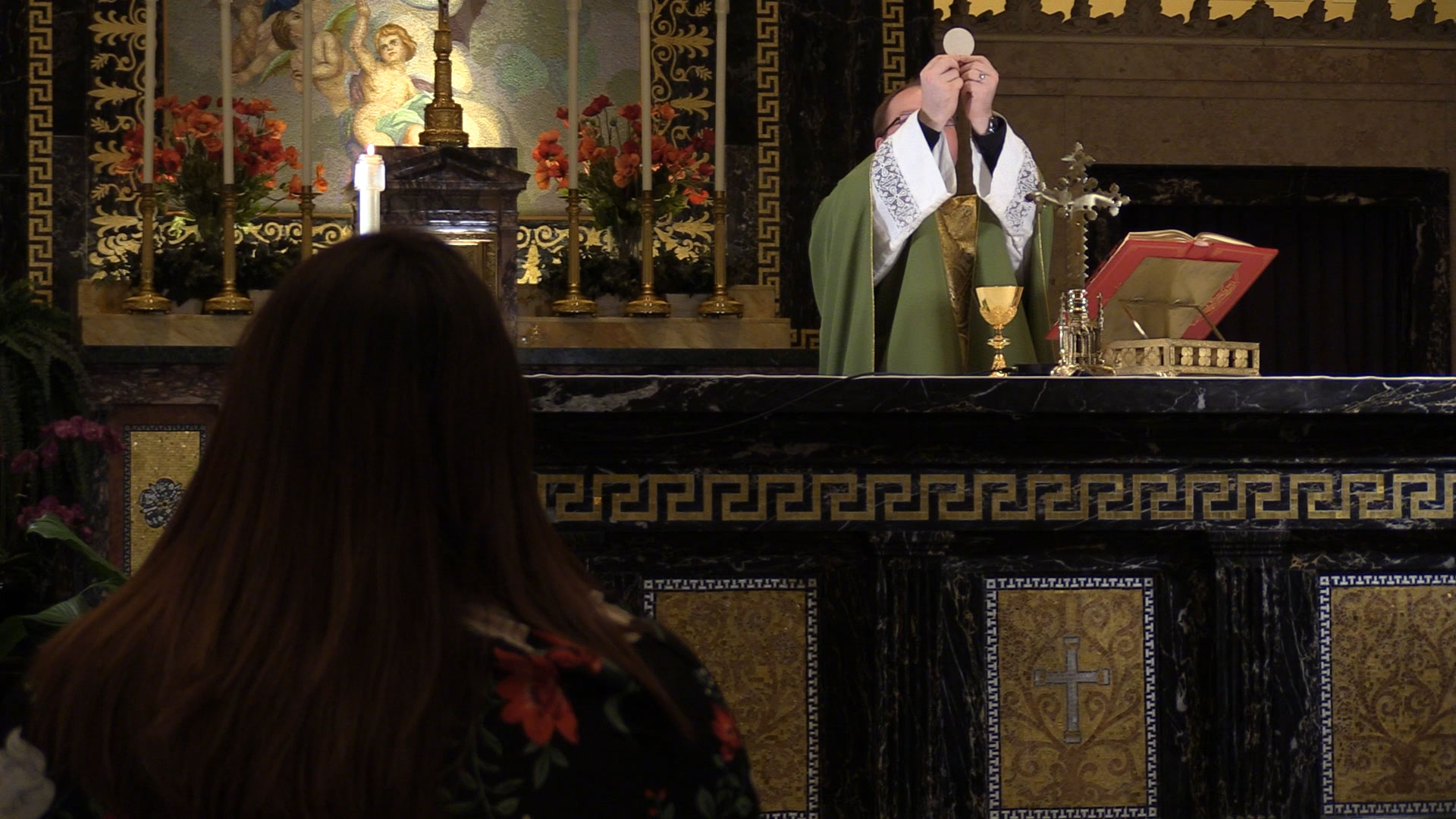 The words “sister” and “nun” are oftentimes used interchangeably by lay people, but there is a distinction. Sisters are more visible to the outside world. Examples include teaching in schools or taking care of patients as a nurse. Nuns, on the other hand, are cloistered and have limited contact with the outside world.
“Whenever we go out and meet people, they are so shocked that they say, ‘Oh my goodness, it has been so long since I have seen a nun. Are you for real?’” Sister Anna Marie said. “Now they can come here and realize that this was not a pipe dream. It took a long time, but this is a place for them. When they see us and come to a place like this, they can think of our life, reminding them that there is more to life than this. It’s about the Kingdom to come.”
The community is still figuring out when Mass will be offered and other schedules of their days, so make sure to check their website opnunsil.org for that information as they continue to get settled. You can also donate to their mission. The nuns also eventually plan a gift shop. You can visit the Dominican Nuns of the Monastery of Mary the Queen at 15635 Greenridge Road in Girard.
Dominican Sisters of Springfield open 150th anniversary year with festive liturgy

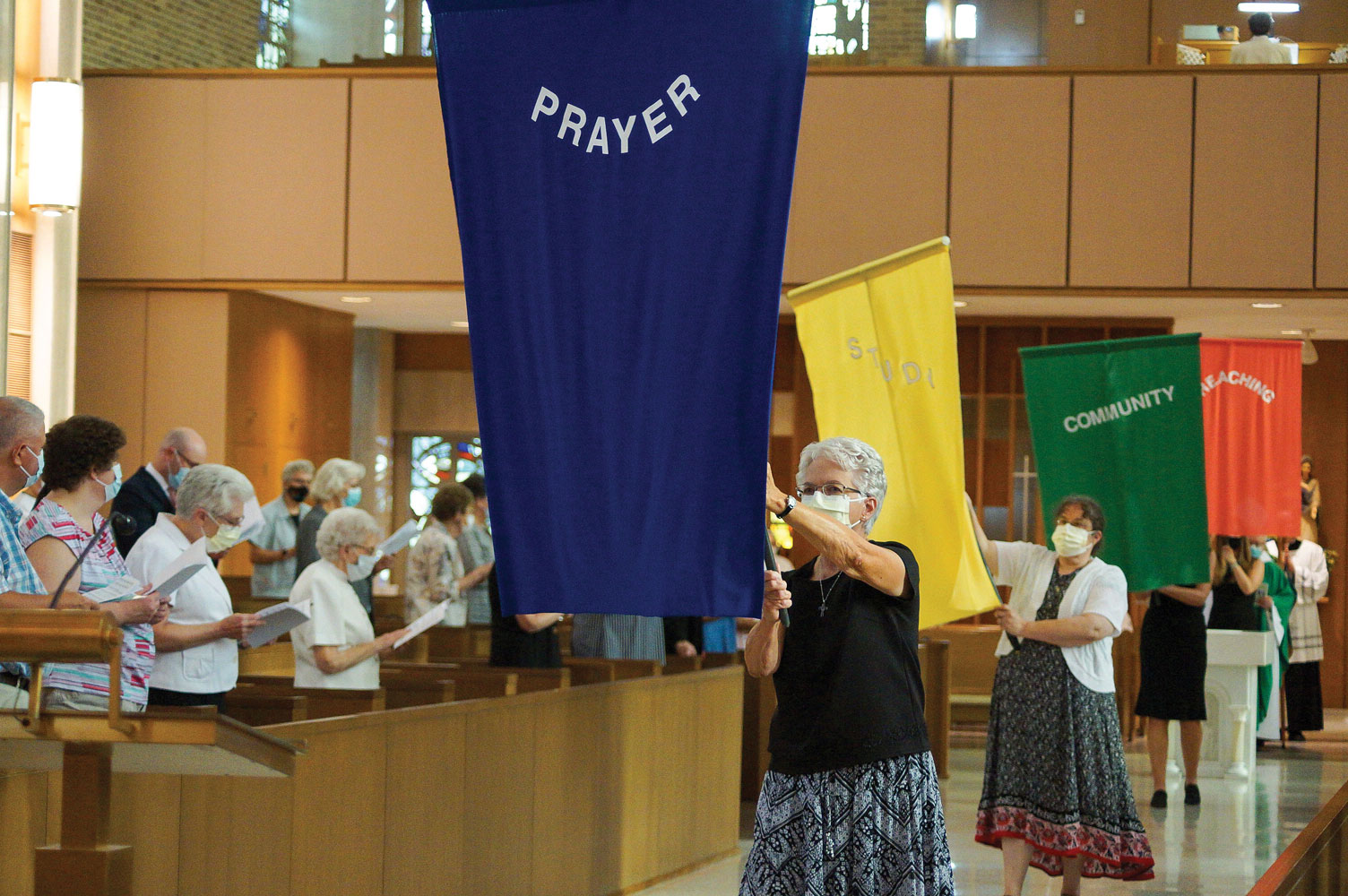 Sisters process through a congregation of Springfield Dominican Sisters and associates, nuns, and laity, carrying banners representing the four pillars of Dominican life: prayer, study, community, and preaching. A yearlong sesquicentennial celebration of the founding of the Dominican Sisters of Springfield began Aug. 19 with a Mass celebrated by Bishop Thomas John Paprocki from Sacred Heart Convent Chapel at their motherhouse. Over the next year, the community will host multiple prayerful and celebratory events, culminating in a public eucharistic celebration on Aug. 19, 2023, to mark the 150th anniversary of the arrival in Jacksonville of the pioneer sisters in 1873.
“Looking back over the span of our history is an exercise in gratitude, humility, and awe,” said Sister Rebecca Ann Gemma, OP, the prioress general of the congregation. “I am grateful to those six women who, with 48 hours’ notice, said ‘yes’ to a mission they could never had imagined. I am humbled by God’s continued fidelity. I stand in awe of the mission to which we are called for the life of the world.”
In the past, being in solidarity with the rostros concretos — as it is expressed in Spanish — meant building educational and healthcare institutions to serve a growing nation of immigrants. With the institution-building phase of the U.S. Catholic Church’s story now long past, an authentic response to the world’s needs looks different that it did in the 19th century.
In 2014, when he declared a year dedicated to consecrated life, Pope Francis told the Church’s religious women and men, sisters, brothers, and priests, to “Come out of yourselves and go forth to the existential peripheries.” He asked religious women and men to go to those who have lost all hope, feel abandoned, without purpose, and “thirsting for the divine.”
Since 1873, Dominican Sisters from the Springfield-based congregation have done just that at hundreds of ministry sites in 21 states and multiple locations in Peru.
“This time of prayerful contemplation on our history is as much about looking toward the future with hope as it is about reflecting back on a storied past,” Sister Rebecca Ann said. “As it was for our founding sisters 150 years ago, our mission of standing in solidarity with persons on the peripheries of our nation, church, and world is ongoing and responsive to the needs of the world today.”
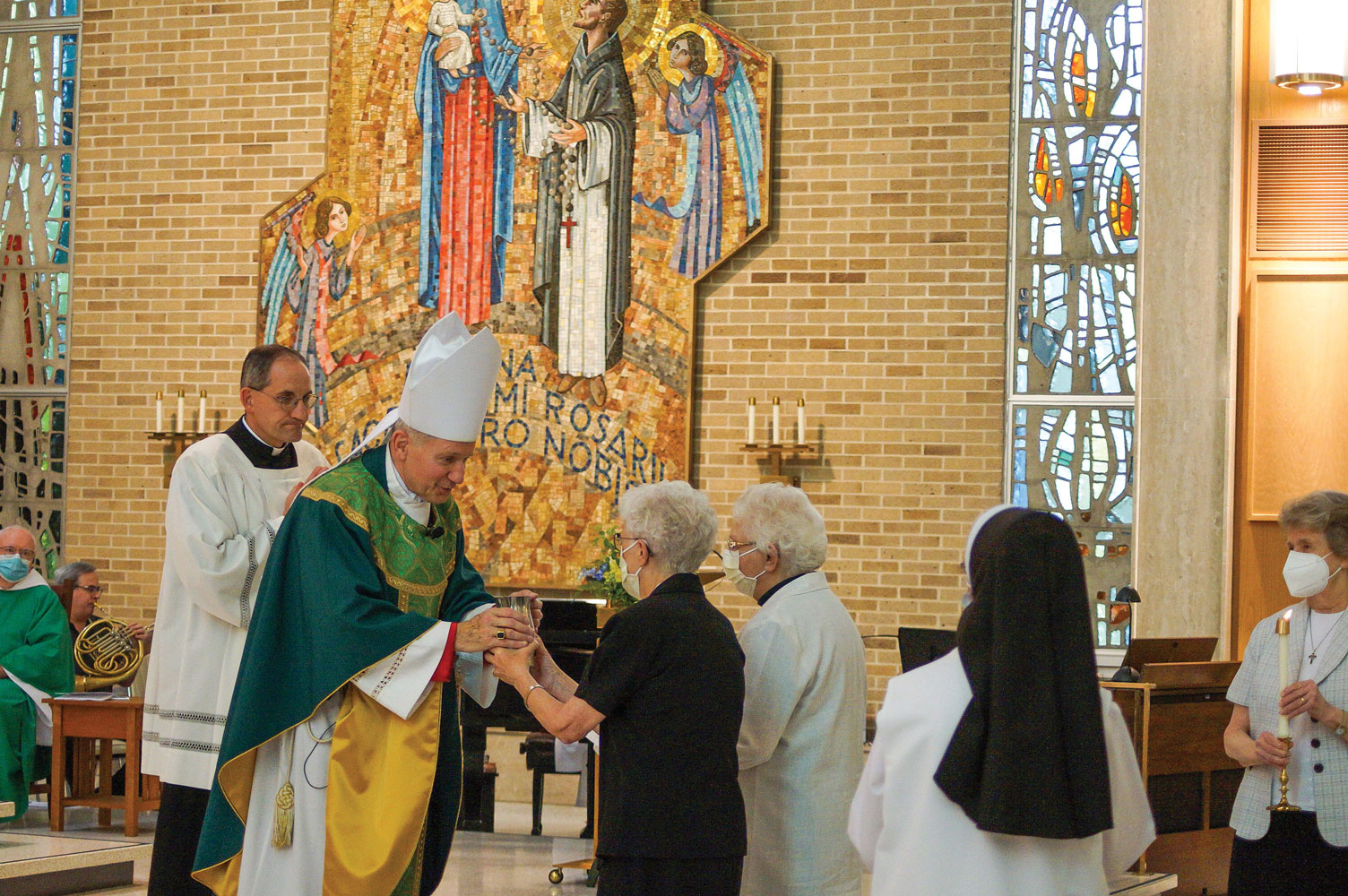 Sister Rose Marie Riley, OP, and Sister Rose Miriam Schulte, OP, right, present the gifts to Bishop Thomas John Paprocki at the altar. Current ministries on the peripheries include education and advocacy for racial justice, immigration reform, accompaniment of Native Americans, and literacy education centers. Springfield Dominican Sisters are engaged in the support of asylum seekers, persons with mental illness, and children living in impoverishment. Though no longer sponsors of health care institutions, Dominican Sisters continue in healthcare ministry as hospital chaplains, home visitors, clinicians, lab technicians, and providers of nursing care.
In addition, the educational mission begun by the founding sisters continues on through three sponsored high schools, two literacy centers, a program of formation of associate candidates, and in multiple other ways of educating, forming, and supporting the faith journeys of individuals, families, and parish communities.
Since 1999, when the sisters took responsibility for Jubilee Farm on Springfield’s western border, the congregation has grown increasingly active in educating and advocating for personal and policy changes that will mitigate the climate crisis and support a healthier planet. The sisters and their associates are active participants in the Vatican’s Laudato Si’ Action Platform.
In 2022 the sisters have been among several dozen communities of women religious to broaden the reach of the global synod of the Catholic Church, an ongoing process initiated by Pope Francis to transform the way the church approaches self-governance and its mission of evangelization.
“It would be impossible to try to enumerate the many places where the Dominican Sisters of Springfield have served over the years, but suffice it to say that thousands upon thousands of souls have been touched by your faithful witness to the Gospel, sharing the Good News of Jesus Christ by word and deed,” Bishop Paprocki said during his homily. “In a diocese with significant tracts of farmland, the image of sowing seeds is one that it is fitting, for through your service, you have sowed seeds in the soil of many souls, especially young people, seeds which, with God’s grace, have grown and borne fruit in ways that you will not fully appreciate this side of Heaven. For that reason alone, you can look to the past with great gratitude and joy, knowing that the Lord has used you as His instruments in helping to build up the Body of Christ in this section of His vineyard.”
Visit springfieldop.org/150years for more about the Springfield Dominican Sisters’ response to God’s call, their history, and all the events planned for the anniversary celebration throughout the year.
Submitted photos
Catholic schools welcome a dozen new principals

By DIANE SCHLINDWEIN
Managing Editor
As the 2022-2023 school years gets under way, one Catholic high school and 11 Catholic grade schools in the Diocese of Springfield in Illinois are relying on new principals to lead the way into the future. On Aug. 2, those individuals gathered at the Catholic Pastoral Center in Springfield to meet with Brandi Borries, superintendent of Catholic schools, as well as other diocesan representatives, to prepare for the upcoming school year and their new leadership roles.
Borries was happy to meet with the new principals and has this to say about them, “We are excited to welcome 12 new principals to leadership in our diocese. They bring a wealth of experience and connections to their schools. With much gratitude to our teachers, staff, and all of our administrators, who have been tireless in their efforts in recent years, we are looking forward to another fantastic year full of faith, fun, and academic excellence.”
Let’s visit with the new principals and see what they have to say about their lives and how they aspire to make a positive impact on their staff members and students.
 Lisa Berhorst
Blessed Sacrament School
Quincy
The new principal of Blessed Sacrament School in Quincy is Lisa Berhorst. She is excited to have just begun leading 20 staff members and 215 PreK-8 students.
Berhorst has a bachelor’s degree in finance and accounting from Culver-Stockton College, an MBA degree from Mississippi State University, and a master’s degree in early childhood administration from National Louis University.
She has been the director at 10th Street Children’s Academy in Quincy as well as an adjunct professor at Culver-Stockton College.
Berhorst says she is looking forward to what her new job has to offer — and what she has to offer her staff and students. “This role will allow myself to grow our student’s faith in everyday life,” she said.
Berhorst and her family are members of Blessed Sacrament Parish. She and her husband B.J. have seven children — two at Quincy Notre Dame High School and five at Blessed Sacrament.
 Brooke Bjorkman
Holy Family School
Granite City
Brooke Bjorkman is the new principal of Holy Family School in Granite City, where she is leading a staff of about 16 to 18 individuals and approximately 160 students in PreK to eighth grade. She has her bachelor’s degree in elementary education from Saint Louis University and her master’s in educational leadership from SIUE.
Bjorkman began her career teaching second grade in Mehlville School District before moving to Arizona where she taught grades 1-3 for the Tempe School District. After four years of teaching in Arizona, she moved back to the St. Louis area where she was able to stay home with her children for 10 years, and attained her master’s degree. She then worked part-time as a reading specialist in the Collinsville School District before moving to Florida, where she taught children in grades K-5. “At the end of the 2021-2022 school year, I had the opportunity to move home,” she said. “At that time, I am honored to say I was hired as the new principal of Holy Family Catholic School.”
As a principal she feels passionate about guiding her school to be successful, both academically and spiritually. “This is an ever-changing and complex world we live in; it is important that our students are prepared through their faith to navigate the obstacles ahead of them,” she said. “I deeply believe in every individual in my care and am driven to keep Christ at the center of our academic days.”
Bjorkman says she is the proud mom of five vibrant kids — two that are freshman at SIUE, one that is a high school junior and two that are beginning their freshman year of high school.
 Jennifer Brummer
Our Lady of Lourdes School
Decatur
Jennifer Brummer has been hired as the new principal of Our Lady of Lourdes School in Decatur, where she is heading up a staff of about 25 individuals as well as 220 students in grades Pre-3 through eight. She has a bachelor’s degree in elementary education from Illinois College and a master’s degree in education administration from Grand Canyon University.
Brummer has been the assistant principal at St. Teresa High School in Decatur for the past three years. She was the junior high science teacher at Our Lady of Lourdes from 2010-2018. She has also taught science for the Pana School District, at Franklin Middle School in Springfield, and at Warrensburg-Latham Junior High.
A member of Our Lady of Lourdes Parish, Brummer says through a variety of life experiences, God has been preparing her to be a Catholic school principal. “All my paths keep leading me back to Our Lady of Lourdes Catholic School,” she said. “I am equipped with the faith, passion, commitment, drive, grit, and history that it takes to be an effective leader. One of the many blessings of being in a Catholic school setting is feeling closer to God through interactions with others, enabling me to strengthen my own Catholic faith and identity and allowing me the opportunity to share my beliefs and witness with the students, families, and faculty in our Catholic school community.”
Brummer says one of her favorite quotes is, “God’s gift to you: potential. Your gift to God: developing it.” She said, “Being the principal at Our Lady of Lourdes Catholic School will help me continue my quest of getting the most out of the potential God has given me and I pray that my influence will help those around me to do the same.”
Brummer and her husband, Mark Brummer, have four children. Morgan is a 2021 graduate of St. Teresa; twins Matthew and Joseph are seniors at St. Teresa; and their youngest, Julianne, is a fifth-grader at Our Lady of Lourdes.
 Gwen Burch
St. Norbert School
Hardin
Gwen Burch has accepted the position as principal of St. Norbert School in Hardin, where she is leading five teachers and 56 students in grades K-8. She has a bachelor’s degree in accounting and business management and leadership from Blackburn College, and a master’s of business administration from Quincy University.
Burch says that leading St. Norbert reminds her that she has come full circle at the school. “I had the pleasure of attending St. Norbert School as a child, and the lessons learned, especially those relating to faith formation, I have carried throughout my life,” she said. “I have closely observed and been involved in operations of the school as a parent of two current students, in addition to having served for several years on the advisory board and support club.
“Having served in those roles, combined with my experience managing the operations of our parish office, I believe will allow for a smooth transition wherein I will be able to effectively administer the operation of our school. I am excited for this opportunity to lead St. Norbert School. I look forward to working with our wonderful faculty to provide quality Catholic education for the children of our community.”
Burch continues that she is prepared to do her personal best for the school. “I will do my best, along with the staff, to instill in our students the values of our Catholic faith, and to continue the legacy of our school whereby our students have gone forth from our halls to be shining examples of scholarship, leadership, and service.”
Burch and her husband, Charles, live outside of Kampsville, with their two daughters, Charlee who is in fifth grade, and Greta who is a third-grader. They are members of St. Francis of Assisi Parish in Hardin.
 Michael Carlson
St. Patrick Catholic School
Springfield
After teaching for over 10 years, Michael Carlson says he is looking forward to leading the 65 students in grades PreK-5 and 12 staff members at St. Patrick Catholic School in Springfield.
Carlson, who has his master’s in religion and literature from Yale Divinity School and a master’s in English from Eastern Illinois University, says his background in teaching humanities subjects in Catholic and private schools will help him to help others.
“The mission of Catholic education brings good news to the poor; in the case of St. Pat’s, the students are low-income and hungry for both academic and spiritual truth,” said Carlson, who is a member of Cathedral of the Immaculate Conception Parish. “We live that mission if we treat every St. Pat’s student as Christ in unfamiliar form, inspire their minds to see the ultimate truth, and guide every soul to faith in action. I want to lead St. Pat’s because I believe that this school truly brings good news to our students and their families.”
 Joanne Coady
St. Mary School
Taylorville
Joanne Coady is proud that she is the principal of St. Mary School in Taylorville, the place where she attended when she was a girl. There she is leading 20 staff members and approximately 35 preschool students and 100 students in grades K-6.
“I am a graduate of St. Mary School as well as my children,” she said. “I am actively involved in the parish through singing in the choir, eucharistic minister, RCIA team member, and a PSR teacher, preparing students for sacraments.”
Coady has both a bachelor’s and a master’s degree in special education from Eastern Illinois University, as well as endorsements in general administration and special education supervision from that university.
Coady and her husband, Mark, are the parents of Danielle (deceased), Jennifer, Johnathan, Joshua, Matthew, and Elizabeth. They also have 14 grandchildren and four great-grandchildren.
She spent nine years with Mid-State Special Education, as a teacher of self-contained elementary special education for students in grades 3-5 for eight years, and resource and self-contained teacher for grades 7-12 for one year. Additionally, Coady spent 15 years as a teacher at Central A & M CUD #21, Kemmerer Village Residential Treatment Center for grades 6-12 and then 10 years as principal at that same place.
“My inspiration to become a teacher came from my first-grade teacher at St. Mary’s, so what better way to end my career in education than at the school where it all began. I love what I do and I want to be that same inspiration to my students,” she said. “My life has come full circle.”
 Timothy J. Harmon
Marquette Catholic High School
Alton
Timothy Harmon was named principal of Marquette Catholic High School in Alton after spending part of the 2021-2022 school year as the interim principal. At the school he is leading 45 to 50 faculty members and 415 students. He has a bachelor’s degree in history with a secondary education teaching certificate, a master’s degree in history, and is working on his education specialist degree.
Harmon has been at Marquette since the 2012-2013 school year. “I have held several positions at Marquette, from dual credit teachers, to boys soccer coach, to girls soccer coach, to boys tennis coach, to National Honor Society faculty monitor, to assistant athletic director, to bus driver, to dean of students, to principal,” he said, adding that he always tries to lead by example.
“In particular, I believe it is important for me as principal to show that I am strong in my faith, support the Catholic Church, have a presence in the Church, both through attending Mass and through volunteering,” he said. “I think it is important to lead with compassion. I want to show students, parents, faculty, and staff that they have a leader who cares about them and wants the best for them.
“I want the students to know that I support them through everything they do, not just schoolwork, but friendships, their walk in faith, and their overall well-being. For parents, I want them to know that they have someone who supports their mission for their sons and/or daughters in a Catholic education,” he said. “As for the faculty and staff, I want them to know they are supported in doing their jobs how they need to be done and that I am here for them whatever they may need. I believe that leadership can truly make or break a school and I hope to be a great leader for Marquette Catholic, now and in the future.”
A member of St. Mary Parish in Fieldon, Harmon and his wife, Natasha, have one daughter, Ava, who attends St. Francis/Holy Ghost in Jerseyville.
 Russell Hart
St. John Neumann Catholic School
Maryville
Russell Hart says he is ready for a good year at St. John Neumann School in Maryville, where he is now leading 31 staff members and 240 students in grades PreK-8. His personal education includes a bachelor’s degree in industrial technology from Ball State University, a master’s degree in school administration from University of North Texas, and a bachelor’s in nursing from Wright State University.
Hart was principal of St. Joseph Freeburg for three years, principal of Gibault Catholic High School for 15 years, and for the last three years, has been a teacher at Father McGivney Catholic High School in Glen Carbon.
“Catholic schools are special places because their values do not change, they bring structure and moral direction to all those in the building,” he said. “The opportunity to serve again later in life is a blessing I just could not pass up.”
Hart is a member of Immaculate Conception Parish in Columbia. He and his wife, Diana, have two sons, Brian and Brett.
 Elizabeth Hogg
St. Mary School
Alton
Elizabeth Hogg is the interim principal at St. Mary School in Alton. This year she is leading 25 teachers and over 15 additional staff members, along with 320 students in grades PreK-8.
She has a bachelor’s degree in elementary education and has spent the last 27 years at St. Mary. “This is my 28th year, with 23 years in the classroom and four years as dean of students,” she said.
“St. Mary’s has become a family to me,” she said. “We have a fantastic staff. I feel blessed to have this interim position.”
Hogg and her husband, Jim, live in Alton. They have a grown son who is a paramedic at Alton Memorial Hospital. She is a member of St. Mary Parish.
 Bryan Kenney
Holy Family School
Decatur
Bryan Kenney is leading Holy Family School in Decatur, where he has not only attended, but has also taught in the past. There he is leading 25 staff members and approximately 250 students who are in PreK 3 through eighth grade.
Kenney has his associate’s degree in science from Richland Community College, his bachelor’s degree in applied mathematics from Millikin University, his master’s in elementary education from Greenville University, and his master’s in educational leadership from the American College of Education.
He taught mathematics and was athletic director at Our Lady of Lourdes in Decatur for seven years, taught mathematics and PE at Holy Family for one year, and taught mathematics for two years at Johns Hill Magnet School.
“I have been involved in some way with the Catholic school system my whole life,” he said. “I am a proud Holy Family and St. Teresa graduate, as was my mother. It is my hope that my kids will also be Holy Family and St. Teresa graduates. I have seen firsthand how great a Catholic school can be in providing an excellent faith-based education. Being in a leadership position allows me to work with the excellent staff currently in place to ensure a successful school and future for Holy Family.”
Kenney is a lifelong member of Holy Family Parish. He and his wife, Holly, have two children, Howie, 3, and Rookey, 2.
 J’dah Koger
St. Louis Catholic School
Nokomis
J’dah Koger spent the 2021-2022 school year as assistant principal of St. Louis Catholic School in Nokomis. This year she began her first year as principal of the school, which has 17 staff members and 65 students who are in PreK through eighth grade.
Koger has her bachelor’s degree in radio, TV, and digital media from Southern Illinois University in Carbondale. She is currently pursuing her master’s degree in education administration. She was formerly a teacher’s assistant and a student activities assistant.
Koger is a parishioner at St. Louis Parish and has three children, two who are students at St. Louis School.
 Julie Radel
St. Francis Solanus School
Quincy
Julie Radel is the new principal at St. Francis Solanus School in Quincy, where she is leading 24 teachers and 256 students in grades PreK-8.
Radel has a bachelor’s degree in education from Illinois College and a master’s degree in elementary education with a specialization in early childhood education from Western Illinois University. Moreover, she has 33 credit hours beyond a master’s.
Although she has been teaching first and second grade at St. Francis over the past five years, Radel spent 25 years as a public school teacher, instructing younger students.
“St. Francis is a family,” she said. “Generations are committed to Catholic education. It is such a faith-filled community with a Franciscan tradition.”
Radel is a member of St. Peter Parish. She and her husband, Ted, have a son, Joseph, who is a sophomore at Quincy Notre Dame.
From a quarterback record holder to theology teacher

‘Why are you Catholic?’
How that one question from one special person made Sean Hussey, a record-breaking high school quarterback who played at the University of Illinois, fall in love with the faith, work for the Church, and now teach theology at St. Anthony High School in Effingham
By ANDREW HANSEN
Editor
One thing Sean Hussey is known for at Charleston High School is dominance. A 2013 graduate, Hussey spent many Friday nights tearing apart defenses as a star quarterback. A First Team All-State selection, he holds records for passing yards, touchdowns, and completions in a game, season, and career at the school. After graduation, he then made the University of Illinois football team as a walk-on quarterback before transferring to Eastern Illinois University.
While his mind as a teenager was focused on athletics, he was going through the motions of living our faith. That’s when one special person asked a very simple but profound question that led him on a journey he would never expect, including becoming a theology teacher at St. Anthony High School in Effingham this year.
Catholic Times editor Andrew Hansen interviewed Hussey to share his story of how falling in love with our faith changed everything.
 Q. You grew up in a Catholic household and went to Mass every Sunday and would go to confession, but despite that, you have said during that time in your life, “Your heart was far from God. You had no relationship with Him.”
A. My parents are unbelievable people. “Saints” Kevin and Kathy. They taught me and my four older siblings to love God, and that was clearly the priority of their life. So, I had a really solid foundation of what should be the priority or what should be essential to my life. For whatever reason, especially in middle school and high school, during these high school football days, being Catholic to some degree was important to me. I would lead prayers before and after the game and that would become a tradition, so there was clearly something in me my parents fostered, but I was living this double life. Going through the motions, I didn’t really see, while important, how it (the Catholic faith) really applied to my life. So, on the one hand, professing to be a Christian, but I lived another way and became entrenched in a life of sin, a life of selfishness, and my life was fixed on “all about me.” I’ve heard the more entrenched we are in sin, the more rational it becomes, and that was where I was at in high school.
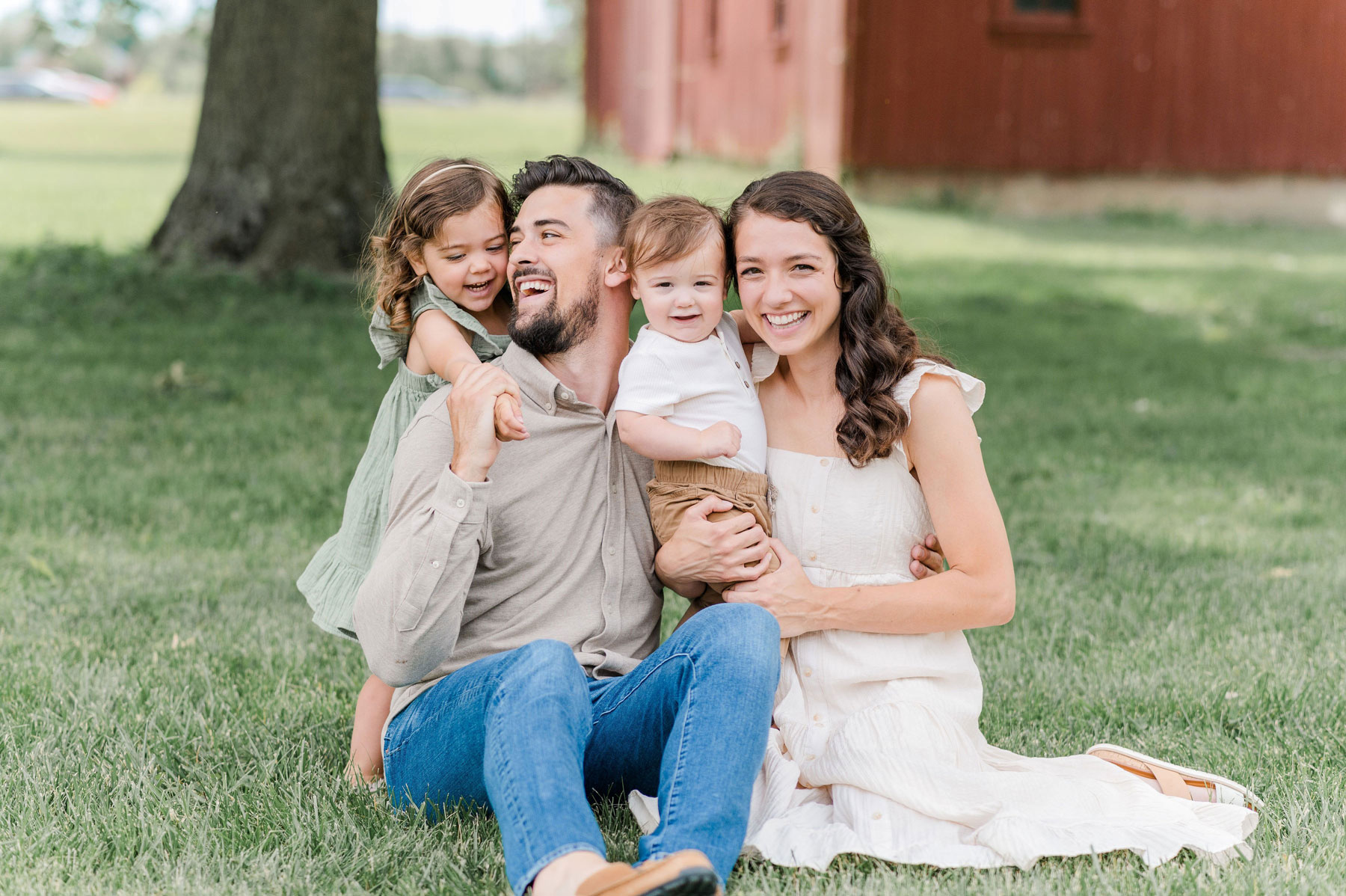 Q. It was your senior year in high school when a question was asked of you from someone you least expected. A classmate, Paige, who was a prayerful Protestant and one you were interested in, asked you, “Why are you Catholic?” Take us back to that moment, what you remember?
A. The more I thought (about that question), the more it hit me. For whatever reason, that was never a question that I ever considered. She loved Jesus, and she was pursuing a relationship with Him, and that was a really clear part about her life, and there was something about her life I was attracted to beyond just her physical beauty, and that was it — that she was different than my other classmates. She prayed every day, and she read Scripture every day, which are two things I never thought of doing.
From her perspective, (asking that question) didn’t come from a place of hostility necessarily. She just didn’t see how somebody could claim to follow Jesus and be a Catholic. So, she wanted to know why I was Catholic.
Do you remember what you said?
Nothing good. I think I said my family is Catholic, and I’m raised Catholic, but I don’t know, and beyond that, I’m not really sure why. As soon as I left (for college), this question was going through my mind, and I started to spend a lot of time thinking about it and diving more into that question.
Q. Tangibly, that simple question then started a whole new journey for you?
A. Because of the foundation I had, I never considered not going to Mass. So, I continued to do that. Meanwhile that summer, I had a real intellectual pursuit of that question, and the first place I did that was reading Scripture for the first time on my own, especially the New Testament. I was very moved by the New Testament and Jesus, the Apostles, and their writings. I was convinced I was seeing Catholicism everywhere. These things that I grew up being taught, things like the real presence of Jesus in the Eucharist, the necessity of baptism, the necessity to confess our sins — all these things I was seeing reading the New Testament. Paige (who I was dating then) was reading the New Testament so I thought this is a great place to start, and we read through it together. As I was having this intellectual discovery, I was having this intellectual conversion. I became not only convinced of Catholicism, but the foundation of Catholicism, Jesus Christ.
I remember some Tuesday morning before workout, going to the chapel on campus, and having my first honest confession. If this is true, and I believe it is true, then my life needs to look different, and what I need first is mercy.
Q. After college, you worked for a parish in the Archdiocese of Indianapolis and then for the diocese itself in ministry. Were you expecting to work for the Church?
A. Early on after that conversion, I never expected it. But there was a person I met who really made an impact on my desire to want to work for the Church, and his name is Norm. I met him actually at the University of Illinois. Norm is a Protestant Christian. Norm really discipled me. Norm was just a model for me on what it looked like to be a disciple. Norm taught me not only to know things about Jesus, he taught me how to follow Him. How to cultivate a daily prayer life, how to read Scripture every day, how to make Scripture an essential part of your life, how to hear God’s voice through Scripture, and how to witness your faith.
That kind of approach is what I became attracted to. I had the opportunity in college to do that with my peers, to meet with people one-on-one, to lead small groups and things like that, and throughout that time, I really felt like the Lord was calling me to that for a career.
 Q. This year, you are teaching theology at St. Anthony High School in Effingham. Why did you choose to teach theology and come back to Central Illinois?
A. The Lord opened some doors to make that happen. I feel like the Lord is asking me to share the Gospel with my life and make sure I am doing that in the context of relationships and certainly what I was doing with the Archdiocese allowed me to do that. I wasn’t really looking to leave the position I was in actually, but at the same time, I got married to Paige, we have two little kids now, and we had been praying intentionally the past couple of years for an opportunity to move closer to Charleston. I didn’t know how that would work out but if God wanted us to come back, He would open up a door. Father Michael Berndt (parochial vicar at St. Anthony Parish), a friend of mine, called me and told me about this position. There were a lot of things that looked like this wouldn’t work out, but all the doors, the Lord opened those, and a great opportunity for us to continue to work for the Church and move closer to home.
Q. So many young adults and teens who are Catholic are not practicing our faith. How do you hope to bring them back as a theology teacher?
A. Pope Benedict XVI said that being a Christian is not the result of being an ethical choice or a lofty idea, but it’s an event, it’s an encounter with a person. I have a relationship with Jesus Christ. I don’t have a relationship with theology. Jesus is who set me free. St. Paul says in Galatians, “It is for freedom (that) Christ has set us free.” More than anything, I hope to introduce students to the person and the work of Jesus Christ. Hopefully anything I say or the theology we study is just a means to an end, a means to encounter Jesus more fully in their life. Hopefully, I can model what it looks like.
Q. You are now married to Paige as you mentioned, who also converted to Catholicism. You have two children. In a culture that is seeing less people get married and so many broken marriages, you two are embracing the sacrament. What has made marriage special for you?
A. Paige is an amazing woman, and I love being married to her because she leads me closer to Jesus every day. That is what marriage is all about. It’s a vocation. It’s something we discern. I have discerned the call to the vocation of marriage. Being married to Paige, we have a responsibility, primarily, to lead each other closer to Christ. it was important for us to get married in the Church because it’s not about us but a unified pursuit of Christ, and together we can help in leading one another and our children to Heaven.
 Q. You are also the host of a popular podcast called Cold Brews and Catholic Truths with more than 15,000 subscribers. Why did you start it, and what is it all about?
A. I felt like I was given certain gifts to teach, and I would love to share some of the things in my own conversion and make a few videos about those things. So, I made a few videos and put them on YouTube. I thought probably no one would see them but some friends and family would and that will lead to some good conversations, and that would be it. Then, COVID shut the world down and we were at home and my wife sat me down and she said that she thinks I have gifts to speak and to share the Gospel and talk about the truth of Catholicism, and I should take that YouTube Channel a little more seriously. Initially, I was not that interested because it sounded like a lot of work, which it is. Providentially, one of those videos I made six months (prior), caught some traction and started to take off on YouTube. It seemed like a clear sign to commit to doing one a week and see how this goes. It was out a desire to share the beauty and truth of Catholicism, and specifically some of the things I have found so convincing that have brought me so much joy to my life as a Catholic.
Q. What is your message to teens and young people today who seem to only care about becoming a celebrity and have become so disconnected from faith?
A. All of those things will pass away. St. Paul says that the things that are seen and are transient are passing. It’s the things that are unseen that are eternal. Our identity is being a child of God. That is the only thing that can never be taken away from us.
Blessed Chiara Badano (1971-1990) was a young teenager, a beautiful woman, was very popular, had a lot of friends, was an athlete, was good at tennis, and had a lot of going for her in the eyes of the world and a lot of these things we seek after. In the midst of all that, she was diagnosed with a terminal brain tumor/cancer. She started to lose all these things she could have defined herself by. She started to lose her physical appearance, she started losing her hair, she started to lose friends and popularity and relationships, and lost her athletic ability. Ultimately, she lost her life. But, in the midst of that tremendous suffering, she was somebody who knew that as good as any of those things are, all of those things can and will pass away, but my identity as a daughter of God cannot. She had this deep sense of joy, this deep sense of peace that no matter what things she lost in this world, she knew she would never lose her relationship with Christ. So, don’t seek after those things. Seek after the Kingdom of God and His righteousness.
Q. So, when you think back to that question Paige asked you in high school, “Why are you Catholic?” what is your response today?
A. Because Catholicism is true. G.K. Chesterton said that there are 10,000 reasons why I am Catholic all amounting to one reason which is that Catholicism is true. I believe that Jesus is God, I believe that Jesus came in the flesh to redeem us from our sins, to reconcile man back to God. The good news is that God demonstrates His love for us and while we are sinners, Christ died for me. I am so grateful for the gift of salvation and the fullness of that gift is given to us in the Catholic Church, the Church Jesus Himself established. He gives His grace to us through the Church and through the sacraments. So, those are the reasons I am Catholic.
Answers taken and edited from Andrew Hansen’s interview with Sean Hussey on Dive Deep, the official podcast of the Diocese of Springfield in Illinois. To hear their full conversation, go to dio.org/podcast or search “Dive Deep” on all the major podcast platforms.
What's in a church (part 1)
Objects you’ve seen before but didn’t know the name or rich history/symbolism behind them
(Part 1 of 2)
By RYAN KEHOE and GRANT WILSON
Special to Catholic Times
There are dozens of objects used during Mass, seen on the walls of our churches, and found in the sanctuary. Whether it is the name of the object, the history, the symbolism behind why it is used, or how it came about, Catholic Times presents to you interesting facts about objects found in our churches that may make you say, “I didn’t know that!”
(Photos by Andrew Hansen taken at the Cathedral of the Immaculate Conception in Springfield.)
 Sanctus bells — These are struck once at the epiclesis when the priest celebrant calls down the Holy Spirit over the bread and wine. The bells are then traditionally rung three times each when the priest celebrant shows the sacred Host and when he shows the chalice following the consecration. This ringing has been a tradition in Catholic churches for 800 years. The ringing of these bells is optional, but it helps signal to the faithful that the liturgy has reached its high point.
 Icon — Traditionally associated with Eastern Christianity, an icon is a sacred image used in religious devotion. This icon was commissioned for the sesquicentennial celebration of the diocese and is entitled The Mother of God, the Life-Giving Spring. Mary is depicted holding Jesus, surrounded by angels and various holy men and women. On her left is the title "Mother of God" and on her right is the title "Life-Giving Spring." Icons are filled with rich symbolism, some of it clearly seen and some hidden.
We call the candles in front of icons and statues "votive candles.” Catholics may make use of votive candles in prayer, asking Mary or a particular saint to pray for their needs. Just as we ask our friends and family to pray for our intentions, so we can also ask the saints to pray for our intentions, since the saints are with God in Heaven.
Paschal candle — This represents the risen Christ whose light has come into the world to scatter the darkness. Each parish purchases a new one each year, and a priest blesses it. It is used during the Easter season and other special occasions, like baptisms and funerals.
Each Paschal candle has a cross, the Greek letters “alpha” and “omega” to show that Jesus Christ is the beginning and end, the one who created everyone and everything; the current year, to show that God is with his people today; and five wax-covered incense grains that are inserted with nails into the candle to represent the five wounds of Jesus on the cross.
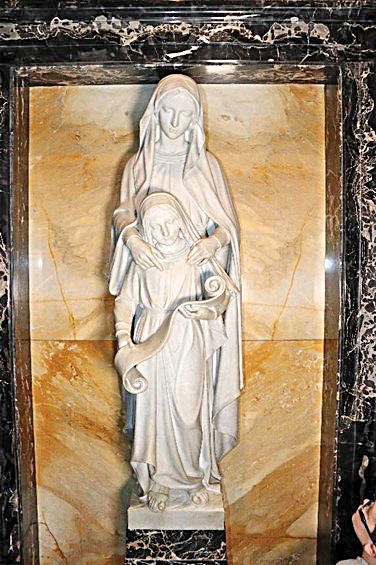 Statues —This is a statue of Mary and St. Ann, Mary’s mother. Catholics put statues of saints in churches, homes, and businesses because, just as we ask our friends and family to pray for us when we need help or support, we ask saints to pray for us. We use statues or images to remind us of their help and presence in our lives. Also, just as people display pictures of family and friends in their homes, Catholics display images of saints because they are our family and friends in Christ.
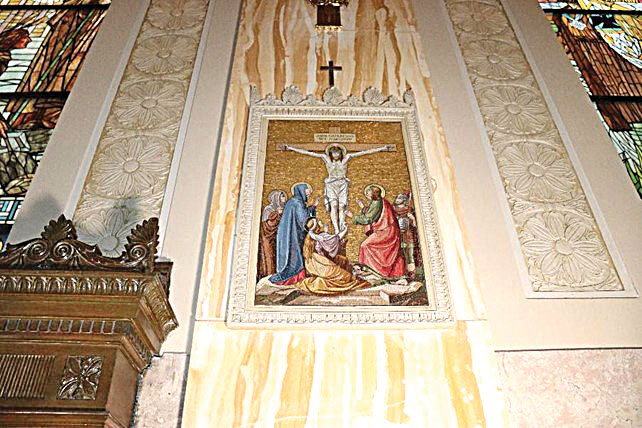 Stations of the Cross — This is a series of 14 images that depict scenes from the day of the Lord Jesus’ passion and death. Done especially during the season of Lent, but at any time of the year, Catholics pray and meditate on these events by processing or walking from image to image. This tradition originated in the Holy Land in the 1400s, where pilgrims followed a certain route and made stops at places where significant events in Jesus’ life happened all the while meditating and remembering his passion and death.
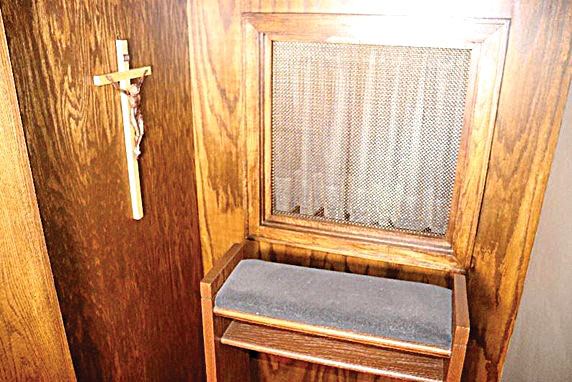 Confessional — Most churches have a small room or kneelers which are built to face each other but which are separated by a wall or other barrier called a “confessional.” This is where Catholics confess their sins to a priest, who acts in the person of Jesus Christ and forgives them. Catholics believe that Jesus delegated the authority to forgive sins to his Apostles, an event recorded in the Gospels of Matthew (16:18) and John (20:22). Jesus gave this authority to priests — to forgive the sins of those who come to confess.
The tradition of confessing sins is mentioned by early Christians, such as St. Irenaeus, who was taught by a disciple of St. John the Apostle; by Origen, a Christian writer from the 200s, and by St. Ambrose, the bishop of Milan, Italy from the 300s, who said that the right of hearing and forgiving sins “is given to priests only.”
 Holy water font — These are usually found near the entrances to a church and have holy water in them which is blessed water by a priest or deacon. When Catholics enter church, they dip their finger in the holy water and make the Sign of the Cross to remind them of their own baptism. Holy water is called a sacramental, a sacred object or action which signifies spiritual effects and helps people to receive the sacraments.
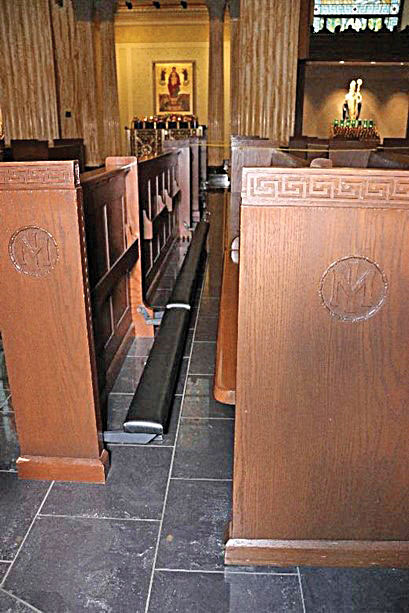 Pew and kneeler — Kneelers were not used in early Christian churches. They are a modern development and have only been a part of the Catholic Mass since the 1500s. During the Middle Ages, the Catholic Church encouraged people to use them during Mass to emphasize each person’s humble position before God.
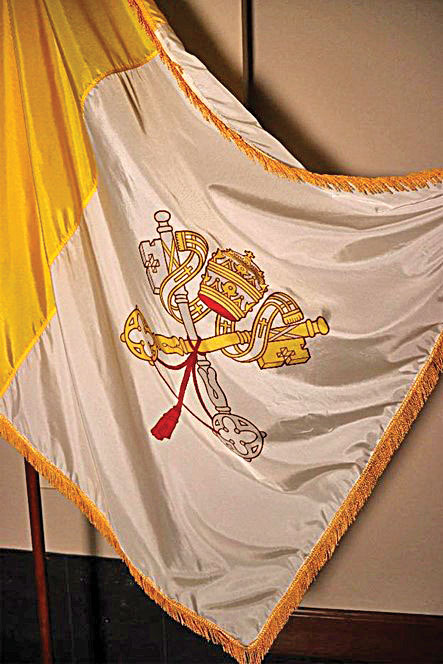 Papal flag — Pope Pius XI adopted the current Papal flag in 1929 when Vatican City became an independent state. It is modeled on the earlier flag used by the Papal States. The flag has the triple papal tiara, the pope’s crown, which symbolizes his authority. Below the crown, there are two keys, one silver and one gold. These represent the keys to the kingdom of Heaven which Jesus gave to Peter. The two different colored keys symbolize that Peter and his successors have both spiritual and worldly power. In many churches, the Papal flag and the national flag can be found.
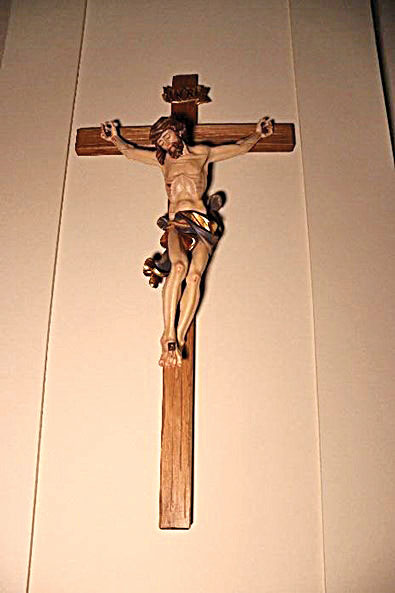 Crucifix — The image of Jesus nailed to the cross is called the “crucifix.” Catholic churches have used this image for over 1,000 years. It is used as a witness to Jesus Christ’s sacrifice and death and to honor what Paul said in his letter to the Corinthians: “We proclaim Christ crucified.” According to liturgical law, every church must have a crucifix on or near the altar.
Hey, Father! Is there a good reason for omitting the Confiteor at Mass?

Why, with already so many of the rubrics and language changes in the New Mass, would there be a good reason for omitting the Confiteor from being said at the Sacrifice of the Mass? (Editor’s note: The Confiteor is the prayer that begins with, “I confess to Almighty God and to you, my brothers and sisters, that I have greatly sinned in my thoughts and in my words … .”
Maxine in Collinsville/Maryville
In the Order of Mass, Mother Church provides three possible options for the Penitential Act (nos. 4-6). The Order of Mass does not indicate if one of the three options is to be preferred over another. The General Instruction of the Roman Missal also does not indicate if one of the options is to be preferred. Rather, it simply says, “the Priest calls upon the whole community to take part in the Penitential Act, which, after a brief pause for silence, it does by means of a general confession. The rite concludes with the Priest’s absolution, which, however, lacks the efficacy of the Sacrament of Penance” (no. 51).
Of these three options, the third form is likely the one with which most Catholics are familiar. The priest invites the congregation to call to mind their sins, after which the priest or the deacon says three invocations directed to Christ Jesus. After each of the invocations, the congregation responds with either “Lord, have mercy” or with “Christ have mercy” (no. 7). This third option does not involve the praying of the Confiteor (the beginning of which, in English, is, “I confess to Almighty God … .”).
The second option provided for the Penitential Act is, for whatever reason, rarely utilized. The priest invites the congregation to call to mind their sins, after which he says, “Have mercy on us, Lord,” to which the people reply, “For we have sinned against you.” The priest then says, “Show us, O Lord, your mercy,” to which the people say, “And grant us your salvation.” Then follows the non-sacramental absolution and “Lord, have mercy. Christ, have mercy. Lord, have mercy.” This second option also does not involve the Confiteor.
In the first option for the Penitential Act, the priest invites the congregation to remember their sins, after which all pray the Confiteor together. Then follows the non-sacramental absolution and “Lord, have mercy. Christ, have mercy. Lord, have mercy.”
Because the liturgical books do not provide a hierarch for these three options, the celebrant of the Mass is free to choose whichever option he prefers. It may be that a priest might choose the first option on more solemn occasions and use one of the other options other days. Regardless of which option a priest uses, we should remember that what the Church allows, the Church allows.
- Father Daren Zehnle is pastor at St. Augustine Parish in Ashland and is the director for the Office of Divine Worship and the Catechumenate for the Diocese of Springfield in Illinois.
Looking back at 25 years of healing and reconciliation in Vandalia

 Our Sorrowful Mother’s Ministry
Looking back at 25 years of healing and reconciliation in Vandalia
By DIANE SCHLINDWEIN
Managing Editor
VANDALIA — It was 1997 when, with a bare bones budget, Debbie Pryor and Vanessa Keck founded Our Sorrowful Mother’s Ministry (OSMM) in Vandalia. What they did have was a fervent desire to provide a place of love and mercy that encouraged reconciliation with one another and with God. Today OSMM continues to flourish, and holds frequent retreats, priests talks, confession, Mass, and has active prayer teams.
Ann Stock, a devoted community member of Our Sorrowful Mother’s Ministry said, “Initially, their goal was to provide knowledge and evangelization to our immediate community and parish. Our pastor at the time, Father Stephen Sotiroff, was very supportive and saw this as what was needed for the parish and even the world to grow in their faith life.”
The ministry has always had the purpose of personal healing for people, she said. “As the years have passed, we have moved on to helping people grow in their interior lives, spiritual growth, forgiveness, and reconciliation with God and others.”
Father Peter Mary Rookey, OSM, was an internationally known healing priest who became a mentor to Pryor and Keck and was instrumental in encouraging them in the beginning of the ministry. Many other priests have provided advice and guidance over the years including Father John Titus, Msgr. Stuart Swetland, Father Bill Casey, CPM, and all the various pastors at Mother of Dolors. Most recently, Father Chad Ripperger has been a mentor and spiritual father to OSMM.
Currently Father Seth Brown, pastor of Our Mother of Dolors Parish in Vandalia and St. Joseph Parish in Ramsey, is the chaplain and spiritual advisor to the ministry. “We are so grateful to have Father Seth here,” said Pryor. “He is a real gift of support and encouragement.”
Pryor adds that they have “been blessed with two holy bishops” who led them to the truth of the Church and have been close advisors. Bishop (now Archbishop) George Lucas led the Diocese of Springfield in Illinois for the first years and now, of course, Bishop Thomas John Paprocki is the diocesan bishop. Bishop Paprocki initiated and carried out the designation of OSMM as a Private Association of the Faithful. He also named and blessed the 6,000-square-feet Sanctuary of the Sorrowful Mother, which was built in 2012.
“The Sanctuary came about because of our need for our own building,” Stock said. “For the first 15 years, we rented the local school buildings and the Mother of Dolors parish center for our retreats. Because of the growth of the ministry, it became apparent that we needed our own building to house all we needed to host those events. The number of books and sacramentals we had also grown, and we needed a place to display them.
“With much prayer, it was discerned that we would build our own place,” she said. “A number of community people confirmed this, but one in particular was in the position to put up the initial finances to get started. With the building well under way, this person became ill and was not able to complete the project. Through the generous support of donors, the building and the ministry in general is able to continue. It all God’s Providence.”
The Sanctuary, where Mass is said and retreats are held, holds about 100 people, and has a reception area, a gift shop, and several side rooms and chapels. The Blessed Sacrament is reserved in the Stabat Mater Dolorosa chapel. There are several other buildings on the grounds including Bethany House, which is reserved for priests to stay during the retreats and also has a chapel where the Blessed Sacrament is reserved; House of Mary and Martha, which is used privately; and House of the Immaculate, which was recently purchased and will be a place where prayer teams meet.
Of course, Pryor and Keck are both still leading the ministry with the help of the OSMM community, a group of people who assist them in a variety of ways during retreats. The helpers are members of prayer teams, handle welcomes and registration, make announcements and introductions, work in the bookstore, provide meals for speakers and other community members, and complete other tasks that help to accommodate participants.
“I think an important thing for people to understand about OSMM is that it is Our Lord’s and Our Lady’s ministry,” Stock said. “We did not begin with a plan. We just took one step and hosted our first event. Then God showed us what was next through people who discerned God’s will or advice from trusted priests.”
Stock says even after a quarter of a century, OSMM is not well known. “Even though we have been doing this for 25 years, we often hear people from our own diocese say they had no idea that this ministry is in Vandalia. People would have to travel all over the country to hear the speakers we have hosted.
“When people visit OSMM, they can expect to meet people just like themselves. People who love the faith and the Church and want to share that with others,” Stock said. “It is a relaxed experience, where people can just come and listen to speakers, come and go as they please. More often, people come and feel the presence of the Holy Spirit here. They find themselves becoming more engaged and speak and visit with community members and often share their faith stories. We have many people who have been coming for years and we know them as friends. We are always welcoming new people and forming lasting relationships.”
OSMM is open only during retreats. “We do have people call and we will meet them there to show them around or shop at our store,” she said. “We have hosted small groups, also.”
Stock says OSMM’s future continues to be in God’s hands. “Whether it was to step out in faith and purchase a building knowing the funds would somehow be provided, or to take another direction with our retreats, it was all through Divine Providence,” she said. “Our response has been open to wherever we are led. Like Mary’s ‘Fiat,’ when God asks us to do something, we do it without question. It has been this way the entire 25 years. There is still no master plan we have for the ministry; we will continue until God tells us to stop.”
For more information about Our Sorrowful Mother’s Ministry, to see a list of their upcoming events/talks, and learn about their retreats, go to www.osmm.org.
Hey, Father! Will people not be in heaven until judgement day?

In the part of the Mass where we recite the Nicene Creed, one line says, “He will come again in glory to judge the living and the dead.” If that be the case, then no one is in Heaven yet because no one will be risen until judgement day?
Ray in Staunton
We cannot earn Heaven — it is by total grace. However, we will be judged by God based on how we have used our free will in this earthly life (cf. Matthew 25:40,45 … “whatever you did or did not do ... ,” among many other citations in Scripture). Catholics believe that there will be two judgements by God at different moments: a particular judgement on an individual basis, which happens immediately after death, and a last or final judgement on a public or all-encompassing basis.
When you die, you will receive what is called a “particular judgement.” The Catechism of the Catholic Church states it this way: “[E]ach will be rewarded immediately after death in accordance with his works and faith.” This means that those who have already gone before us have received their particular judgement from God. Upon death, one’s soul is either sent to Hell immediately or rewarded with Heavenly paradise (either immediately or eventually through purification in purgatory). Therefore, many souls are already enjoying Heaven right now. Eternal life exists without bodily resurrection. The “perfection” of eternal life is the union of body and soul in Heaven (the only two people who have achieved this already are Jesus and Mary).
Put another way, righteous souls who have passed away and that are currently in Heaven are not yet “complete,” however, as they do not have their bodies. We also profess in the Nicene Creed the “resurrection of the dead,” in which our souls will be reunited with our glorified bodies. This is where the Last Judgement comes into place, in which the good we did or did not do in our life will be seen by all (CCC 1038, 1039 and Matt 25:31, 32, 46).
This all may sound rather frightening, but if taken in the right way, it should call us to conversion while there is still time. It should also make us desire Heaven over all earthly things! God desires everyone to be in Heaven, yet some reject His grace. The Church encourages us to hope, pray, believe, and to “stay awake, for you know neither the day nor the hour” (Matthew 25:13).
Father Michael Berndt is parochial vicar at St. Anthony of Padua Parish in Effingham.
Dozens of women honored for building up the Kingdom of God in diocese


They are selfless, faith faith-filled Catholics who are prayer warriors, disciples of Christ, and dedicated to building up the Kingdom of God. On July 23, dozens of women from parishes across the diocese were honored for their outstanding leadership and service to God, the Church, and their parish at The Our Lady of Good Counsel Women of Distinction Mass and Award Celebration at the Cathedral of Immaculate Conception in Springfield. This event was hosted by the Springfield Diocesan Council of Catholic Women (SDCCW).
Parishes in our diocese are invited each year to choose one woman to represent all the outstanding women in their parish. Several priests, deacons, family, and friends of the honorees were in attendance. Bishop Thomas John Paprocki was the principal celebrant of the Mass and presenter of the Women of Distinction Awards.
The celebration also honored several high schoolers with scholarships from the SDCCW. Those include Ava Kessler (Holy Cross Parish in Wendelin), Grace Lynch (Holy Family Parish in Decatur), Jenna Ochs (St. Mary’s Assumption Parish in Sainte Marie), Monica Wendle (St. Mary Parish in Alton).
Alton Deanery
- Peggy Butkovich, Holy Angels, Wood River
- Charlotte Charbonnier, St. Elizabeth, Granite City
- Patricia L. Klasner, St. Ambrose, Godfrey
- Linda Leleniewski, Holy Family, Granite City
- Patricia Mueller, St. Jerome, Troy
- Kathy Jo Parker, Mother of Perpetual Help, Maryville
- Brenda Tebbe, Our Lady Queen of Peace, Bethalto
- Shirley Caperton, St. Elizabeth, Marine
- Benna Denue, St. Boniface, Edwardsville
- Patti Kruegel, Ss. Peter and Paul, Alton
- Delores Bruncic, St. Mary and St. Mark, Madison
- Shirley Landolt, Sacred Heart, Livingston
- Shirley Potthast, St. Lawrence, Greenville
Jerseyville Deanery
- Shelley Becker, St. John Paul II, Mt. Olive
- Cindy Borklund, Holy Family, Litchfield
- Janice R. Charnisky, St. Louis, Nokomis
- Eduvigas “Vicky” Crye, Sacred Heart, Virden
- Julie Goetten, St. Mary, Fieldon
- Teresa Goetten, Holy Ghost, Jerseyville
- Marlene Marten, St. Raymond, Raymond
- Carolyn Masinelli, St. Michael the Archangel, Staunton
- Mary Kay Newman, Ss. Simon and Jude, Gillespie
- Barbara Ryan, St. Agnes, Hillsboro
- Mary Jane Schmidt, St. Mary, Farmersville
- Joyce Vaughn, St. Francis Xavier, Jerseyville
- Denise Linn, St. John the Evangelist, Carrollton
- Rose Marie Tebbe, St. Joseph, Benld
Mattoon Deanery
- Barbara Bierman, St. Isidore the Farmer, Dieterich
- Lori Creek, St. Columcille, Sullivan
- Sue Green, St. Anthony of Padua, Effingham
- Jeanne Gross, Immaculate Conception, Mattoon
- Carole Halloran, St. Aloysius, North Arm
- Lucille (Lucy) Hewing, Sacred Heart, Effingham
- Pat Jackson, Mother of Dolors, Vandalia
- Linda Mertens, St. Thomas the Apostle, Newton
- Jane Plummer, St. Rose of Lima, Montrose
- Valerie Probst, St. Michael the Archangel, Sigel
- Celeste Rogers, Forty Martyrs, Tuscola
- Mardell Sheehan, Annunciation, Shumway
- Judith Vaughn, St. Charles Borromeo, Charleston
- Theresa (Teri) Whalen, Immaculate
- Conception, Shelbyville
- Sue Esker, St. Francis of Assisi, Teutopolis
- Delores Jansen, St. Mary Help of Christians,
- Green Creek
- Patricia Kerner, St. John the Baptist, Arcola
- Debra Kirsch, St. Mary, Paris
- Kathy Staller, St. Elizabeth, Robinson
- Carol Zellars, Our Lady of Lourdes, Oblong
Quincy Deanery
- Tawny Benz, St. Anthony of Padua, Quincy
- Carolyn Briddle, St. Francis Solanus, Quincy
- Marjorie Kendrick, St. Edward, Mendon
- Lorrie Klauser, St. Brigid, Liberty
- Connie Marie Schrage, St. Peter, Quincy
- Millie Venvertloh, St. Joseph, Quincy
- Margaret J. Coon, St. Mark, Winchester
- Mary Jo Ward, St. Mary, Pittsfield
Springfield Deanery
- Nancy Baker, Holy Family, Athens
- Beverly Dortch-Smith, Cathedral of the
- Immaculate Conception, Springfield
- Debra Forbes, St. Maurice, Morrisonville
- Stacie Henderson, St. John Vianney, Sherman
- Michelle Marie Knap, Resurrection, Illiopolis
- Judy Kohlrus, St. Frances Xavier Cabrini, Springfield
- Barb Leaf, Church of the Little Flower, Springfield
- Alice Rose Massey, Our Saviour, Jacksonville
- Jan Mudd, Our Lady of the Holy Spirit, Mt. Zion
- Lois Ryan, St. Mary, Taylorville
- Jinny Sachsenmaier, St. Joseph the Worker, Chatham
- Linda Schmidt, St. Joseph, Springfield
- Frances Sperry, Ss. James and Patrick, Decatur
- Linda Younkin, Christ the King, Springfield
- Mary Lou Walker, Our Lady of Lourdes, Decatur
- Deena Warrick, Holy Family, Decatur
- Jeannette Waters, St. Jude, Rochester
- Rita Guinan, St. Peter, Petersburg

