
Diocesan Administrator Account
Recycled trash becomes cushy mat, warm blanket through Mats for the Homeless ministry in Macon County

 By ANDREW HANSEN
Editor
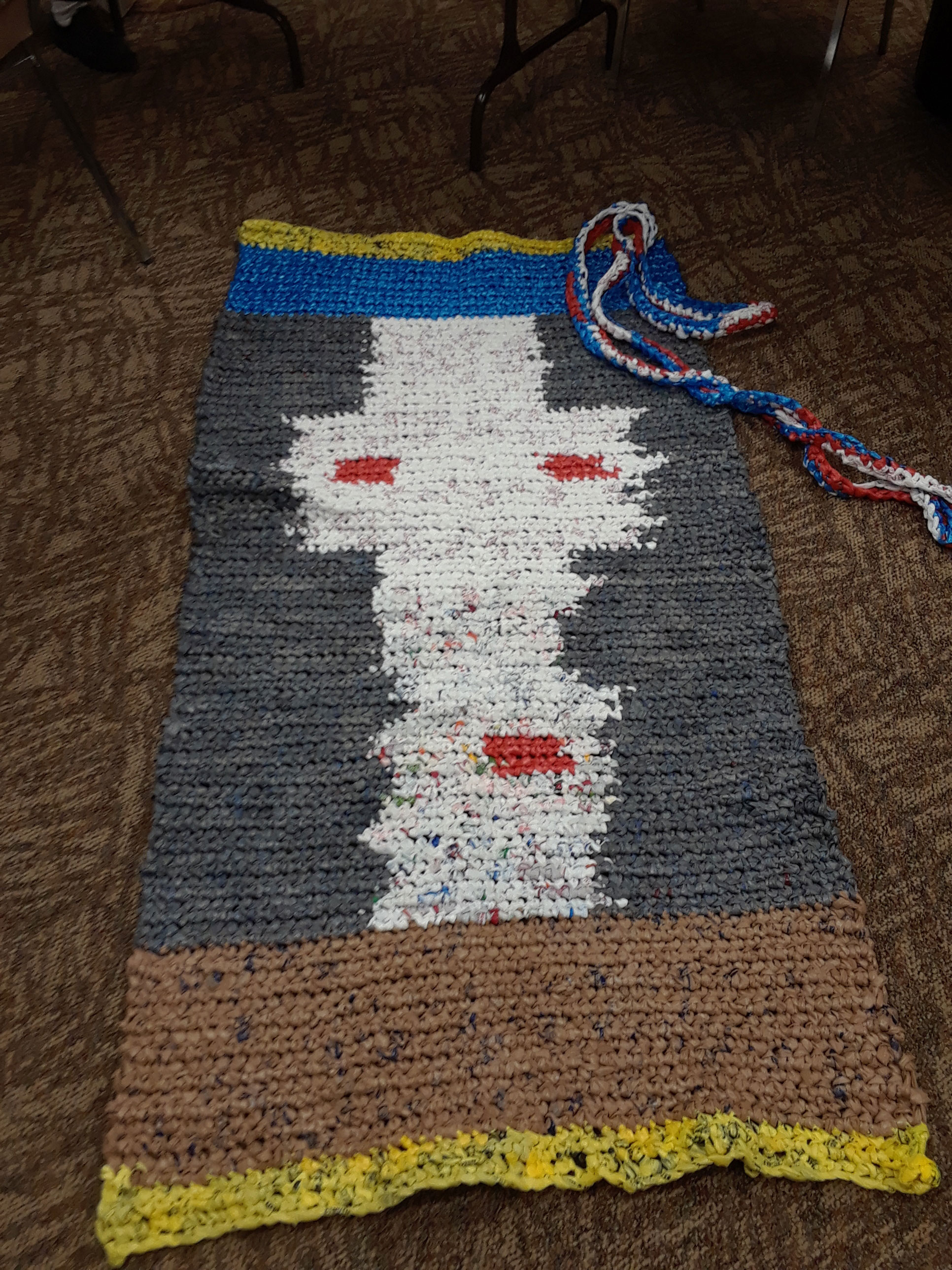
It’s a cold night in Decatur. For those who are living on the streets and cannot find a roof over their head this night, some turn to something else to keep them warm or something soft to sleep on. What they have is made from plastic bags, but not just a few bags, but 700 bags. Most importantly, it’s made with love and compassion, telling the homeless that people do care about them.
Ed and Pat Cirks of Our Lady of the Holy Spirit Parish in Mt. Zion started Mats for the Homeless in 2016. Using their time and talent, the married couple have about 20 people helping now and have recruited about 100 people over the years to take on an intricate and time-consuming ministry, but one that has a big impact and embodies the Gospel message of helping strangers in need.
Here’s how it works: The group collects plastic bags then flattens them, cuts them into three-inch strips, loops the strips into balls, and then crochets it all together into a 3 feet by 6 feet sleeping mat, which can be used as a cushion to sleep on or as a blanket.
“We feel that we are providing some comfort to the poorest of the poor,” Pat Cirks said. “We feel that our time is well spent doing this ministry.”
Each mat of 700 plastic bags takes 40 hours to complete. The group of volunteers will meet typically on a Monday to process everything at the parish and the crocheting is done in each person’s homes. So far, the ministry has made 770 mats for the homeless, which means they have not only helped provide comfort to so many but have helped reuse 539,000 plastic bags.
 Cirks is also pleased to see more people in the community getting involved. This summer, several young girls set up a lemonade stand to raise money for the ministry to buy cutters, rulers, quilting mats, and safety handles.
“Our equipment was getting rundown, especially our blades,” Cirks said.
The girls raised $280. Cirks says any money that is left over will be used by the ministry to purchase towels and winter clothing.
“We desperately need crocheters,” Cirks said as the demand for these mats continues to be there. That also includes plastic bags people can collect and drop off.
“We have collection boxes for plastic bags at Our Lady of the Holy Spirit in Mt. Zion, St. Isidore Parish in Bethany, and the VFW Post 99 in Decatur,” Cirks said. “We deliver the mats to VFW POST 99, Oasis Day Center, The Salvation Army Men’s Homeless Shelter, Northeast Community Fund, Good Samaritan Inn, and Dove.”
Editor’s Note: If you are interested in volunteering to be a crocheter, please contact the Our Lady of the Holy Spirit Parish office in Mt. Zion at (217) 864-3467.
Hey, Father! Do guardian angels really exist?

As one who attended Catholic elementary schools, I was taught The Guardian Angel Prayer and prayed it daily. Do they really exist? Given events like the school shooting in Texas, if they really do exist, they certainly aren't doing their jobs!
Nancy in Springfield
Much of the general public’s knowledge and understanding about angels comes from popular media sources such as movies and television programs. Some of it is accurate while some of it is not. Still, there are those who wonder if angels really exist and if they have any impact in our lives.
The Catechism of the Catholic Church (CCC) tells us that the existence of angels is a truth of faith which is based upon Sacred Scripture and Church tradition (CCC 328). As Catholics, we profess this faith on a weekly basis when we proclaim our Nicene Creed at Sunday Mass. The Creed does not mention angels specifically, but it does allude to them when it states that God created all things that are visible and “invisible” (CCC 331).
Angels are those beings that are unseen and so for the most part, we do not see the angels. However, angels have made their appearance from time to time in Sacred Scripture. Even certain saints such as Padre Pio claimed to have seen their guardian angel. The children of Fatima were addressed by an angel.
The word angel means “messenger,” and there are numerous instances in Sacred Scripture that involve the presence of angels. Sometimes they come under the appearance of human beings, even though angels themselves do not have bodies. They are pure spirits.
There are good angels and bad angels. Satan, the devil, is an angel. He and many other angels of their own free will rebelled against God and were then cast into Hell (Isa 14:12, Lk 10:18, CCC 392-393). They are called demons. Most of the angels, however, remained faithful to God. God sends His good angels to assist, warn, and guide His people (CCC 331-333). Demons, on the other hand, do have the ability to tempt people to do evil things (CCC 395).
These are just a few examples from Scripture regarding the presence of angels (CCC 331-333):
- Angels came to inform Abraham that he would have a son (Gn 18:10);
- An angel guided the Israelites from Egypt into the desert (Ex 14:19);
- Satan tempted Jesus during His 40-day fast in the desert (Mt 4:1-11);
- Angels ministered to Jesus at the end of His fast in the desert (Mt 4:11);
- Jesus cast out demons from possessed persons (Lk 8:26-33);
- The Archangel Gabriel was sent by God to the Virgin Mary to seek her willingness to be the mother of His Son (Lk 1:26-38);
- In a dream, angels guided Joseph to take Mary and the Child Jesus to Egypt (Mt 2:13);
- Angels came to comfort Jesus in the Garden of Gethsemane (Lk 22:43);
- An angel freed Peter from jail (Acts 12:7);
- Jesus said that the angels of children gaze upon the face of God, therefore affirming that each person has a guardian angel (CCC 336, Mt 18:10);
- In Revelation, the Archangel Michael does battle with Satan and the demons (Rev 12-7).
It is sometimes said that if angels are real, and they are meant to help us, why do they not intervene when evil things are about to happen such as murders and suicides? This touches on the mystery of the presence of evil in the world (CCC 309, 385). All evil has its origin in sin, particularly the original sin of Adam (CCC 386-389). This sin was instigated by the evil angel, Satan. The original nature of man was damaged by this first sin and thus the consequent tendency to commit sin, which is referred to as concupiscence is passed on to successive generations down to our present day (CCC 2514-2516). Couple the tendency to sin with free will and you have a precarious combination.
God has given both angels and men the gift of free will (CCC 311, 1704, 1731). Some human beings choose to serve God by obeying his Commandments and living holy lives. The choice to serve God and do what is good brings peace to society, generally speaking. Other human beings out of weakness choose to do bad things which brings about disorder, chaos, and suffering. Good human beings and bad human beings live among each other for the most part. Jesus described this reality in the parable about the wheat and the weeds (Mt 13: 24-30). We can see this reality in our own communities. God respects our free will to make choices. He does not force us or our neighbor to do that which is good. Being a good person and doing what is good is a deeply personal decision. Just like being a bad person is a personal decision.
So, where do the angels come in here? The devil and other evil angels encourage people to do that which is evil, because they hate us and want our souls in Hell with them. God gives the good angels the mission of encouraging people to do good things. But angels, good or bad, cannot force our free will. They can only encourage us one way or the other.
We must be careful not to attribute our decisions to do good or evil entirely to the influence of angels. The individual person must make their own free will choice and unfortunately, some people choose to do bad things and, in some instances, very bad things like starting wars and murdering innocent people.
The spiritual life is a spiritual battle and God has given us good angels to help us in this battle, but the angels respect our personal freedom to choose, even when we make bad choices. The angels are God’s gift to us. We should seek their guidance each day (cf. www.stmaryspittsfield.dio.org, Homily Archives).
Father Mark Schulte is pastor of St. Mary Parish in Pittsfield and St. Mark Parish in Winchester.
Illiopolis woman looks back at 35 years teaching PSR

 Says working with children enriched faith, gave joy
By DIANE SCHLINDWEIN
Managing Editor
When it comes to leading PSR classes, only a few people in the Diocese of Springfield in Illinois can match the years Cathy Mitchell has been teaching in Illiopolis. Whether assisting at a class, teaching, or acting as DRE of Resurrection Parish, Mitchell has been involved with PSR since the early 1980s.
In the beginning, Mitchell was an assistant when her son was in classes at what used to be known as Visitation Parish in Illiopolis. She had decided the best way to get to know people was to get involved with the parish. “I thought I’d like working with the religious ed program,” she said. “I started as a helper in the classes on Wednesday evening. The first class I taught solo was my daughter’s first Communion class. The teacher had retired, and no one wanted to do sacramental prep, so I said I would try.”
Since those early days, she has seen a lot of changes. “When I started teaching the three parishes (Visitation in Illiopolis, St. Joseph in Buffalo, and St. Ann in Niantic) were all separate and doing their own programs,” she explained. “When the parishes combined as a tri-parish, but each had their own church, we still did everything in our own parishes until the three parishes came together under one church. There were some activities we might do together, but classes and sacraments were held in each separate parish.” She says in “the old days” everything was done with workbooks. “Now we use a variety of resources to engage the children more,” she said.
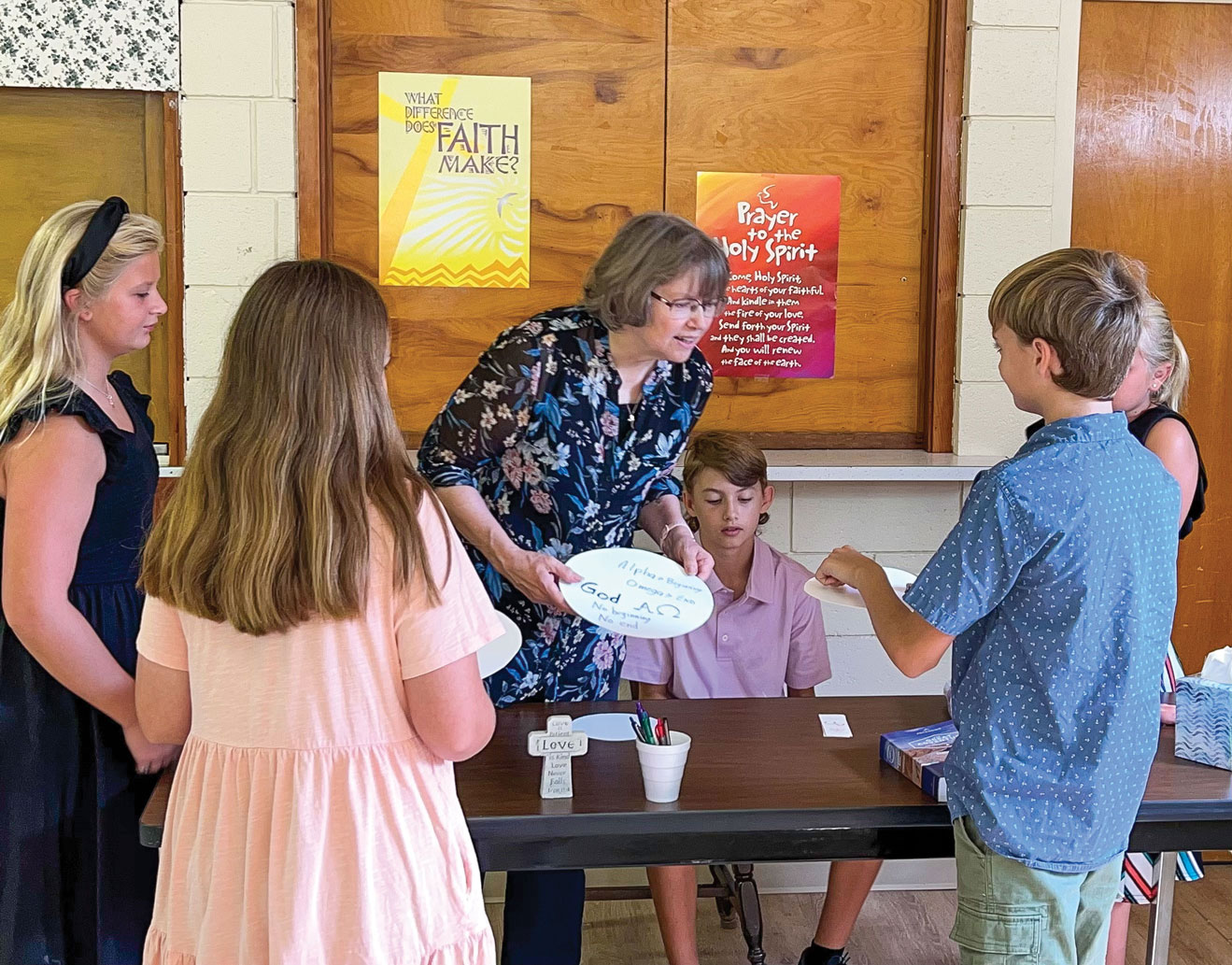 At Resurrection Parish, students now attend PSR classes during the hour before Sunday Mass. The program is small, with 10 to 12 children in grades 1-6. “Right now, we don’t have any junior high students and only one in high school,” she said. “At this time, I am teaching the third- and fourth-grade class, which is three students. This is my second year with this class, and they are doing the Restored Order of Sacraments. We had one receive the sacraments last year and another one set for this year and one in RCIC. The ones going through the sacraments are given additional time with me outside of class.”
In addition to Sunday classes, each year the PSR students take part in opening and closing events, and a Christmas party. “We try to include fun in their learning experiences,” she said. “I also do Rice Krispie Advent wreaths with my class every year. The children learn discipleship by helping with food pantry collections, socks for the homeless, and most every year they assist in the making of sandwiches for the homeless when our parish provides the meal.”
However, Mitchell doesn’t limit her parish participation to teaching PSR. “Being a member of a small parish allows you to be able to get involved in almost all aspects of parish life,” she said. “I am currently on the Pastoral Council and DRE in addition to teaching PSR and RCIA. When our parishes combined, they wanted to keep a few people who know the parishes history on the council. I am also head of the kitchen for the chicken dinner … for so many years I can’t remember. My newest duty is working part-time as parish secretary, which I started in March. One of the best parts of working in a small parish is getting to know everyone personally. We are like one big family, and we become that way by worshipping and working together.”
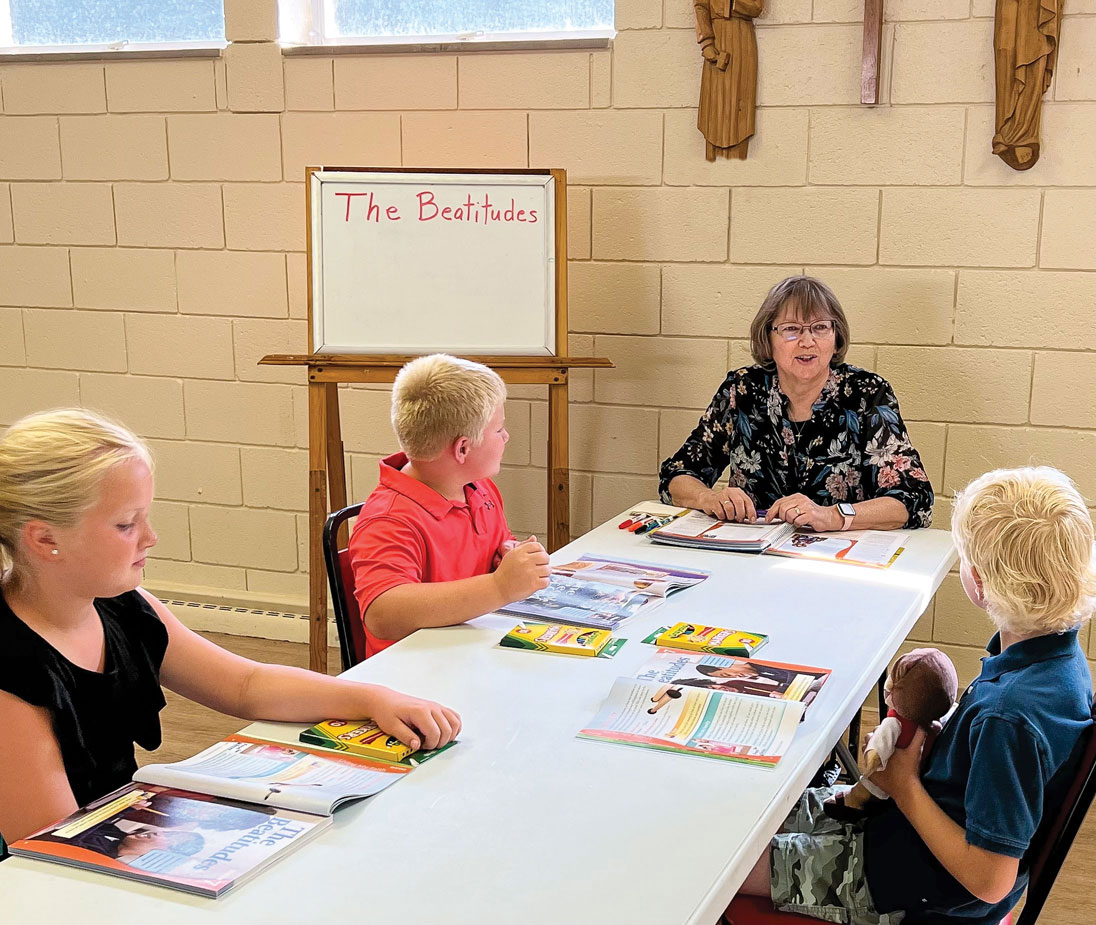 As DRE, Mitchell says she oversees finding people to volunteer. “Every time I ask for volunteers to help teach PSR, I am told, ‘I don’t know enough to teach’ or ‘I don’t feel qualified to answer the children’s questions.’ I respond that if you start with the younger students, you can learn along with them. Every year I teach I learn something. We are here to teach the children that God loves them and cares for them. No matter what. … There is nothing that warms my heart more and shows it’s all worth it than sitting in the back of church and watching my class receive reconciliation, first Communion, or confirmation. Somehow those energetic students become little angels ready to experience God’s love in the sacraments.”
She has several other reasons for continuing her teaching ministry. “I guess I have kept coming back to teach PSR partially because the need is there, partially because it is a fun and new experience each time, and mostly because I believe it is what God wants me to do,” said Mitchell, who has been married 48 years and has two grown children and three grandsons. “I took a year off now and then, and during those times it seemed like something was missing. I think it was the sharing of my faith with the children —and they shared their faith with me. I love to see the children grow spiritually and know that I am helping them on their journey with God.
“When I am working with the students, I get to see the simplicity of faith and how sometimes we make it so much more complicated than it needs to be. They have such a different perspective on things,” she said. “The young ones are little sponges eager to hear about God. The older ones challenge me with questions that sometimes I need to research — and in the process learn more about my faith. As they learn, I also learn, deepening and growing my faith and helping me see just how blessed I am.”
Emergency responders, public invited to Blue Mass at Cathedral

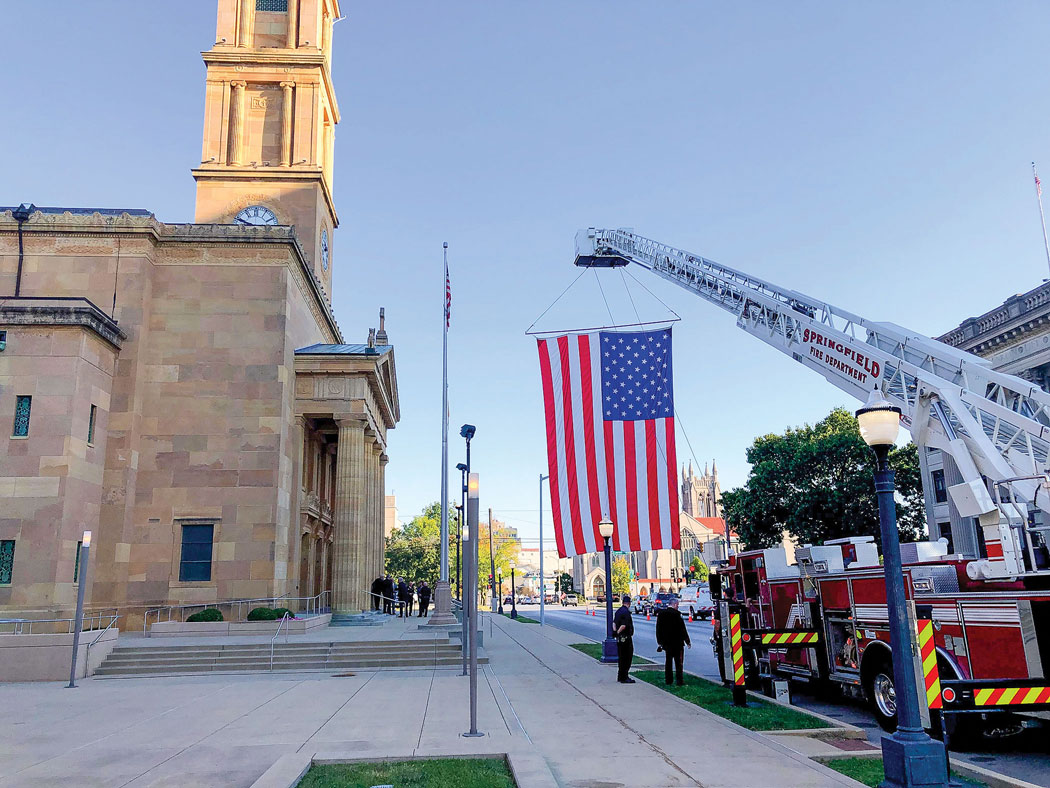 First responders risk their lives daily to provide services for their community. This risk is done with commitment and admiration. Out of sincere respect and appreciation for the sacrifices made by these committed public safety officials, the Blue Mass is being held to celebrate the service of first responders and to pray for their safety and continued diligence in all their good work. The Blue Mass is to provide spiritual assistance to these men and women of all faiths who consistently put their lives on the line to ensure the rule of law and safe society.
Bishop Thomas John Paprocki will celebrate the Blue Mass for first responders Sept. 27 at the Cathedral of the Immaculate Conception in Springfield at 9:30 a.m.
First responders and their families are invited to attend as well as the lay faithful to show their support and pray for our brothers and sisters on the front lines.
Following the Blue Mass, Brendan Kelly will be the featured speaker at the Cathedral, presenting his talk, “The most important tool.” Kelly is the Director of the Illinois State Police, a former St. Clair County State’s Attorney, a former Surface Warfare Officer for the U.S. Navy, and graduate of the University of Notre Dame and the St. Louis University of law.
International Catholic speaker, Chris Stefanick, coming to Effingham

 By ANDREW HANSEN
Editor
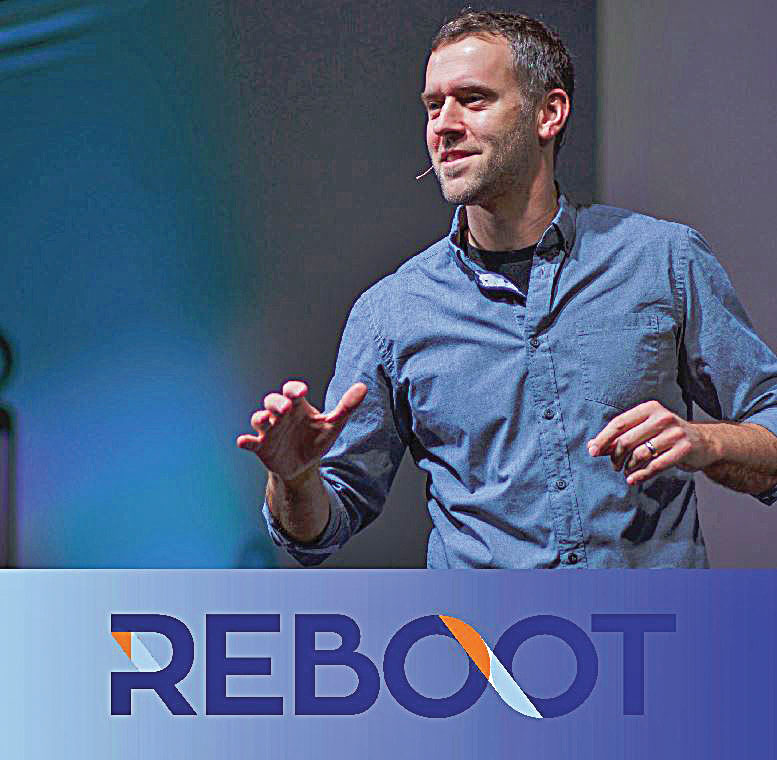
Chris Stefanick, an internationally acclaimed Catholic speaker, author, and TV host will present REBOOT!, an experience of learning how to better apply the beauty and genius of the Gospel to every aspect of life at the Effingham Performance Center Nov. 2 at 7 p.m.
It won’t be Stefanick’s first appearance in the Diocese of Springfield in Illinois. A packed crowd of more than 700 people welcomed him to the Cathedral of the Immaculate Conception in Springfield in 2019.
“A lot of people associate Catholicism with a particular issue, a particular teaching, or our beautiful rituals,” Stefanick said. “All that stuff is part of it. But, the heart and center of this faith and of life itself is the love that God the Father has for us and our call to respond to that in the way we live our everyday lives.
“Jesus didn’t come to say, ‘To make them boring.’ He said, ‘I came so they might have life and have it to the full. And I told you these things so my joy may be in you and your joy may be complete.’ When we rediscover our Catholic faith as that love story, that makes life beautiful, and honestly, it’s the most attractive thing in the world. It’s the best thing ever,” Stefanick said.
You can purchase tickets ($30-39) at reallifecatholic.com.
Women of diocese invited to October one-day retreat to experience the power of Christ in scripture and sacrament

All women of the diocese are invited to a day of reflection, relaxation, and rejuvenation as the Diocesan Women’s Ministry hosts another one-day retreat for women who want to deepen their spiritual lives by coming to receive God in Scripture and the sacraments. Called “Vessels,” the one-day event will take place at the Villa Maria Retreat Center on Lake Springfield on Oct. 8 from 8:30 a.m. to 4 p.m.
The Diocesan's Women's Ministry is hosting the day recognizing that women need time away to not just refresh but to receive sustenance by focusing on helping women discover their identity in God and what He wants to give to women in the seconds, minutes, and hours of their days.
The Oct. 8 event is the second of three in the Vessels retreat series this year, although if you did not attend the first retreat, you can still attend this one. The Oct. 8 retreat, “Vessels: Filled,” features speakers Janet Kehoe and Msgr. David Hoefler. You can also mark your calendar for Dec. 3 as the third installment in the Vessels retreat series, “Vessels: Poured,” features speakers Sister M. Karolyn Nunes, FSGM, and Father Brian Alford.
Through talks, reflections, individual prayer time, Mass, confession, and social time, the October retreat will touch on a woman's journey of becoming filled with the Holy Spirit. The December retreat focuses on pouring it all out for the glory of God.
Women who attended the first retreat described the day as “definitely a God send, (where I) met new friends and enjoyed the fellowship,” and, “It was an experience of joy, holiness, and goodness!”
The cost is $35, which includes materials, drinks, coffee, snacks, and lunch. To register, go to www.dio.org/vessels. For questions, contact Sister M. Clementia Toalson, FSGM, at or call (217) 698-8500.
Hey, Father! When did plenary indulgences start in the Catholic Church?

When did plenary indulgences start in the Catholic Church? Where in the Bible can plenary indulgence be found?
- Stan Obert, Liberty, IL
Stan, if you’re willing, I would like to answer your question about when indulgences started, and where their background can be found in the Bible, by means of a quick walk-through of salvation history. To begin with a basic definition: indulgences are a gift, and grace, that remits the temporal punishment due to a sin, which has already been forgiven but not rectified, that the Church gives for some pious action.
To explain the first part — about sin’s temporal punishment — we take our time machine back four or five thousand years. Humanity decided to disobey God. It wasn’t our best moment, and we’ve kept up the terrible practice ever since, with horrible consequences for ourselves and pretty much the entire cosmos. Sin, the name we give to this constellation of selfishness, distrust, imprudence, and hatred, has left its damage on the world around us, and the world within us (and we don’t seem much closer to a homegrown solution than we were then). Notice that this sin needs to be forgiven, absolved, but it also needs to be fixed, healed, and justice needs to be restored. This second reality is what Christ accomplished on the cross and gives through His Church in what we call indulgences.
Now, this claim — that the Church has been given this authority — needs to be demonstrated, and for that we turn to about 3,000 years ago. God’s favorite insignificant gaggle of tribes recently returned to the fertile crescent after a few hundred years eating onions and making bricks in Egypt. They are not particularly unified and are often governed by unsavory warlords, but they claim, unprecedently, that there is only one God, and that they are in a covenant relationship with Him. After Saul, David, Solomon, and a handful of other good and bad kings, Hezekiah, a decisively good king, fills us in on the secret to being a king faithful to this one God: choose virtuous stewards. Seriously! Saul fell into witchcraft and Solomon into idolatry, because they didn’t listen to good advisors, whereas when David sinned, Nathan the prophet called him out for it, and he repented. Hezekiah at first had a selfish, ungodly, steward named Shebna, but removed him to choose a good and righteous man named Eliakim, and the king and kingdom were then holy, as they were supposed to be.
Now, 1,000 years later, only 2,000 years before today, Jesus stood in Capernaum and taught his Apostles about forgiveness, a radical forgiveness that must begin brother to brother, must be extended again and again, and a forgiveness He entrusted to them as the leaders of the Church so that His Kingdom would be holy:
“Truly, I say to you, whatever you bind on earth shall be bound in heaven, and whatever you loose on earth shall be loosed in heaven” (Matthew 18:18).
Christ, the King, uses the language of stewardship from Hezekiah to entrust to His Apostles His own authority: to reconcile people to God when they have repented of their sins. It is this authority that the Church has carried ever since, using it through the sacrament of confession and in indulgences, unbinding people from the weight of their sins by the healing mercy and justification of Christ.
OK, we’re now left with the final part of our definition, and a final trip back through time and Scripture. We have seen the consequences of sin, God’s response of mercy, and the authority of the Church, but what about the pious actions the Church links to indulgences? Is this just the Church putting up the merits of Christ and His saints for sale? Let us return to a scene right after the one in Capernaum. Jesus shows his Apostles how to give His merciful love to someone.
“If you would enter life, keep the commandments.” ... The young man said to him, “All these I have kept. What do I still lack?” Jesus said to him, “If you would be perfect, go, sell what you possess and give to the poor, and you will have treasure in heaven; and come, follow me.” When the young man heard this he went away sorrowful, for he had great possessions” (Matthew 19:17, 20-22).
Forgiveness/mercy is a gift for the sake of communion. If someone rejects communion with Jesus, even the Lord Himself cannot force mercy into their heart, and neither can His Apostles. For this reason, from the earliest ages of the Church, those given Christ’s mandate to forgive looked for signs of interior openness on the part of the penitent to live in accord with that re-gifted friendship with Christ. What are some of those exterior evidences? Going to confession, receiving holy Communion, and any number of particular devotions, pilgrimages, works of mercy, and reading the Bible (the Church has hundreds of these so you could do a pious act every day).
Bear with me on a final trip back 1,000 years to see when the word “indulgence” was first coined. It was a fall afternoon in Clermont, France, when Pope Urban II stepped out before an excited crowd after the conclusion of a Church council. On top of everyone’s mind was the split between the Eastern and Western Church of 40 years before and the capture of Jerusalem and all the holy sights associated with Christ’s life only 20 years before. To heal the divide and recover the Holy Land, Urban proclaimed a relief mission that would traverse the Eastern empire and make its way all the way to Jerusalem. This tremendous effort would, he announced, replace any other penance then weighing on someone for sins they may have committed. So, let us take advantage of these tremendous gifts for our own walk with the Lord, and for those that have passed on before us.
Father Dominic Rankin is Master of Ceremonies and priest secretary for Bishop Thomas John Paprocki, is Vocations Promoter for the Diocese of Springfield in Illinois, and has a license in Theology of Marriage and Family from the John Paul II Institute in Rome.
Family day retreat in Quincy Oct. 22 to help families better connect with God

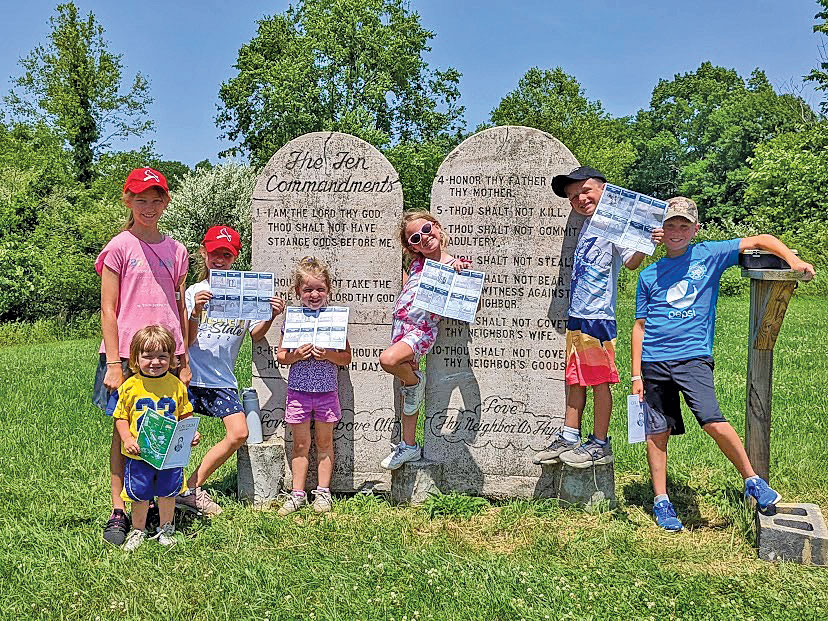 Several Quincy families attended the Holy Family Fest in Ohio last year. This photo was taken during a scavenger hunt taking place throughout the campus of Catholic FamilyLand. The families' positive experience led them to bring a similar experience to our diocese. Quincy Holy Family Fest, a day retreat for families, takes place on Oct. 22 at the Quincy Knights of Columbus campus in Quincy.Families! Looking to connect with God, have fun, and create memories?
Attend family day retreat in Quincy Oct. 22
By ANDREW HANSEN
Editor
QUINCY — Mike Young, a Blessed Sacrament parishioner in Quincy, has attended the Apostolate for Family Consecration's Holy Family Fest in Ohio the past several summers. The grace-filled and fun-filled experience his family enjoyed has led him, his wife, Mandy, and two other families in Quincy to bring a similar experience to Quincy. Quincy Holy Family Fest is a day retreat on Oct. 22 and is geared toward any families wishing to take a day out of the busyness of life to reconnect with God and have fun together.
“There is a daily rhythm to each day of the retreat in Ohio, and we have modeled our day after that rhythm,” Young said. “It's a rhythm of prayer, especially the sacraments, and family fun. Our family has attended the Holy Family Fest in Ohio the past four summers. Our kids have consistently said they would rather return there each year than go on a trip to Disney World! I believe the reason for that is that all kids, and adults for that matter, crave time with God and time with family and friends. As a dad, I know I get too busy and the craziness of everything life throws at me keeps me from reconnecting with God and with my family as much as I should. This forces me to set time aside from the craziness to intentionally do both of those things. And, it has been an incalculable blessing to our family and the families who have attended with us the past three years.”
The day in Quincy will consist of Mass together as families, and then programming/talks geared toward various age levels. After lunch, there will be a variety of activities and games available such as a bounce house, sand volleyball, board games, kickball, bags, and more. During the recreation time, confessions will also be available. The day will end with a family holy hour, including exposition of the Blessed Sacrament, and a family rosary.
“We can look around and see the world is getting crazier and crazier,” Young said. “In particular, the family is really under attack. We need all that the Church has to offer to grow in strength to resist those forces and deepen our relationship with our Lord.”
Quincy Holy Family Fest takes place from 9 a.m. to 5 p.m. on Sat., Oct 22 at the Quincy Knights of Columbus campus (700 S 36th St., Quincy). It’s $40 per household, which includes lunch and a T-shirt for each parent. To sign up, go to tinyurl.com/48hm5xuk. For questions, call (217) 257-0186 or email . The deadline to sign up is Oct. 9.
Photo by Aaron Kerkhoff
What's in a church (Part 2)

What’s in a church?
Objects you’ve seen before but didn’t know the name or rich history/symbolism behind them (part 2)
By RYAN KEHOE and GRANT WILSON
Special to Catholic Times
Photos by Andrew Hansen taken at the Cathedral of the Immaculate Conception in Springfield.
There are dozens of objects used during Mass, seen on the walls of our churches, and found in the sanctuary. Whether it is the name of the object, the history, the symbolism behind why it is used, or how it came about, Catholic Times presents to you interesting facts about objects found in our churches that may make you say, “I didn’t know that!”
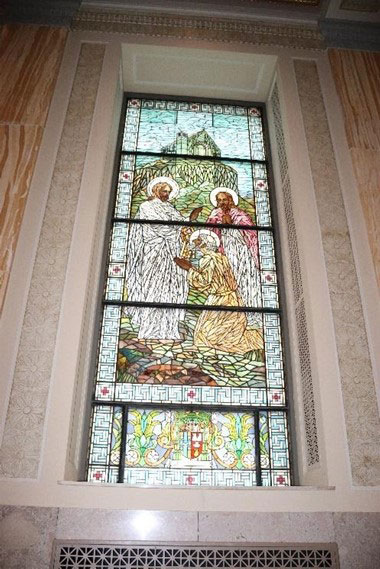 Stained glass windows — These often depict scenes from the Bible, the lives of saints, or some other aspect of salvation history. Primarily, there are three reasons we use this glass in churches. The first reason is functional. Windows allowed the church to be well lit in the ages before lightbulbs. Secondly, stained glass is helpful in catechesis. Before reading was common, depictions were an easy way to provide catechesis. Finally, these windows are meant to be beautiful additions to the space we worship in. The Temple of Jerusalem from the Old Testament was filled with beauty, and it drew the people of God to Him in wonder and awe. Like the Temple, our churches are to be filled with beauty and, in this case, the beauty of stained-glass windows is meant to inspire us and draw us deeper into the divine mysteries.
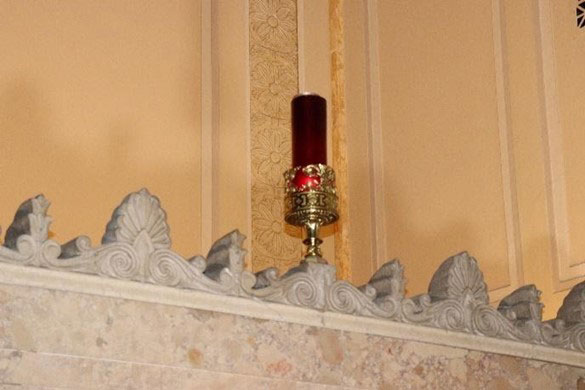 Sanctuary lamp — The Church teaches and believes that Jesus Christ is truly present Body, Blood, Soul, and Divinity in the Eucharist. In Catholic churches, Jesus is therefore present to us in the tabernacle for our prayer and adoration. The sanctuary lamp points to his true presence in the tabernacle. Historically, lamps were used to give light to help people find their way or to convey information by signaling to another person. The sanctuary lamp does the same for us. It is meant to signal to us that Jesus is present in the tabernacle, and He is the light that will guide our path to Heaven. This lamp also has connections to the Old Testament (Exodus 27:20-21) when God prescribed that a lamp burn visibly in the Temple to signify His presence.
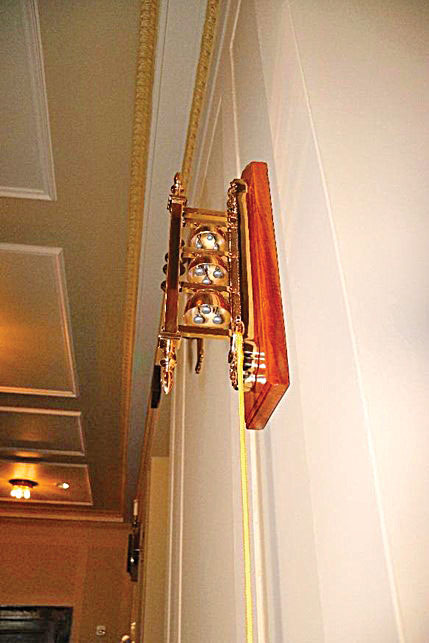 Bells — These bells found on some church walls are rung to signal to the congregation that Mass is starting. Bells have a long history in the Catholic Church. In monasteries and towns, large tower bells would be rung to announce the time for Mass. This was especially important since there were no watches or clocks to announce the time.
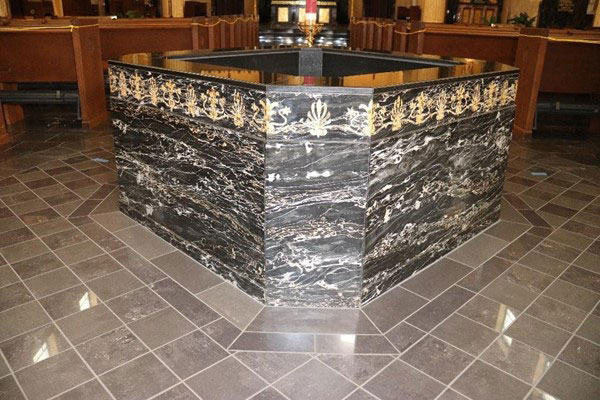 Baptismal font — Baptism is the first of three sacraments of initiation, through which men and women become incorporated into the mystical body of Christ. This sacrament comes directly from the commission of Jesus to the Apostles when He sent them out to the whole world to spread the good news of his saving love (see Mark 16:15-16, Acts 1:1-5, 8). Baptism is performed when water passes over the brow of a person’s head and the minister of the sacrament says the words “I baptize you, in the name of the Father, and of the Son, and of the Holy Spirit.” Once a person is baptized, he or she is a member of the Body of Christ (1 Corinthians 12:12-13), a child of God, and an heir to the Kingdom of Heaven (CCC 1213). From the earliest days of the Apostles, we hear that Christians were baptized by use of water (Acts 8:36, 1 Peter 3:20-21). Many fonts always have holy water in them which we use to bless ourselves by making the Sign of the Cross. When we do this, it should remind us that we are children of God and members of Christ’s Body who are called to become saints.
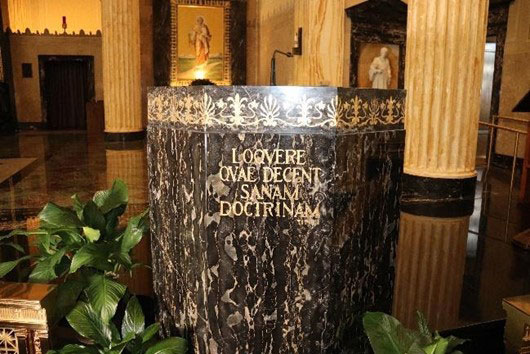 Ambo — During Mass, the readings from Sacred Scripture are done from the ambo. The word “ambo” comes from Greek meaning “high place.” At Mass, the readings, Psalms, and the Gospel are proclaimed from this small “mountain.” Matthew 5:1-2 tells us that Jesus went up the mountain and taught his Disciples from there. Likewise, Moses brought the Word of God to the people from Mount Sinai, and the priest then, like Jesus, teaches from the “mountain” through his homily.
 Tabernacle —The word “tabernacle” comes from the Latin word tabernaculum meaning “tent.” This is in reference to the meeting tent of the Old Testament where the Ark of the Covenant was kept, where Moses would speak with God (Exodus 33:7-9). In Exodus, we read that the meeting tent was in another area, away from the rest of the camp. Anyone who wished to speak with God would go near it and pray. Similarly, the tabernacle is where Jesus in the Blessed Sacrament and is kept for our prayer and adoration. This is why Catholics genuflect toward the tabernacle. The Blessed Sacrament is the Body, Blood, Soul, and Divinity of Jesus Christ and by genuflecting toward Him, we are showing reverence. Although the use of a tabernacle goes farther back, it was the Fourth Lateran Council in 1215 which required that the remaining Hosts from Mass be kept in a secure well fashioned receptacle.
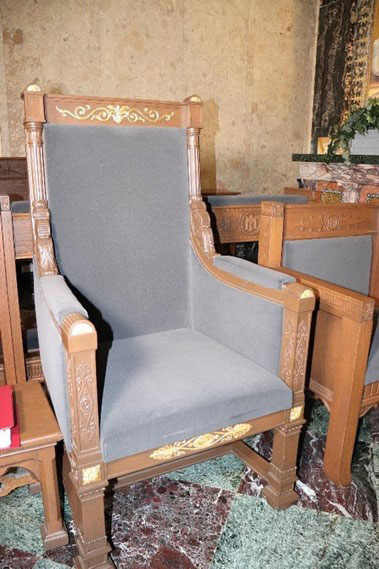 Presider’s chair — The presider’s chair is located in the sanctuary. It is from there that the priest begins and concludes Mass. It is separated from the rest of the community to show that the priest is the leader at the Mass because he stands in persona Christi capitas, in the person of Christ. The chair for the main celebrant of the Mass should be distinct from any others in the sanctuary, but not ostentatious or throne-like.
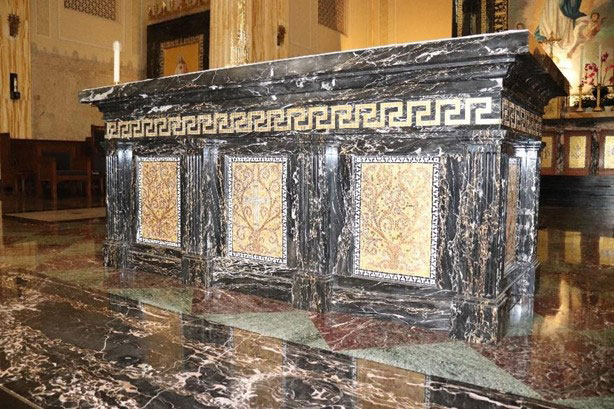 Altar — The altar is where the main action of the Mass happens during the Liturgy of the Eucharist. The Catholic Church has used altars to offer the Holy Sacrifice of the Mass since Apostolic times and their use demonstrates a continuity in our worship and in our understanding of sacrifice as stemming from worship in the temple.
Altars are to be consecrated since they are not normal tables but become the “Table of the Lord” as Paul says in 1 Corinthians 10:21. Some altars contain the relics of saints. When the first Christians worshipped in secret, the altars they used were the stone tombs of the martyrs. To this day, many churches continue to offer the Sacrifice of the Mass on top of the relics of those who have offered their lives to God to imitate the early Christians.
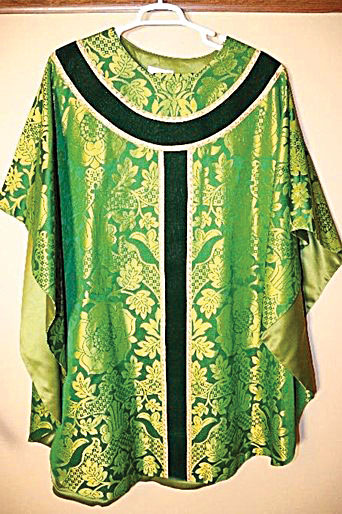 Chasuble — The chasuble is one example of vestments that are worn by ministers at Mass and the celebration of the sacraments. Each vestment at one time had a practical societal use but are now adopted by the use of the Church and given symbolic meanings. The chasuble worn by a priest or bishop at Mass is the outermost garment worn and is symbolic of charity which is put on over all other things.
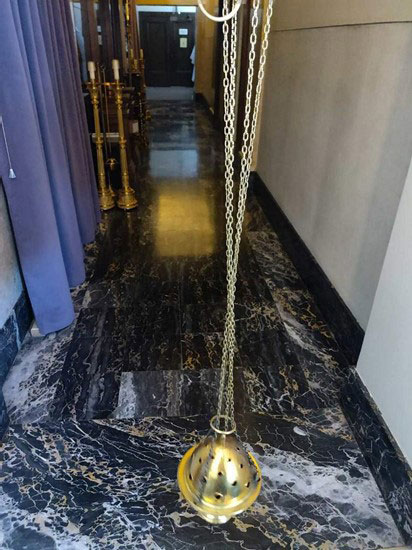 Thurible and incense boat — A thurible is a sturdy metal container on the end of a chain of which inside, are burning coals used to melt and burn the incense, creating smoke and a pleasant fragrance. The priest, deacon, or altar server will swing the thurible during certain parts of liturgies, such as before the reading of the Gospel or during the Consecration. The smoke symbolizes the prayers of the faithful being taken up into Heaven.
Incense adds an element of mystery to the Liturgy. For example, when the incense is burned, it fills the church with a smokey mist that hangs in the air. This is connected to the vision of Isaiah (Isaiah 6:1-4) in which he “saw the Lord sitting upon a throne” with angels in attendance filling the room with praise of Him and smoke. The whole scene described by the prophet is mysterious, and when incense is used in the Mass, we should recall this scene and the opening words of the priest at Mass where he calls the Mass “the Sacred Mysteries.”
Finally, incense has been used over the centuries as part of sacrifices and offerings. In Psalm 141:1-2, it says, “Lord, I call to you; hasten to me; listen to my plea when I call. Let my prayer be incense before you; my uplifted hands an evening offering.”
Hey, Father! Can I take communion at a non-Catholic church?

As a Catholic, if I were to attend another church service that is not Catholic and they distribute communion, is it OK if I receive communion there? Can my Christian friends receive Communion at a Catholic Mass, for example, at a wedding?
Paul in Springfield
Whereas many Protestant denominations allow Christians who are not members of their denominations to receive communion in their services, the Catholic Church does not. Because many do not understand the reasoning behind this, some people feel offended by the Church’s insistence that only Catholics (and, in some instances, Orthodox Christians) receive the Eucharist.
The Most Holy Sacrament of the Altar is called by several different names, as considered in paragraphs 1328-1332 in the Catechism of the Catholic Church. One of these names is holy Communion “because by this sacrament, we unite ourselves to Christ, who makes us sharers in his Body and Blood to form a single body” (CCC, 1331). After all, the word communion itself means “union with.” The Catholic Church only allows those who are her members — those either baptized into the Catholic Church or those who have been received into her through the profession of faith — to receive the Eucharist. If she allowed those who are not united with or in the Church to receive the Eucharist, she would seem to acknowledge something that is not true.
As Catholics, we know that the Eucharist is the very Body and Blood, Soul, and Divinity, of Jesus Christ. We know that the Real Presence of Christ effected in this sacrament does not cease once the celebration of the Mass is finished. This is why we worship the Eucharist, “genuflecting or bowing deeply as a sign of adoration of the Lord” (CCC, 1378). When a Catholic says, “Amen” to “The Body of Christ” and/or “The Blood of Christ,” he or she acknowledges the Eucharist to be the very Body and Blood of Christ — and not a mere symbol. At the same time, a Catholic acknowledges and accepts the teachings of the Church and maintains communion — unity — with the Church. This is something a non-Catholic cannot honestly say.
Most Protestants (even non-denominationals) do not believe that holy Communion is the very Body and Blood of the Savior. If one of them said, “Amen” to “The Body of Christ,” he or she would commit a lie. Even if a Protestant does believe that holy Communion is the very Body and Blood of Christ, he or she could still not honestly say, “Amen” to “The Body of Christ,” because he or she has no real intention of maintaining unity with the Catholic Church. If he or she did, one would either be taking part in the Rite of Christian Initiation of Adults or would already be Catholic. Because the Catholic Church respects the beliefs of our non-Catholic brothers and sisters in Christ, we do not share Communion with them because we want them to remain men and women of integrity.
The same discipline applies when a Catholic attends a non-Catholic service at which a communion ritual is celebrated. Just as non-Catholics cannot receive Communion in the Catholic Church, Catholics cannot receive communion in non-Catholic services (regardless of what the Protestant denomination teaches). The only exception to this is in the Orthodox Churches, who have maintained a valid priesthood, something no Protestant community has done. If a Catholic received communion in a Protestant service, the Catholic would be professing unity with that religious body, something that is not true.
It is because the Catholic Church loves and respects all people that we do not share Communion with those who are not in union with us. This discipline derives, in part, from the clear teaching of St. Paul, who says, “Whoever, therefore, eats the bread and drinks the cup of the Lord in an unworthy manner will be guilty of profaning the body and blood of the Lord … . For anyone who eats and drinks without discerning the body eats and drinks judgment on himself” (I Corinthians 11:27-29).
If a non-Catholic does believe what the Church believes about the Eucharist, the Church would gladly share holy Communion with him or her. All such a person needs to do is enter into the full communion of the Church established by Christ the Lord.
- Father Daren J. Zehnle, JCL, KCHS, is pastor at St. Augustine Parish in Ashland, director of the Office for Divine Worship and the Catechumenate, and judge in the diocesan Tribunal.