
Diocesan Administrator Account
Beauty Series - QU Chapel


 St. Francis Solanus Chapel – Quincy University
The St. Francis Solanus Chapel at Quincy University has been a gem in the “Gem City” for over a century, when Brother Anselm Wolff, OFM, designed the glorious church as a miniature of his masterpiece, St. Anthony of Padua Church in St. Louis. Today, the chapel, which is bigger than many parish churches in our diocese, continues to offer students at Quincy University a foretaste of Heaven during the Holy Sacrifice of the Mass as they are surrounded by dozens of images of saints, beautiful artwork, and the Eucharist.
Father Daren Zehnle, pastor of St. Augustine Parish in Ashland, grew up in Quincy and attended Quincy University and says he is “struck by the sheer beauty of the space.”
“It’s really a unique place in the diocese and probably in the country,” Father Zehnle said.
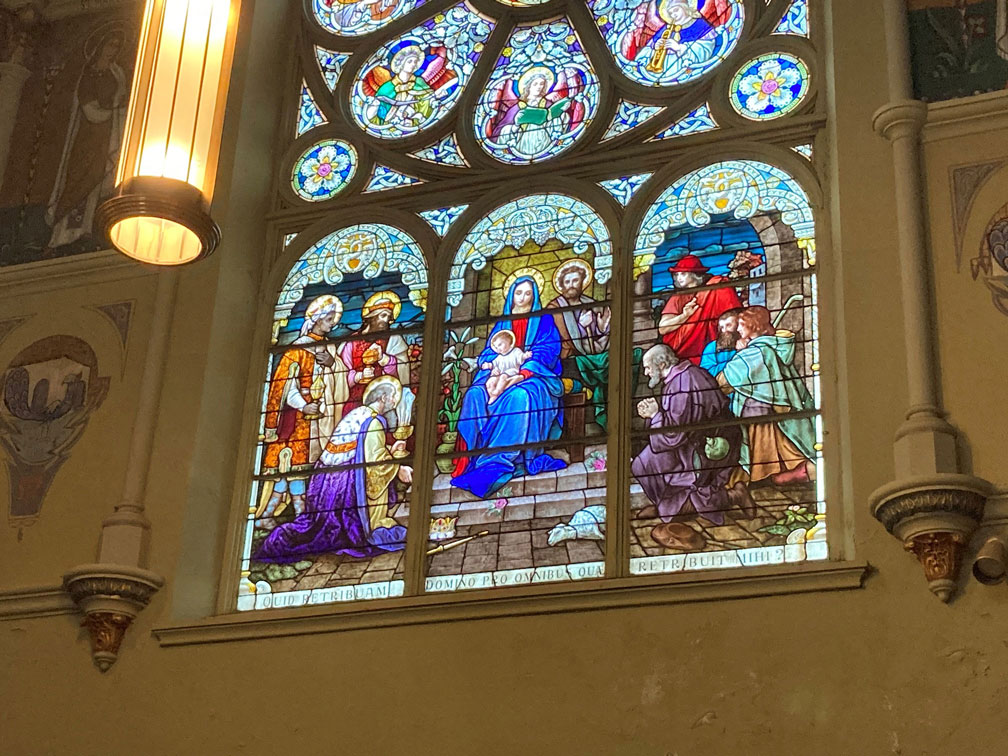
Stretching 123 feet in length, only the finest materials were used when the chapel was designed in 1910 and finished in 1912 including marble pillars, oak pews, and steel beams. The impressive stained-glass windows were created by a company in St. Louis and were imported from Germany.
The chapel has gone through many changes over the decades. Years of neglect during the Great Depression resulted in damage. In 1956, the chapel was redesigned using the Byzantine style, which portrays figures of Jesus, Mary, angels, and the saints in more of a heavenly theme. Father Tom Brown, OFM, one of the Franciscan Friars at the university, was the creator of the changes.
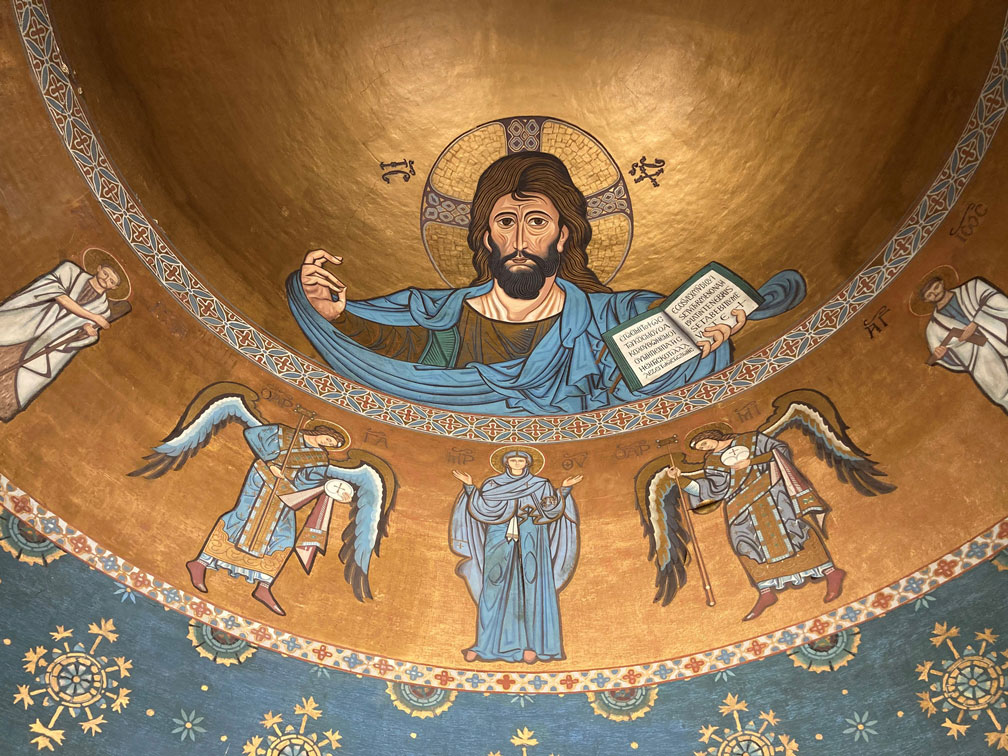 “He modeled it after the church of San Apollinare in Classe in Ravenna in the north of Italy,” Father Zehnle said. “When it was built there, it was the seat of the Roman empire, and the church still stands today. Over there, it was built in mosaic, but here he painted the various images on some sort of a canvas, and glued them up to the wall, but it’s a pretty faithful replication of what you see in Ravenna.”
One of the most decorative features of the chapel are the images of 70 saints that encircle the chapel. With male saints on one side and female saints on the other, each saint carries a symbol pertaining to their life.
“The depictions of them always serves as a great reminder that we are all processing with them toward Christ the Savior,” Father Zehnle said. “They also serve as a reminder to us that if they can live a holy life, if they can be saints, then each of us can as well.”
Another image that draws people’s attention is a copy of the famous the Good Shephard, a mosaic that is in the Mausoleum of Galla Placidia in Italy. The most striking piece of artwork, however, hits you right when you walk in — a 16-foot painting of Christ the Pantocrator, the title of Christ as ruler of the universe.
While Quincy’s Venerable Father Augustine Tolton, who escaped slavery to become the nation’s first black priest in Quincy never stepped foot inside this chapel, dying in 1897, he did attend Quincy University in 1878, which at that time was called St. Francis Solanus College. Today, Father Tolton is honored with a one-of-a-kind painting in the chapel.
 “It’s a newer addition to the chapel, just a few years ago, and it was painted by Isabelle Armengol Lewis,” Father Zehnle said. “It depicts Father Tolton’s first Mass which he celebrated at St. Peter’s Basilica in Rome. She didn’t intend for it to be housed at the QU Chapel, but it found its way here. It mixes really well with the colors already present which I think is a great sign of Providence. She painted it a few years ago, and I think it’s a great way to have a greater connection to Father Tolton who not only grew up in Quincy as a boy after he escaped slavery in Missouri but also attended Quincy University before going off to Rome to study in the seminary, and then he was sent back to Quincy by Rome to be a priest here. He stayed in Quincy for three years, and then he went up to Chicago for seven years before he died. Now, he is buried in Quincy.”
To think of the all the students who prayed inside these walls, 14 of whom became bishops throughout the United States and several others who are now serving as priests in our diocese, this chapel at the only Catholic University in our diocese, has played a major role in the history of our Church and in the faith life of countless of souls who came from different walks of life and different parts of the world.
“In that sense, this chapel serves in a real physical reminder of the universality of the Church that you wouldn’t most likely see in most parish churches in our diocese but because of the university involvement here, I think that all just sits right home,” Father Zehnle said.
Eight women to make next step in religious life for Sisters of St. Francis of the Martyr St. George

 Shown are the eight women who will take next steps in religious life for the Sisters of St. Francis of the Martyr St. George on Aug. 2 in Alton. Back row: Kathleen McMullin (Sister Mary Kolbe), Sister M. Xavier Schulze, Sister M. Pieta Keller, Elizabeth Buckley (Sister M. Gloria). Front row: Sister M. Annuntiata Gangl, Sister Maria Christi Delaney, Sister M. Veronica Kennedy, Sister Bethany Marie Burnham.ALTON — The Sisters of St. Francis of the Martyr St. George will celebrate the final profession of four junior sisters, the first profession of two novices, and the reception into the novitiate of two postulants during Mass at 10 a.m. on Tuesday, Aug. 2. Bishop Thomas J. Paprocki will be the main celebrant of the Mass, held at St. Mary Catholic Church in Alton.
The four juniors who will make final profession are Sister Maria Christi Delaney, daughter of Kathryn Delaney and the late Thomas Delaney of Williamsville, N.Y.; Sister M. Xavier Schulze, daughter of Mr. and Mrs. Mark Schulze of Anna, Ohio; Sister M. Annuntiata Gangl, daughter of Mr. and Mrs. Michael Gangl of Brainerd, Minn.; and Sister M. Pieta Keller, daughter of Mr. Philip Keller of Loveland, Ohio, and Ms. Cynthia Janson of Cincinnati, Ohio.
The novices who will make first profession are Sister M. Veronica Kennedy, daughter of Mr. John Kennedy of Chicago, and Ms. Nancy Kennedy of Parker, Colo.; and Sister Bethany Marie Burnham, daughter of Mr. and Mrs. James Burnham of Lake Charles, La.
The postulants who will receive their habit and veil and their new religious names are Kathleen McMullin (Sister Mary Kolbe), daughter of Mr. and Mrs. Scott McMullin of Brandon, Miss.; and Elizabeth Buckley (Sister M. Gloria), daughter of Mr. and Mrs. Martin Buckley of St. Louis.
The Sisters of St. Francis of the Martyr St. George invite you to participate and share in their joy via watching the Mass on livestream at www.altonfranciscans.org/feastday .
Photo courtesy of the Sisters of St. Francis of the Martyr St. George
Springfield area Dominican Associates make commitment

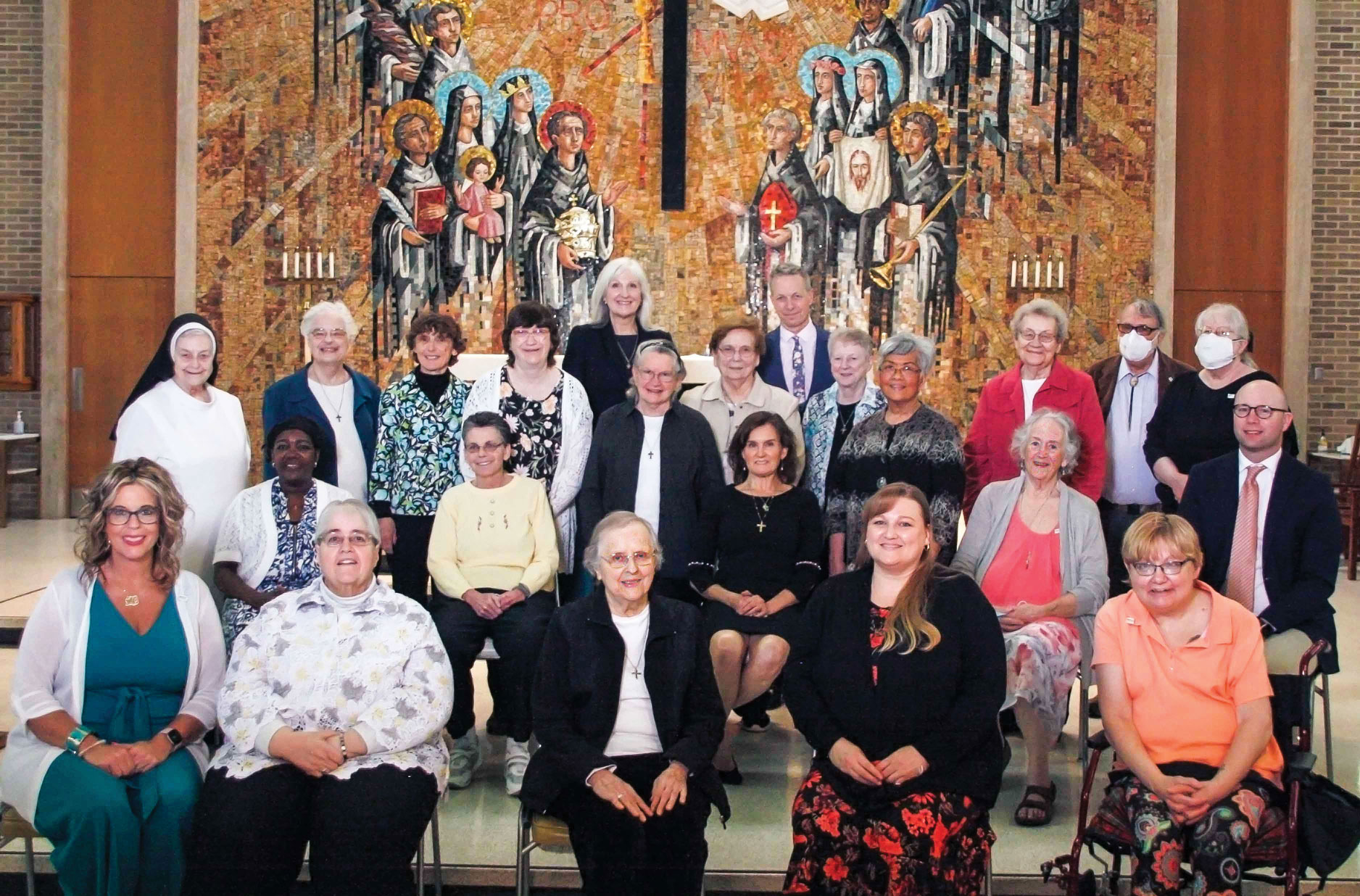 Shown are members of the 2022 Dominican Associate class with associate sponsors, and Dominican Sisters. Row 1: Molly Murphy, Sister Martha Carmody, Sister Agnes Ann Pisel, Lisa Barnett, Jan Montgomery. Row2 (seated): Stella Shaw, Sister Teresa Marron, Cyndi Goeahl, Margaret Greco, Jantzen Eddington. Row 3: Sister M. Joan Sorge, Sister Georgiana Stubner, Charlotte Vollmer, Ann Moroff, Sister Patricia Stark, Delia Lising, Sister Bernice Juip, Peter Ellersten, Debbie Ellersten. Row 4: Lucinda Buescher, Sister Marilyn Jean Runkel, Keith Buescher, Sister Judith Pfile. For the first time since 2019, the commitment ceremony for a Springfield Dominican Associate class was held in-person at Sacred Heart Convent Chapel last May.
The new associates prepared for commitment by participation in nine monthly sessions of prayer and study about the history of the Order of Preachers and the Springfield Dominican congregation, about the theology of mission and ministry, Catholic Social Teaching, and liturgy and prayer. Each candidate was accompanied by a sponsor — a sister or an associate — who answered their questions and offered encouragement during their period of discernment before commitment.
Dominican associates embrace the Dominican traditions of prayer, study, community, and ministry. They respond to God's call to share the Gospel by preaching it through the witness of their lives.
Each associate was called forward by the associate program director, Sister M. Joan Sorge, OP. They stated publicly their commitment to “preach the Word and witness Gospel values,” and received an associate pin from Sister Rebecca Ann Gemma, OP, prioress general of the congregation.
The new associates include:
- Lisa Barnett, parishioner at the Cathedral of the Immaculate Conception, whose commitments include volunteering for the homeless and at Jubilee Farm.
- Keith Buescher, parishioner at St. Joseph Church, Springfield, whose commitments include study of the Bible and using his voice to speak against injustice.
- Lucinda Buescher, parishioner at St. Joseph Church, Springfield, whose commitments include sharing her faith with her family and helping at Jubilee Farm.
- Jan Montgomery, parishioner at the Cathedral of the Immaculate Conception, Springfield, whose commitments include serving in RCIA ministry at Cathedral, fighting racial injustice and human trafficking, and working for the right to life for all.
- Ann Moroff, parishioner at Christ the King, Springfield, whose commitments include being a compassionate presence in her work, supporting members of the Cor Unum community with her prayer, and engaging in study and spiritual reading.
- Molly Murphy, parishioner at the Cathedral of the Immaculate Conception, Springfield, whose commitments include continuing study of the Gospel and of Catholic teaching, and witnessing to her students through acts of service and discipleship.
- Charlene Vollmer, member of the Church of the Little Flower, Springfield, whose commitments include serving as a volunteer and eucharistic minister at Springfield hospitals and volunteering at St. Martin De Porres Center.
- Margaret Greco, parishioner at St. Joseph the Worker Parish, Chatham, whose commitments include co-chairing the Right to Life ministry at her parish and studying her faith.
The first Springfield Dominican associates made commitments in 1991. Since then, hundreds of women and men, baptized Christians in the United States and Peru, have become associates.
Dominican associates undertake individual volunteer ministries in their own parishes and communities. They may also join the sisters on committees and boards, work side-by-side with the sisters in their ministries, or provide logistical support for the congregation’s public events. To learn more about becoming a Springfield Dominican Associate and other ways you can participate in their mission visit Springfieldop.org/dominican-mission or call Sister M. Joan Sorge, OP, at (217) 787-0481.
Photo courtesy of the Dominican Sisters of Springfield
Hey, Father! Whose responsibility is it to teach the rosary to children?

As my grandchildren receive the sacrament of confirmation and first holy Communion, we have been letting them pick out a rosary. It concerns us that they didn't know what a rosary was. Whose responsibility is it to teach children how to use/pray the rosary? Should parents do this or does the Catholic schools include it in their teachings? I plan to take them to the next rosary at their church.
- Anonymous in the diocese
As a priest, I always find one of the most powerful parts of the Order of Baptism of Children is the blessing over parents reminding them that they are the first teachers of their children in the ways of faith, and that they “may, by word and example, prove to be the first witnesses of the faith to their child.” I do not believe this blessing is intended to “lay more guilt” on our parents but rather a reminder to be open to God’s ever-present grace in fulfilling their vocation. How wonderful that grandparents are also ready, willing, and able to assist with our young people’s faith formation as well. As the late Father Don Meehling used to say, “Our children should never remember a time when they didn’t come to Mass.”
Coming into the Catholic Church in my 20s, I can say learning to pray the rosary, the meditative prayer of the Gospel, was an important part of my journey.
Even with their limited time constraints, I hope every Catholic school and faith formation program is able to introduce the rosary to our students. The Catholic schools/faith formation programs that I am familiar with in our diocese does this. But, like every other teaching and practice of our faith our schools and faith formation programs attempt to impart on children, the teaching of the prayers, mysteries, and form of the rosary will have minimal impact unless our young people see it lived in their own homes and in the lives of the people they love the most. As Roy Lanham, director of Campus Ministry for our diocese, likes to say, “This is not a question of an either/or but a very Catholic both/and.” Children “learn” what they are taught at school when they experience it being modeled for them at home.
One of the great benefits of the growing Family of Faith model of religious formation in our schools/parishes is children are not simply “dropped off” at Catholic school or religion class, but parents are actively engaged in ongoing formation and working with their children themselves. This provides an opportunity for this new generation of parents, who may not be familiar or comfortable praying the rosary themselves, to learn more about this biblical prayer and to learn how to incorporate the mysteries of our faith in the life of Christ and Our Lady in their own lives.
Searching online for “How to teach children to pray the holy rosary?” will produce a wealth of suggestions and resources to assist parents and grandparents. Taking the time to help our children learn the prayers, to become familiar with the stories of each of the mysteries, to think about similar experiences in their own lives, and perhaps naming someone to pray for on each bead, will help children embrace what can become the practice of a lifetime. I always like to remind students they do not need to have an actual rosary to pray the rosary. Just praying with our 10 fingers is an amazing way as Pope St. John Paul II pointed out “to contemplate with Mary the face of Jesus Christ.”
Father John Titus is pastor Immaculate Conception Parish in Mattoon and St. Columcille Parish in Sullivan.
Sacred Heart Church in Oconee celebrates 150 years

 By ZETTA WOLF
Special to Catholic Times
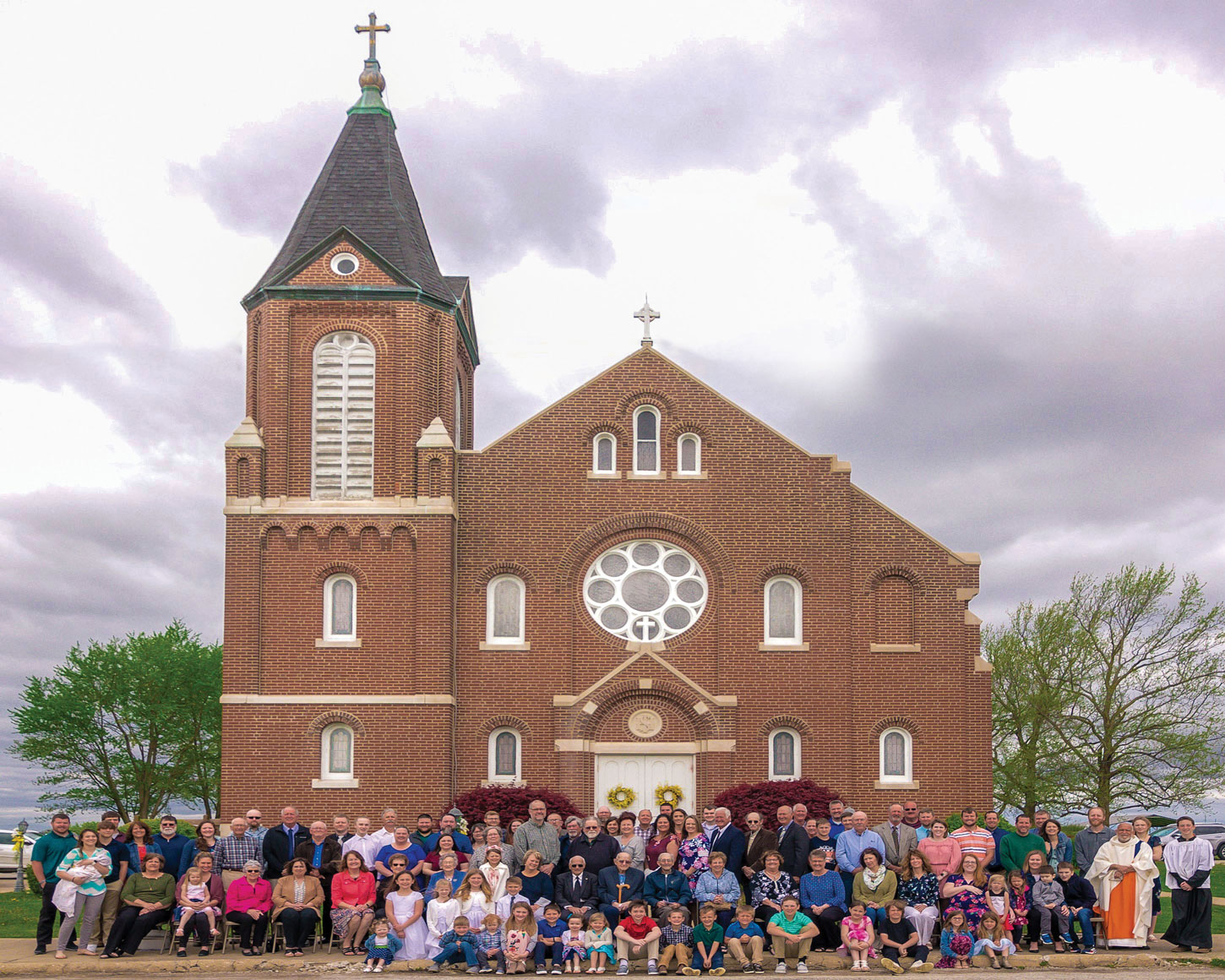
OCONEE — Sacred Heart of Jesus Catholic Church in Oconee is celebrating a special milestone in 2022— 150 years as a parish.
Most of the current parishioners are descendants of the pioneers who worked hard to establish and build the parish. As German settlers began to open fields and farm the land around Oconee in the 1860s, they likewise started to search out any German-speaking priest who traveled through the area, to invite him to say Mass in various homes in the Oconee area.
In 1868, Gerhardt Herman Rakers Sr. and his family came to Oconee and Rakers was instrumental in finding a German-speaking priest. Father Weis (stationed in Vandalia) would say Mass and distribute the sacraments when he could. He urged the men to build a small but modest chapel. The congregation could gather there each Sunday to pray the rosary together and the children could be instructed by a layman. With a priest visiting on a regular basis, the congregation grew, and a wooden structure measuring 18 feet by 36 feet was built. This church had no pews; the parishioners brought chairs or buckboard benches to sit on during Mass.
The church and parish were dedicated to the Sacred Heart of Jesus on May 9, 1872. In June 1888, Bishop James Ryan came to Sacred Heart of Jesus and confirmed a class of 23 young people. By the 1890s the little church was outgrown and the plans for a 60 feet by 36 feet wooden structure with a 65-foot bell tower were planned. The brick for the foundation was bought and hauled by the parishioners from north of Ramsey. The cornerstone was laid in October 1891 and the new church was dedicated a year later. In early 1900, the bishop offered to supply a resident priest if proper housing could be provided. (Before the rectory could be built, the priest used the sacristy as an office, took meals, and roomed with the William Eckholt family.)
The first resident priest, Father Francis Harbe, arrived in 1903. Work on the church was delayed due to lack of funds, but began again in 1904 after the rectory was complete. In early 1909 lightning struck the church causing damage mostly to the front and vestibule. Labor and money were again invested in the church, from concrete floors in the basement to a heating system, an altar, the communion rail, and ceiling redecorating.
Sadly, In September 1911, at 1:30 one morning, the church spire was struck by lightning and the church and rectory burned to the ground. When it was apparent that they would not be able to save the buildings, Father Pachlhofer and parishioners courageously saved the Blessed Sacrament and any items they could. The parishioners worked diligently to clear the remains and begin again. During the rebuilding process, the first church was used for services. Father Pachlhofer stayed at the Turner house.
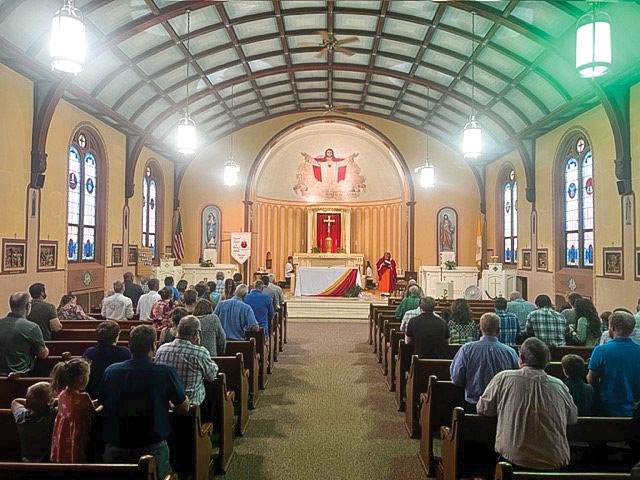 The loss of the church and rectory was only partially covered by insurance. With parishioners, friends, and neighbors supplying labor, donations, and furnishings, the present church was a labor of faith and love. The design is in the Roman style of architecture, constructed of steel skeleton with red brick foundation and lining. The cornerstone for the current church was laid on Sept. 8, 1912. The first Sunday Mass was celebrated on Palm Sunday of 1913.
Many changes have taken place in the decor of the church but the steadfast devotion to the Sacred Heart and our Blessed Mother remains strong within the parishioners of today. An outdoor eucharistic procession is observed each year on the feast day of the Sacred Heart of Jesus. The annual May crowning of the Blessed Mother dates to 1915. From 1922 to 1978, the parish provided a Catholic education for eight grades being instructed by the Ursulines of Decatur.
Fall is a busy time for the parish. For almost 90 years, it has been hosting an annual Trap Shoot on the first Sunday in November. Additionally, the popular Family Fall Festival is held the last Sunday of September and the first two Sundays of October.
Parishioners are grateful for each priest who has served the parish, especially the beloved current priest, Father Rodney Schwartz. Sacred Heart Parish of Oconee is truly a family through our labors of love and dedication to our faith.
Zetta Wolf is the parish secretary for Sacred Heart Parish in Oconee.
Statewide grassroots effort calls for prayer, fasting on bread and water on Fridays for Illinois to become more pro-life

 Governor wants more pro-abortion laws passed in special session
By ANDREW HANSEN
Editor
When the U.S. Supreme Court overturned Roe v. Wade in June, it was a monumental victory not only for the pro-life movement, but for babies in the womb and mothers across the country. At the same time, however, the decision meant Illinois would play an even larger role in the Midwest for abortion access.
In Illinois, abortion is a “fundamental right” under the law, there is taxpayer funding for abortion, minors can get an abortion without even notifying their parents, and abortion is legal throughout the nine months of pregnancy. Now, the spotlight is on Springfield, as Governor J.B. Pritzker and some legislators are wanting even more pro-abortion laws including, among other things, having non-doctors perform abortions, and passing these laws during a special legislative session.
On that note, enter a statewide grassroots effort to stop Illinois from becoming the Midwest’s abortion hub, organized by a group of women from the Diocese of Joliet.
“When the Supreme Court announced the reversal of Roe V. Wade, there was hope again,” said Sarah Turk of Joliet who is spearheading the effort. “We have a long way to go but we have hope! We realize the pressure on this state to become the Midwest abortion provider, and we must try to stop it. We also realize that this evil is so massive that only God can stop it. That is why this group of lay Catholics are making the effort to spread the prayer and fasting on Fridays message.”
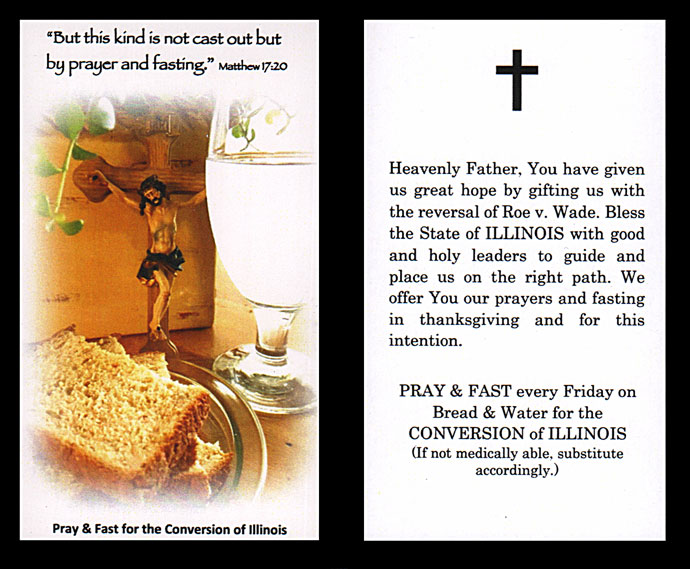
Turk and several other lay Catholics have teamed up to contact all six dioceses in Illinois to spread the word as quickly as possible, asking Catholics, if they are able, to pray and fast every Friday on bread and water alone for the conversion of Illinois. They are hoping to reach 800 or more parishes in the state. Several parishes in the Diocese of Springfield in Illinois are participating by hanging posters and having prayer cards available for people to take home.
“Fasting strengthens and helps us to focus on prayer,” Turk said. “When we fast, we are saying we are serious that we need this evil (abortion) to be cast out. Fasting isn’t easy especially today when we have every kind of food and drink available to us 24/7. While it can be most powerful to fast only on bread and water, there are many ways to fast. It can be giving up a meal, sweets, alcohol, coffee, etc. You could also pray a rosary or go to Mass on Friday if this is something you would not normally do.”
The prayer card starts with a Scripture passage from Matthew 17:21, which says, “But this kind is not cast out but by prayer and fasting.”
The prayer reads:
Heavenly Father, You have given us great hope by gifting us with the reversal of Roe v. Wade. Bless the State of Illinois with good and holy leaders to guide and place us on the right path. We offer You our prayers and fasting in thanksgiving and for this intention.
“We are simply thanking God thereby acknowledging His part in this and petitioning Him, recognizing there is more to be done to satisfy His law,” Turk said. “We are extremely grateful to these brave justices and to all the individuals and organizations who have been in this fight to protect these precious lives. This battle is just short of 50 years — It needs to end!”
The call to prayer and fasting from this grassroots effort is also a good reminder for Catholics that every Friday (unless the Friday is a solemnity), Catholics must abstain from meat, even outside of Lent, unless some other form of penance or work of charity is done on that Friday (canon 1251).
Catholics commemorate 125th anniversary of Quincy’s Father Tolton’s death

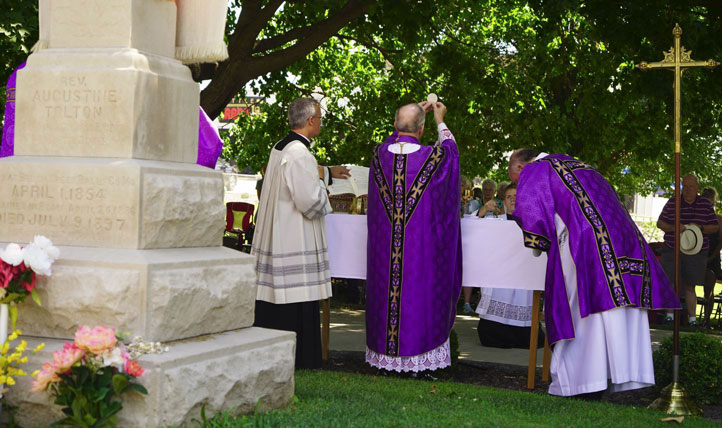 Photo by Jay Niles, The Catholic MissourianQUINCY – About 150 Catholics devoted to the Venerable Servant of God Father Augustine Tolton who grew up in Quincy, ministered in there, and is buried in there, commemorated the 125th anniversary of his death with a pilgrimage procession on Saturday, July 9 in Quincy. Father Tolton is recognized as the first black priest in the United States and the Cause for his beatification and canonization of sainthood is ongoing in Rome.
The mile-long pilgrimage procession began at the statue of Father Tolton outside St. Peter Catholic Church. After a few words of welcome and explanation, followed by a prayer, the pilgrimage procession processed to St. Peter Catholic Cemetery where Father Tolton is buried. The celebration of Holy Mass then took pace with Bishop Thomas John Paprocki as the celebrant.
The pilgrims also prayed for an end to hatred and violence, greater respect for life, and for more priests through Father Tolton’s intercession, as well as for Father Tolton’s canonization as a saint. The pilgrimage procession concluded with the singing of “Holy God, We Praise Thy Name,” Father Tolton’s favorite hymn.
“When he left Quincy for Rome, Father Tolton promised not to forget the people of the Gem City, so we must not forget him either,” said Father Daren Zehnle, pastor of St. Augustin in Ashland and who organized the event. “It is fitting to remember him on the anniversary of his death to pray for his canonization, to ask his intercession, and to strive to emulate his virtues.”
 Photo by Scott Stadler“If we are to imitate the virtue of Father Tolton, we, too, must seek to be united to the sufferings of Christ throughout our lives so that we might also be glorified with him,” Bishop Paprocki said in his homily. “A most important way for us to be united to sufferings of Christ is to imitate the courageous patience of Father Tolton, especially in a society that is so quick to rage. There is unquestionably no shortage of occasions for each of us to practice this same virtue of courageous patience in our own lives. Opportunities for long-suffering abound in our families, in our places of employment, in our schools, and in society generally. What is needed for us is that we be stout-hearted and wait for the Lord, as Augustine did.”
Father Tolton was born into slavery in 1854. In 1862, his mother and siblings made a daring escape across the Mississippi River to Illinois. After settling in Quincy, he went to school at St. Peter’s Catholic School. Tolton later went to seminary in Rome because no American seminary would accept a black man. Thinking he would minister in Africa, once he was ordained, he was instead sent back to Quincy, where he arrived to thousands of supporters. Known for his incredible singing and homilies, Tolton spent several years in Quincy before transferring to Chicago. He died of heatstroke at the age of 43 on July 9, 1897 and is buried at St. Peter’s Cemetery in Quincy. Pope Francis declared him “Venerable” on June 12, 2019, the second step of four to becoming a saint in the Catholic Church.
2 tank Catholic trips

How does one dispose of blessed objects?

How does one dispose of blessed objects? Is there a place in the diocese that will accept these? If not, I need guidance on what to do with them.
Kathy in our diocese
It is not an uncommon experience for a Catholic to acquire blessed objects, be they books, statues, pictures, medals, rosaries, etc. After a time, some of these accumulate in great number or may no longer be needed or wanted. This leads to Catholics to wonder what they can do with these blessed items.
Traditionally, the Church recognizes three options: They may be given away to another person who may benefit from them; they may be buried; or they may be burned. Blessed items are not to be sold; if they are sold, they automatically lose their blessing.
Blessed items should not be given away simply to be rid of them and to clear up space in the closet. When considering giving away a blessed object, it should be considered who might actually benefit from this item.
When burying blessed objects, they may be buried in a place where they are unlikely to be accidentally dug up. While the diocese does not have a program to accept blessed objects, some Catholic cemeteries or funeral homes may have reserved space for the burial of these items.
When burning blessed items, it should done quietly and reverently, in a way so as not to draw attention to what is done. Also, the same fire not ought to be used for roasting hot dogs or making s’mores. Should a blessed object unintentionally be broken, it may simply be discarded, though this should be done quietly.
Father Daren Zehnle is pastor at St. Augustine in Ashland and is the director for the Office of Divine Worship and the Catechumenate for the Diocese of Springfield in Illinois.
He saw Communion as purely symbolic but when he received the Eucharist for the first time, it left him stunned

By DEACON ADAM COX
Special to Catholic Times
Many Catholics across the country are starting a three-year journey. This journey is about Eucharistic Revival, and it is intended to wake up that inner longing for Jesus in the most intimate way possible by placing the proper emphasis on the Blessed Sacrament.
Coming from a Protestant background, I saw Communion as purely symbolic, and this view is held by many denominations still today. The Eucharist is still a mystery to me in some respects, but as a deacon, I can’t imagine my life without it and the wonderful graces I receive from it. I will be the first to say that it wasn’t always this way. In fact, I was somewhat skeptical when I went through the RCIA program and all the way up to when I received holy Communion for the first time.
From that very moment at the Easter Vigil, my life changed, and I didn’t take holy Communion for almost another year. I experienced something and it scared me. I felt love, not just any love, but something that welled up from deep inside my inner being. I won’t get into why that scared me because I have a long and complicated past, but for once in my life, I was accepted for who I am.
My love for the Eucharist has only grown stronger over the years, and I am saddened by how in some places, it has been taken for granted. To receive the Eucharist, is to receive a friend, a friend who will give anything for your wellbeing. This is not something to take lightly but should always be respected and something we should always be grateful for. The Eucharist should never be part of a “list” of items that we will get to for the week, but in some cases, it is treated as such.
The Eucharist is an experience and once you feel that experience, it will shake you to your soul. That experience will vary from person to person, but in the end, you cannot help but be changed for the better.
When I assist at Mass, I always have the upmost respect for the Eucharist, and there is always a moment of grief when I place the ciborium back in the tabernacle because I’m closing the door on my Lord. As I genuflect, I need to remind myself that Jesus is always present, and it’s not “Goodbye,” but, “See you next time.” It may sound ridiculous to some, but once you are touched by the love of Jesus, you will continue to crave that connection.
Over the next three years, the goal of the nationwide Eucharistic Revival is to spread a devotion to the Blessed Sacrament that for some reason has diminished. We need to rekindle the love and respect for the Eucharist because Christ is truly and unequivocally present in all tabernacles of the world. Next time you are at Mass, and you present yourself for holy Communion, that is not some altar bread from a supply house but a King, a friend, and our Savior Jesus Christ. Amen.
Deacon Adam Cox serves at Mother of Perpetual Help in Maryville.