
Diocesan Administrator Account
I am ready to go to confession! Where can I go?

Remember, you can always call a parish and schedule your confession with a priest if these days and times do not fit your schedule.
SPRINGFIELD
Cathedral of the Immaculate Conception
Sunday, 4-4:45 p.m.
Monday-Friday, 4:15-5 p.m.
Saturday, 9-10 a.m., 2:30-3:30 p.m.
Blessed Sacrament
Monday-Friday, 7:30-7:45 a.m.
Saturday, 7:30 a.m.- 7:45 a.m., 3-4 p.m.
Christ the King
Sunday, 4-4:45 p.m.
Monday-Friday, 6:30 a.m.-6:50 a.m.
Wednesday, 5-5:45 p.m.
Saturday, 3-4 p.m.
Little Flower
Saturday, 3:30-4:30 p.m.
St. Agnes
Saturday, 3-4 p.m.
St. Aloysius
Saturday, 3:30-4 p.m.
St. Joseph
Saturday, 3:15-4 p.m.
St. Katharine Drexel (Sacred Heart and St. Patrick churches)
Before all Masses, seven days a week
ALEXANDER
Visitation BMV
Saturday, 3-4 p.m.
ALTON
St. Mary
First Friday, 4-5 p.m.
Saturday, 4-5 p.m.; 7-8 p.m.
Ss. Peter and Paul
Saturday, 3:15-3:45 p.m.
ARCOLA
St. John the Baptist
Thursday, 6:45 p.m.
ARENZVILLE
St. Fidelis
Saturday, 3:30-4 p.m.
AUBURN
Holy Cross
Sunday, 7:30-8 a.m.
BEARDSTOWN
St. Alexius
Third Sunday of the month, 6 p.m.
Thursday, 6 p.m.
BETHALTO
Our Lady Queen of Peace
Monday, available 45 minutes before Mass
Saturday, 3:30-4:15 p.m.
BETHANY
St. Isidore
Sunday, 7:30-7:50 a.m.
Tuesday, 7:30-7:50 a.m.
Saturday, 7:30-7:50 a.m.
BRUSSELS
St. Mary
Saturday, 5:45-6 p.m.
CAMP POINT
St. Thomas
First Fridays, 5-5:45 p.m.
CHATHAM
St. Joseph the Worker
Saturday, 3:15-4 p.m.
CHARLESTON
St. Charles Borromeo
Saturday, 3:30-4:30 p.m.
Wednesday morning before Mass
COLLINSVILLE
Ss. Peter and Paul
Saturday, 3-3:30 p.m.
DECATUR
Holy Family
Saturday, 3:30-4 p.m.
Our Lady of Lourdes
Tuesday, 12-1 p.m.
Thursday, 5-6 p.m.
Saturday, 11 a.m.-12 p.m.
Ss. James and Patrick
Monday, 7:30-7:45 a.m. at St. James
Wednesday, 7:30-7:45 a.m. at St. James
Friday, 10:30-11 a.m. at St. Patrick
Saturday, 11-noon at St. Patrick; 3:15-3:40 p.m. at St. James
St. Thomas the Apostle
Saturday, 3 p.m.
DIETERICH
St. Isidore the Farmer
Sunday, after 10 a.m. Mass at Island Grove
Tuesday, after 8 a.m. Mass at Bishop Creek
Thursday, after 8 a.m. Mass at Island Grove
Saturday, 4:45 p.m. at Bishop Creek
EDWARDSVILLE
St. Boniface
Wednesday, 5:30-6:30 p.m.
Thursday, 6-6:30 p.m. (bilingual)
Saturday, 3:30-4 p.m.
St. Mary
Saturday, 3:30-4:30 p.m.
EFFINGHAM
Sacred Heart
Monday-Thursday, 8-8:25 a.m.
First Monday of the month, 7 p.m. during adoration
Saturday, 3 p.m.
St. Anthony of Padua
Monday, Tuesday, Thursday, Friday, 7:45-8:15 a.m.
Saturday, 3:15-4 p.m.
FIELDON
St. Mary
Saturday, 5:15-5:50 p.m.
GLEN CARBON
St. Cecilia
Monday, 6-6:30 p.m.
Saturday, 3:30-4 p.m.
First Saturdays, 7:30 a.m.
GODFREY
St. Ambrose
Saturday, 3:30-4 p.m.
GREEN COUNTY
All Saints (White Hall)
Sunday, 9:15-9:25 a.m.
St. John the Evangelist (Carrollton)
Saturday, 5:15-5:45 p.m.
St. Michael (Greenfield)
Saturday, 3:15-3:45 p.m.
GREENVILLE
St. Lawrence
Saturday, 4:45-5:15 p.m.
GRANITE CITY
Holy Family
Saturday, 3-3:30 p.m.
St. Elizabeth
Saturday, 3-4 p.m.
GRANTFORK
St. Gertrude
Tuesday, 8:30-9 a.m.
HIGHLAND
St. Paul
Saturday, 3 p.m.
JACKSONVILLE
Our Saviour
Saturday, 3:15 p.m.
JERSEYVILLE
Holy Ghost
Sunday, 7:15-7:50 a.m.
Saturday, 3-3:50 p.m.
St. Francis Xavier
Saturday, 3:15-3:45 p.m.
LIBERTY
St. Brigid
Saturday, 3:50-4:20 p.m.
LITCHFIELD
Holy Family
Saturday, 3:15-3:45 p.m.
MATTOON
Immaculate Conception
Sunday, 7:30 a.m.; 4:30 p.m.
Monday, Wednesday, Friday, 6:30 a.m.
Tuesday, Thursday, 5 p.m.
Saturday, 2:30-3:30 p.m.
MARINE
St. Elizabeth
Sunday, 9:15 a.m.
MARSHALL
St. Mary
Wednesday, 6 p.m.
MARYVILLE
Mother of Perpetual Help
Tuesday, 5-5:45 p.m.
Saturday, 3-3:45 p.m.
MENDON
St. Edward
Saturday, 7:15-7:45 p.m.
MONTROSE
St. Rose of Lima
Saturday, 4:30-5 p.m.
MT. STERLING
Holy Family
Saturday, 4-5 p.m.
MT. ZION
Our Lady of the Holy Spirit
Sunday, 10-10:20 a.m.; 5-5:20 p.m.
Monday, Thursday, Friday, 7:30-7:50 a.m.
Wednesday, 4:15-5:15 p.m.
Saturday, 4-5 p.m.
NEWTON
St. Thomas the Apostle
Wednesday, 4:15-4:30 p.m.
Saturday, 8-9 a.m., 3:30-4 p.m.
NOKOMIS
St. Louis
Saturday, 3-3:30 p.m.
NORTH ARM
St. Aloysius
Sunday, by appointment
PANA
St. Patrick
Saturday, 2:45-3:25 p.m.
PARIS
St. Mary
Saturday, 4-5 p.m.
PETERSBURG
St. Peter
Saturday, 3-3:45 p.m.
PIERRON
Immaculate Conception
Thursday, 5:30-7 p.m.
PITTSFIELD
St. Mary
Friday, First Friday after 8 a.m. Mass
Saturday, after 6 p.m. Mass
POCAHONTAS
St. Nicholas
Saturday, 3:45-4:15 p.m.
QUINCY
Blessed Sacrament
Sunday, 4-4:30 p.m.
Wednesday, 4:30-5:10 p.m.
Saturday, 9-9:30 a.m.
St. Joseph
First Saturdays, 9-9:20 a.m.
St. Francis Solanus
Saturday, 8:30 a.m.; 3-4 p.m.
St. Peter
Saturday, 7:30-7:50 a.m.; 3:30-4:30 p.m.
St. Rose of Lima
Sunday, 7:30 and 10:30 a.m.
Monday, 11:30 a.m.
Tuesday, 6:30 a.m.
Wednesday, 11:30 a.m.
Thursday, 6:30 p.m.
Friday, 11:30 a.m.
Saturday, 7:30 a.m.
RAMSEY
St. Joseph
Sunday, 7-7:45 a.m.
RIVERTON
St. James
Saturday, 3 p.m.
ROBINSON
St. Elizabeth
Saturday, 3:45 p.m.
ROCHESTER
St. Jude
Tuesday-Friday, 6:45-7:15 a.m.
Saturday, 3:15-4 p.m.
SHELBYVILLE
Immaculate Conception
Saturday, 45 minutes prior to Mass
SHERMAN
St. John Vianney
Wednesday, 5-5:30 p.m.
Saturday, 4-4:45 p.m.
SHUMWAY
Annunciation
Wednesday, 7:45-8:15 a.m.
Saturday, 4:15-5 p.m.
SIGEL
St. Michael the Archangel
Saturday, 3:15 p.m.
STAUNTON
St. Michael the Archangel
Sunday, 7:30-7:55 a.m.
Saturday, 3:30-3:55 p.m.
SULLIVAN
St. Columcille
Wednesday, 5-6 p.m.
TAYLORVILLE
St. Mary
Saturday, 11:30 a.m.-noon
TUSCOLA
Forty Martyrs
Saturday, 5 p.m.
VANDALIA
Mother of Dolors
Saturday, 3-3:45 p.m.
VIRDEN
Sacred Heart
Sunday, 9:45-10:10 a.m.
VIRGINA
St. Luke
Tuesday, 6-7 p.m.
WINCHESTER
St. Mark
Sunday, after 10:30 a.m. Mass
WOOD RIVER
Holy Angels
Saturday, 3-4 p.m.
Confession in Spanish
Our Lady of Lourdes, Decatur:
Tuesday, 12-1 p.m., Thursday, 5-6 p.m., Saturday, 11 a.m.-12 p.m., or by appointment:
St. Thomas the Apostle, Decatur:
Saturday, 3-3:45 p.m. or by appointment:
Sacred Heart, Springfield:
Last Thursday of the month, 6 p.m. or by appointment: (217) 523-4501
St. Boniface, Edwardsville:
Thursday, 1 p.m. or by appointment: (618) 656-6450
Sacred Heart, Effingham:
By appointment: (217) 347-7177
St. Mary, Alton:
By appointment: frpaul@stmarysalton. com / (618) 465-4284, ext. 227
Immaculate Conception, Mattoon:
30 minutes before daily Masses, 3-4 p.m. on Saturday, or by appointment: 217-235-0539.
Forty Martyrs, Tuscola:
By appointment: (217) 253-4412
St. John the Baptist, Arcola:
Thursday, 6:45 p.m.
Other languages
Philippines (Tagalog and Cebuano): by appointment: (715) 207-9575 (textable); or email Father Nick at or
Indian (Kannada, Telugu, and Tamil): by appointment: email Father Chowrappa:
Vietnamese: by appointment: (217) 961-6404, ask for Father Dat Hoang
Italian and Igbo (language in Nigeria): By appointment: Father Freddy, (217) 220-1837
Polish: By appointment: Father Michal Rosa, (217) 347-7177 or by appointment: Father Augustyniak, , (217) 774-3434
American Sign Language: Our Saviour Parish, Jacksonville: By appointment:
Can you please explain the suffering servant from the book of Isaiah?

Can you please explain the suffering servant from the book of Isaiah?
Pat in Ramsey
“The suffering servant” is a famous passage from Isaiah 53, which theologians claim is a messianic prophecy about Jesus. It talks about the suffering this “servant” will endure, however, to get the full picture, you need to look at four Songs of the Servant of the Lord.
The four Songs of the Servant of the Lord (Is 42:1-9; Is 49:1-7; Is 50:4-11; Is 52:13-53:12) describe the mysterious figure of the “Servant of God” who in some respects resembles Israel — the Servant of the Lord from many other texts (Is 41:8), but in His other features, He is someone completely different, a very distinguished and distinctive personality, having no equal (Is 49:5).
The “Servant of the Lord” is chosen by God for His mission while still in the womb, fashioned by Him, filled with His spirit (Songs I and II). He is a docile, attentive, and a faithful disciple of the Lord, diligently listening to His teachings to be able to teach people in turn (Song II). The task and role of this Servant is to announce a new religious law for all nations, not only for Israel. It is to be a light for the nations and a covenant for Israel, to bring people messianic good and salvation (Song I, II, III).
Although persecuted and despised by people, the Servant will not be afraid and will carry out His mission bravely, trusting in the power of God, who will constantly support Him and surround Him with His care, and finally, reward and glorify Him (Songs III and IV). The fourth song presents and ponders the sufferings of the Lord's Servant. Though innocent, He suffers severe physical torments and spiritual humiliation inflicted upon Him by people, up to and including a shameful death, as if He were the worst villain. He, however, suffers these torments voluntarily as an expiation for the sins of others, namely all sinful people, because He took them upon Himself. The Lord acknowledged and accepted His Passion as universal satisfaction. Therefore, the Servant of the Lord will receive as a reward eternal glory and immense descendants forever, that is, of the people He redeemed, both from Israel and from other nations.
In various texts, the New Testament recognizes and sees in Isaiah's “Servant of the Lord” a prophetic announcement — a type of Jesus Christ Himself, the Messiah and Savior (Mt 3:17; Mt 8:17; Mt 12:17-21; Lk 2:31; Lk 4:17-21; Acts 3:13). More often, the words of the fourth Song of the Servant of the Lord are used or quoted (Is 53) in Mk 9:12; Jn 12:38; Acts 8:32-35; Rom 4:25; Rom 10:16; Rom 15:21; 1 Cor 15:3; 2 Cor 5:21; 1 Pt 2:22-25.
Christ combines in His person both the features of the glorious Messianic King of the Davidic family (2 Sm 7:12-17; Is 7:14; Is 9:5; Is 11:1-5) and the suffering Servant of the Lord (Is 52:13-53:12; Ps 22). Christ Himself identified Himself as the Servant of the Lord (Lk 22:37).
Father Michal Rose is pastor of Sacred Heart Parish in Effingham.
Founder of HSHS Passes Away

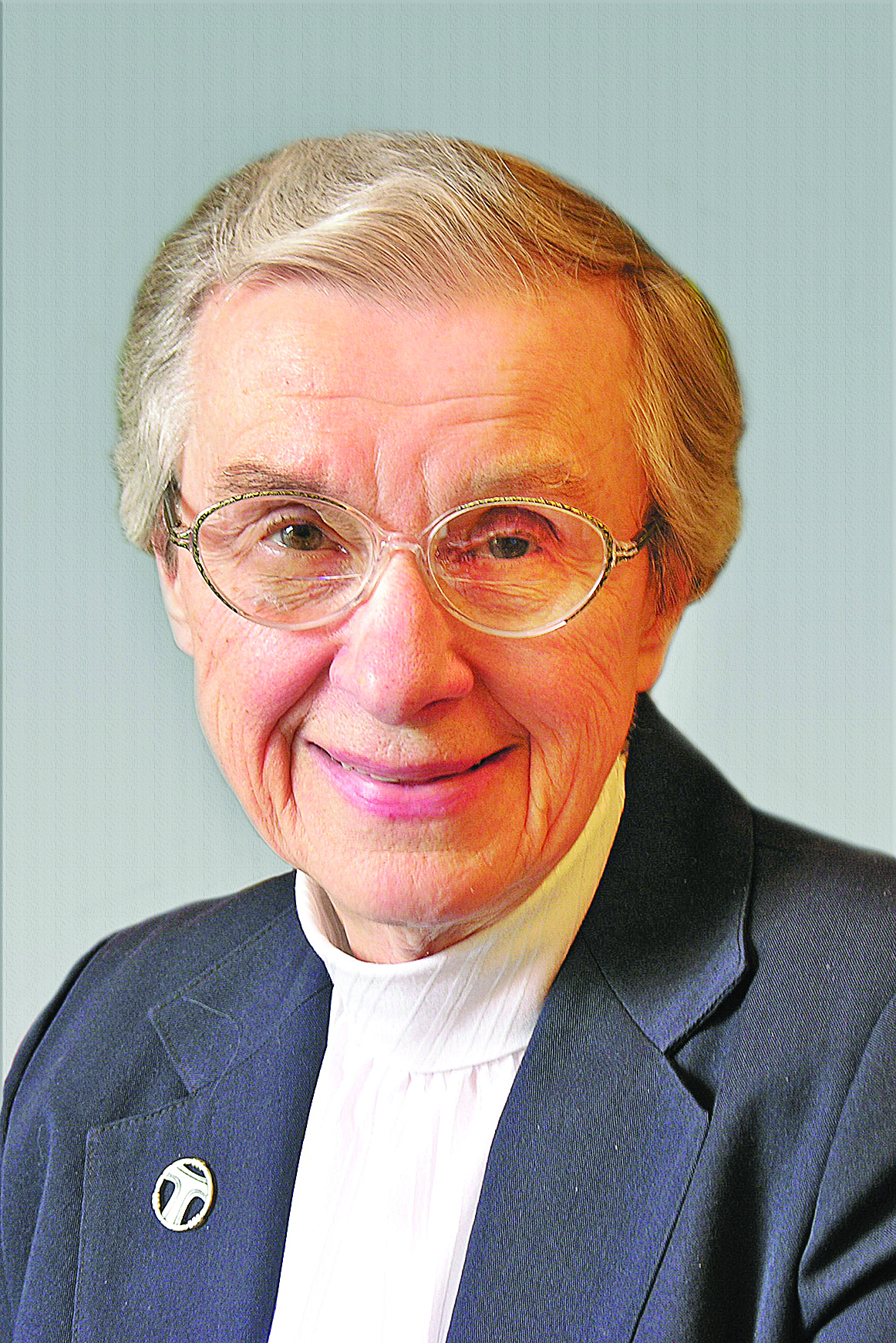 A Cinderella story of a visionary who went from the kitchen to the board room
Sister Marianna Kosior, OSF, age 99, passed away on Dec. 11, 2021 at St. Francis Convent, Springfield. Sister Marianna was the founder of Hospital Sisters Health System (HSHS), a multi-institutional health care system in 14 communities in Illinois and Wisconsin with 15 hospitals, health centers and clinics, physician partners, and colleagues.
In the early 1970s, “Sister Marianna found herself responsible for 12 Catholic hospitals at a time of considerable flux in sponsorship and organizational arrangements within Catholic health care,” said Sister Jomary Trstensky, OSF, chair, Hospital Sisters Ministries, and HSHS president from 1989 to 2006. “She led the way with her creative vision and unwavering belief that the future of Catholic health care would be built on strong systems and lay leaders. With no blueprint she established Hospital Sisters Health System and entrusted others to give life to her vision.”
In a 2006 interview, Sister Marianna stated, “As the Lord served people and washed his Disciple’s feet, I have tried to live my life in service to others.”
When she entered the Hospital Sisters of St. Francis in 1943, she was ready to devote her life to God and the service of his people. The path that God paved for her was something that most women, including those not in religious life, could not imagine would be possible. In 1978, Sister Marianna was one of the first women CEOs of a multibillion-dollar corporation as she founded HSHS and was named its executive vice president. At this time in U.S. history, health systems had only been formed by three other religious communities, and Sister Marianna, the provincial superior of the Hospital Sisters of St. Francis from 1973 to 1979, pioneered the process for the hospitals the Sisters had founded.
Sister Marianna was born in 1922 in Indiana. After graduating from high school, she worked as a secretary, and as her friends were signing up to help in the war effort in 1941, she wondered if she should find ways of serving God. A friend invited her to a weekend retreat where Sister Marianna asked the retreat leader if he thought she had a religious vocation. He sent her to visit a “nice Franciscan group in Springfield, Ill.,” and Sister Marianna recalled that her visit to the Motherhouse felt like home. She entered the community in 1943 and professed first vows in 1946.
Despite her lack of interest in nursing, she attended St. John’s Hospital School of Nursing, Springfield. “I remember sitting in the balcony of the chapel facing a picture of the healing Christ and I said, ‘Well Lord if this is what you want, you’re just going to have to help me.’ I was in tears because I just didn’t know how I was going to do it.”
Throughout the following years, Sister Marianna worked at St. Mary’s Hospital (Decatur) and St. Anthony’s Memorial Hospital (Effingham). An election by the Hospital Sisters in 1969 brought Sister Marianna to the Motherhouse as a member of the leadership team and four years later, she was elected Provincial Superior and served until 1979.
During this time in the U.S., religious congregations were closing their Catholic hospitals or turning them over to be run as community facilities because of Medicare regulations. While facing these challenges, the Hospital Sisters also faced the decline of women entering their community and so they began discussing the future of their hospitals. Sister Marianna and her team researched options for an organization that would oversee the management and operations while keeping the Sisters involved with sponsorship and governance.
One of the first steps she implemented was the establishment of a holding company in the late 1970s with a parent corporation and subsidiary corporations. The members of the parent corporation were the Sisters’ leadership team, who were similar to major stockholders. The health system was the holding company, and the hospitals were the subsidiary corporations.
“The Catholic Church has a long history of care for the sick, which is a work of mercy,” Sister Marianna explained in a 1981 interview with the Catholic Health Association. “The religious congregations have been given this apostolate almost as a trust and if congregations can’t continue in the same way, then what can we do to preserve that work as a mission of the Church? If we develop strong systems and begin to pass our torch to laypersons who see health care as a mission, possibly it could survive through lay leadership,” she added. “It is the age of the laity, and even if they are not in the traditional religious congregations, they have an obligation to do the works of mercy. They find a different working environment in Catholic hospitals with value other than profit and the bottom line.”
On Dec. 26, 1978, HSHS was incorporated, and Sister Marianna was named president in August 1979, a position she held until her retirement in October 1989.
“My Cinderella story of my life as a Hospital Sister took me from the kitchen to the board room, and throughout my life, I was open to the Spirit and waited to see where the Lord was calling me,” she stated. “All people are called to holiness, and so it is my hope that we should always strive to develop a greater love with our neighbor, and in doing so, we will share our love with the Lord.”
Three things you didn't know about Christmas

By DAVID BERTAINA
Special to Catholic Times
 1. Why is Dec. 25 the date for Christmas?
Matthew and Luke are the only two Gospels that mention the birth of Jesus Christ. Although they do not provide a clear date for Jesus’ birth in their narratives, they did leave implicit clues. As Christians began to be interested in celebrating Jesus’ birth as a special feast date annually, they used the Gospels to calculate Dec. 25 as the specific date for the Nativity.
In Luke 1:9, the Gospel author notes that Zechariah “was chosen by lot, according to the custom of the priesthood, to enter the sanctuary of the Lord and offer incense.” This location was the altar of incense just outside the Holy of Holies in the inner sanctuary of the Temple. Early Christians, who believed that Zechariah was serving as high priest that year, associated this special event with the feast of Yom Kippur, or the Day of the Atonement, which usually falls in late September. When the angel Gabriel appeared to Zechariah, he gave him the news of the coming of his son John the Baptist. In fact, the Church recognizes the conception of John the Baptist on Sept. 23.
The second key point from Luke is the date for the Annunciation. According to Luke 1:26-27: “In the sixth month [of Elizabeth’s pregnancy], the angel Gabriel was sent by God to a town in Galilee called Nazareth, to a virgin engaged to a man whose name was Joseph, of the house of David. The virgin’s name was Mary.” Based upon this information, we can determine that six months from late September brings us to a date in late March. The Feast of the Annunciation is in fact held on March 25. Continuing with this information, three months later (June 24) is the date for the birth of John the Baptist. And finally, nine months from the Annunciation brings us to the 25th day of December. This biblical information is what led early Christians to celebrate Christmas on Dec. 25. In the fourth century, St. John Chrysostom even explains these calculations in one of his Christmas sermons as the reason for celebrating the feast on this date.
Early Christians also believed that God had chosen Dec. 25 because it fulfilled biblical prophecies of the Old Testament and because of its cosmic significance. As for biblical prophecy, Malachi 4:2 predicted the coming of God’s judgment with his Messiah: “But for you who fear my name, the Sun of Righteousness shall rise, with healing in its wings.” Early Christians noticed that the Sun of Righteousness was a symbolic sign for the Messiah, who would come when the sun would rise. In the Julian calendar of the ancient world, the winter solstice fell upon Dec. 25. Therefore, the image of the sun rising held significance as the date predicting the birth of the Messiah. This is further confirmed in the New Testament. The Gospel of John points to cosmic solar symbolism as a sign of Jesus Christ: “The light shines in the darkness, and the darkness has not overcome it … . The true light that enlightens every man was coming into the world.” In John 3:30, John the Baptist admits that “He must increase, but I must decrease.” In other words, Jesus Christ, the light of the world, came at the time when light was increasing. Since the winter solstice is the beginning of the increase in light, early Christians recognized that God had given His Son this auspicious birth date to prove his divine origins to all people. The Old Testament, New Testament, and cosmic symbolism all suggested to Christians that Dec. 25 was the birth date of Jesus Christ.
 2. Where was Jesus born?
According to Luke, the Holy Family traveled from Nazareth to Bethlehem (the city of David), and the Virgin Mary gave birth to him and “wrapped him in swaddling cloths, and laid him in a manger, because there was no place for them in the inn” (Luke 2:7). The ancient term for an inn was not meant to convey a formal place for travelers, but mostly likely a simple lodging where one could stay at a residence.
Imagine a Nativity scene like the one that many Catholics have in their homes. There is a stable made of wood, with farm animals such as an ox, donkey (Isaiah 1:3), and sheep gathering around the Holy Family. This image comes from the popularity of the manger scene spread by St. Francis of Assisi (d. 1226), who celebrated a Mass at a stable with living animals. Later, living Nativities and artistic Nativities became widespread across medieval Europe.
However, the typical Jewish stable would not have been made from wood, which is a plentiful source in Europe but was already depleted in Israel by the first century. Instead, caves functioned as stables for animals in the region. An early second-century Christian tradition about the Nativity recounts the cave birthplace. It notes how as onlookers approached the cave, a dark cloud hovered over the cave and Mary’s midwife declared it a miracle. As the cloud withdrew, suddenly a great green light appeared in the cave. Then when the light subsided, the child Jesus was born.
The tradition of Jesus’ birth in a cave is found in the writings of early Christians such as Justin Martyr (d. 165) (“he took up his quarters in a certain cave near the village”). The Christian teacher and theologian Origen also confirmed the cave as a sacred site of veneration in the early third century: “There is shown at Bethlehem the cave where He was born, and the manger in the cave where He was wrapped in swaddling-clothes. And this site is greatly talked of in surrounding places, even among the enemies of the faith, it being said that in this cave was born that Jesus who is worshipped and reverenced by the Christians.” This location was a shrine by the second century where Christians venerated Jesus’ birth at the site of the Church of the Nativity, which was built around the cave by Constantine in the fourth century.
The cave also had theological significance for pointing out how God uses signs to prove the coming of His son Jesus Christ. Just as Jesus’ birth was in a cave, so his body would be placed in a cave at his death. Just as he was wrapped in swaddling clothes at his birth, Jesus was wrapped in cloths at his death. Just as angels announced his birth, so too they would announce his resurrection. These theological parallels and the early Christian traditions indicate that Jesus was born in a cave.
 3. Who were the Magi and why did they bring gold, frankincense, and myrrh?
The Magi are mentioned only in the Gospel of Matthew. According to Matthew, “wise men from the East came to Jerusalem, saying, ‘Where is he who has been born king of the Jews? For we have seen his star in the East and have come to worship him’.” After speaking with King Herod, “the star which they had seen in the East went before them, till it came to rest over the place where the child was. When they saw the star, they rejoiced exceedingly with great joy; and going into the house they saw the child with Mary his mother, and they fell down and worshiped him. Then, opening their treasures, they offered him gifts, gold and frankincense and myrrh.”
The term Magi (plural) comes from the singular Magus, which means someone who examines the stars for auspicious signs that point to real world events. These wise men were in a sense like astrologers, who had noted the star of Bethlehem and came from the East. The Magi were known as religious adherents to Zoroastrianism in the ancient world — so why would they be interested in a Jewish king? An Old Testament prophecy predicted that when the Messiah appeared, wise men from the East would arrive. In Numbers 24:17–18, Balaam, a wise man from the East, tried to put a curse on Israel, God made him speak only words of blessing, saying: “I see him, but not now; I behold him, but not nigh: a star shall come forth out of Jacob, and a scepter shall rise out of Israel.” Jews knew that the appearance of a star would signal the coming of the Messiah King. This passage was a foretelling of the coming of Magi following their guide, the star of Bethlehem. The ones who worshipped stars were taught by a star to worship the true star and light of the world, Jesus Christ.
In the western Church, there developed a tradition that there were three wise men: Balthasar, Melchoir, and Gaspar. By the fifth century, there were already mosaics of the Magi offering their gifts to the Christ child with their names mentioned in the artwork in the Basilica of St. Apollinarus in Ravenna, Italy.
The three gifts of gold, frankincense, and myrrh were both a fulfillment of Old Testament prophecy about the Messiah as well as a symbol of the status of Jesus Christ. In Psalm 72:10-15, the author affirms that kings of nations will bow before the son of David, bringing him gifts of gold. This passage is where we get the tradition that the Magi were also kings. Likewise in Isaiah 60:3 and 6, we read that kings will come at the rising of the Messiah, and that “they shall bring gold and frankincense.” Therefore, the Magi represent all of humanity across the world acknowledging that Jesus Christ is Lord. As for the symbolic significance of these three gifts, they also demonstrate Jesus’ rank. Gold is the sign of a king. Frankincense is the sign of worship for a divinity. Myrrh, which is a burial ointment pointing to Jesus’ eventual death, is the sign of his humanity. Therefore, Jesus’ kingship, humanity, and divinity are revealed through the gifts of the Magi.
This Christmas season, think about the gift of Jesus Christ to the world. Remember the gifts of the Magi. Gift-giving does not have to be a materialist and consumer-driven motivation to acquire more things. God is the ultimate gift giver. And in return we can be like the Magi and offer our gifts to the only one worthy of worship this Christmas season.
- David Bertaina, PhD, is a professor of history at the University of Illinois Springfield and is a parishioner at Blessed Sacrament Parish in Springfield.
Hey, Father! What is the distinction between Venerables, Blesseds, and Saints?

Laura in Springfield
The titles of Venerable, Blessed, and Saint are given at various stages to those whom the Catholic Church is considering for canonization, the title of Saint, of course, being the last one.
Once a local bishop receives permission from the Congregation for the Causes of Saints in Rome to investigate the life of a person who has died and who had a reputation for holiness, the title of Servant of God is given to the person. The bishop then begins a formal inquiry into the biography of the Servant of God to be certain he or she actually existed, has died, and researches the Servant of God’s writings looking for anything contrary to the faith. When the investigations are complete, a report is sent to the Congregation for the Causes of Saints.
After the cardinals and bishops who are members of the Congregation for the Causes of Saints read through the report, they make a recommendation to the pope as to whether or not the pope should declare that the person in question lived a life of heroic virtue. If the Holy Father so declares, he grants the title of Venerable to the person because his or her life is worthy of imitation by the Christian faithful.
After a person is declared Venerable, the Church begins looking for possible miraculous healings that can be attributed to the intercession of the Venerable. When such a case is reported to the bishop, an investigation is done which involves a team of medical professionals to ascertain whether the healing can be attributed to any natural means. If the investigation finds the contrary, another report is sent to the Congregation for the Causes of Saints. If the cardinals and bishops who serve on the Congregation judge the healing to be miraculous, they recommend it to the pope. If the pope finds it to be a miracle, he grants the title of Blessed to the person in question through a formal declaration that the Blessed is in Heaven because he or she has been shown to have interceded before the throne of God. When a person is declared Blessed, liturgical prayers for the Mass and the Liturgy of the Hours may be prayed in the location where he or she lived and/or died, but not throughout the universal Church.
After a person is declared a Blessed, a search begins for a second miraculous healing that can be attributed to the Blessed’s intercession. If such a miracle is found and so determined by the pope, he names the Blessed a Saint, which allows for liturgical prayers to be prayed in the Mass and the Liturgy of the Hours in honor of that person throughout the whole world.
Father Daren Zehnle is pastor at St. Augustine Parish in Ashland and is the director for the Office of Divine Worship and the Catechumenate for the Diocese of Springfield in Illinois.
St. Francis Solanus - Quincy

 By ANDREW HANSEN
Editor
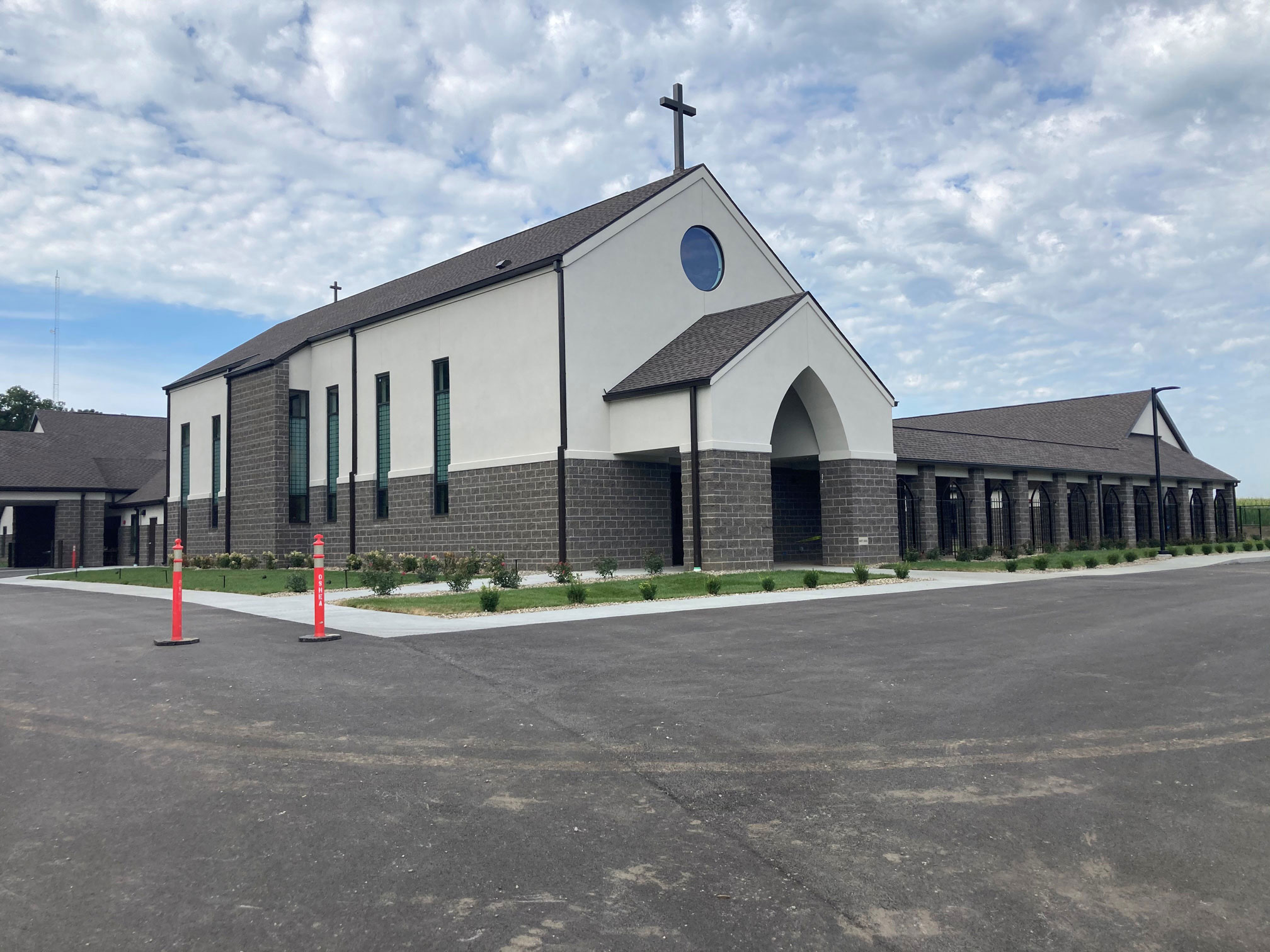
Founded by the Franciscan friars from Germany in 1860, St. Francis Solanus Parish in Quincy is rich in history and deeply Catholic. The church, built in 1885, is home to beautiful statues, gorgeously colored Stations of the Cross, a towering ceiling that makes you look up toward heaven, and a high altar unlike any in the diocese.
“This church is so spectacularly built, so well appointed, and so beautiful,” said Father Steven Arisman, pastor. “They put so much effort into making sure it lasted and truly it has because all these years later, it is still standing.”
One of the biggest parishes by family count in the Diocese of Springfield in Illinois, St. Francis Solanus Parish was known for 160 years as having the Franciscan friars minister to the people of the parish. This included decades ago when dozens of Franciscans would offer Mass every half hour starting at 5 a.m. until 8 a.m. at the five different altars in the church. In 2020, the order transferred the staffing of the parish to the Diocese of Springfield in Illinois.
 “This parish was the Franciscan’s novitiate, this is where they would do some of their studies, and formation as Franciscans,” Father Arisman said. “Beyond that, at one point, there were 55 priests who at one point lived here that took care of this parish and the people at Quincy College and St. Francis Solanus College, which is now Quincy University. Those Franciscans have left such a legacy of building a Catholic culture and people who follow the Lord as disciples.”
Inside, the church is a treasure of everything Catholic. Relics of saints can be seen including St. Francis Solanus, St. Francis of Assisi, and St. Anthony of Padua. Franciscan saints line the main area of the pews, towering above the faithful. Nearly 1,000 people can be seated inside. Most eyes, however, are immediately drawn to the white and gilded high altar. It was designed by 19th century designer, Franciscan Brother Adrian Wewer and built by Henry Schenk of Quincy. Standing more than three stories tall, the base includes a replica of Leonardo DaVinci's Last Supper and closer to the top, the statue of St. Francis Solanus. The statue depicts St. Francis baptizing a native of Peru while he was a missionary in South America.
The statue of the crucifix that is just above the tabernacle is unlike any in the diocese. That is because there are three crucifixes with three different backgrounds. All the priest must do is spin the mechanism and depending on the solemnity or what the priest wants to portray, that is the crucifix and background that is displayed.
 To side of the high altar is the friar’s choir, where the Franciscans would pray together. In the etching of each of the dozens of wooden seats is a phrase from the Psalms that when you read them from one side to the other, it reads that Psalm out in Latin.
“One of the other unique things about the church is the stained-glass window on the font of the church which depicts St. Francis Solanus playing the violin for the native people,” Father Arisman said. “That was one of the ways he drew them to Christ — the beauty of music.”
Other interesting spaces in the church include the library, which includes a ladder and stairs so readers can find books on two levels. In the basement, under the sacristy, is an area where altar servers used to get ready for Mass decades ago. The old cabinets their vestments would hang in are there and are still in good shape. This changing area for the servers was accessible by an outside door. That is because with so many Masses going on daily, this allowed the dozens of daily servers to enter and exit the building without making any noise for the faithful praying in the church.
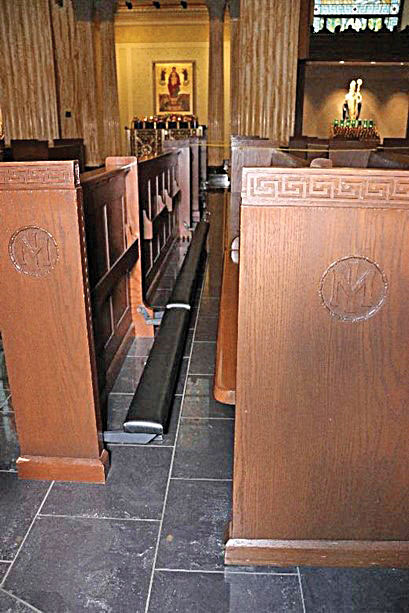 The church itself is 75 feet high, with the steeple climbing to 217 feet high, making it one of the prominent structures in the Gem City. Right next to Quincy University and Underbrink’s Bakery, in one of the most historic parts of Quincy, St. Francis Solanus is a refreshing reminder of the dedication and faithfulness of Catholics from the past and the present.
“There have been so many different people who have walked through here with so many stories,” Father Arisman said. “There are so many families who are tied to this parish, and they have very large families. With that, some have been tied to this parish from the very beginning. The work the Franciscans and these families have done to build up this parish community is quite beautiful. The work they have done with native peoples, the work they have done with the Hispanic culture, and the work they did with (Venerable) Father Augustine Tolton, and to think that Father Tolton was in this building at one point in his lifetime, is quite astounding to us as a parish — to have that kind of history to stand on, a foundation rooted on Christ with Him as our cornerstone and the people of this parish following after Him.”
Christmas Mass Schedule

SPRINGFIELD
Cathedral of the Immaculate Conception
Christmas Eve, 4 p.m., 7 p.m.;
Midnight;
Christmas Day, 9 a.m.
Blessed Sacrament Parish
Christmas Eve, 4:30 p.m., 8 p.m., 11 p.m.;
Christmas Day, 8:30 a.m., 10:30 a.m.
Christ the King Parish
Christmas Eve, 4 p.m., 6:30 p.m., 10 p.m.;
Christmas Day, 9:30 a.m.
Little Flower Parish
Christmas Eve, 4:30 p.m., 10 p.m.;
Christmas Day, 9 a.m.
St. Agnes Parish
Christmas Eve, 4:30 p.m., 8:30 p.m.;
Christmas Day, 10 a.m.
St. Aloysius Parish
Christmas Eve, 4:30 p.m.;
Midnight;
Christmas Day, 7 a.m.
St. Francis Cabrini Parish
Christmas Eve, 7 p.m.;
Christmas Day, 9:30 a.m.
St. Joseph Parish
Christmas Eve, 5 p.m., 9:30 p.m.;
Christmas Day, 9:30 a.m.
St. Katharine Drexel Parish
Christmas Eve, 4 p.m.;
Midnight;
Christmas Day, 7 a.m., 8 a.m. (Latin), 9 a.m. (St. Patrick Church), 10:30 a.m. (Spanish), 12:30 p.m. (Latin)
All Masses are at Sacred Heart Church, except 9 a.m. Christmas Day, which is at St. Patrick Church.
ALEXANDER
Visitation of the Blessed Virgin Mary Parish
Christmas Day, 8 a.m.
ALTAMONT
St. Clare Parish
Christmas Eve, 6 p.m.;
Christmas Day, 10 a.m.
ALTON
Immaculate Conception Parish (St. Mary)
Christmas Eve, 4 p.m., 6 p.m.;
Midnight;
Christmas Day, 6:30 a.m., 8 a.m., 10 a.m.
Ss. Peter and Paul Parish
Christmas Eve, 4 p.m., 8 p.m.;
Christmas Day, 10 a.m.
ARCOLA
St. John the Baptist Parish
Christmas Eve, 7:30 p.m.;
Christmas Day, 9:30 a.m.
ARENZVILLE
St. Fidelis Parish
Christmas Eve, 4 p.m.
ASHLAND
St. Augustine Parish
Midnight;
Christmas Day, 9 a.m.
ASSUMPTION
Assumption of the Blessed Virgin Mary Parish
Christmas Eve, 6 p.m.
ATHENS
Holy Family Parish
Christmas Eve, 6 p.m.;
Christmas Day, 10 a.m.
AUBURN
Holy Cross Parish
Christmas Eve, 4 p.m.
Overflow seating in the parish center.
BEARDSTOWN
St. Alexius Parish
Christmas Eve, 7:30 p.m. (Spanish);
Christmas Day, 8 a.m. (English/French)
BENLD
St. Joseph Parish
Christmas Eve, 5:30 p.m.
BETHALTO
Our Lady Queen of Peace Parish
Christmas Eve, 4:30 p.m., 9 p.m.;
Christmas Day, 9 a.m.
BETHANY
St. Isidore Parish
Midnight;
Christmas Day, 7 a.m. (Latin)
BRUSSELS
Blessed Trinity Parish
Christmas Eve, 4 p.m. (St. Mary Church, Brussels);
Midnight (St. Joseph Church, Meppen);
Christmas Day, 8 a.m. (St. Barbara Church, Batchtown)
CAMP POINT
St. Thomas Parish
Christmas Eve, 6 pm.;
Christmas Day, 9 a.m.
CARLINVILLE
Ss. Mary and Joseph Parish
Christmas Eve, 4 p.m.;
Christmas Day, 9 a.m.
CHARLESTON
St. Charles Borromeo Parish
Christmas Eve, 5 p.m., 10 p.m.;
Christmas Day, 8:30 a.m.
CHATHAM
St. Joseph the Worker Parish
Christmas Eve, 4:30 p.m., 9 p.m.;
Christmas Day, 9 a.m.
COLLINSVILLE
Ss. Peter and Paul Parish
Christmas Eve, 4 p.m., 7 p.m.;
Christmas Day, 8 a.m., 10:30 a.m.
DECATUR
Holy Family Parish
Christmas Eve, 4 p.m., 9 p.m.;
Christmas Day, 9 a.m.
Our Lady of Lourdes Parish
Christmas Eve, 4 p.m., 7 p.m. (Spanish);
Midnight;
Christmas Day, 7:30 a.m., 9:30 a.m.
Ss. James and Patrick Parish
Christmas Eve, 4 p.m. (St. James Church), 6 p.m. (St. Patrick Church), 11 p.m. (St. James Church);
Christmas Day, 10:15 a.m. (St. Patrick Church)
St. Thomas the Apostle Parish
Christmas Eve, 5 p.m.;
Christmas Day, 10 a.m.
DIETERICH
St. Isidore the Farmer Parish
Christmas Eve, 4 p.m. (St. Aloysius Church, Bishop Creek), 7 p.m. (St. Joseph Church, Island Grove), 10 p.m. (St. Aloysius Church, Bishop Creek);
Christmas Day, 10 a.m. (St. Joseph Church, Island Grove)
No 6 p.m. Mass on Dec. 25.
EDGEWOOD
St. Anne Parish
Christmas Day, 8 a.m.
EDWARDSVILLE
St. Boniface Parish
Christmas Eve, 4:15 p.m., 9:15 p.m.;
Christmas Day, 8:15 a.m., 12:15 p.m. (Spanish)
St. Mary Parish
Christmas Eve, 4 p.m., 6 p.m.;
Christmas Day, 9 a.m.
No 5 p.m. Mass on Christmas
EFFINGHAM
Sacred Heart Parish
Christmas Eve, 4 p.m.;
Midnight;
Christmas Day, 9:30 a.m., 5 p.m. (Spanish)
St. Anthony of Padua Parish
Christmas Eve, 4:30 p.m., 7 p.m.;
Midnight;
Christmas Day, 9 a.m.
FARMERSVILLE
St. Mary Parish
Christmas Eve, 4 p.m.
FIELDON
St. Mary Parish
Christmas Eve, 6 p.m.
FRANKLIN
Sacred Heart Parish
Christmas Eve, 6:30 p.m.
GILLESPIE
Ss. Simon and Jude Parish
Christmas Eve, 4 p.m.;
Christmas Day, 10:30 a.m.
GIRARD
St. Patrick Parish
Christmas Day, 4 p.m.
GLEN CARBON
St. Cecilia Parish
Christmas Eve, 4 p.m.;
Midnight;
Christmas Day, 10 a.m., 4:30 p.m.
GODFREY
St. Ambrose Parish
Christmas Eve, 4 p.m., 6 p.m., 7:30 p.m. (St. Michael Church, Beltrees), 10 p.m.;
Christmas Day, 10 a.m., 4:30 p.m.
Masks are highly encouraged. Seating is limited. Two sections remain “safe distanced” seating.
GRAFTON
St. Patrick Parish
Christmas Eve, 6:30 p.m.;
Christmas Day, 8 a.m.
GRANITE CITY
Holy Family Parish
Christmas Eve, 8 p.m.;
Christmas Day, 10:30 a.m.
St. Elizabeth Parish
Christmas Eve, 4 p.m., 11 p.m.;
Christmas Day, 8 a.m., 10 a.m.
No 4:30 p.m. Saturday Mass on Dec. 25 in anticipation of Sunday, for Sunday obligation.
GRANTFORK
St. Gertrude Parish
Christmas Eve, 7 p.m.
GREEN CREEK
St. Mary Help of Christians Parish
Christmas Eve, 6 p.m.;
Christmas Day, 8 a.m.
GREENVILLE
St. Lawrence Parish
Christmas Eve, 5:30 p.m., 10 p.m.;
Christmas Day, 9 a.m.
HIGHLAND
St. Paul Parish
Christmas Eve, 4 p.m. (St. Paul Church), 4:15 p.m. (K.C. Hall), 6 p.m. (St. Paul Church), 11 p.m. (St. Paul Church);
Christmas Day, 8:30 a.m. (St. Paul Church), 10 a.m. (St. Paul Church)
HILLSBORO
St. Agnes Parish
Christmas Eve, 10 p.m.;
Christmas Day, 9 a.m.
HUME
St. Michael Parish
Christmas Day, 8 a.m.
ILLIOPOLIS
Resurrection Parish
Christmas Eve, 8 p.m.;
Christmas Day, 10:15 a.m.
JACKSONVILLE
Our Saviour Parish
Christmas Eve, 4 p.m., 6 p.m.;
Christmas Day, 9 a.m.
The 4 p.m. Christmas Eve and 9 a.m. Christmas Day Masses will both be LIVE streamed and interpreted for the deaf.
JERSEYVILLE
Holy Ghost Parish
Christmas Eve, 4 p.m., 8:30 p.m.;
Christmas Day, 8 a.m.
St. Francis Xavier Parish
Christmas Eve, 4 p.m., 8:30 p.m.;
Midnight;
Christmas Day, 10:15 a.m.
LIBERTY
St. Brigid Parish
Christmas Eve, 7 p.m.;
Christmas Day, 8 a.m.
LILLYVILLE
Sacred Heart Parish
Christmas Eve, 9 p.m.;
Christmas Day, 8:30 a.m.
LITCHFIELD
Holy Family Parish
Christmas Eve, 4 p.m.;
Christmas Day, 10:30 a.m.
MADISON
St. Mary and St. Mark Parish
Christmas Eve, 4 p.m.
MARYVILLE
Mother of Perpetual Help Parish
Christmas Eve, 4 p.m., 7 p.m.;
Christmas Day, 9 a.m.
MATTOON
Immaculate Conception Parish
Christmas Eve, 4 p.m., 9 p.m.;
Midnight;
Christmas Day, 8 a.m.
MENDON
St. Edward Parish
Christmas Eve, 4:30 p.m.;
Midnight
MONTROSE
St. Rose of Lima Parish
Christmas Eve, 5:30 p.m.;
Christmas Day, 9 a.m.
MORRISONVILLE
St. Maurice Parish
Christmas Eve, 4 p.m.
MOUNT OLIVE
St. Pope John Paul II Parish
Midnight;
Christmas Day, 10:30 a.m.
MOUNT STERLING
Holy Family Parish
Christmas Eve, 4 p.m., 9 p.m.;
Midnight;
Christmas Day, 7 a.m.
MOUNT ZION
Our Lady of the Holy Spirit
Christmas Eve, 4 p.m.;
Christmas Day, 9 a.m.
MOWEAQUA
St. Francis De Sales Parish
Christmas Eve, 4:30 p.m.
NEOGA
St. Mary of the Assumption Parish
Christmas Eve, 7 p.m.;
Christmas Day, 10 a.m.
NEW BERLIN
Sacred Heart of Mary Parish (St. Mary)
Christmas Eve, 4. p.m.
NEWTON
St. Thomas the Apostle Parish
Christmas Eve, 4 p.m., 11 p.m.;
Christmas Day, 9:30 a.m.
NOKOMIS
St. Louis Parish
Christmas Eve, 4 p.m., 9 p.m.;
Christmas Day, 9 a.m.
NORTH ARM
St. Aloysius Parish
Christmas Eve, 7 p.m.
OBLONG
Our Lady of Lourdes Parish
Christmas Eve, 4 p.m.
PANA
St. Patrick Parish
Christmas Eve, 4 p.m., 8 p.m.;
Christmas Day, 9 a.m.
PARIS
St. Mary Parish
Christmas Eve, 4 p.m., 10 p.m.;
Christmas Day, 9 a.m.
PETERSBURG
St. Peter Parish
Christmas Eve, 4 p.m.;
Christmas Day, 8 a.m.
PIERRON
Immaculate Conception Parish
Christmas Eve, 4:30 p.m.;
Christmas Day, 10 a.m.
PITTSFIELD
St. Mary Parish
Christmas Eve, 8 p.m.;
Christmas Day, 8:30 a.m.
POCAHONTAS
St. Nicholas Parish
Midnight
QUINCY
Blessed Sacrament Parish
Christmas Eve, 4 p.m., 5:30 p.m., 11 p.m.;
Christmas Day, 9 a.m.
St. Anthony of Padua Parish
Christmas Eve, 4 p.m., 6:30 p.m.;
Midnight;
Christmas Day, 9 a.m.
St. Francis Solanus Parish
Christmas Eve, 4 p.m., 6 p.m., 8 p.m., 10 p.m.;
Midnight;
Christmas Day, 8 a.m., 10 a.m.
No 4:30 p.m. Mass on Dec. 25.
St. Joseph Parish
Christmas Eve, 4:30 p.m.;
Christmas Day, 8 a.m.
St. Peter Parish
Christmas Eve, 4 p.m., 6 p.m., 8 p.m.;
Christmas Day, 8 a.m., 10 a.m.
St. Rose of Lima Parish
Christmas Eve, Carols at 11;20;
Midnight;
Christmas Day, 11 a.m.
RAMSEY
St. Joseph Parish
Christmas Eve, 8 p.m.
RAYMOND
St. Raymond Parish
Christmas Eve, 6 p.m.;
Christmas Day, 9 a.m.
RIVERTON
St. James Parish
Christmas Eve, Carols 3:30 p.m., Mass 4 p.m.;
Christmas Day, 8:30 a.m.
ROBINSON
St. Elizabeth Parish
Christmas Eve, 6 p.m.;
Christmas Day, 8 a.m., 10:30 a.m.
ROCHESTER
St. Jude Parish
Christmas Eve, 4 p.m., 6 p.m., 10 p.m.;
Christmas Day, 9 a.m.
SAINTE MARIE
St. Mary of the Assumption Parish
Christmas Eve, 6 p.m.;
Christmas Day, 8 a.m.
ST. ELMO
St. Mary Parish
Christmas Eve, 4 p.m.
ST. JACOB
St. James Parish
Christmas Day, 10:30 a.m.
SHELBYVILLE
Immaculate Conception Parish
Christmas Eve, 8 p.m.;
Christmas Day, 10 a.m.
SHERMAN
St. John Vianney Parish
Christmas Eve, 5 p.m.;
Midnight;
Christmas Day, 8 a.m.
SHUMWAY
Annunciation Parish
Christmas Eve, 5:30 p.m.;
Christmas Day, 8:30 a.m.
SIGEL
St. Michael the Archangel Parish
Christmas Eve, 4 p.m.;
Midnight;
Christmas Day, 10 a.m.
STAUNTON
St. Michael Parish
Christmas Eve, 4 p.m., 9 p.m.;
Christmas Day, 8 a.m.
SULLIVAN
St. Columcille Parish
Christmas Eve, 6:30 p.m.;
Christmas Day, 10 a.m.
TEUTOPOLIS
St. Francis of Assisi Parish
Christmas Eve, 4 p.m., 6 p.m., 10 p.m.;
Christmas Day, 9 a.m.
No 4:30 p.m. Mass on Dec. 25
TROY
St. Jerome Parish
Christmas Eve, 4 p.m., 10 p.m.;
Christmas Day, 8:30 a.m.
TUSCOLA
Forty Martyrs Parish
Christmas Eve, 4 p.m., 5:30 p.m.;
Christmas Day, 8 a.m.
VANDALIA
Mother of Dolors Parish
Christmas Eve, 4 p.m.;
Midnight;
Christmas Day, 9 a.m.
VILLA GROVE
Sacred Heart Parish
Christmas Eve, Carols 4 p.m., Mass 4:30 p.m.;
Christmas Day, 10 a.m.
VIRDEN
Sacred Heart Parish
Christmas Eve, 5:30 p.m.
VIRGINIA
St. Luke Parish
Christmas Eve, Carols 5 p.m., Mass 5:30 p.m.
WAVERLY
St. Sebastian Parish
Christmas Day, 9:30 a.m.
WINCHESTER
St. Mark Parish
Christmas Eve, 5 p.m.;
Christmas Day, 10:30 a.m.
WOOD RIVER
Holy Angels Parish
Christmas Eve, 4 p.m.;
Midnight;
Christmas Day, 9 a.m.
What happens when we dip our fingers in holy water and make the Sign of the Cross?

There are a couple of things that happen. First, we are reminded of our baptism. The blessed water, which fills the baptismal fount, calls to mind for us that we were immersed in water or had water poured over our head as infants or perhaps as adults when we came into full communion with the Church at the Easter Vigil, in the case of non-baptized persons.
We recite the doxology, the holy names of the persons of the Holy Trinity: Father, Son, and Holy Spirit to remind us that we were baptized in the name of the Holy Trinity. We became children of God and adopted as His sons and daughters and brothers and sisters in Christ upon being baptized.
Second, we make the Sign of the Cross reminding us that in our baptism we entered into the death of Jesus on the cross. The cross also reminds us of Jesus' prescription to His Disciples that if they wish to follow Him, they must take up their cross and follow Him. In a deeper way, we recognize that we belong to a community of believers and are connected more closely to the Church.
The Catechism of the Catholic Church teaches us that sacramental signs point us toward the reality of what we receive in the sacraments. Dipping our fingers in holy water and making the Sign of the Cross are sacramental signs which point to the salvific grace we receive in the sacrament of baptism. It is also true, as the Church teaches, that participation in these sacramental signs cleanses us of venial sin and provides protection against evil.
There is a tradition that in Catholic homes families have small founts in the home to remind them of the sacramental signs of baptism, and if regularly used, provide the grace necessary to live out their discipleship in Christ. The use of these sacramental signs will also help us to remember that our baptism had a cleansing effect of original sin and the need for ongoing repentance of our sins.
It is important to remember that when we perform these sacramental signs that we do so with great reverence.
Father Stephen Thompson is pastor of Holy Family Parish in Granite City and St. Mary and St. Mark Parish in Madison.
Beauty Series - St. Patrick in Decatur

By ANDREW HANSEN
Editor
 In 1908, St. Patrick Catholic Church in Decatur opened to feelings of awe and glory. Today, its splendor continues to radiate and makes people look around in amazement.
“The moment you walk into the church, you are drawn to how massive it is, how high the ceiling is, how wide the transepts are,” said Father Chris Comerford, pastor. “Everyone who comes looks up and takes it all in, and it gives you that sense of ‘wow.’ It is a great way of being drawn into the immensity of God too.”
In 1908, the church, located on Eldorado Street, was part of a quiet neighborhood. Today, U.S. Route 36 runs right in front of it, which when the highway was built, took out the church’s stone steps, trees, front lawn, and front parking lot. The structure of the church is considered a Neo-Gothic design influenced by many of the classic Gothic churches in Europe. Inside, the design reflects the reverence of worshipping God. Like many churches built more than a 100 years ago, the colors are plentiful and no detailed spared. The stained-glass windows, statues, and architecture all help the faithful better understand the Bible, important moments in Salvation history, and helps focus their worship toward Jesus Christ.
 “Wherever you look in this church, you see symbols of the faith,” Father Comerford said. “There are lots of statues, lots of stained-glass windows, beautiful woodwork — all of it drawn to Christ, to the saints, to Mary. It is an incredible way of saying, ‘Yes, this really is a place of worship for our faith.’ You cannot look anywhere without taking that in.”
The church has gone through several makeovers over the decades. Remodeling was done in 1961 and the interior was refurbished in 2002.
As you enter the main entrance, on the exterior of the church, you will see a bas-relief on the tympanum of St. Patrick baptizing Brian Boro, an Irish tribal chieftain. This scene is what is credited as the official conversion of Ireland from a pagan kingdom. You can also find dozens of carved shamrocks around the church, as shamrocks are the symbol of St. Patrick, which according to legend, he used to illustrate the three persons of the Holy Trinity. When driving through downtown Decatur, the steeple acts as the church’s most prominent feature, stretching 150 feet high. The church bell, cast in 1902 in West Troy, N.Y., is 3.5 feet tall, 4 feet wide, and weighs 4,000 pounds and is rung daily.
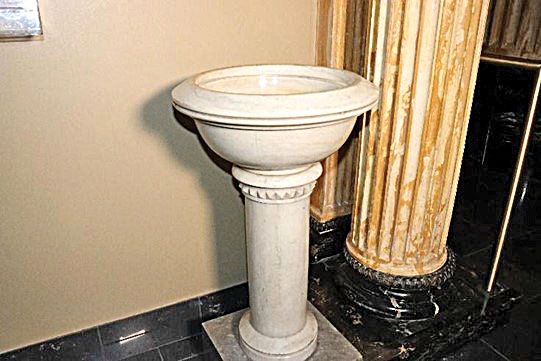
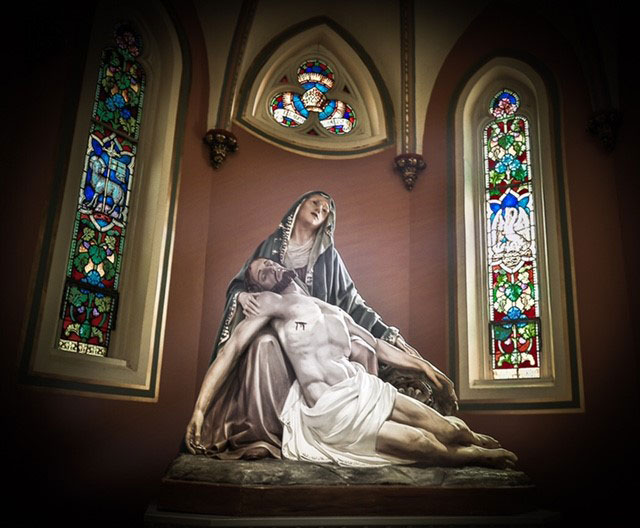 Back inside the church, the most striking feature is considered the reredos behind the altar. The pointed tops are from the altar from Holy Family Catholic Church in Chicago, and they are believed to predate the Civil War. The sanctuary is cruciform in design, meaning it is in the shape of the cross, to remind the faithful of the sacrifice of Jesus. Behind the altar located in what would be considered the upper level of the apse is gold lattice work on a black background. This gallery was originally built for the cloistered nuns who served St. Patrick Parish in the early part of the 20th century. The old baptismal font, made in 1880, is still used today to baptize infants. Hand carved in Italy; it was originally from St. Aloysius Church in Litchfield. The ambo at St. Patrick is taller than most ambos. This is because it contains part of the original 1908 altar. The front of the current altar, which was constructed in 2002, is made from the gates of the original Communion railing in the church. Originally, the dome at St. Patrick adorned the pictures of four saints. Today, you can see a pure white dove, symbolizing the Holy Spirit.
“I love the tabernacle,” Father Comerford said. “The way it was created out of wood, it looks like a small model of the church. I think that it is such a great sign that where the physical Eucharist is kept, is also connected to the larger church building too — even the tabernacle itself is another house and dwelling place for God.”
Built for $125,000, the treasures inside St. Patrick Church are priceless and historic. Known as an unofficial landmark in the Soy City, the church, and the history here are rich and deeply Catholic. For Father Comerford, his grandmother was baptized here, his grandparents were married here, and his father was baptized here.
“This was the first Catholic parish in Decatur, so this is known as a symbol in downtown and there have been so many people who have been a part of this,” Father Comerford said. “There have been so many great weddings and funerals, and it has affected essentially every Catholic family in the Decatur community.”
Twice blessed! Several diocesan priests remember growing up as twins

By DIANE SCHLINDWEIN
Managing Editor
Just before Christmas, people who are twins celebrate National Twins Day on Dec. 18. It is estimated that 1 in 250 pregnancies will naturally result in twins, which makes being a twin rather unique.
 In the Diocese of Springfield in Illinois, several priests grew up with a twin, including Father Brian Alford, Father Dean Probst, Father Rafal Pyrchla, Father Dominic Rankin, and Father Michael Trummer. Interestingly, all these priests have a fraternal twin and all but Father Pyrchla have twin sisters.
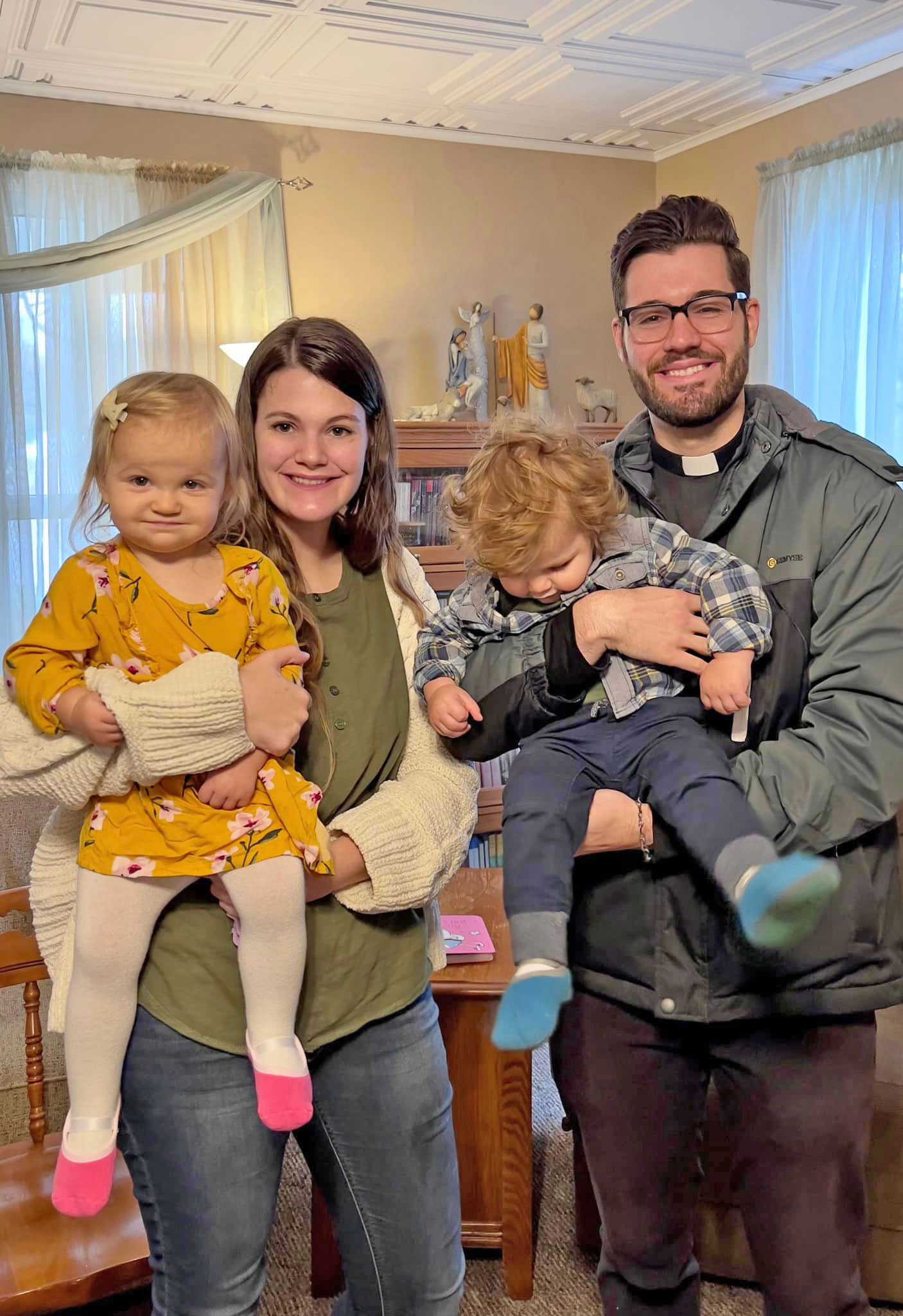
Many people know that Father Michael Trummer has a brother very close to his age who is also a priest — Father Chris Trummer — but not as many know that he has a twin sister as well. Her name is Katrina Joy, and they were born on March 10, 1992. With three of their four children born in 16 months, it goes without saying that their parents had a very busy household for many years.
Young Michael and Katrina were close growing up, said Father Trummer, parochial vicar at Our Lady of Lourdes Parish and St. Thomas the Apostle Parish, both in Decatur. “We weren’t best friends, but not super distant, either. But apparently we have the same Meyer’s Briggs (Type Indicator) personality.”
Like many siblings, the two children got into trouble once in a while. “One time I asked my sister if I could cut off some of her hair. We were in kindergarten at the time,” Father Trummer said. “She was hesitant, but I begged her to let me just cut off a little bit with our kitchen scissors. She conceded, but I cut off several inches right in the back of her head. It was the day before picture day!”
Now that Katrina Schoenfeld is grown and married, she is raising her own twin babies, Tucker and Clair, and is in the middle of getting her master’s degree in clinical social work. “I baptized one of the twins, and my brother, Father Christopher, baptized the other one.”
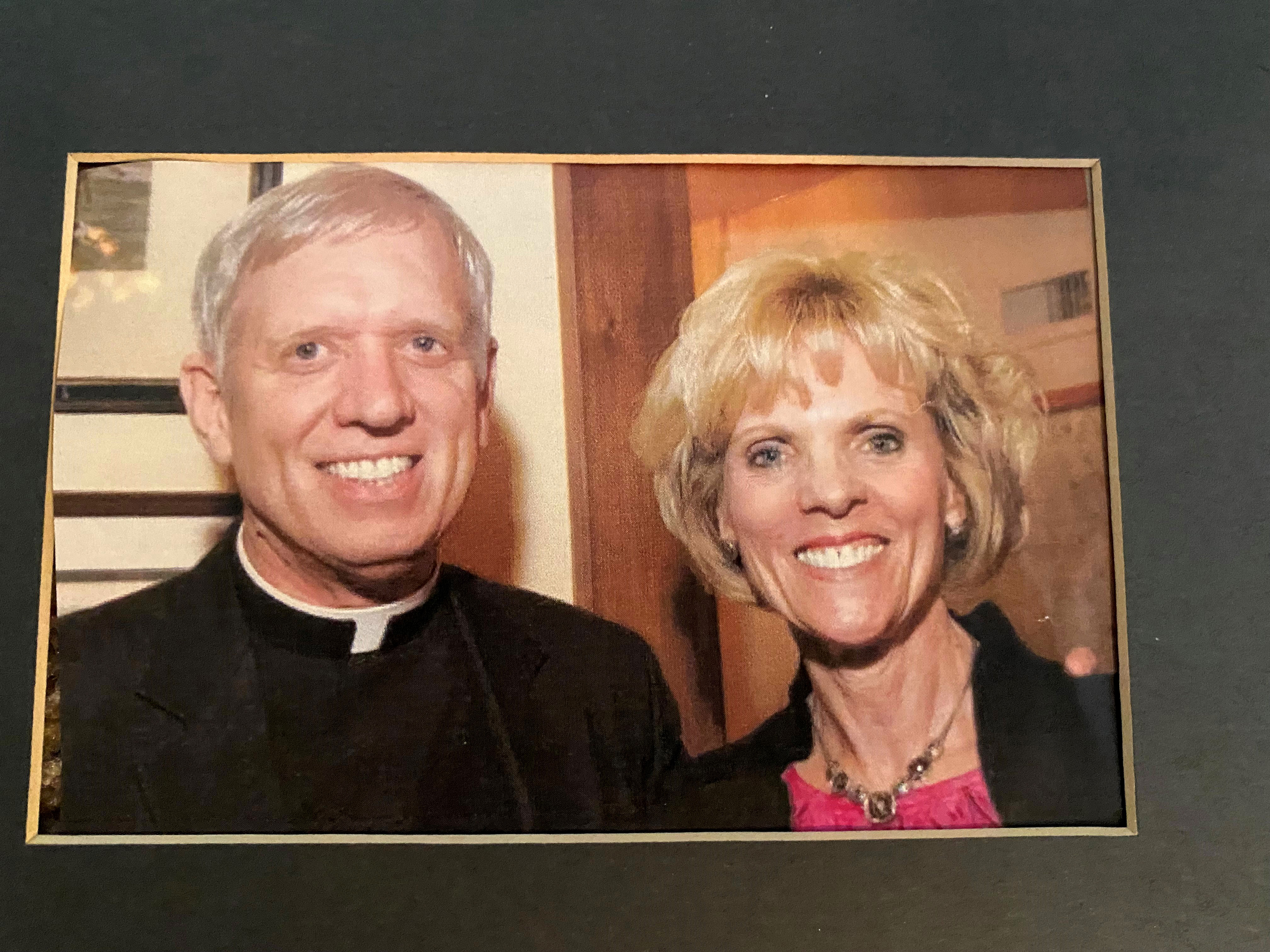 Ronald Dean Probst and his sister Constance Jean Probst were born on Oct. 22, 1952, in Flora. “We were born in the Flora hospital as St. Anthony Hospital in Effingham had burned down several years earlier and wasn’t rebuilt,” said Father Dean Probst, who is pastor at St. Thomas the Apostle Parish in Newton and St. Mary of the Assumption Parish in Sainte Marie. “The doctor said that since Mom was having twins, she should deliver in a hospital.
“Mom wanted our names to rhyme so it was Ronnie Dean and Connie Jean. Dad asked, ‘Who would name their child Constance?’ and my mom said, ‘You did!’ So we went by our middle names, Dean and Jean. I was the first-born son, and she was their third daughter. I was an hour older by birth.”
Father Probst recalls hearing that his mother was overwhelmed knowing she was having twins. “Our mother was apprehensive about having twins with two children all within four years,” he said. “She cried to her mother about how she would manage, when Grandma had 11 children!”
Father Dean said he and his twin sister are supportive of one another and were “very close in grade school and high school.” He was a groomsman in Jean’s wedding when she married her husband, Dan Cunningham. The couple had two sons. Jean Cunningham is now a retired schoolteacher who lives in Mattoon.
 Father Brian Alford and his twin sister Cindy were born on March 9, 1979. “Although we were born pretty well on time and at healthy weights, I had some breathing difficulties which required me to spend a little extra time in the hospital before finally coming home,” said Father Alford, rector at the Cathedral of the Immaculate Conception and vicar for Clergy, Consecrated Life and Vocations.
Growing up, Father Alford said he “doesn’t recall being too mischievous” and said he and Cindy were “pretty close.” “We were both involved in band and had several mutual friends. It was my twin sister who first told me that she thought I was going to become a priest.” Father Alford went on to witness his sister’s marriage and then baptized both of her children. Cindy Bushnell now lives in Houston, Texas and is involved in health and wellness work.
“Looking back, it never seemed really too different having a twin sister,” Father Alford said. “Thankfully we got along together and still do to this day. I have a good relationship with all of my siblings, but I obviously feel closest to my twin sister, and I am grateful that the Lord blessed my life with this unique gift.”
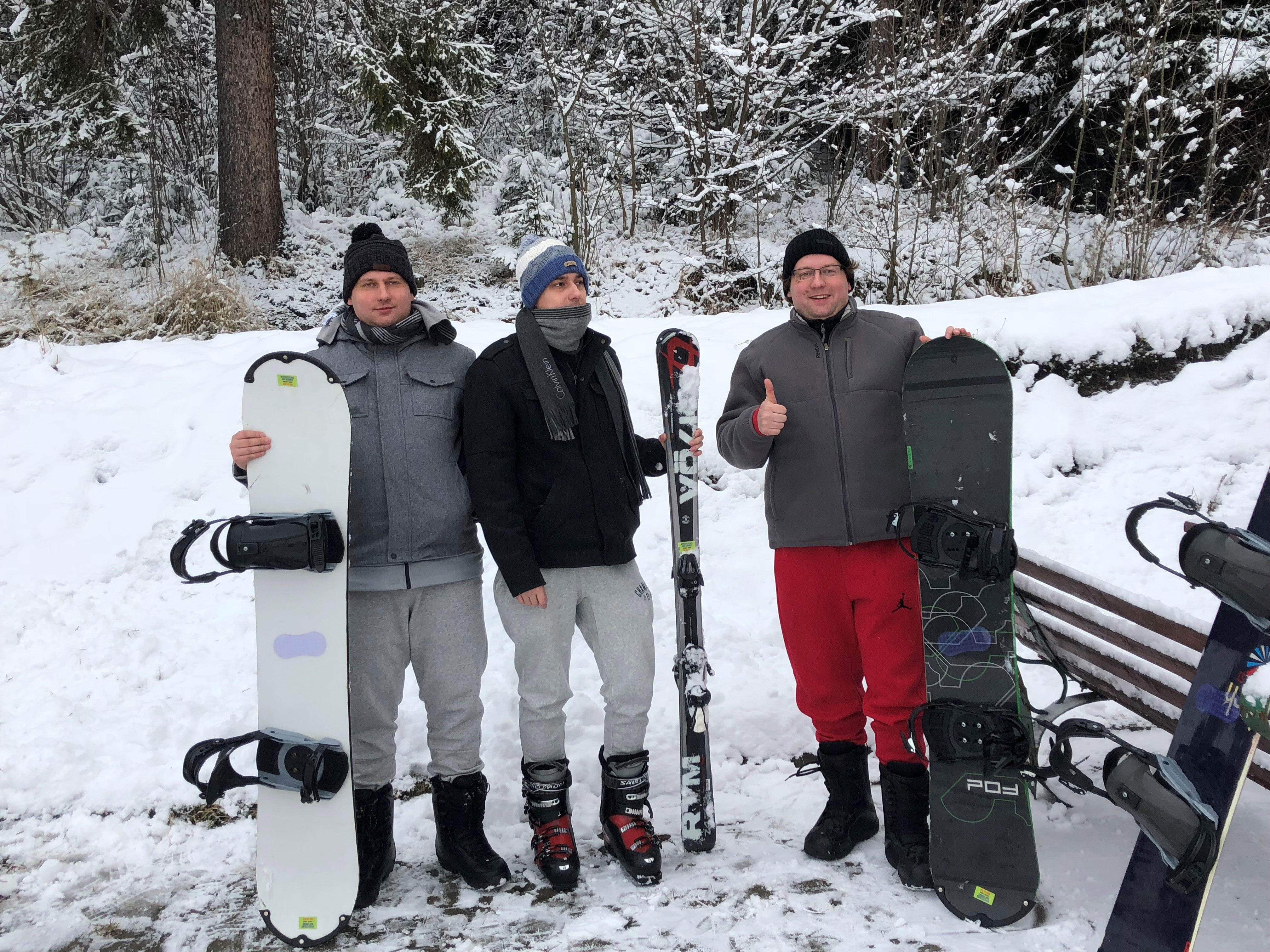 Father Rafal Pyrchla and his twin brother Bartlomiej were born April 13, 1986, in Poland. “As far as I know we were full term, approximately 5 pounds each,” said Father Pyrchla, parochial vicar at St. Francis Solanus in Quincy. “I was the second born, he is 10 minutes older than me.” Bartlomiej is now a carpenter in Straszecin, Poland.
In school, teachers couldn’t tell the Pyrchla brothers apart. “That was very funny. We always sat at the same desk in school. We were very close. We wore the same clothes. People, even the close family wouldn’t recognize (the differences in) us, who is who,” Father Pyrchla said and added with a wink, “I am more handsome.”
Although Bartlomiej was supportive of his twin brother becoming a priest, Father Pyrchla said, “It was hard for him when I decided to join the seminary. Still, he was very happy for me, and he came with our mother to the U.S. for my priesthood ordination.” Now that they live so far apart, the brothers communicate by Skype.
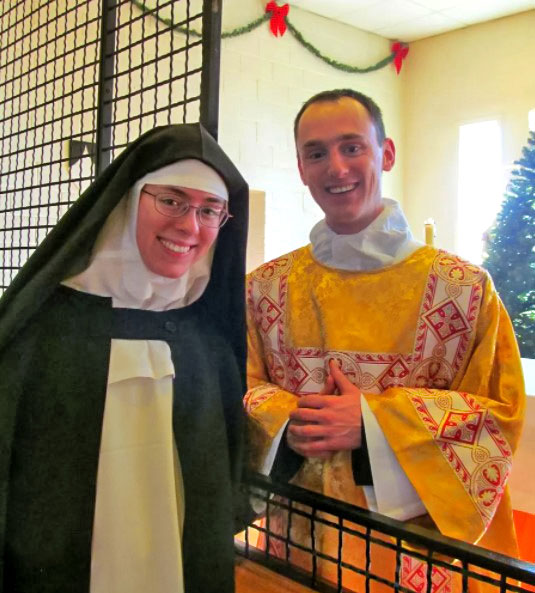 Another diocesan priest who is a twin and has another religious vocation in his family is Father Dominic Rankin, Master of Ceremonies and priest secretary to Bishop Thomas John Paprocki and associate director of the Office for Vocations. He and his twin sister, Sister Mary Thomas of the Holy Name of Jesus, OP (born Nicole Therese) came into the world very prematurely in May 1993.
“We were due around July 23, but born on May 9, which meant both of us were very small — I was 2 pounds-something and my sister was 1 pound-something — and had a lot of developing still to do. Providentially, my parents were in St. Louis visiting with my dad’s parents, which meant some of the best neonatal facilities were a quick rush across the road when my mom went into labor all those weeks early rather than the hours it would have taken from Quincy to get to St. Louis or Springfield.
“It was touch and go for those 100 days, with plenty of lung, heart, brain, and nutrition challenges all throughout — and my parents said I kept them on pins and needles for several months after coming home when I would decide to stop breathing for heart-wrenching spans, which meant we had oxygen tanks and monitors to decorate the nursery!”
When they were a little older and healthier, the twins became even more in tune to one another, Father Rankin said. “Mom and Dad say that when we were very little, we had our own language to communicate with each other before we started speaking English. We would run into the room together, chatter something to each other, and start laughing about whatever it was we were scheming before scattering out of the room, with Mom and Dad uncertain what ruckus was about to transpire.”
Father Rankin believes his sister to be a brave woman who, while she was still a teenager, put her trust in God, applied and was accepted to the convent where she would eventually take vows. She is a cloistered and contemplative Dominican Nun in Marbury, Ala.
“I was present for both my sister’s temporary profession in fall 2015 and her final vows in January of 2018. In the first case, I had just begun my studies in Rome at the North American College, so I was not ordained, but did assist at the Mass as a seminarian. In 2018, I was a transitional deacon, preparing to be ordained a priest that May, and was blessed to assist the bishop there for her final vows as a Dominican nun.”
Father Rankin said that because he had spoken about being a priest from his early childhood days, his twin sister knew about his thoughts as they grew up. “By the time I got up the courage to ask the diocese about entering seminary, she had already been accepted to the convent, so at that particular junction it was by means of letters we exchanged that I broke the news to her,” he said.
He has even more thoughts on that subject. “Although we cannot read each other’s minds, she as a consecrated contemplative nun has a very close connection with Jesus, and He knew I was called before I did,” he said. “So, I wonder if the Lord broke the news to my sister before I got around to it.”
Father Zehnle remembers his lost twin
While Fathers Probst, Alford, Trummer, Rankin, and Pyrchla grew up with their siblings, Father Daren Zehnle was born a twin, but sadly lost his brother about 36 hours after their birth. Father Zehnle, pastor of St. Augustine Parish in Ashland, has often pondered how his life has turned out and what it might have been like to grow up with that boy.
In his blog, Servant and Steward, Father Zehnle shared that he and his brother, Matthew William, were born at St. Mary’s Hospital in Quincy on March 26, 1978, about seven weeks before their due date. It was Easter Sunday, and most of central Illinois had been shut down because of a serious ice storm.
Matthew was born at 10:04 a.m. and weighed 5 pounds and 2 ounces. At 10:12 a.m., his twin brother Daren was born, weighing 4 pounds and 9 ounces. “Both Matthew and I were born with a blockage of some kind in our throats, which made breathing very difficult,” Father Zehnle wrote. “Matthew was viewed by the medical team as the stronger of us, while I was seen as the weaker and not expected to live long.”
Since the twins were both in danger of death, a priest was called to baptize them. “Father Landry Genosky, OFM, came and not only baptized us, but confirmed us as well, a privilege granted to priests for those in danger of death. We had neither godparents nor sponsors and, to my knowledge, no confirmation names. I am simply Daren Joseph,” wrote Father Zehnle.
Sadly, Matthew died at 10:38 p.m. on March 27. At some point a tracheotomy was performed on little Daren. “I’m not sure if this was done before or after Matthew died. The tube remained for the first two or three years of my life, and I still bear the scar to this day,” wrote Father Zehnle, who wonders how life must have been for his late parents.
“Mom wrote that ‘the first three months have been bad. I spent two days in the hospital for dehydration.’ I’ve no idea how my parents coped with the death of their firstborn child together with my difficult first few years,” he wrote. “If they had a baby book for me, I do not know where it is, but I do have Matthew’s baby book. It is an odd feeling to flip through a baby book with only a couple pages filled in and I can well imagine why they may not have kept one for me.”
Father Zehnle wrote he has other thoughts on his life. “I’ve often wondered why I, the weaker one, survived. My arthritis too, before it was finally diagnosed, brought me near to the point of death, and yet I survived. I see in these pivotal moments of my life the protective hand of God.
“And though he lived only slightly more than a day,” he wrote, “there is a part of me that longs for the companionship of a brother and confidant, even a partner in mischief, which I know is the bond shared by twins.”