
Diocesan Administrator Account
Public invited to venerate relics of St. Padre Pio coming to Cathedral in Springfield

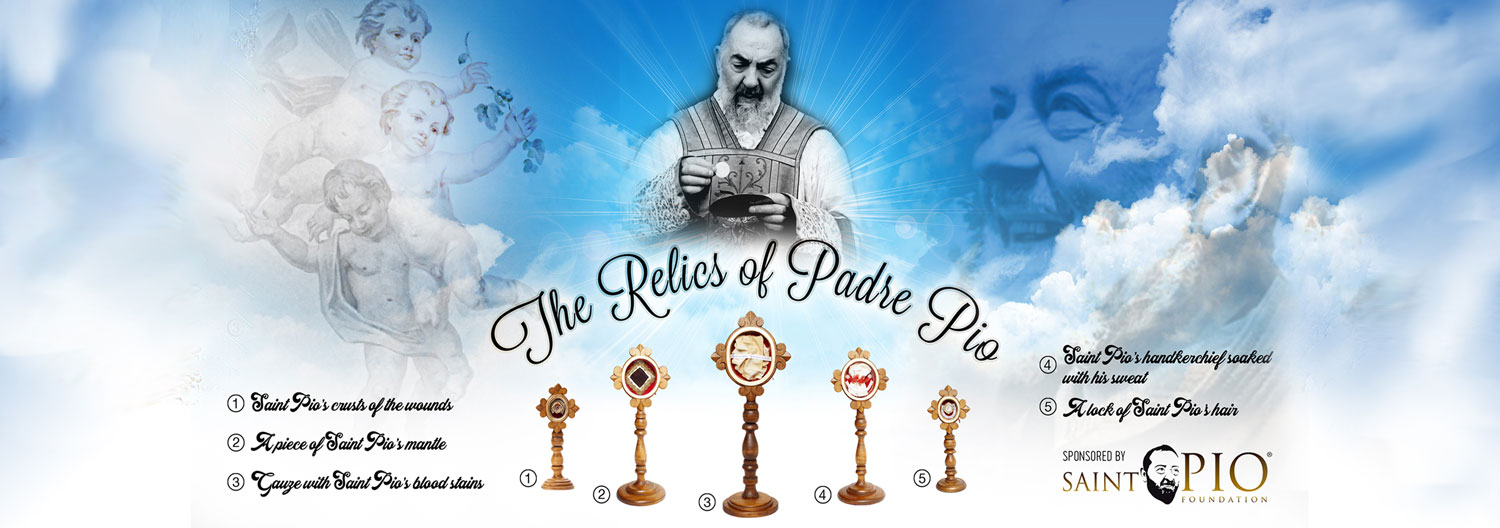
He is one of the more recent saints in the Catholic Church who was known as a mystic, who suffered the stigmata (wounds of Christ), and could read people’s souls in the confessional. St. Padre Pio, who died in 1968, was an Italian Franciscan friar who was declared a saint by Pope Saint John Paul II.
Catholics are invited to see and venerate relics of St. Padre Pio after the 4 p.m. Mass at the Cathedral of the Immaculate Conception in Springfield on Saturday, Nov. 6 and after the 10 a.m. Mass on Sunday, Nov. 7 until 4:30 that afternoon in the Cathedral atrium. Four first class relics and one second class will be available to the faithful to see and venerate. While the event is free, good will donations are appreciated and a second collection will be taken up during one of the Masses.
Answering God's call to religious life

Answering God’s call to religious life
Celebrating National Vocation Awareness week
National Vocation Awareness Week, celebrated Nov. 7-13, is an annual week-long celebration of the Catholic Church in the United States dedicated to promoting vocations to the religious life through prayer and education, and to renewing our prayers and support for those who are considering one of these particular vocations. In this edition of Catholic Times, we highlight two religious vocations stories that prove God can work in mysterious ways. Also, for parents and grandparents who see a religious vocation in their son, daughter, or grandchild, read Hey, Father!, in which we answer the question, “How do I talk to my kids about vocations?”
He grew up non-Catholic. Marriage was ‘on the horizon.’ Then he had this ‘crazy thing’
The story of Father John Titus
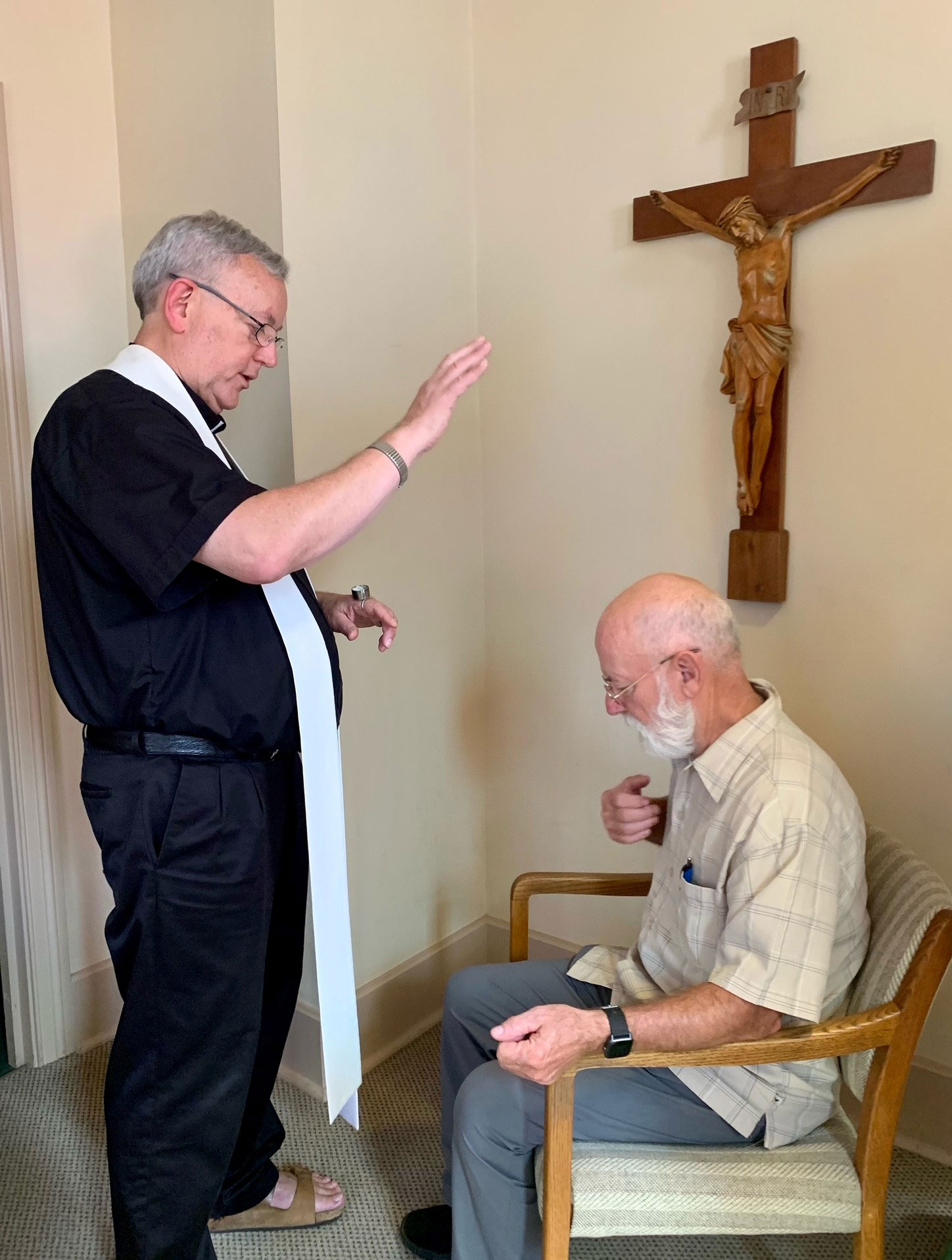 In a sacramental way, the journey of God’s call in my life began on May 13, 1956, the feast of Our Lady of Fatima. I don’t suppose, however, anybody in the Bradbury Free Methodist Church, north of Toledo, Ill., knew about Our Lady’s feast that day. Surrounded by cousins and folks in love with God’s Word at Bradbury, as a young child, my family moved to Mattoon where I attended the Presbyterian Church through my college years at Eastern Illinois University (EIU) in Charleston. Active in Sunday school and church activities, I became friends with a few future Presbyterian ministers and felt God’s call to the ministry myself. During my college years, I visited a Presbyterian seminary but never took that “next step.”
Growing up, I had Catholic relatives and friends and would sometimes attend Mass at Immaculate Conception in Mattoon and other parishes. Becoming involved in the pro-life movement in high school and college years, I was struck by the predominance of Catholic Christians among its ranks during those early days. I wondered to myself: Where were the people I had been praying with all my life? I was drawn to a faith that impacted how we lived our lives in the public square. Having been involved in political campaigns since high school, it just made sense that the most important choices we make for the greater community would be informed by our religious faith and the values of the Gospel. I loved the idea of a faith that informed our actions and choices not only as individuals but in the public square.
At EIU, still “spinning my wheels” regarding a future field of study or career choice, I fell back on majoring in history which I had always loved. St. John Henry Cardinal Newman once said, “To be deep in history is to cease to be protestant.” While none of my professors would have suspected me of being very “deep in history,” my study did lead me to an awareness that divisions in the Body of Christ were the fruit of human sinfulness, culture, and politics and certainly not the will of God.
Ultimately it was of course my desire for the holy Eucharist that led me to seek full communion with the Catholic Church. Praying with John 6 and time spent before the tabernacle opened up to me the desire for the graces of the sacramental life. I had been attending daily Mass for some time when I finally stepped out in faith and talked to a parish priest about more formal “instruction” in the Catholic faith.
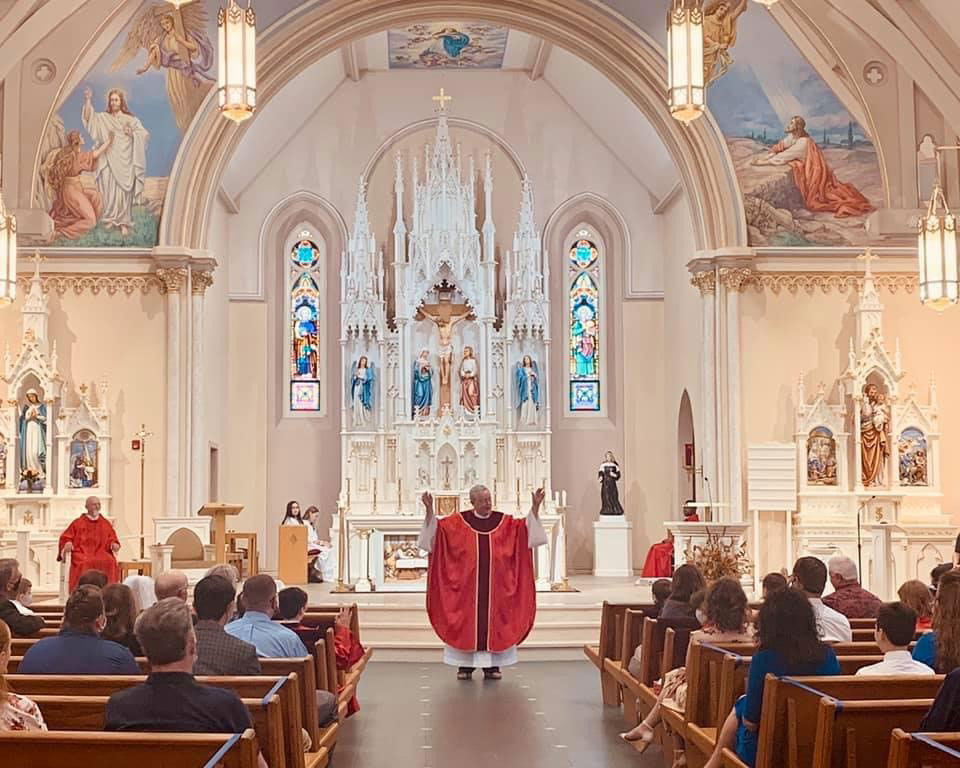 I was living in Decatur and working for Walgreens when I entered the Church at St. James. I became involved in the parish as my schedule permitted. “Thursday Night Parties” bingo was my main volunteer activity. I was dating a lady at the time who had a young son. The relationship was going well, and it seemed marriage might be on the horizon. I shared with her that before we could take the next step, I had this “crazy thing” I had to get “off the table.” I explained as a protestant minister, a wife and family was the norm, but if God was calling me to the Catholic priesthood, that could be a “deal breaker.”
I assured my girlfriend that there was nothing to worry about, however. As far as I knew, Catholic couples brought little baby priests home from the maternity ward with little Roman collars around their neck. I was sure I would never be accepted to study for the priesthood anyway. I wasn’t smart enough. I wasn’t holy enough. I hadn’t been a Catholic all my life. It just wasn’t going to happen.
Once again, I sat down and visited with my parish priest and soon began a journey that continues to this day. The doors that I expected to close kept opening. An uncertainty about so many things developed into a quiet confidence and renewed hope. I learned priests aren’t ordained on the first day of seminary. Formation is a process including prayer, study, and pastoral experiences where the Church gets to know you and you get to know the Church in fuller ways. With each passing month and new opportunity, I learned more and fell in love more with Christ and his people.
The joy of walking with Christ’s risen body, the Church as a Catholic and a Catholic priest, is incomparable with any other experience of my life. I have learned God never wastes any experience and helps us to use in for the common good when we place it in His hands. Thirty-three years after my ordination as a transitional deacon, I have never looked back but get up each morning joyfully anticipating what surprises the Lord may have in store.
Father John Titus is pastor of Immaculate Conception Parish in Mattoon and St. Columcille Parish in Sullivan
‘He told me I would be a Dominican nun’
The story of Sister Mary Grace, OP
 My family was blessed with an ideal childhood: a devout Catholic mom, devout Presbyterian dad, and children. We attended a Catholic grade school and a Catholic high school. I was the youngest, very close to my sister, and adored my brothers even though they teased me to no end.
I was in the third grade when I received my first clue that I had a talent for art. The third-grade sister was showing the fourth-grade teacher one of my pictures. My art was encouraged at home in many ways and has been a big part of my life to this day.
During those formative years, I was attracted to Catholic Church things and persons. In high school, a sister sat me down one time and suggested that I might have a vocation to the religious life, but I quickly rejected that thought. I imagined I was destined for marriage and family life.
A secular university took me farther away from my earlier pious tendencies although I never neglected the basics of my faith. I achieved degrees in applied arts and teaching. After graduation, I taught art in an inner-city public school which taught me that teaching was not my thing. So, three of my fellow classmates and myself began a business out of my father’s second floor retail stationary store. That was an adventure and lasted until my associates began wanting more funds and better clothes. I lingered on for a while and eventually tried teaching again with the same conclusion.
Several jobs later and all the time dating and hoping to settle down, nothing clicked in that process. Eventually I came to a crossroad in my life: I needed to make a strategic choice for which I was not prepared. By now I was 25 years old and, remembering a piece of advice in one of the many letters I received from my brother (who was a priest), that if I ever needed to talk with someone, this priest would be a good one. Not remembering the name of said priest, I went to the drawer in my room where I kept all his letters in random fashion and found the name in the first letter I picked up.
Father Wenzel agreed to see me. After hearing my tale of woe, he suggested I join a sodality sponsored by Xavier University, which I did. The meetings and the required exercises, which I faithfully practiced, brought me back to a closer relationship to the Church. Around this time, the company I was working at went bankrupt, and I was looking for the next door to open. It did. A fellow sodalist mentioned that a missionary group, the Verona Fathers, were looking for a secretary. I loved that job and flourished there.
In the meantime, because we were required to have a spiritual director, the first time I met with mine, a Jesuit, he asked me what kind of a man I was looking for. Wow! Was he going to go out on the campus and see if he could fulfill my requirements? I told him that I was beginning to think maybe God was wanting me to enter a religious community. “All right,” he said. “This is what you do: Give yourself a certain amount of time, pray very hard about this decision, and God will lead you.” So, I did, and before long it became very clear to me that I should enter religious life. But where?
 So, my director took me to the library and took out the large religious directory containing lists and descriptions of all the congregations in the United States. I was to write to any that would allow me to develop my art and one that was well established. I received stacks of mail, but nothing attracted me. Stalemate! I kept praying and one day, a woman visited the Verona Father who had a reputation for holiness. I got to talking with her about my problem and she suggested that I go to confession to a very holy priest, which I did, on April 1, 1962, April Fools’ Day — but what the priest told me I did not take as a trick. He heard me out in silence, followed by a sacred silence, and then he told me I would be a Dominican nun.
Although I knew nothing of cloistered life, nor that there was a monastery in Cincinnati, I immediately and wholeheartedly accepted his directive as the greatest gift I could be given.
As I look back on my life, I realize that I did not have, at that time, the psychological maturity to discern for myself God’s will for me. And so, God took over in a very direct way which, after 56 years of monastic living, I can see as the very best possible solution for me, and I never cease being grateful for that day.
I was kept waiting to meet the prioress of Holy Name Monastery. She encouraged me and after many weekend visits there, the date was set for my entry on Dec. 8, 1962. Of course, the separation from my mother, the only family member still at home by then, was excruciating, for her and for me, more so for her who had been widowed at age 52 and now was facing life in the homestead by herself. When I was a postulant and in the presence of the prioress and myself, she asked how I was doing. The prioress answered that I was doing very well, and my mom’s reply was: “I was afraid of that.” Nevertheless, she never objected to my vocation and supported me and the monastery in every way she could.
I was 27 years old then and was used to an independent life of my own choosing. The discipline of monastic living was jarring in many ways, but I was happy. All throughout my 56 years, the sisters have allowed me to continue developing my art.
I cannot say that I am a born contemplative by any means. I pretty much began the spiritual life from scratch. I am still climbing slowly, but I value all the opportunities and even the atmosphere that are most conducive to living as close to God as I have grace for. Grace is never lacking but, as my Jesuit brother once told me, I am a slow learner.
Dominican monastic life for me has been and is a nurturing home and community which allows one to be who they are and to strive to become the best they can be in God’s plan.
Sister Mary Grace, OP, is a sister with the Monastery of Mary the Queen located in Springfield
Have you considered becoming a deacon?
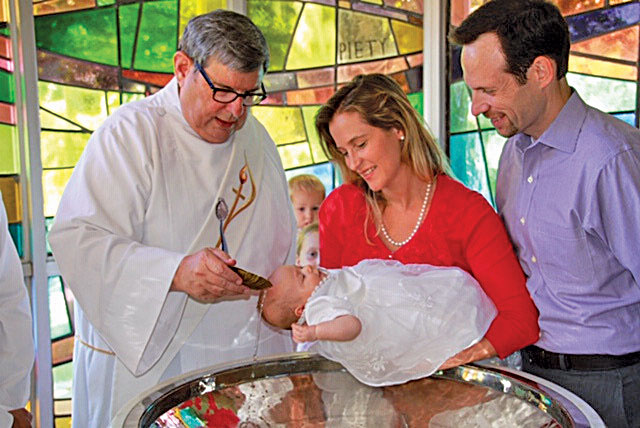 There are three informational meetings in different parts of our diocese for men interested in becoming a deacon. The first takes place in Jacksonville at the Knights of Columbus Hall (320 E. State) on Saturday, Nov. 13 from 9-10:30 a.m. The second takes place in Mattoon at Immaculate Conception Church Parish Center (320 N. 20th St.) on Tuesday, Nov. 16 from 6:30-8 p.m. The third takes place in Quincy at the St. Francis Parish Center (1721 College) on Sunday, Nov. 28 from 1-2:30 p.m. The meetings will present information for those interested in the permanent diaconate formation which begins in the fall of 2022. Applications are being accepted at this time.
The permanent diaconate is open to men between the ages of 32 and 57 who are active in the practice of our faith and who desire to grow in their relationship with God and in their service to the Church. If interested, and if married, wives are welcome and encouraged to attend. For questions, email Deacon Dave Sorrell: . You can also visit dio.org/diaconate.
Catholic, then atheist, now Catholic again: Psychologist speaks out about coming back to the faith

By DIANE SCHLINDWEIN
Managing Editor
 Springfield psychologist and author Dr. Kevin Vost says although he spent the first 18 years of his life as a practicing Catholic, it was reading the works of some well-known philosophers that ultimately led him to seriously doubt the existence of God, becoming an atheist. He says “then it only took him 25 years” to come back to the faith, thanks to the Holy Spirit and the writings of St. Thomas Aquinas.
Vost, a member of St. Katharine Drexel Parish, was born into a Catholic family, baptized as an infant and attended Catholic school. “We went to Mass, but we really didn’t talk about the faith,” he says. He is eternally grateful that his parents sent him to Catholic schools where he gained a strong sense of morality, was taught right from wrong, and earned self-discipline and how to be respectful of others.
As he grew and became a teenager, his faith increased and so did his love of weightlifting. Many of those weight-lifter friends were members of non-denominational or Pentecostal churches. He attended some services with them but didn’t abandon Catholicism. “I ran into trouble elsewhere,” he has written, “within the musty pages of old philosophy books.”
Always interested in books and philosophy, at age 18 Vost — who also admired and read about Mr. Universe Mike Mentzer who challenged Christianity — immersed himself in the writings of Voltaire, Friedrich Nietzche, Bertrand Russel, and Ayn Rand. It was Rand’s writings that finally separated him from his faith, Vost said.
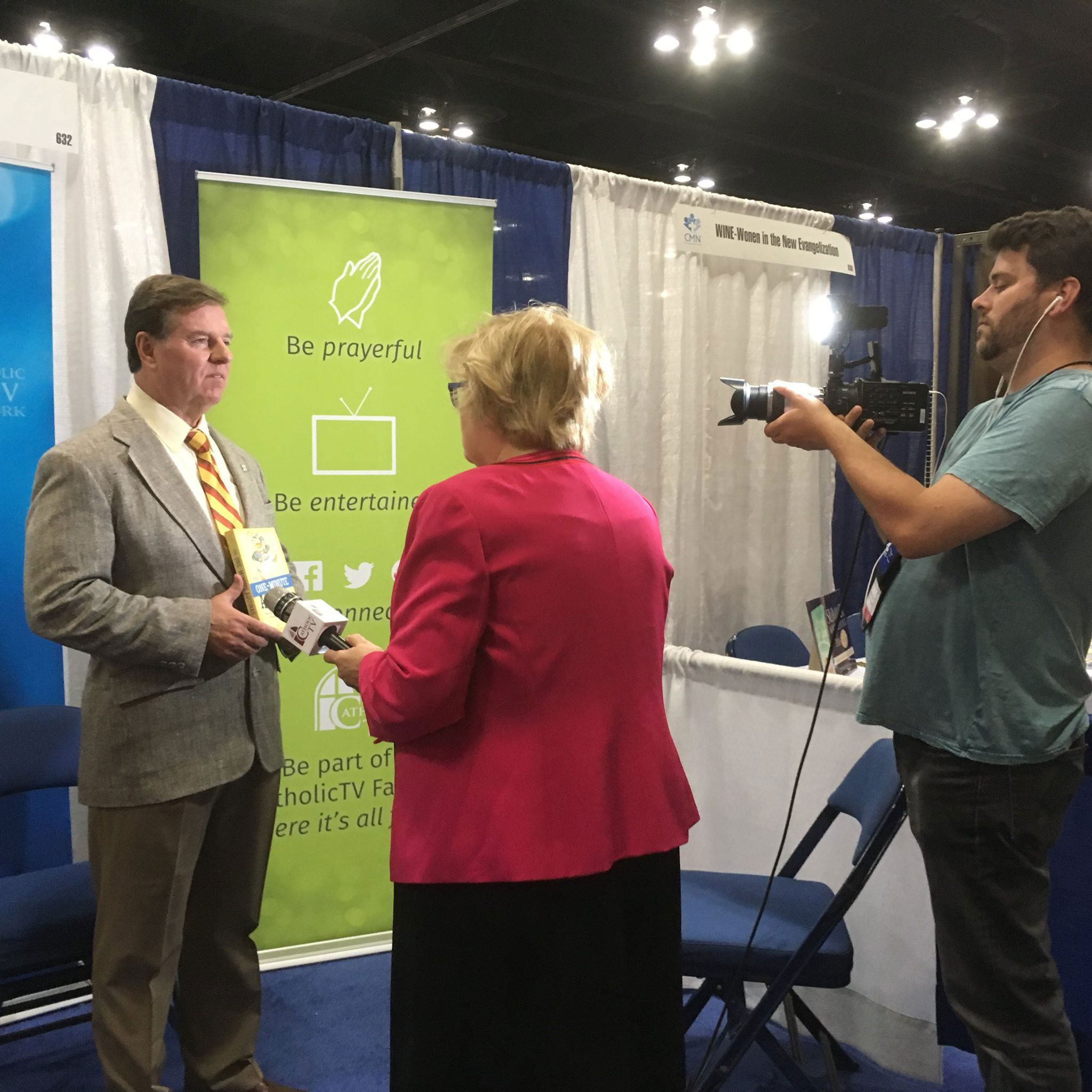 “A lot of these atheists, I was coming across arguments that I have never seen before that led me to think that the idea of God is either self-contradictory or that you really don’t need the concept of God,” Vost said. “For example, atheists bring up this argument of how can God be both all powerful and all knowing because if He knows what He is going to do tomorrow, then He doesn’t have the power to do something different. Another argument is that God is not really necessary because existence exists. Open up your eyes. There is the world out there. You don’t have to ask where that came from because that is the starting ground.”
Unable to refute those arguments for atheism he said, “At that point in my life, reason became my god.” While still convinced the existence of God simply didn’t make sense, he went on to earn a doctorate in clinical psychology. He had a long career working in the disability evaluation field and teaching as an adjunct professor. He has been writing books for the last 15 years and was also a powerlifter and weight-lifting instructor.
Vost says that for over two decades he never spoke out against Catholicism but could not make himself believe in God. During that time however, he and his wife Kathy were married in the Church, had their sons baptized Catholic and sent those children to Catholic schools. “There was kind of a sadness. Personally, I deeply wanted to believe, but I did not feel that in good conscience I could pretend to believe what I did not.”
A great proponent of ongoing education, Vost eventually came upon a DVD course on Natural Law that introduced him to the writings of St. Thomas Aquinas. “That lead me to desire to read the works of St. Thomas Aquinas directly,” he said. It was the words of that Dominican friar, famous philosopher, and theologian that ultimately led Vost to return to the Catholic faith.
“One of the first things I read is when Aquinas talked about the attributes of God and what God must be like,” Vost said. “This is where we get the answers to the questions that I thought were unsolvable like God is a contradictory or how can He do something tomorrow, and Aquinas talks about the eternity of God.
“If you think of God’s tomorrow, you’re thinking of God as a human being. But God lives in the eternal now. It is all present to Him,” he said. “So, there’s no contradiction. His will is unimpeded forever, as is His knowledge. Aquinas gives this wonderful analogy. He says that imagine you are walking on your way to a little village, and it’s a hilly road. So, you won’t see that village until you are at the top of the last hill. You also won’t know who is coming before you or who came after you. But imagine the perspective of someone high in the sky. They see the destination the whole time and everyone on the route, and in a sense, that is an analogy of God’s eternal knowledge all at once, and that wowed me.”
With that question answered, Vost then found his answer to when atheists say, “existence exists, or you don’t have to ask where the universe came from.”
“Aquinas points out, look at the universe, look at yourself and ask which one of us gave us our own existence — well none of us,” Vost said. “Look at all the objects around us. Everything is constantly changing. So, what material thing gave itself its own existence and has the power to do that? Nothing. It is all contingent. It might exist, it might not exist. Aquinas also said at some point in time nothing existed, so then, there out be nothing to bring it into existence. So, basically Aquinas is saying there must be some necessary being that cannot not exist. This what we call God. So, reason and faith match up.”
This argument, that there has to be an unchangeable first mover (God) and there has to be an uncaused cause in in which everything comes from to get the entire existence going, also wowed Vost.
All this happened when Vost was 43 years old. “It was like a gradual process but then all of the sudden I realized, ‘Oh my Lord! I believe again.’ It was an awe-inspiring thing — it was kind of like the scales fell from my eyes,” he said.
 Returning to Mass and the sacraments was, of course, a welcome relief for not only Voss, but his wife, sons, and other family members. “My boys were thrilled. My brother told me that our mother (who had already passed away at the time) always prayed that I would return to the faith,” he said and then added, “I’m sure my mom knows.”
Participating in Mass once again was something that gave Voss “great joy.” “It was a feeling that now I can fully participate. I’m really believing this,” he said. Going back to confession was incredible. “That wonderful feeling when the weight was removed — the burden of my sins. It was an absolutely joyful time.”
Coming back to Catholicism has led Voss to write over 20 books that have been also largely influenced by St. Thomas Aquinas. His first book, Memorize the Faith!, remains his best-seller so far.
“It took me 25 years to realize that I was wrong about the most important thing of all. You know, I always tried to live a virtuous life … but the real difference is there is now a deep sense of peace and joy and calm and relief,” he said. “It was just a life-changing thing. Our Catholic faith is full of beauty, full of life and also full of truth.”
As for advice he has for parents who have children who have fallen away from the faith, Vost points to prayer first, but also having those deep conversations about what our faith really teaches. “If our children really understood the depth of our faith — it’s full of beauty, it’s full of love, but it is also full of truth, and we can defend that truth,” he said. “So, for the kids who are pulled away from these false arguments, keep in contact with your children and know what they are thinking in terms of the faith.”
To hear more about Dr. Kevin Vost’s conversion story, including what he thought about the idea of eternal life as an atheist, how he came back to believe in the true presence of God in the Eucharist, and the five proofs of the existence of God as written by Aquinas, listen to Dive Deep, the official podcast of the Diocese of Springfield in Illinois. Go to dio.org/podcast or search “Dive Deep” on all major podcast platforms.
Celebrating World Mission Sunday Oct. 24

Click here to see how you can celebrate Mission Sunday
He said ‘yes’ - Catching up with Bishop Kemme, former priest from Effingham, now bishop of Wichita

 By DIANE SCHLINDWEIN
Managing Editor
WICHITA, Kan. — While growing up and then ministering as a priest in the Diocese of Springfield in Illinois, Bishop Carl A. Kemme didn’t know much about the Diocese of Wichita, where he has been serving as bishop since 2014. In fact, he said, “I tell people here, the only things I knew about Kansas was what I learned from The Wizard of Oz.”
That all began to change on Valentine’s Day in 2014, when he received a call from the papal nuncio, telling him that Pope Francis appointed him the 11th bishop of the Diocese of Wichita. “I think that was the most monumental phone call I’ve ever received or ever will receive,” Bishop Kemme said.
Because then-Msgr. Kemme was traveling, he missed the nuncio’s initial phone call, so when he called back the nuncio was in a meeting. “He told me what he wanted and that he would call me back in 30 minutes for my answer,” Bishop Kemme said.
In that quick time frame, the future bishop of course took time to pray but he also quickly began to research the Diocese of Wichita. “I found it was amazing how much you can learn in 30 minutes time about a diocese,” he said, adding that the nuncio was prompt in calling him back. He accepted the pope’s invitation with the knowledge that God would lead him in the right direction. God has never let him down as he ministers to move forward in his diocese, he said.
 Bishop Kemme had 28 years’ experience as a priest in all corners of our diocese before he was ordained a bishop on May 1, 2014 — and that experience was varied. In those 28 years he served at parishes in Decatur, Collinsville, Springfield, Brussels, Meppen, Batchtown, Mt. Zion, Petersburg, and Sherman. In 2002, he was appointed vicar general and moderator of the Curia by then-bishop George J. Lucas. That same year he was named a monsignor (Prelate of Honor) by Pope John Paul II. Additionally, he served as diocesan chancellor from January to June 2005. When Bishop Lucas was named head of the Archdiocese of Omaha, in June 2009, he served as diocesan administrator until 2010. He continued to serve as vicar general and moderator of the Curia when Bishop Thomas John Paprocki was installed.
It was his leadership in the Curia that helped Bishop Kemme feel more secure in being named Bishop of Wichita. “There’s always a lot of anxiety (when making a decision), but I had 12 years of administrative experience and one year as a diocesan administrator … so I knew most of what the governance of a diocese entailed,” he said. “So even though I felt like there were many more qualified candidates, I felt a certain peace and tranquility about it.”
Leaving his home diocese was rather difficult, he admits. At the time his parents were still living on the small family farm. “I was sad to leave home, family, so many friends and brother priests,” he said. “My plan and desire was to live there (in the Springfield diocese) and serve my local church. But God had other plans.”
Bishop Kemme remembers all the ceremonies and getting accustomed to being a bishop were daunting. “In the first two years or so I wondered, ‘Why am I here?’ but I am in my eighth year now. It has been a real blessing. This has become home. The people here are wonderful, and the priests are very cooperative. I am excited for this ministry here.”
Speaking out on tough subjects can be a challenge for a bishop, Bishop Kemme admits. “Everybody wants to know what the bishop thinks,” he said. “Whether they like it or not, they want to know. But I know that God gives me the words he wants me to say, and I’m open to it.” A bishop’s schedule is grueling, but God has helped him out in that aspect, too, he said.
 Bishop Kemme says discipleship, evangelization, and stewardship are the touchpoints for his diocese’s pastoral plan — a plan that he and his strong leadership team are continually pursuing. “We work very closely together,” he said. “We aren’t there yet and we have a long way to go, but we’ve got a road map.”
He also desires to make Sundays special again — a day for worship, family, and renewal. “We are really trying to reclaim Sunday as the Day of the Lord,” he said. “That’s a big challenge. By and large we’ve lost that through our culture.”
Bishop Kemme and the other bishops in Kansas meet with one another about four or five times a year, and those visits are valuable, he said. He also attends the United States Conference of Catholic Bishops (USCCB) meetings. “You know, the life of a bishop can be kind of isolating, so I value very much my time with my brother bishops,” he said.
He also returns home several times a year to visit his parents, Donald and Marita Kemme, who now live in a small home in Effingham. From time to time, his priest friends and former parishioners stop by to visit him in Wichita. He says he remains grateful to all the people he served as a priest and all the friends he made in the Springfield diocese. “All of you helped make me who I am. … I have nothing but gratitude.”
Bishop Kemme said no matter where he has been in life, he has never once stopped relying on and believing in God’s grace. “It has always been my experience that God helps us all and He gives us the grace to do what we are called to do. God promised the Holy Spirit and when we are open to that, God is ever-faithful, and he walks with us in our lives,” he said. “God is right here, and He never fails us.”
Want to hear more from Bishop Kemme, including more thoughts on serving his people, God’s grace and his devotion to a particular young person on the road to sainthood? Listen to Dive Deep, the official podcast of the Diocese of Springfield in Illinois. Go to dio.org/podcast on DATE.
Hey, Father! October 7 was the feast of Our Lady of the Rosary, in honor of Mary. What's the difference between venerating and worshiping Mary?

Anonymous in the diocese
For those who are unfamiliar with the Catholic Church’s devotion to the Blessed Mother, Mary the mother of Jesus, it may seem like the Catholic Church is lifting her up as a god. After all, many churches are adorned with pictures, statues, and images of the Blessed Mother, as well as other saints. So, what is the difference then of worshiping and venerating, in particular with regard to the Blessed Virgin Mary?
The Catholic Church recognizes that there is only One Triune God — the Trinity — Father, Son and Holy Spirit. The Church also recognizes that only through God are all things created, kept in existence, and saved so that we may have the hope of eternal life in Heaven with God. So, we do only teach that God is God and no one else is.
We do, however, also recognize that Jesus in his life, death, and resurrection demonstrated to us that God uses intermediaries in this earthly life to help draw others to Himself. He does not do this because He needs to, but because in His love and generosity, He invites us to be a part of His ongoing plan. So, when we look throughout Scripture, and throughout the long history and tradition of the Catholic Church, we see Christ, and His Church, lifting up specific people who have demonstrated by their own lives what it means to be an authentic follower of Christ. Furthermore, since we believe in the Communion of Saints, we recognize that even after a person’s earthly death, they are still connected to us through God, and by the power of God are allowed to intercede for us and help us follow the Lord.
Therefore, the Catholic Church teaches there are three levels of devotion. First is latria which is what we would know and understand as true worship. This is worship and devotion due only to God and God alone, recognizing Jesus as our savior.
The next two are devotion not in the sense of worship but rather extreme honor because the Lord lifted them up as part of His plan of salvation. First, there is the Blessed Mother Mary because she was conceived without original sin in order to be the mother of Christ (the Immaculate Conception). She is recognized with the highest respect of created things. We call this respect and devotion, hyperdulia. The saints, because they can intercede for us and pray for us, are given a great respect and devotion that we call dulia. Neither dulia nor hyperdulia are worship, for worship is due to God alone, but rather, a way to remember that God, who created all things, often uses those things He creates to draw us closer to Himself.
Father Marty Smith is pastor at St. Francis Xavier Parish in Jerseyville and St. Patrick Parish in Grafton and is an associate vocations director for the Diocese of Springfield in Illinois.
Beauty Series - St. Mary Church in Brussels


 By ANDREW HANSEN
Editor
Brussels, in rural Calhoun County, an area known in Central Illinois for its tasty peaches, is home to St. Mary Church. It is simple and small, yet one of the most beautiful churches in one of the most beautiful areas in our diocese. The village of about 150 people sits between the Mississippi and Illinois rivers on rolling hills and some dense forests. In fact, this village is named in memory of the first priest in the area, Father John Molitor, a native of Brussels in Belgium. He was also the first priest to be buried in Brussels.
“The parish history goes back to 1858 when the parish was formed,” said Father Don Roberts, pastor. “Within a short time, they began construction of a church — the keystone on our church is 1863. I think one of the marvelous things about the parish is it is rooted in those who founded the parish. They came here to an isolated area especially during a time with no easy transportation when the parish was formed. The people made every sacrifice possible so that they could live their faith.”
 The history of the church is filled with joy and sorrow and then joy again. The first joy was the construction of the original church, which was filled with sacred art and images. It lasted nearly 150 years before a Christmas Eve fire in 2011, sparked by an electrical malfunction in the attic, destroyed practically everything. The people of the parish were devastated. Through hard work, holy dedication, and generous stewardship, a radically restored church was reconstructed and rededicated by Bishop Thomas John Paprocki on the Feast of the Immaculate Conception, Dec. 8, 2014. Then-Msgr. Carl Kemme was also in attendance that day. His first assignment as a pastor was at St. Mary in Brussels. He is now bishop of the Diocese of Wichita. The gold crosses on the walls of the church today mark the anointing and blessing of the restored church.
“I think it was very evident at the time of the fire how this really generated in the minds and hearts of people just a great sadness — there were a lot of broken hearts,” said Father Roberts. “At the same time, as they were dealing with a real sense of loss, I think it drew them closer together which became a strength for them.”
As you enter the church today, your eyes are drawn immediately to the altar and the area around it, due in part to the striking white color. Medallions found near the ceiling are titles of the Blessed Virgin Mary as found in the Litany of Loretto. The eight stained glass windows depict beautiful images and allow rich colored light into the church. The windows are more than 150 years old and were crafted by a German artisan and retrofitted by Emil Frei and Associates. St. Mary Church acquired them from the Archdiocese of St. Louis where they had been in storage and originally used at St. Boniface Church in St. Louis. Several statues of saints in fine, artistic detail can also be found all around the church.
 “One of the most outstanding features of the church are the windows,” said Father Roberts “They really bring a sense of the sacred to the church in terms of the sensibilities of people, especially when it is a bright day, we see how beautiful the windows are. It really catches the attention of people. All the statues have been redone, and they really magnify the beauty of what is the original architecture of the church.”
Today, St. Mary is part of Blessed Trinity Parish, made up of two other churches, St. Barbara in Batchtown and St. Joseph in Meppen. St. Mary School in Brussels has provided continuous Catholic education since 1869 with the current school structure built in 1930.
“Everyone here can basically trace themselves back to the early founders of the parish,” Father Roberts said. “That is a really marvelous thing. Their faith and family are all tied together in parish life and that is one of the things that is really genuine.”
Emergency responders come to Cathedral for Blue Mass for them

 By ANDREW HANSEN
Editor
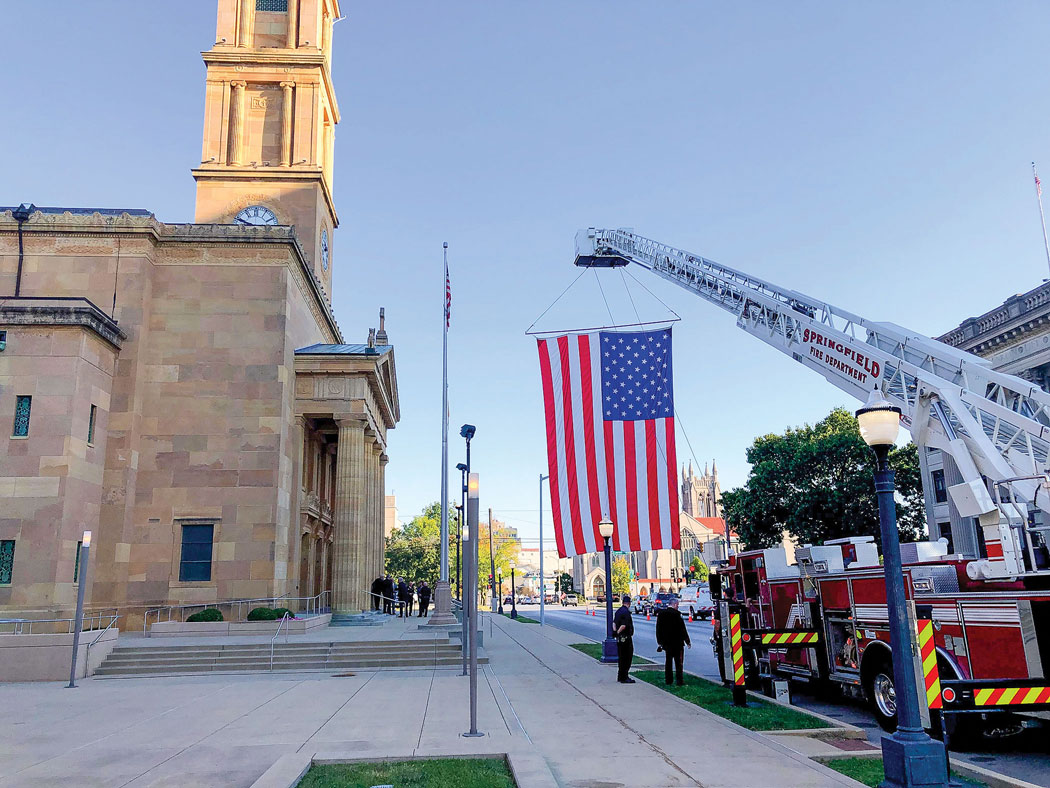
Police officers, fire fighters, and other emergency responders from different parts of the Diocese of Springfield in Illinois came to the Cathedral of the Immaculate Conception in Springfield Sept. 28 for a Mass offered for them. Praying for their safety and continued diligence in their work; to thank them for their selfless commitment to taking care of people in our communities; and praying for the repose of the souls for those who died in the line of serving and protecting, Bishop Thomas John Paprocki celebrated the Blue Mass for emergency responders.
“There is risk with everything as it’s part of what we do,” said Carl Hinman, Captain Paramedic with the Springfield Fire Department. “It’s why we are called a ‘higher calling.’ We put ourselves on the line for others. Sometimes, all the help you can get can be the difference between saving someone and not saving someone, and sometimes that help has to come from places that we don’t really understand, and I have seen and even benefited from help from above.”
 “Every police officer knows there are moments when they have to have the help of God and it is only the help of God that sees them through that shift,” said Deacon Rob Sgambelluri of the Cathedral of the Immaculate Conception, who is also retired from the Illinois State Police. “The Blue Mass — we pray for that — to pray for that help, pray for that guidance, and pray for protection for all of us and all the people we serve.”
The day began with emergency responders from several different agencies gathering at the Cathedral, followed by the posting of the colors, and then Mass.
“We believe as Catholics that Christ comes present to us in the Eucharist,” said Bishop Paprocki. “So, for the sanctification of our work as we go forth and we are sent out from this Mass, we believe that we take Christ with us. So, with Christ in our hearts, we send our emergency responders to go out as they do their work to remember that Christ is with them and helping them in all that they do.”
Beyond having Christ within them, first responders say that coming together for this special Mass helps create a more positive culture in our society.
“Everything that is going on and the narrative that ‘everything we are doing is wrong,’ the Blue Mass is just outstanding to show the support, the outpouring support, the community has, to pray for us that we come home safely and do our jobs efficiently,” said Cheryllynn Williams, the Chief Deputy for the Sangamon County Sheriff’s Office.
 “We believe prayer is good at this time, and it’s imperative that we do this (have the Blue Mass),” said Limey Nargelenas, the Springfield Park District Police Chief.
After Mass, Terrance Gainer was the guest speaker in the Cathedral atrium. He is a former U.S. Senate Sgt. At Arms, Chief of the U.S. Capitol Police, and Director of the Illinois State Police, and is a retired Captain of the U.S. Navy.
“I think part of this is just to thank the first responders — the police, fire, hospital workers, the ambulance folks,” Gainer said. “These have been a tough couple of years with COVID and some of the disorder across the United States. So, we need to support each other and be there for each other.”
Public invited to venerate relics of St. Padre Pio coming to Cathedral in Springfield

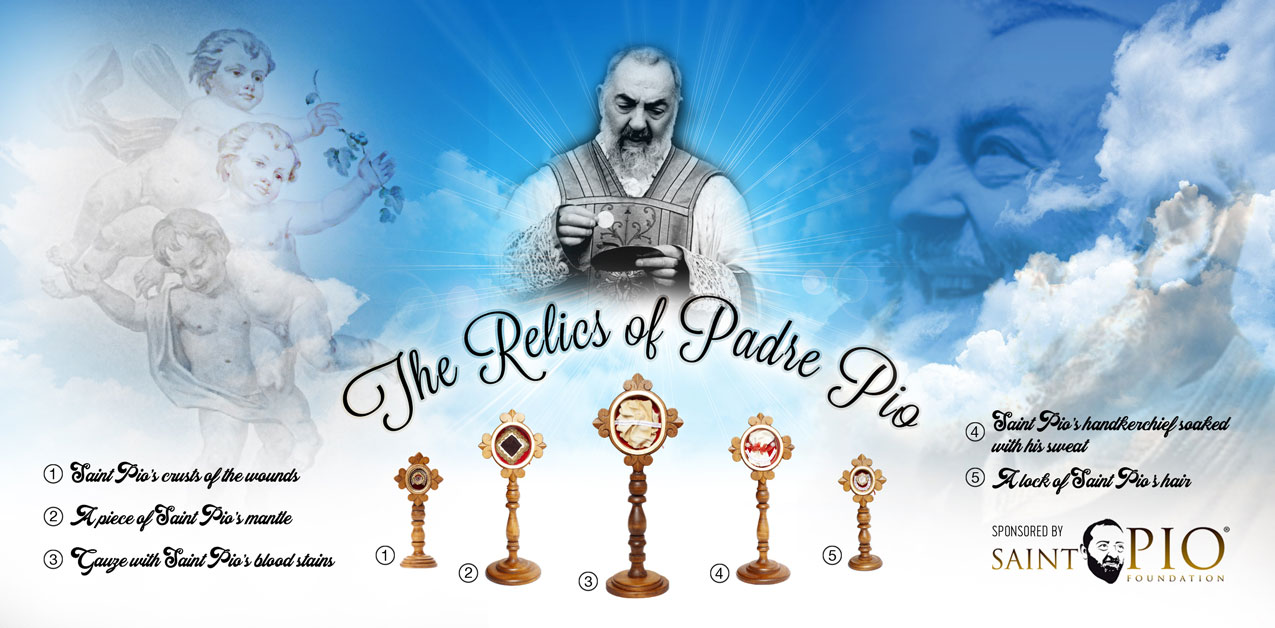
He is one of the more recent saints in the Catholic Church who was known as a mystic, who suffered the stigmata (wounds of Christ), and could read people’s souls in the confessional. St. Padre Pio, who died in 1968, was an Italian Franciscan friar who was declared a saint by St. Pope John Paul II.
Catholics are invited to see and venerate relics of St. Padre Pio after the 4 p.m. Mass at the Cathedral of the Immaculate Conception in Springfield on Saturday, Nov. 6 and after the 10 a.m. Mass on Sunday, Nov. 7 until 4:30 that afternoon in the Cathedral atrium. Four first class relics and one second class will be available to the faithful to see and venerate. While the event is free, good will donations are appreciated and a second collection will be taken up during one of the Masses.
