
Diocesan Administrator Account
Springfield scientist shares his conversion story

'I realized I was thinking about God all wrong'
Nathan Grider of Springfield shares his conversion story
 By ANDREW HANSEN
Editor
A self-described atheist at one point in his life, Nathan Grider’s passion is science. His love for the field led him to a career as a biologist for the Illinois Department of Natural Resources. But it was during his pursuit of his degree when Grider started looking at different religions of the world and their history. He said that he “liked that the Catholic Church had a strong connection to science and seemed to embrace science more consistently rather than dispute it.”
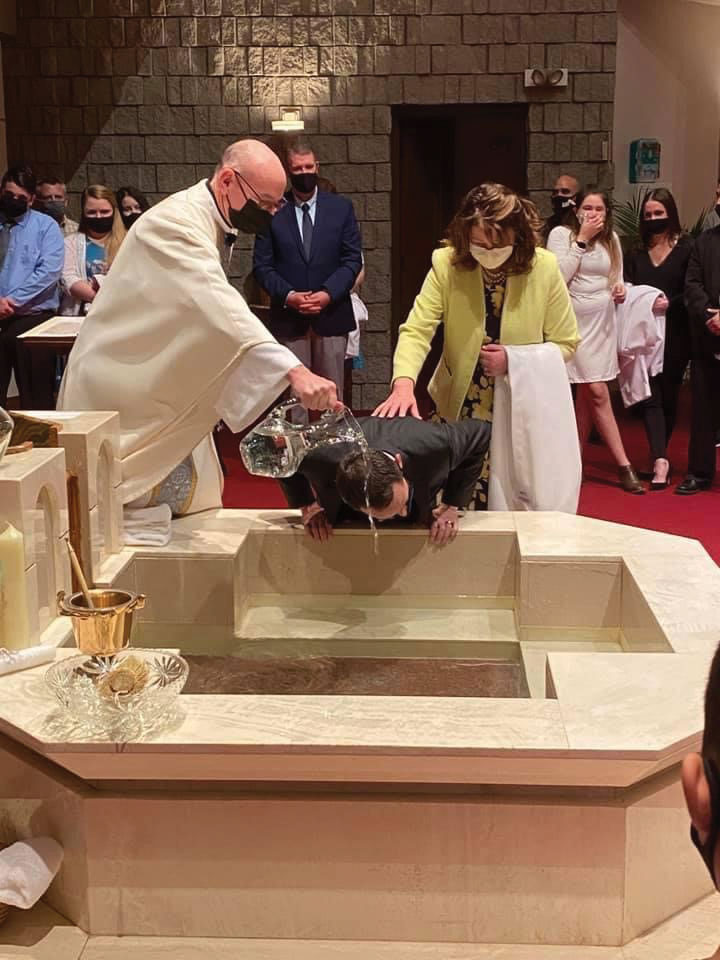
His story to embrace the Catholic faith, however, wasn’t easy. As a scientist, Grider had to dive deep by asking questions, watching videos, and studying what the Church taught. What he eventually learned opened his eyes to another world — a world of faith. Grider became Catholic on Easter last year, receiving the sacraments of baptism, confirmation, and first holy Communion.
Catholic Times Editor Andrew Hansen interviewed Grider, a 37-year-old parishioner at St. Agnes in Springfield who is married with two daughters.
What led you to even start looking at different religions?
In more recent years, I started to recognize that I had many friends and colleagues who were scientists and Christians. I thought that was interesting and asked a few of them about their perspectives on science and religion with complete sincerity. They were usually brief conversations and we tended to land at a usual place, “There is a lot we don’t know or understand … .” These are great people, and I could see how their faith made them better at their lives and even their jobs. Keep in mind, I had been attending Catholic church with my wife and her family for about 12 years by this time. I was taking it all in, but reluctant to just let go of my stubbornness that had me thinking that I had it all figured out through studying science. All the while, I knew church was a good thing and good for society, so I figured it didn’t hurt for me to go. As my belief in God continued to develop, a lot of things I heard while attending church with my family started to make more sense. I still wrestle with some of the details, but I knew I was ready to explore it further, so I joined the Church.
At one point in your life, you considered yourself an atheist. Was there a moment during your search when you thought, “I am wrong. God does exist, and I want a relationship with Him!”
A few years ago, I started to realize that I was thinking about God all wrong. A few things helped open my mind. One was a book called Proof of Heaven, given to me by a family member and fellow scientist. I recommend it for anyone struggling with these questions. This book is about “near death experiences” (NDEs), which lead me to learn more about them. There is a common theme reported from people who experience NDEs and for me, actual evidence of God started to take shape there. Further, I came to understand, at least in my mind, that God really is the energy all around us that makes up everything and has influence on everything — the source of the universe and what lies beyond it, before it, and after it. I don’t picture an old, bearded man in the clouds as it had been presented to me before or even a “He or She” necessarily. The power that is God that I have come to know is beyond needing to fit biology and the natural world that we understand. I’ll refer readers to Episode 3 of The Search (The Search is a video series that tackles the key questions of every human heart from a Catholic perspective). The Search completely changed my view of God and helps explain the perceived clash between science and religion. I overheard it while my wife was watching it, and I was drawn in. It changed me, and I joined the Church not long after.
Also, the story of Jesus became more compelling to me the more I dove into it. There are too many details from multiple witnesses to just be made up. There is something to it! Eternity is a long time, and I don’t want miss out on something great because I was too stubborn, especially if my family goes, and I don’t. How terrible would that be! Nothing bad can come from Christianity. It only brings out the good in us. Imagine a world without it!
 So many falsely think the Church and science are at odds with each other. In your search, how did you conclude that in fact, the two are in unison?
To me, science and religion were two separate things and at odds with each other. I remember saying that “the clash will always continue because neither could ever prove the other wrong.” Religion tends to rest on faith without hard evidence, and science has no way to test and prove God does or does not exist. However, I started to understand that science is there to explain the “how” but not the “why.” Again, Episode 3 of The Search helped me better understand how the two can coexist. Of course, there is also the fact that many of the greatest scientists who ever lived were also priests and the Church funded most of the science in the past. I still accept the theory of evolution to be true based on the overwhelming evidence and all the other things that science teaches us about our world. Thus, there are things about the Bible, especially the Old Testament, that I don’t take literally.
Last Easter, you became Catholic, receiving three sacraments. What was that day like?
That was an exciting day. I never thought I would officially join the Church if someone was to ask me a few years ago. That day felt like starting a new journey of trying to reach a deeper understanding of life. I was surrounded by my family and new friends of the Church. Everyone was very welcoming. I also spent time that day thinking about my daughters and feeling better knowing that I was doing what I could to have a chance at seeing them again after I die. That gave me peace.
When you look back at your journey to Catholicism, what stands out?
What stands out the most to me is the moment I realized I was thinking about God all wrong for most of my adult life. The way I was thinking about it purely as told to me from the Bible stories did not allow my science-based way of thinking to accept it. It was only when my perception of what God is changed that I was able to start to understand and begin a spiritual relationship. I think many people are stuck on this part too, and maybe my story will help them out.
What do you love most about our faith?
I love that the Catholic Church embraces science and does so many good things in communities. I have always been a philanthropist type and care deeply about other people’s wellbeing, including our planet and all the life that it supports because it is truly amazing, rare, and precious. I know my purpose in life is to care for our planet and the life that it supports, and the Bible tells us to do the same. There are many similarities between my line of work in conservation and the faith and that gives me further motivation to carry out the difficult work. It helps give me strength and patience in my daily life. I love that about it!
Make your Lent holier
Join Catholics across our diocese for a Lenten mission to restore our souls with grace in preparation for the Resurrection. Sign up to receive weekly Lenten inspiration, tips, and resources from priests in our diocese in your inbox as we focus on REconciliation to the REsurrection. Go do dio.org/lent to sign up!
An unending circle of prayer: 15 years of Sister Maristella Dunlavy's card ministry

 By SISTER BETH MURPHY, OP
Special to Catholic Times
When Sister Maristella Dunlavy retired from her educational ministry in 2006, she concluded 14 years as principal of Cathedral Grade School. As she prepared to move on, the prioress general of the Dominican Sisters of Springfield asked whether she would consent to serving as sacristan at Sacred Heart Convent. “Yes, I’d be honored to do that,” she replied. “But there is something else I’d like to do, too.”
That something else was a dream Sister Maristella had harbored for years. She wanted to begin a prayer card ministry, designing, and distributing cards that came with a promise of prayer from the Dominican Sisters.
“I wanted to extend to as many people as possible the powerhouse of prayer we have at the motherhouse,” she said, referring to Sacred Heart Convent on West Monroe Street in Springfield, where she continues to serve as sacristan. “The cards are a tangible reminder to people that we are always praying for them.”
Fifteen years later, Sister Maristella says she can’t possibly count the number of cards she has distributed or measure the impact of the daily prayer our sisters offer for those who send and receive the cards. “It is considerable,” she said matter-of-factly.
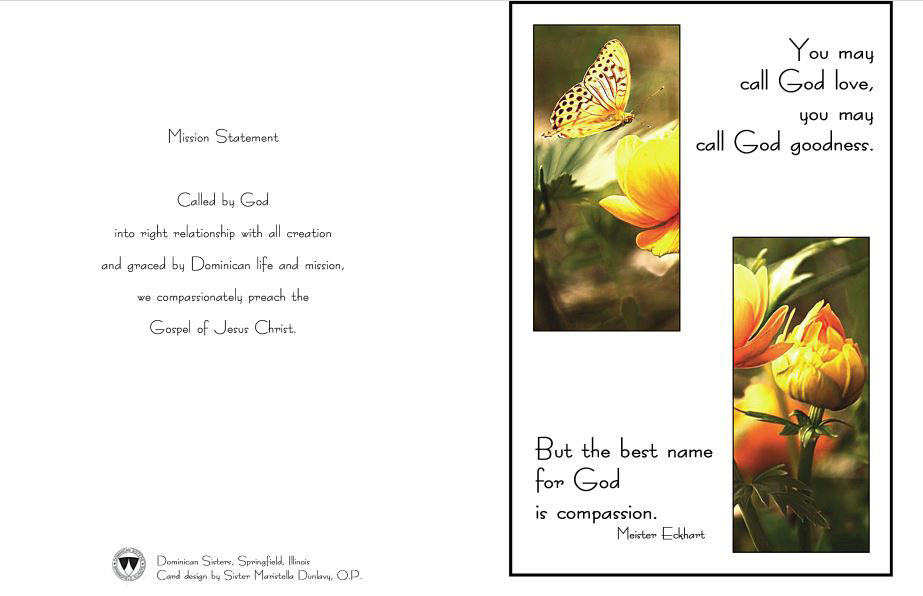
 Her original five designs — sympathy, get well, birthday, anniversary, and thank you cards — continue to be popular. She has also added new designs — 16 blank notecards — now available to order at springfieldop.org/prayer-cards. They include some of her favorite Scripture quotes and inspirational words.
She pairs a line from the book of Daniel — “Ice and snow bless the Lord!” — with an image of the convent bell tower hovering over icy tree branches. Another, with a stunning fire blazing in the dark, includes the words of the Dominican mystic St. Catherine of Siena: “Be who God meant you to be and you will set the world on fire.”
In addition to meeting the need of that rare breed of people — those who choose to communicate their care and concern through handwritten notes — Sister Maristella sees this ministry as an important way to expand the ministry of prayer of the 90 or so sisters who live at the motherhouse. “As we age, we aren’t as busy as our sisters who are still ministering around the U.S. and in Peru,” she explained. “We have much more time to dedicate to prayer ‘for the life of the world’ as we say. It is meaningful to us to be able to share the life and energy of our relationship with God with so many around the world who count on prayer to sustain them in difficult times.”
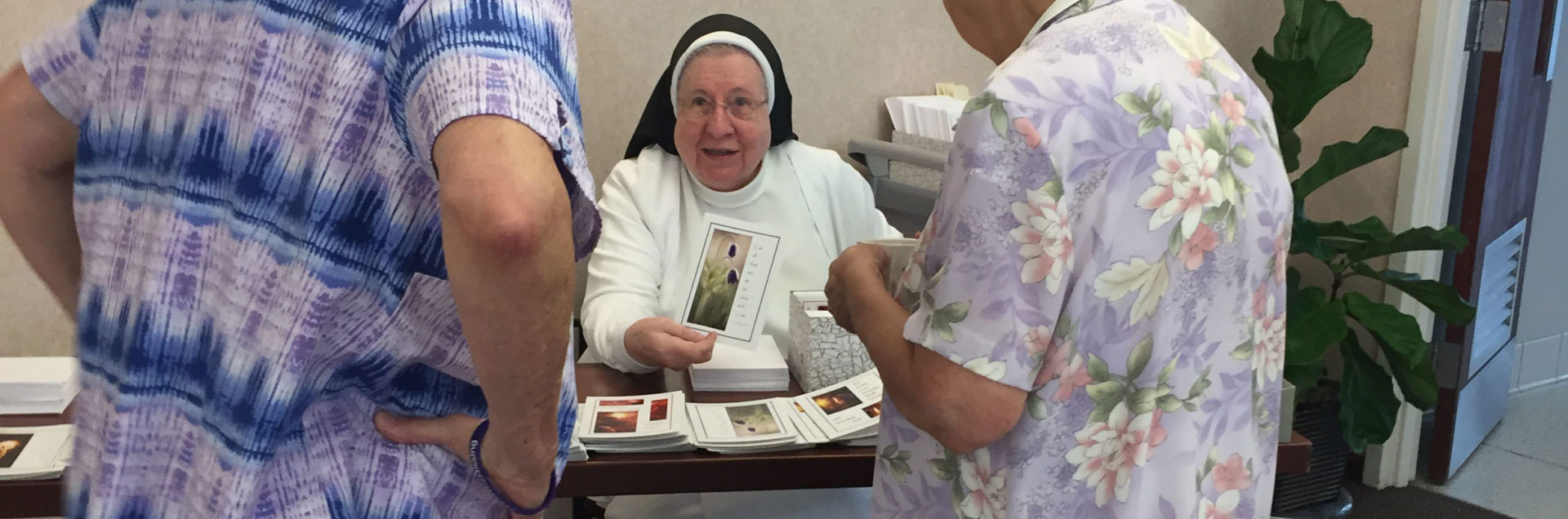
In addition to acting as a sacristan at Sacred Heart Convent in Springfield, Sister Maristella Dunlavy, OP, has been running a prayer card ministry for 15 years.
 Those who request cards are invited to make a donation to help cover costs and sustain the outreach that has given Sister Maristella such life and energy for such a long time. All donations are put right back into the ministry to cover the cost of printing and shipping the cards.
“Many of those requesting cards are our sisters, associates, family, and friends,” Sister Maristella explained. “I also hear from people I’ve never met. Recently a gentleman from New York made a request for cards.” She speculates that he either found his way on his own to the website or received a card from a friend and decided to order some of his own.
Quincy resident Jo Buckley, who for years worked in the Diocesan Office of Education, is a dear friend of Sister Maristella’s and a frequent card customer. “Sister Maristela is a joy and I love her cards. She is good about getting them in the mail right away. They come in handy,” she said, especially the birthday and sympathy cards. “I send them to my friends, and they love them.” When Buckley’s husband died last fall, she got a taste of what it means to be the recipient of a handwritten expression of care. “It was nice to get so many sympathy cards,” she said. “They meant so much. I am going to read them all again.”
And isn’t that the point? After 15 years, Sister Maristella’s card ministry has surely provided that same kind of care and comfort for countless people.
If you’d like to join the circle of prayer Sister Maristella began with her prayer ministry 15 years ago, visit springfieldop.org/prayer-cards.
Sister Beth Murphy, OP, is communication director for the Dominican Sisters of Springfield Illinois.
Submitted photo
Twenty-one diocesan schools eligible for $10,000 match for scholarship donations

Your donation also gives you 75 percent tax credit
A matching gift program for 21 schools in our diocese is happening right now thanks to a generous couple who is offering a 1:1 donation match toward the 2022-2023 tax credit scholarships that help students in need. Gifts made through Empower Illinois for the Invest in Kids Tax Credit Scholarship Program at eligible schools will be doubled up to $10,000.
Illinois’ bipartisan Invest in Kids Tax Credit Scholarship Program provides need-based scholarships to kids from low-income and working-class families to attend their best-fit school. Program donors earn a 75 percent state tax credit on their gift. For example, if an individual donor contributes $1,000, they will receive a state tax credit of $750. Donors can also direct their donations to a school of their choice. Since 2018, the Invest in Kids Tax Credit Scholarship Program has awarded more than 28,000 scholarships totaling more than $250 million.
Donations must be made before April 15 or when the cap is met at your select school to be eligible for the match. For more information on how to donate visit empowerillinois.org/donate or call (800) 616-7606.
Eligible schools:
- Blessed Sacrament — Springfield
- Blessed Sacrament Catholic School — Quincy
- Christ the King — Springfield
- Little Flower School — Springfield
- Our Lady of Lourdes —Decatur
- Our Saviour School — Jacksonville
- Quincy Notre Dame High School — Quincy
- Routt Catholic High School — Jacksonville
- Sacred Heart-Griffin High School — Springfield
- St. Agnes School — Springfield
- St. Aloysius School — Springfield
- St. Dominic School — Quincy
- St. Francis/Holy Ghost School — Jerseyville
- St. Francis Solanus School — Quincy
- St. John the Evangelist School — Carrollton
- St. Mary School — Mount Sterling
- St. Patrick Elementary School — Decatur
- St. Patrick Grade School —Springfield
- St. Peter School — Quincy
- St. Teresa High School — Decatur
- St. Mary School — Taylorville
New institute for Catholic formation and new Norbertine community coming to Springfield

The Evermode Institute to offer spiritual and intellectual formation for clergy, religious, and lay Catholics
By Andrew Hansen
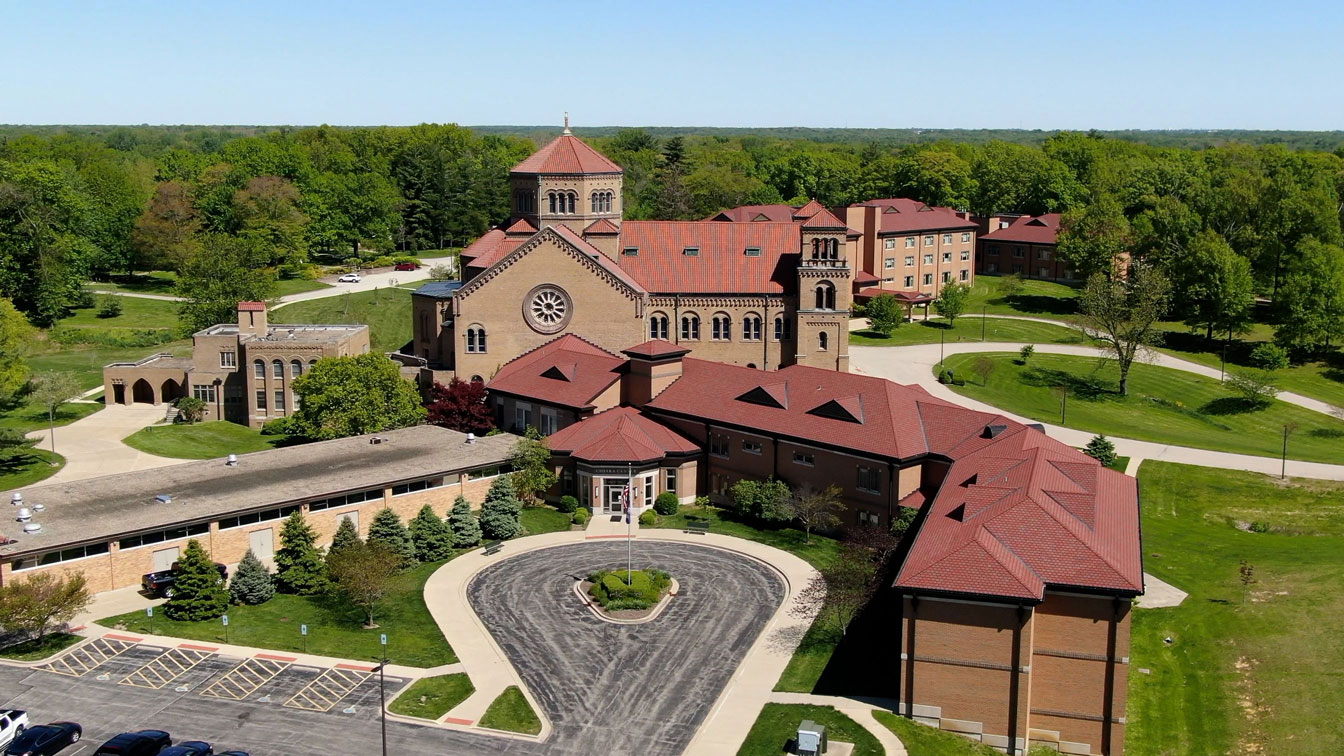
 The Diocese of Springfield in Illinois announced March 3, plans to establish The Evermode Institute, a new center for Catholic spiritual and intellectual formation in Springfield, and that the institute will include priests from the Norbertine Fathers of St. Michael’s Abbey, who will establish a new community there.
In what will be located at the site of the former Chiara Center on the grounds of the Hospital Sisters of St. Francis in Springfield, The Evermode Institute will focus on formation for Catholics, offering programming for both ordained and lay teachers of the faith such as catechists, Parish School of Religion teachers (PSR), Catholic school teachers, and other groups who teach the faith. Several priests from the Norbertine Fathers of St. Michael’s Abbey, based in Orange, Calif., will move to the property with the necessary preliminary steps being taken this summer. Serving at The Evermode Institute will be their primary apostolate. A date for when The Evermode Institute will open has not been finalized.
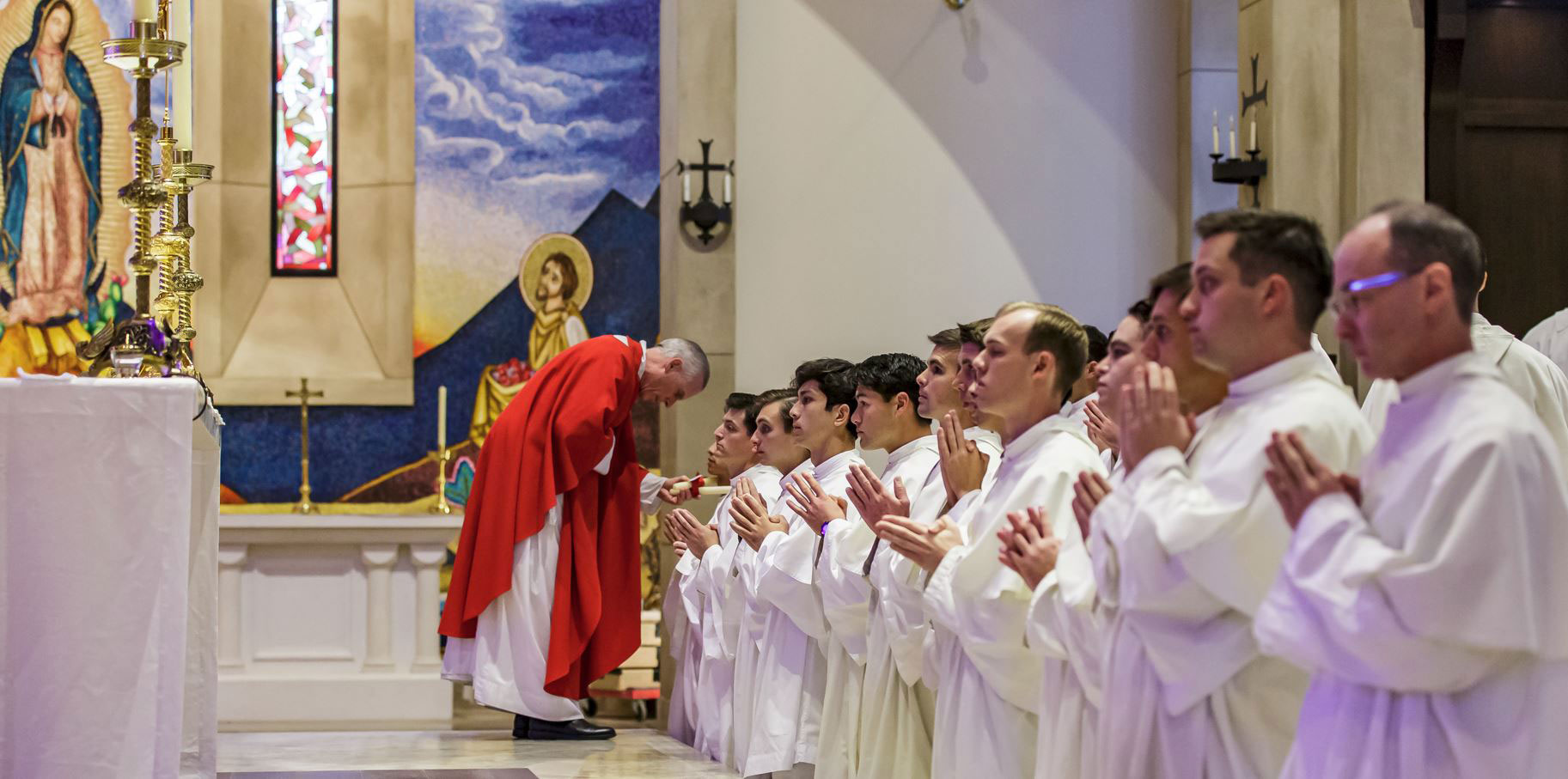 “We have developed a strong relationship with the Norbertine Fathers of St. Michael’s Abbey over the past several years, and we are thrilled to welcome them to our diocese,” said Bishop Thomas John Paprocki of the Diocese of Springfield in Illinois. “The Norbertine Fathers of St. Michael’s Abbey are a vibrant and growing community of holy men, and their presence and apostolic work will be a great blessing to the people of our diocese and to this region.”
The Norbertine Fathers of St. Michael’s Abbey recently completed construction of a new abbey in Orange County, Calif., and the monastery is already at full capacity, with nearly 50 priests and 40 seminarians.
“In light of the growth in our community, we had already been discerning the possibility of establishing a new community when Bishop Paprocki approached us,” said Abbot Eugene Hayes, O. Praem. “After prayerful discernment as a community, we have joyfully accepted Bishop Paprocki’s invitation, and we are grateful for the opportunity to establish a presence in the Springfield diocese.”
 The Evermode Institute is being established under the patronage of St. Evermode, a Norbertine prelate who died in 1178 and was a close collaborator of St. Norbert. St. Evermode is credited with great and effective works of evangelization and formation in the Catholic faith.
These announcements follow news earlier last year when the Diocese of Springfield in Illinois and the Hospital Sisters reached an agreement for the diocese to establish a trust that has now assumed ownership of the sisters’ buildings and grounds effective Jan. 1, 2022. The Hospital Sisters will continue to live in the convent indefinitely as part of that agreement.
“We welcome the Norbertine Fathers to Springfield and to the holy ground that has been our home since 1917,” said Sister Maureen O’Connor, OSF, Provincial Superior of the Hospital Sisters of St. Francis. “This new chapter in the history of the Hospital Sisters and the diocese marks the beginning of what we pray will be a mutually beneficial relationship. Throughout our nearly 150 years in America, the Hospital Sisters have collaborated with others in the work of the Church, and so we view this agreement between the diocese and the Norbertine Fathers as a continuation of that tradition.”
About the Norbertine Fathers of St. Michael’s Abbey
Immersed in the 900-year tradition of our order, the Norbertine Fathers live a common life of liturgical prayer and care for souls. Their life at St. Michael’s Abbey is organized according to prayer of the Church: the Holy Sacrifice of the Mass and the Liturgy of the Hours. “Seven times a day I praise You,” says the Psalmist, and by chanting together the prayers of the Divine Office, Norbertine canons “continually offer up a sacrifice of praise to God.”
For more than 60 years, the Norbertine Fathers have served the Christian faithful in Southern California, “lifting high the Holy Eucharist over the miseries and errors of this world” (St. Pope John Paul II). The community’s apostolic ministries are many and various, but they all find their source in a common life of prayer and fraternal charity. To learn more, visit stmichaelsabbey.com.
Deacon Hoefler of Holy Family Parish in Athens recounts stories that gave him 'privilege of serving'

 By ANDREW HANSEN
Editor
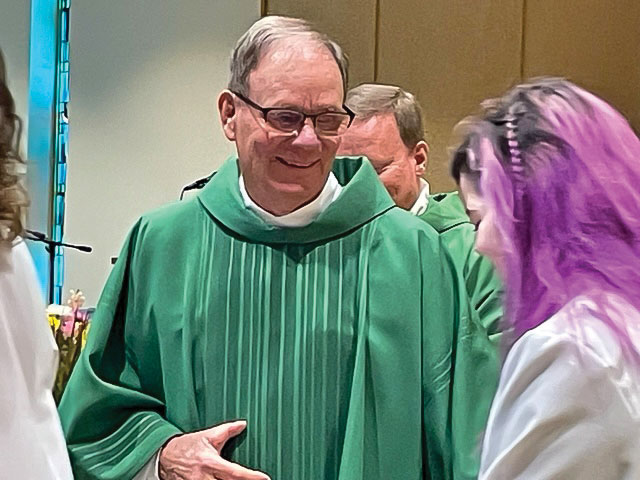
How many people can say they locked eyes with a saint? The year was 1984, just two years after being ordained to the permanent diaconate. That’s when something happened to Deacon Benedict Hoefler that has stuck with him since. He was serving as a deacon during Mass at St. Peter’s Basilica in Rome with now Pope St. John Paul II. As the pope was about to elevate the Body and Blood of Christ, Deacon Hoefler says the pope’s eyes locked with his.
“When Pope John Paul II looked at you, he looked right into your soul,” Deacon Hoefler describes it. “To me, that moment in my mind translated to the pope ‘saying’ that ‘you’re here at the altar with me, but when he elevated the Body and Blood of Christ, you’re here at the altar with Jesus.’ I have never forgotten that.”
Another powerful moment then happened just minutes later. After distributing holy Communion, while purifying the vessels, Deacon Hoefler remembers looking up and seeing now St. Mother Teresa.
“I thought, ‘I am standing between two saints! Holy cow! What a privilege this is,’” Deacon Hoefler said.
Another powerful story that is engrained in Deacon Hoefler’s memory involves a man who had not been to confession in 50 years. Deacon Hoefler was visiting a nursing home when he met the man.
“I asked him if he would like to go to confession,” Deacon Hoefler said. “The man replied that he would ‘burn the priest’s ears off.’ I told him I know a priest who has served for more than 55 years who could hear his confession.”
After arranging the confession, the man went, seeking forgiveness from God. Deacon Hoefler later found out that just two days after the man confessed his sins for the first time in 50 years, he died.
“Those are the kinds of things you don’t forget that make a big impression on me,” Deacon Hoefler said.
While the permanent diaconate has made a “big impression” on Deacon Hoefler, on Feb. 13, Deacon Hoefler realized just how much of a big impression his ministerial work has had on people. At Holy Family Church in Athens, dozens of parishioners, friends, and family — some from hours away — came to Mass to celebrate the anniversary of his 40th year as a permanent deacon. His son, Msgr. David Hoefler, Vicar General for the Diocese of Springfield in Illinois, was the celebrant. The day was filled with emotion, laughter, and smiles as the first permanent deacon of our diocese looked back over 40 years.
“I thought about becoming a priest when I was younger as I had three uncles who were priests,” Deacon Hoefler said. “They made a big impression on me.”
But, after marriage and four children (three daughters and one son), priesthood was not going to happen. After moving from Iowa to Rockford in 1972, Deacon Hoefler met a man in their permanent diaconate program. Thinking you needed an advanced degree, but finding out that was not the case, he says he immediately became interested. Then, after talking about it with his family over the next couple of years, Deacon Hoefler remembers his family simply saying, “Go for it.”
Deacon Hoefler was ordained in 1982 in Rockford. The Hoeflers later moved to Springfield in 1993. Deacon Hoefler has served at St. Aloysius in Springfield, St. John Vianney in Sherman, on the Deacon Formation Team, and presently at Holy Family in Athens.
“I’d have to say being with the people is my favorite thing about being a deacon,” Deacon Hoefler said. “It’s the people that are in the parish that allow me to be who I am. They give me the privilege of serving them.”
'To feel finally a true feeling of worth, God's presence' - Debra Ross of Casey shares her conversion story

 By ANDREW HANSEN
Editor
CASEY — When Debra Ross of Casey came to the Cathedral of the Immaculate Conception in Springfield in February of 2021, during the Rite of Election, she said she was so nervous, that if you simply tapped her shoulder when she was standing, she would have fallen over. These nerves became most apparent when Bishop Thomas John Paprocki ratified, with his signature, the enrollment of names of the catechumens in the Book of the Elect. Ross was a catechumen at the time, someone who is unbaptized.
A few weeks later at the Easter Vigil at Immaculate Conception Parish in Mattoon, Ross was fully initiated into the Catholic faith, receiving the sacraments of baptism, confirmation, and first holy Communion from Father John Titus.
“To feel finally a true feeling of worth, God’s presence, cleansing, a marriage — whole!” Ross said, describing what she felt that day.
The journey to Catholicism was a long road — 66 years. Raised Pentecostal, Ross had some connection to Catholicism with family on her mother’s side being Catholic. She remembers her family taking her to Mass, but “No one truly explained what the Mass was.”
Despite feeling drawn to the faith, she says what held her back was that she didn’t want to disappoint her family and not understanding what everything was about.
Decade after decade went by, but after each year, the nudge to become Catholic became stronger. So, Ross stopped by Immaculate Conception Parish in Mattoon and met their RCIA (Rite of Christian Initiation of Adults) team who answered questions, provided her materials to learn more about the faith, but most importantly, Ross said that the team was always there for her. While going through the RCIA process, Ross thinks back and now laughs because of what surprised her the most.
“How much I felt at home, Ross said. “I guess I also really had a Catholic core and really did not know it!”
As she learned more about the richness and treasures of the faith, Ross says she developed a devotion to Mary and St. Michael the Archangel. “It’s such an honor to talk to her,” Ross said. “I feel safer with St. Michael.”
Today, the retired mother of three girls is enjoying time with her nieces, grandchildren, and great-grandchildren, going to Mass, and spending time at her parish. When she looks back over her journey to the Catholic faith, what stands out the most to her is a simple five-word answer.
“Why it took so long.”
Debra Ross has a conversation with Father John Titus, her pastor at Immaculate Conception Parish in Mattoon. At the Easter Vigil last year, Ross received the sacraments of baptism, confirmation, and first holy Communion from Father Titus.
Submitted photo
Hey, Father! Why place more emphasis on Jesus' Crucifixion than His Resurrection

Why does it seem we place more emphasis on Jesus’ Crucifixion than on His Resurrection? We could all be put to a torturous death on a cross, but we can’t be raised like Jesus was. If there was no Resurrection, there is no point in the Crucifixion other than it was done to an innocent man.
Nancy in Barry
When St. Paul went to preach at the Areopagus in Athens, he went to proclaim the Resurrection of Jesus Christ from the dead. As he proclaimed the bodily Resurrection of the Lord to the philosophically minded Athenians, they scoffed at him and rejected his message out of hand. The Greeks, who looked upon the body as nothing more than a prison from which the soul sought to escape, thought the notion of the reunification of the body and the soul preposterous. From that day on, St. Paul resolved to “preach Christ crucified” (I Corinthians 1:23). He went so far as to say, “For I resolved to know nothing while I was with you except Jesus Christ, and him crucified” (I Corinthians 2:2). We place more emphasis on the Crucifixion because St. Paul does.
The Church has always held the cross of Christ to be the great sign of his victory — a trophy, of sorts — over sin and death. Just as the Church depicts the martyrs with the signs of their victory (St. Paul, for example, was beheaded by the sword and often is shown carrying a sword because it was the instrument of his death), the Church depicts the Lord on the instrument of his death, an instrument which brought us our salvation and victory over sin.
The Catechism of the Catholic Church reminds us that “the Resurrection of Jesus is the crowning truth of our faith in Christ, a faith believed and lived as the central truth by the first Christian community; handed on as fundamental by tradition; established by the documents of the New Testament; and preached as an essential part of the Paschal mystery along with the cross” (638). This is why St. Paul frequently spoke of Jesus as the one who “died and was raised” (II Corinthians 5:15). The death of Jesus on the cross cannot be separated from His Resurrection from the dead, and vice versa; to preach one is to preach the other.
We emphasize the Crucifixion of Jesus in the certain hope that “if, then, we have died with Christ, we believe that we shall also live with him. We know that Christ, raised from the dead, dies no more; death no longer has power over him… Consequently, you too must think of yourselves as being dead to sin and living for God in Christ Jesus” (Romans 6:8-11). The effective means of preaching this central truth of the Christian faith and life is to follow the example of Saint Paul, to preach Christ Crucified.
Father Daren Zehnle is pastor at St. Augustine Parish in Ashland and is the director for the Office of Divine Worship and the Catechumenate for the Diocese of Springfield in Illinois.
Women of diocese invited to Lenten retreat

The Springfield Diocesan Council of Catholic Women (SDCCW) is sponsoring a Lenten Retreat March 29-30 at the Villa Maria Retreat and Conference Center in Springfield. The subject of the retreat is, “Life’s journey — Why is God so important?” Father Larry Brunette, retired from the Dioceses of Springfield in Illinois and Joliet will facilitate the retreat.
The SDCCW Lenten retreat will feature spiritual presentations, prayer, the rosary, confession, fellowship, and the celebration of Mass. The retreat begins with registration and a light breakfast at 9 a.m. on March 29 and concludes after lunch on March 30.
Retreat costs include meals, refreshments, retreat master, retreat materials, and the use of the facility. The cost for an overnight stay, double occupancy is $90. An overnight stay, single occupancy is $110 or for commuters it is $70. Registration is due by March 22 and payment can be made to S.D.C.C.W. Contact your parish office, your women’s group, or your deanery president for additional information and registration form or email Myrna McKee at sdccwinil@gmailcom.
The Villa Maria is located at 1903 East Lake Shore Drive in Springfield.
Beauty Series: St. Francis of Assisi – Springfield
By Andrew Hansen EDITOR
Tucked away, on the outskirts of Springfield sits a peaceful and sacred ground. Beautiful, dense trees and treasures of nature surround a property that for more than 100 years has been serving as the Motherhouse for the compassionate and faith-filled Hospital Sisters of St. Francis. The beating heart of this property? One of the most majestic and beautiful churches in the Midwest, St. Francis of Assisi Church, designed by Helmle & Helmle, a Springfield architectural firm, and built by local contractor Frank Fitzsimmons in the 1920’s. The church was dedicated in 1924.
“When I go into that church, the expression is ‘this is a hidden gem,’” said Bishop Thomas John Paprocki of the Diocese of Springfield in Illinois. “It is not a parish church, so there are not people coming there every Sunday. A lot of people in our diocese do not even know it exists. It is just a magnificent structure.”
The Romanesque style church is 133 feet long, 115 feet wide, and 84 feet tall and is shaped like a cross. It has spectacular artwork, mosaics, and statues, a vaulted ceiling, elaborate designs, striking stained glass, detailed bronze stations of the cross, and an astonishing scarlet dome.
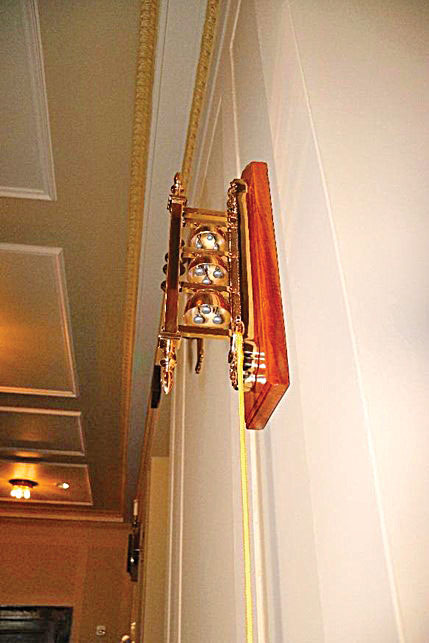 On display, there is a bone relic of St. Francis of Assisi and a relic of the true cross that belonged to Pope Pius IX. The St. Joseph altar is made from rare Italian and Greek marble and the statue. Made in 1932, is among the first colored marble statues imported to the United States. The Altar of Reservation of the Blessed Sacrament is also made of rare marble from Greece and Italy. The gold covered tabernacle was designed in Belgium after images of the Ark of the Covenant and the door features the four evangelists. A crucifix above the altar was made in Belgium by a master artisan and is the only one of its kind in existence. The baldacchino is modeled after the tent under which the Ark of the Covenant was carried. If the sanctuary does not catch your attention, the large mural of “Christ the Almighty” will. Then, there is the dome, which rises 120 feet from the floor. It contains 24 windows of angels and 750 stars that symbolize the members in the American Province of the Hospital Sisters of St. Francis in 1964.
This sacred space has been described as “overwhelming splendor,” all of which is about one thing, reminding us that we are called for holiness and to not live for this world, but for the everlasting reward in heaven.
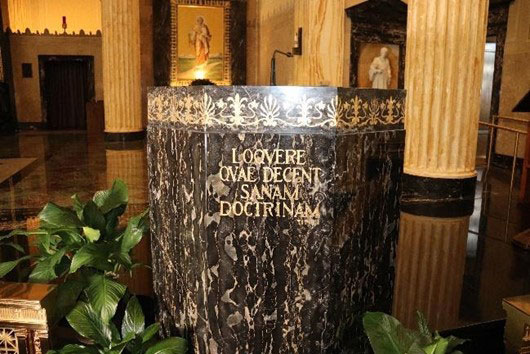 “When you talk about a favorite thing (about the church), in my first ministry as a Franciscan, I was a pediatric nurse,” said Sister Maureen O’Connor, OSF, the Provincial Superior of the Hospital Sisters of St. Francis. “There is a statue of Mary where she is holding Jesus as about a toddler. It is such a wonderful picture of the humanity of Jesus because his little sandal is hanging off his foot. I think most parents would pick up their kids up and they would say that there shoes are here or their hat is there, and I see the loving embrace of Mary for Jesus and two minutes later she put him down and put his shoe back on him. It touches me for the relationship between Mary and Jesus and takes me back to my happy pediatric time.”
The property also features several shrines, including shrines to St. Therese of Lisieux, Our Sorrowful Mother, and St. Felicitas, otherwise known as St. Felicity. The Shrine to St. Felicitas shrine includes a wax body representing her with a small relic encased within. The Relic Chapel, which is situated as you enter the main entrance of the church, contains bone fragments, clothing fiber, and hair, among other relics of saints from all ages of the Church.
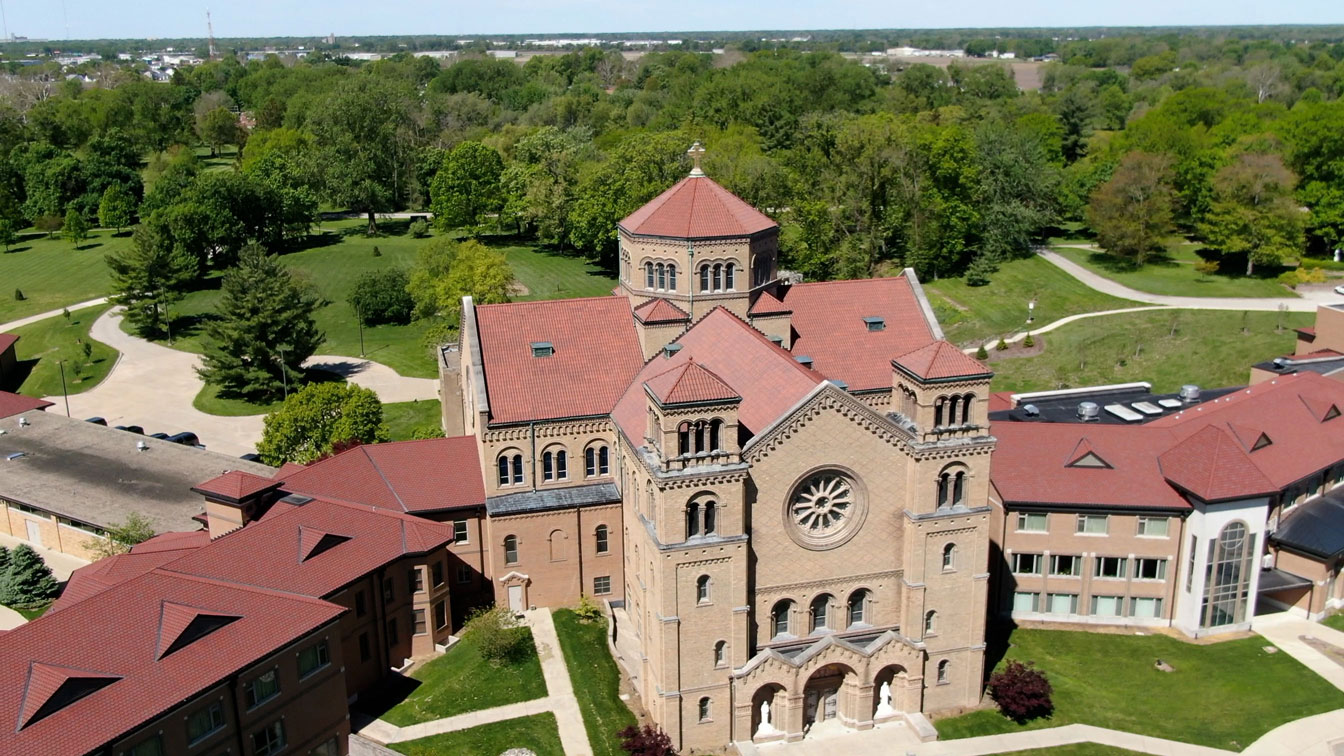 Outside on the 300-acre property, there are shrines to Our Lady of Fatima and Our Lady of Lourdes. Several saints are also honored through devotionals along a walking path.
“Our first Motherhouse was at St. John’s Hospital,” said Sister O’Connor. “After the sisters had been there for some time, they acquired the property out here (in 1917), and the first structure was St. John’s Tuberculosis Sanatorium. They cared for TB patients here for many years. That brought our healing presence to this property. We also had the St. John’s Crippled Children’s Home, which took care of a lot of polio children and youngsters with cerebral palsy. We had treatment, and they went to school here. So, this property was initially for the healing ministry, and then the next structure was the church, a place for the sisters to live, and the chapel, and it just continued to grow, but it was always in service of our ministry.”
In May of 2021, the Hospital Sisters and the Diocese of Springfield announced that the diocese would form a new entity that will assume ownership and responsibility in a trust, effective in January, for the operations, care, and maintenance of the St. Francis Convent property. The Hospital Sisters community will continue to live on the property. The diocese also announced that they will form a new institute for religious life and intellectual and spiritual formation for teachers of the Catholic faith, parish teams, priests, and lay faithful living locally and across the country. So, all the treasurers on this property will be available to the faithful.
Hey, Father! Explain why Catholics 'pray' to saints?

How do I defend our teaching of asking the saints to intercede for us? How do I respond when I am asked, “Why don’t you just pray to God directly?"
Anonymous in the diocese
To answer that question properly, we must first clarify what we are exactly doing when we ask for the intercession of Mary or a particular saint. When we say a saint prayer, whether it is the Hail Mary, the St. Patrick Prayer, or the St. Michael the Archangel Prayer etc., we are not actually “praying to” saints, even though that is the language we as Catholics even use.
We recognize that these saints, who are creations of God, have played an important part in God’s plan in this world. We, therefore, through prayer, are actually asking them to “pray for us” and intercede for us because they are saints, friends of God, and are literally in his company in Heaven. God doesn’t need them to do this. He knows all things and can do all things and is perfectly able to hear and answer all prayers Himself. He does, however, invite His creation to be a part of His ongoing plan of salvation.
We recognize that no saint, not even Mary, has any power in and of themselves, but that everything they do is through the power of God. The saints and the Blessed Mother want us to remember this too. That is why they are always pointing us toward Jesus. The saints and Mary help us recognize Jesus and His call to us in our lives. The saints teach us by their example and by the way they followed Christ while they were on this earth. They intercede for us, offering their prayers for us as close friends of God, just in the same way if you ask a friend or family member to pray for you or loved one in need. When you ask someone to pray for you or a loved one, you are not worshiping them or thinking that they have the power themselves to change things themselves.
Every person in Heaven is a saint, and we are still connected to them through what is called the Communion of Saints (we must also strive to be a saint one day). To ask for prayers from the saints is to ask friends to help us stay focused on Jesus, His plan, and what He asks us to do.
We can of course always lift our prayers directly to God, but we should also remember that God the Father, God the Son, and God the Holy Spirit used angels, prophets, apostles, and disciples as messengers and intercessors all throughout the Scriptures to do His work and spread the Good News. God didn’t need to do this. He could have done it Himself, and yet He used others to help with His mission.
In the same way, we continue to recognize that the saints play an important role in God’s plan, so why not ask them to help us and encourage us on the way! So, continue to pray to God, but ask too for the saints to pray for you or a loved one. After all, the saints are our friends, and they desire us to be next to them in Heaven worshipping God forever.
Father Marty Smith is pastor of St. Francis Xavier Parish in Jerseyville and St. Patrick Parish in Grafton and is an associate vocations director for the Diocese of Springfield in Illinois.