
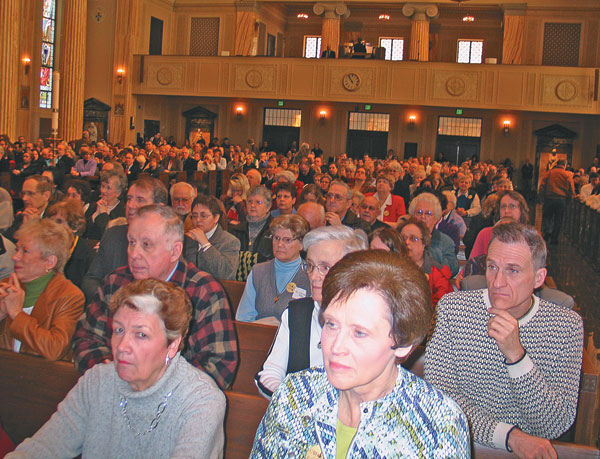
Chicago Cardinal Francis George presided at the Mass, which began at 10 a.m. Concelebrants included Msgr. Carl Kemme, administrator of the Springfield diocese, Bishop Thomas G. Doran of Rockford, Bishop Daniel Jenky, CSC, of Peoria, Bishop Edward K. Braxton of Belleville, Auxiliary Bishop Joseph M. Siegel of Joliet, and Chicago Auxiliary Bishops George J. Rassas, Thomas J. Paprocki, Francis J. Kane, and Gustavo Garcia-Seller.
Sixteen priests from throughout the state were also vested in the sanctuary.
 After Mass, Robert Gilligan, executive director of the Catholic Conference of Illinois, the legislative arm of the Catholic Church in Illinois that organized the event, spoke briefly to the crowd about issues of particular concern that the CCI is focusing on this session.
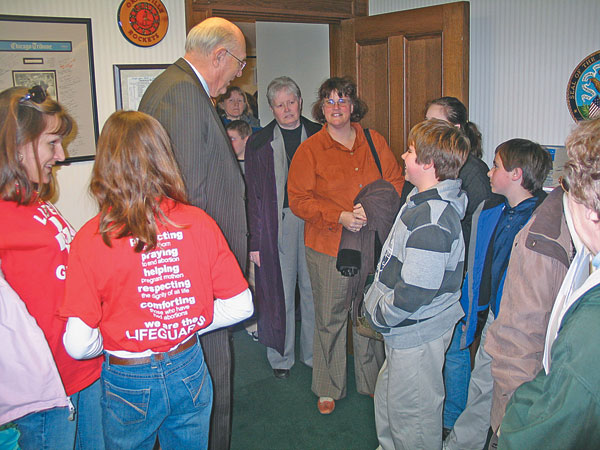
“We did this last year, and were pleased with the results,” Gilligan said, referring to the first Catholics at the Capitol day, which filled the Capitol rotunda and hallways with scores of Catholic school children and their chaperones. This year, the CCI planned the day for adults to represent parishes and schools — principals, parents, and parishioners — who were encouraged to make arrangements in advance to meet with their local representatives and to call attention to social justice issues and concerns facing Catholic schools.
Both Cardinal George, in his homily, and Gilligan, in his remarks, acknowledged the task ahead might not be easy because of the state’s ongoing financial crisis.
 “We will be among friends and enemies,” Cardinal George said in his homily. “Our response, first of all, is to pray. Pray for them, both friends and enemies. Take courage. Think of the people you carry with you today, the people you represent and have chosen to identify yourselves with. Think of children waiting to be born in their mothers’ wombs … of children who are being prepared for a life in Christ in Catholic schools. Think of immigrants and their families, and the poorest of the poor. If you’re looking for the kingdom of God, it’s not a bad group to be in.”
Later at the Capitol, Sen. David Luchtefeld, (R-Okawville) assistant minority leader, told Karen Seaborn from Waterloo, Dorothy Hendricks from Belleville and Gina Stateler from St. Libory, “The budget is a mess. We have got to the point where we just can’t borrow any more money. There is no provision in federal law for a state that goes bankrupt. Now what do we do?”
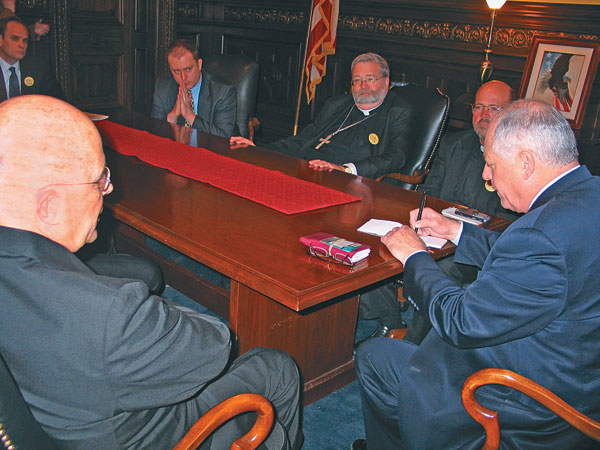
 Up on the second floor of the Capitol, in the governor’s office, Cardinal George, Msgr. Kemme, Bishop Jenky, and Bishop Braxton, met briefly with Gov. Patrick Quinn. “He listened politely as we made our appeal, but was noncommittal on most issues,” Msgr. Kemme said. “But he did tell us he is going to try to restore textbook loan funding.”
The textbook funding program has been in operation since 1975. Its purpose is to provide secular textbooks, learning materials and instructional computer software to public and nonpublic school students in grades K-12. Although most of the program’s funding goes to public schools, Catholic schools have long depended on this program and have used the benefit to continually update math, science and reading textbooks, as well as to purchase new instructional software for technology labs.