
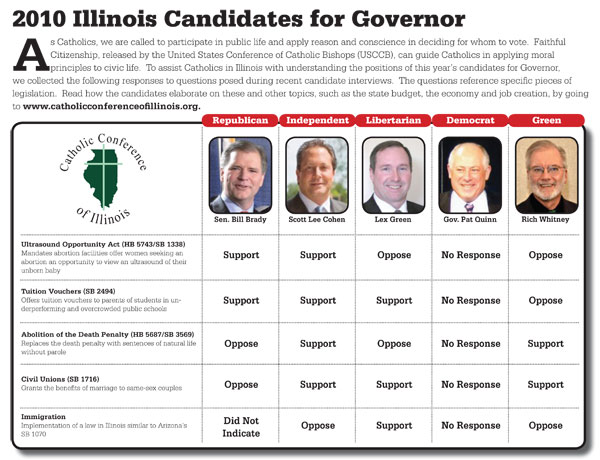
 In an election year dominated by economic and budget concerns, four of the five candidates for Illinois governor sat down with the Catholic Conference of Illinois (CCI) in late summer to discuss their views on those issues as well as legislative issues including education, abortion, the death penalty, immigration, and civil unions.
"We appreciate the candidates taking the time during the busy campaign season to share their views on legislation of interest to Catholics in the state," said Robert Gilligan, CCI executive director.
"Their answers and insights into these issues are of great help to Catholics across Illinois as they consider the choices available to them in November," continued Gilligan. "The Catholic Church does not endorse candidates, but CCI works hard to inform Catholics of public policy issues important to the common good and to the church."
Completing brief questionnaires from CCI, which are available in English, Spanish, and Polish at www.catholicconferenceofillinois.org, and then taking part in follow-up interviews prior to the Nov. 2 election were the following governor candidates:
-
State Sen. Bill Brady, Republican, 49, a real estate and home developer from Bloomington;
-
Scott Lee Cohen, Independent, 45, an entrepreneur with experience in the real estate industry who won the Democratic primary for lieutenant governor but later gave up the position following revelations about his personal life;
-
Lex Green, Libertarian, 56, an electrician from Bloomington making his first run for political office, and
-
Rich Whitney, 55, a Carbondale attorney and one of the founding members of the Illinois Green Party who also ran for governor in 2006.
-
Incumbent Gov. Pat Quinn, who is running for re-election on the Democratic ticket, declined to take part in either the survey or interview despite numerous contacts to his office.
The full texts of the interviews — conducted on behalf of CCI by Tom Dermody, editor of The Catholic Post, the newspaper of the Diocese of Peoria — have been posted online at www.catholicconferenceofillinois.org. The survey results are being distributed to all Catholic parishes in the state. In addition, individual news stories from the interviews — including further background on the candidates' motivations to run for political office — are posted on the Catholic Times website at ct.dio.org.
Following are the survey questions, the candidates' responses, and selected quotes from their interviews.
{faq inline/sliders}| Do you support or oppose The Ultrasound Opportunity Act (House Bill 5743), which mandates abortion facilities offer women seeking abortion an opportunity to view an ultrasound of their unborn baby? | Brady (R): Supports. "Anything we can do to give individuals the greatest knowledge possible about protecting human life, it is incumbent on us to do so." Cohen (I): Supports. "I think there needs to be a better education on alternative choices to abortion." Green (L): Opposes. "I feel that government power is something to be distrusted, and I think that the ultrasound option is a good idea, but I don't think that the government mandate is necessarily the way to go." Whitney (G): Opposes. "It's intrusive in an area that I think should be the province of physicians and patients." |
| Do you support or oppose legislation (Senate Bill 2494) offering tuition vouchers to parents of students in underperforming and overcrowded schools so they may choose a quality, state recognized non-public school? | Brady (R): Supports. "I fought for passage of that in the House and the Senate. I worked across party lines. Parental choice in education is paramount to bringing the best educational opportunities for our children." Cohen (I): Supports. "I'm going to restore the funding that was cut to education. Because the classrooms are so overcrowded, we need to do everything in our power to give these children the opportunity for a good education and if that is provided by these vouchers, so be it." Green (L): Supports. "If you have open enrollment, which would be facilitated through the use of vouchers, then I think we would have much better education, at least for the majority of school districts, and I do think that private schools should be included in those programs." Whitney (G): Opposes. "I see this as a device which will only tend to further the deterioration of our public schools. The fundamental problem with our public schools is lack of funding. We need to be fixing that problem." |
| Do you support or oppose the abolition of the death penalty (House Bill 5687)? | Brady (R): Opposes. "This is a difficult decision for me. I support the law of the land. Every safeguard should be undertaken and this should be reserved for the most heinous crimes that exist. This will be the most difficult thing ever to observe as governor." Cohen (I): Supports. "We're not God. Human beings don't have the right to take a human being's life. There's still the possibility of an innocent person being put to death for a crime he didn't commit, which makes it doubly wrong." Green (L): Opposes. "Life is sacred, and therefore we should not take it for light purposes. However, I don't think that a person is immune from giving up his right to life for a particularly heinous crime." Whitney (G): Supports. "I do not think it is the role of imperfect human institutions, such as government, to take a human life. Virtually every civilized country in the world has abolished capital punishment. The United States is really a backwards nation in this regard." |
| Do you support or oppose legislation establishing civil unions for same-sex couples in Illinois (Senate Bill 1716)? | Brady (R): Opposes. "I believe marriage is a sacred institution between a man and a woman and should be maintained as such. I think we have to realize that First Amendment rights should be preserved and we have to be careful not to pass laws that create that kind of conflict." Cohen (I): Supports. "I feel if we don't give them the rights or benefits of a married couple, they're not going to be interested in monogamy. We're giving them hope and stabilizing society a little bit." Green (L): Supports. "I support legislation giving homosexual and gay couples equal rights under the law. I am a fan of limited government. I would be opposed to forcing the church or an adoption agency sponsored by the church from having to do anything that the government tells them to do." Whitney (G): Supports. "I actually support the right to marry for same-sex couples. Civil unions would be the next best thing. It's a question of equal protection under the law, equal rights under society." |
| Would you support or oppose legislation in Illinois similar to Arizona's law — SB 1070? (In part, SB 1070 originally allowed for local law enforcement to check the status of persons they stop legally whom they suspect are undocumented immigrants and made it a state crime to not carry the proper immigration documents.) | Brady (R): Did not indicate a preference. "I support Arizona's right to do what they think best and best serves their state. In Illinois we have a different situation. At the end of the day we need a federal solution that will bring about meaningful immigration reform." Cohen (I): Opposes. "The federal government needs to implement some better restrictions on people who are coming in illegally; however, as governor I will not separate families. Nor will I discriminate because of a people's color, race, or religion." Green (L): Supports. "I am running as a states' rights candidate, and I think that what Arizona did was to look out for their own interests and protect their own citizens. I don't necessarily agree with all the details." Whitney (G): Opposes. "There's another way to respond, and that is to recognize what are the sources of the problem and turn to solutions that involve building greater unity, not greater divisiveness." |
Asked at the conclusion of the interview for other thoughts they would like to express to Catholics in the state, most candidates took the opportunity to share their views on addressing the state's economic woes.
"I look at Illinois like a glass that's over half full," said Brady, who serves on the board of directors of Catholic Charities in the Diocese of Peoria. "Yes, we have our political divisions that have to be overcome, we have our record deficits and debt, but I don't think there is a state with more opportunity to change the lives of the people and I don't think there is a time better to do that than today."
He said Illinois leaders have failed to best utilize the state's plentiful resources including its agriculture base, a transportation infrastructure located "in the center of the country's economic universe," its educational institutions and hospitals.
Cohen said that "as important as the moral issues are, we need to elect a government that has the ability to bring back the jobs and put people to work."
Saying that as an Independent candidate he can help divided sides find common ground on both moral and fiscal matters, Cohen pledged to raise money for the state not by raising taxes but by "bringing businesses back to Illinois." Cohen also said he would work to eliminate waste, mismanagement and corruption.
Green, who like Cohen is making his first run for political office, said he favors limiting the size and scope of government. Furthering that model, he said, "maximizes freedom for the Catholic Church, for all churches, and for people who don't attend church."
"Those freedoms are very important to me," said Green. "They were put in place by the founding fathers."
Whitney called the budget "the big elephant in the living room when you're talking about what needs to be done in Illinois" and said it affects many other issues, including the ones discussed in the CCI questionnaire.
"This is one of the wealthiest states in the wealthiest nation," said Whitney, who garnered 10 percent of the vote when he ran for governor in 2006. "It is absolutely appalling and absurd and unacceptable that we're in a situation now where our schools are being cut to the bone, our public services are failing, people that are in dire need of mental health services are being kicked to the curb, and our colleges are becoming more and more unaffordable."
The candidates also told why they became involved in public service and listed some of their personal heroes. Those answers, as well as the full transcripts of the candidate interviews, can be found online at www.catholicconferenceofillinois.org.
Candidate Information
{faq inline/tabs}| Bill Brady | Republican candidate Brady: Pro-life, educational choice By Tom Dermody Asked to name his heroes in politics and public service, State Sen. Bill Brady listed Ronald Reagan, Abraham Lincoln, Winston Churchill, and his parents, who “motivated me more than anybody to give back to the community.” He then added another name to the list: Pope John Paul II. “To some extent he was a political figure in cracking the communist wall . . . one of the greatest political figures in our lifetime,” said Brady, 49, of Bloomington in a recent interview with the Catholic Conference of Illinois. Brady is one of five candidates for Illinois governor in the Nov. 2 election. In late summer, four of the candidates – Brady, the Republican nominee, Scott Lee Cohen (Independent), Lex Green (Libertarian), and Rich Whitney (Green) -- completed brief questionnaires from the Catholic Conference of Illinois (CCI) and agreed to follow-up interviews. Incumbent Gov. Pat Quinn, who is running for re-election on the Democratic ticket, declined to take part in either the survey or interview. Calling himself “pro-life,” Brady said he would “absolutely” support two measures backed by CCI –The Ultrasound Opportunity Act and parental notification – as well as increase support for adoption. ”Anything we can do to give individuals the greatest knowledge possible that would lead them to make as conscious a decision as possible about protecting human life, it is incumbent on us to do so,” said Brady, a real estate developer and home builder who has represented the state’s 44th Legislative District since 2002 and served in the Illinois House for eight years prior to that. He pointed to his record of working “across party lines” in attempts to pass legislation offering tuition vouchers to parents of students in underperforming or overcrowded schools so they may choose a state-recognized non-public school. “Parental choice in education is paramount to bringing the best educational opportunities to our children,” said Brady. He called fair educational choice a “social justice if not a civil rights issue” because of how crowded, underfunded public school systems impact minority and economically distressed populations. Brady also opposes the establishment of civil unions for same-sex couples in Illinois. “I believe marriage is a sacred institution between a man and a woman and should be maintained as such,” he said. But he parted ways with CCI on the issue of the death penalty, opposing its abolition in the state. “I must say that this is a difficult decision for me,” said Brady. Standing between someone and their death would be “the most difficult thing ever to observe as governor,” he said, noting that the death penalty should be reserved “for the most heinous crimes with appropriate safeguards and protections.” Brady opted not to specifically answer if he would support or oppose legislation in Illinois similar to Arizona’s controversial immigration law. “I support Arizona’s right to do what they think best and best serves their state,” said Brady, adding that “in Illinois we have a different situation.” “We need a federal solution that will bring about meaningful immigration reform” and allow more legal immigration, said Brady. “I thank God I live in a country where people are willing to risk their lives to get to, but I believe we have to preserve our borders for the security of our country and our citizens, particularly in these times.” “Yes, we have our political divisions that have to be overcome,” said Brady. “We have our record deficits and debt. But I don’t think there is a state with more opportunity to change the lives of the people and I don’t think there is a time better to do it than today.” Brady is a graduate of Central Catholic High School and Illinois Wesleyan University in Bloomington. He serves on the Board of Directors of Catholic Charities of the Diocese of Peoria. He and his wife Nancy have three children. |
| Scott Lee Cohen | Independent candidate Cohen: “We have to change” By Tom Dermody Illinois gubernatorial candidate Scott Lee Cohen feels that his status as an Independent will help often-divided sides find common ground. “As an Independent,” said Cohen in a recent interview with the Catholic Conference of Illinois (CCI), “one of the most important things I bring to the table is the ability to work with the Democrats on one side and Republicans on another, as well as the special interest groups and the lobbyists. Until we really sit down and give and take a little, things are not going to happen in this state for the betterment of the people.” Cohen, 45, an entrepreneur with a real estate background who resides in Chicago, is one of five candidates for Illinois governor in the Nov. 2 election. In late summer, four of the candidates -- Cohen, Illinois Sen. Bill Brady (Republican), Lex Green (Libertarian), and Rich Whitney (Green) -- completed brief questionnaires from CCI and agreed to follow-up interviews. Incumbent Gov. Pat Quinn, who is running for re-election on the Democratic ticket, declined to take part in either the survey or interview. Cohen voiced his support for abolishing the death penalty in Illinois. “We’re not God,” he said. “Human beings don’t have the right to take a human being’s life. Aside from that, there’s still the possibility of an innocent person being put to death for a crime he didn’t commit, which makes it doubly wrong.” He also supports legislation offering tuition vouchers to parents of students in underperforming schools – “We need to do everything in our power to give children the opportunity for a good education, and if that is provided by these vouchers, so be it,” he said – as well as The Ultrasound Opportunity Act, mandating abortion facilities offer women seeking abortion an opportunity to view an ultrasound of their unborn baby. “I think there needs to be better education on alternative choices to abortion,” said Cohen. He also promised to help bridge partisan divides on issues such as the right to life. “We’re going to change the whole mentality and temperament of Springfield,” he said. “We have to.” Cohen said he would support legislation establishing civil unions for same-sex couples in Illinois. “This is something on which the Church disagrees with me,” he acknowledged. But when told how such legislation might impact religious liberty in areas such as hiring and adoption services, Cohen acknowledged, “I haven’t thought about that.” “Listen, I’m not a career politician so there are some issues that, when people bring things to light, I like to learn about them,” he said. Cohen successfully won the Democratic primary for Lieutenant Governor in February but gave up the position under pressure shortly after the primary following revelations about his personal life – details he said he chose not to hide. “In 2005, I was going through a divorce and got mixed up in some things that were not healthy for me as a person,” he told the CCI. The father of four, Cohen had not run for office prior to the 2010 campaign season but headed an organization calling for the resignation of former Gov. Rod Blagojevich. Cohen said he would oppose immigration legislation in Illinois that would be similar to Arizona’s controversial law. “The federal government needs to implement some better restrictions on people who are coming in illegally,” he said, “but as governor I will not separate families.” Still, he said he understands citizens’ frustrations over people “coming here illegally, taking away jobs and costing the taxpayer money.” While saying moral issues are important, Cohen stressed he feels the number one issue in Illinois is “jobs and the economy.” “We need to elect a government that has the ability to bring back the jobs and put the people back to work,” he said. “I’ve been in small business my whole life.” |
| Lex Green | Libertarian Candidate Green: Fan of Limited Government By Tom Dermody For the Catholic Conference of Illinois Ask Lex Green about political issues with moral and ethical overtones, and his answer will likely include a statement such as “I don’t believe that the government should be involved.” “I’m a fan of limited government,” said Green, the Libertarian Party candidate for governor of Illinois. In an interview with the Catholic Conference of Illinois (CCI), Green said a model of limited government “maximizes freedom for the Catholic Church, for all churches, and for people who don’t attend church.” “Those freedoms are very important to me,” he continued. “They were put in place by the founding fathers, and I think we should return to that model for our government.” Green, an electrician from Bloomington making his first run for political office, is one of five candidates for Illinois governor in the Nov. 2 election. In late summer, four of the candidates – Green, Sen. Bill Brady (Republican), Scott Lee Cohen (Independent), and Rich Whitney (Green) -- completed brief questionnaires from CCI and agreed to follow-up interviews. Incumbent Gov. Pat Quinn, who is running for re-election on the Democratic ticket, declined to take part in either the survey or interview. The questionnaire asked for the candidates’ support or opposition of five pieces of legislation of interest to Catholics of the state. While Green’s responses were mixed when compared with CCI positions, his political philosophy was consistent. For example, while he believes that offering women seeking an opportunity to view an ultrasound of their unborn baby is a good idea, he opposes the Ultrasound Opportunity Act that would mandate abortion facilities to do so. “”I feel that government power is something to be distrusted,” said Green, adding “I don’t think that the government mandate is necessarily the way to go.” Green’s views on the limits of government were most defined in speaking of marriage, and the possible establishment of civil unions for same sex couples in Illinois. While supporting legislation giving same sex couples equal rights under the law, Green opposes any government “intrusion” in marriage, including even the requirement to obtain a marriage license. “So I would actually prefer to go the other way and repeal parts of Illinois law having to do with who can and cannot get married,” he said. Asked about the impact of civil union legislation on religious organizations, including in areas of adoption or foster care, Green said the Catholic Church should be able to carry out those programs under its own rules. “I would be opposed to forcing the church or an adoption agency sponsored by the church from having to do anything that the government tells them to do, basically,” he said. Green’s philosophy leads him to support offering tuition vouchers to parents wishing to enroll their students in a non-public school, saying he is for “anything that gives us more choice where schools are involved.” “If we have open enrollment, which would be facilitated through the use of vouchers, then I think we would have much better education, at least for the majority of school districts,” said Green. “And I do think that private schools should be included in those programs.” While agreeing “life is sacred,” Green opposes the abolition of the death penalty in Illinois. Outlining a series of steps he would insist upon to eliminate “mistakes” in the system, Green said individuals can give up their right to life by committing “particularly heinous crimes.” On immigration, Green said he is an advocate of “states’ rights.” While he does not agree with all aspects of Arizona’s controversial immigration law, Green supports any state’s right to pass “whatever laws they see necessary to protect their own citizens, as long as they are fair and do not infringe on people’s rights.” Green, whose website biography was written by his wife, Karen, told CCI his values came from his family, especially his grandfather, George Johnston, whom he called “a paragon of virtue who lived to serve other people.” He acknowledged it is “a big leap” to run for governor in his first try for political office. The secretary of the McLean County Libertarian Party, Green said he was looking for an appropriate office to seek and the governor opportunity “fell into my lap.” |
| Rich Whitney | Green Party Candidate Whitney: Involve Citizens in Solutions By Tom Dermody For the Catholic Conference of Illinois Instead of looking for someone in politics to “save us,” citizens need to be more involved themselves in organizing a better society, according to Rich Whitney. Now making a second run for Illinois governor as a Green Party candidate – the Carbondale attorney garnered 10 percent of the vote in 2006 – Whitney, 54, said his life has been a “quest” to find and help implement answers to problems such as unemployment, poverty, and pollution. He is one of the founding members of the Illinois Green Party. In an interview with the Catholic Conference of Illinois (CCI), Whitney found agreement with conference positions on legislation involving immigration and capital punishment, but admitted “we’re going to have to agree to disagree” on certain pro-life, marriage, and education issues. Whitney is one of five candidates for Illinois governor in the Nov. 2 election. In late summer, four of the candidates – Whitney, Illinois Sen. Bill Brady (Republican), Scott Lee Cohen (Independent), and Lex Green (Libertarian) -- completed brief questionnaires from CCI and agreed to follow-up interviews. Incumbent Gov. Pat Quinn, who is running for re-election on the Democratic ticket, declined to take part in either the survey or interview. Whitney, who practices in employment law, civil rights, and criminal defense, was ”adamant” in opposing “repressive” views of immigration issues that seek solutions through deportation, building higher walls, or turning Illinois “into a police state.” “There’s another way to respond, and that is to recognize what are the sources of the problem and turn to solutions that involve building greater unity, not greater divisiveness,” he said. “I support that course,” he added, though acknowledging most immigration issues have to be solved federally “and ultimately, internationally.” On capital punishment, Whitney said he has long opposed the death penalty and, as governor, would go beyond the current moratorium in Illinois and support a bill like House Bill 5687 to completely abolish it. “I do not think it is the role of imperfect human institutions, such as government, to take a human life,” said Whitney. Further, he has seen through his own law experience that there are “imperfections throughout” the criminal justice system. He also believes in the “power of redemption,” even for those who have committed violent crimes. The issue of same-sex marriage is one on which Whitney disagrees with Catholic public policy. Not only does he support legislation establishing civil unions, but Whitney said he supports the right of same-sex couples to marry. “For me, it’s a question of equal protection under the law, equal rights under society,” said Whitney. However, he did express concern for how such legislation would affect religious institutions, saying it would require “some careful line drawing.” “A Catholic or a Lutheran or a Presbyterian or whatever organization that is doing good work in placing children with adoptive parents shouldn’t be put in a position where it has to compromise its own principles in order to continue that work,” he said. He also opposes offering tuition vouchers to parents of students in underperforming or overcrowded schools to enable them to choose non-public schools if desired. He believe the practice would violate the U.S. Constitution’s First Amendment “establishment clause” on religion and also “further the deterioration of our public schools.” For reasons of privacy, expense, and government “intrusion” on what he considers a patient-physician decision, Whitney also opposes the Ultrasound Opportunity Act. The Catholic Conference of Illinois supports the legislation which would mandate that abortion facilities offer women seeking abortion an opportunity to view an ultrasound of their unborn baby. Whitney doesn’t believe in “re-criminalizing abortion,” but said people divided on the issue can find common ground in efforts to reduce its frequency. He would work to create a full employment economy, offer the fullest educational opportunities, and create “an environment where women who do become pregnant are better enabled to afford to raise children.” Whitney and his wife, Paula, are the parents of three adult children. |
| Pat Quinn | Incumbent Gov. Pat Quinn, who is running for re-election on the Democratic ticket, declined to take part in either the survey or interview despite numerous contacts to his office. |