
19th century Springfield diocesan priest proposed for sainthood
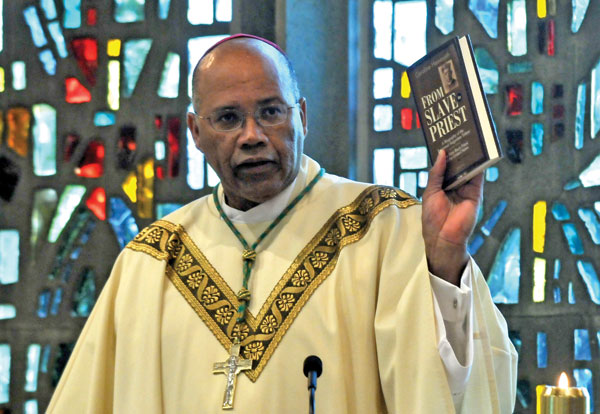 In 1889, Father Augustine Tolton (also known as Augustus) addressed the First Black Catholic Congress in Washington, D.C. On that occasion he said, “The Catholic Church deplores double slavery — that of the mind and that of the body. She endeavors to free us from both.”
He had known both kinds of slavery. Once freed from the bodily sort, he strove all his life to overcome that of the mind. To do so he used the freedom of spirit provided by his Catholic Faith.
Tolton, born in 1854 in Missouri, was the child of slaves. His Catholic owner stood as his godmother at his baptism. The baptismal record does not record the baby’s name, only those of his owners. When he was 6, his father died. He later left that slave-state with his mother, older brother, and younger sister. The family found refuge in Quincy, in the free-state of Illinois. Although his body was no longer owned by another, his freedom to study and develop his mind suffered the slavery of prejudice based on skin color and social status. Opposition from white parishioners who did not think children of former slaves should mix with their children caused the pastor of St. Boniface to remove “Gus” from that parish school. Father Peter McGirr took Augustus into St. Lawrence O’Toole parochial school (now known as St. Peter). As Father Roy Bauer, a Tolton historian, says, Father McGirr “had his parishioners understand that there would be no opposition.”
Several priests and religious sisters in Quincy helped Augustine free his mind and spirit through a solid Catholic education in both secular and religious subjects. His personal religious practice and keen mind lead them to encourage “Gus” to think of a vocation as a priest. However, former slaves had received a mixed reception from the beginning of the church’s history. St. Paul sent a run-away slave back to his master as a brother in Christ, after the slave’s conversion in Rome and his support of Paul while in prison (Letter to Philemon). In the early 300s, the Council of Elvira in Spain declared that a former slave could not be ordained if his former master was still alive. In 1880 in the United States, no seminary would admit a former slave as a candidate.
So, Tolton had to go to Rome to study for the priesthood at the prestigious Propaganda, the university which prepared priests for world-wide evangelization. As a man who sought freedom of mind and spirit, it was prejudice itself that occasioned the best education for this young seminarian. The other force was Rome’s determination to accept persons of all colors as co-workers in the spread of the Gospel.
After ordination in 1886 at the pope’s cathedral church of St. John Lateran, Father Tolton thought he might be sent to Africa as a missionary. The university’s prefect, Cardinal Simeoni, decided to send him back home saying, “America has been called the most enlightened nation; we will see if it deserves that honor. If America has never seen a black priest, it has to see one now.”
See one they did, and the response again was mixed. As a Roman educated priest, Father Tolton’s sermons and catechism classes became quite an attraction for both black and white Catholics in Quincy even though he was assigned as pastor to the segregated black parish in town. This occasioned the jealousy of the pastor at a white Catholic parish. Also, Father Tolton’s care of the African-American population raised the ire of some Protestant ministers who saw him an encroaching on their flocks.
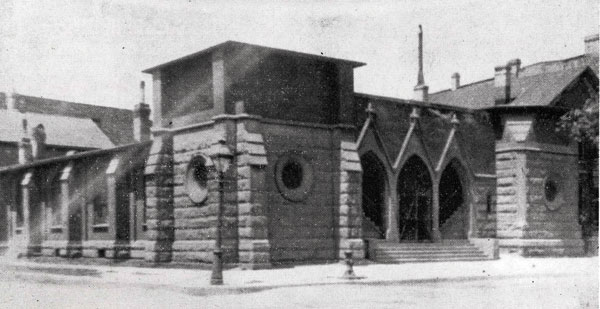 As the first former slave to be ordained a Catholic priest for America, Father Gus was a lightening rod for both racial and anti-Catholic prejudice. He finally sought some relief both by asking to work in a black parish in Chicago and through his correspondence with a Catholic heiress who founded an order of religious women to work with black and Native Americans, St. Katherine Drexel. However, even after his death from heat stroke in 1897, his search for the full freedom of the children of God met a mixed end. He was buried at his request in Quincy in the Catholic cemetery. However, the story is told that another priest was buried on top of him with Father Augustus Tolton’s name inscribed on the rear of marker.
Still his journey toward perfect freedom continues. Father Tolton is now proposed as a saint in the church, as a man who chose to enter through the narrow gate into the Kingdom. In his case, the narrow passage led through the struggle to free himself from slavery of body and of mind. The force by which he achieved those freedoms in his lifetime was the freedom of spirit he found in the Catholic Church and through its priesthood.
He told the Black Catholic audience in Washington, “I was a poor slave boy but the priests of the church did not disdain me. It was through the influence of one of them that I became what I am.” One day, his canonization may move our minds and spirits to work for the freedom for all persons.