
November Is Black Catholic History Month
 Is race real?
Race is a way of categorizing persons based on skin color and other observable external features. For instance, Father Augustine Tolton (also known as Augustus), a former slave who served parishes in Quincy and Chicago, is called the first black priest in America. But was he?
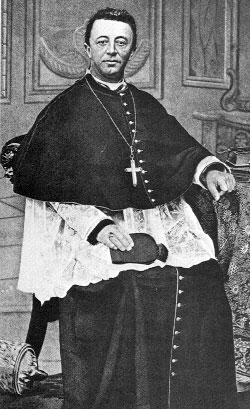
In 1875, five years before Tolton entered the seminary, Father James Healy was named Bishop of Portland in Maine. Bishop Healy’s mother was of mixed racial ancestry; his father an Irish immigrant. His photo does not portray African features or noticeable skin color. Was Bishop Healy black?
Racial codes in Georgia at his birth in 1830 declared any child of mixed white and African ancestry to be Negro or black. Such codes existed in most states. Race was not simply a matter of actual skin color but a system based on ancestral links to persons of color. It appears to have had only one purpose, the support of racism.
Racism assigns a person’s social status based on his or her skin color or associated cultural linkage. For instance, some say Bishop Healy was black because he had some African blood; others say he “passed for white.”
James Loewen, in Lies My Teacher Told Me, (Touchstone, 2007) says that today’s racial categories in Western societies were created by Europeans in the 1500s and 1600s in order to colonize the world by “taking land from and destroying indigenous peoples and enslaving Africans to work that land.”
Loewen says that in order to teach about racism, one first has “to show students the dynamic interplay between slavery as a socioeconomic system and racism as an idea system.” Racism then is an effective way of thinking about people of color so that they can be used to sustain white political, economic and social privilege. This is why racism is often defined as the systemic use of power to enforce white racial privilege — or in Catholic terms as the sin of devaluing, based on racial typing, of the unique dignity of persons before God.
In Dismantling Racism (Augsburg Fortress, 1991), Joseph Brandt says that bigots are intentional racists but that all white persons, like Brandt himself, are enslaved to the idea of race. “As American citizens, every white person supports, benefits from, and is unable to be separated from white racism,” Brandt says.
White racism he defines as the white society’s belief “that people of color need and want to become free like us. … When we speak of equality, we mean we want them to become equal to us. … We have difficulty believing that we, too, as well as people of color, are oppressed [by the idea of race] and need liberation.”
Columnists Cokie and Steve Roberts think white racism is behind the current attacks on President Barack Obama. They believe that the cry “I want my country back” is evidence of whites’ fears of loosing their privileged place in society to persons of color. Of course, those who fear that the president is neither Christian nor an American citizen wonder why these commentators think their idea of taking back America is racially motivated, despite the fact that discrimination in America was historically sustained by linking Christianity, skin color and privilege.
According to Loewen, an historian, the history of racial discrimination in America is real and is dependent on never questioning the idea of race as a way of categorizing “them” as different from “us.” However, race as skin color prejudice usually included other markers, like religion.
Their Christian faith caused some Europeans to consider themselves superior to people of color. Both Catholic and Protestant missionaries converted some of the Native Americans and most of the African slaves to Christianity. Being Christian allowed for partial inclusion in white society. Being non-Christian or not the right kind of Christian was another feature associated with being “colored,” that is socially unacceptable, foreign. Yet when it came to social and economic privilege in America, racial prejudice based on skin color trumped religious markers.
In 1860, Irish immigrants in Philadelphia were fighting anti-Catholic prejudice. They were poor and suspect of not being “Christians.” Confined to menial labor, they most often worked alongside black freedmen. How the Irish Became White by Noel Ignatiev (Routledge, 1996) outlines how these Irish Catholics ended up competing for menial jobs with blacks in order to make their way up the social ladder. Competition meant keeping persons of color out of those jobs. Cooperation with skin color prejudice gave the advantage to the Irish Catholic laborers in many American cities. Italians, too, were considered non-white in many places in America in the 1900s, as are Spanish-speakers today. The way to social acceptability still remains being able to define oneself and ones group as white enough.
At the same time as the Irish were making their way into white society in Philadelphia, Francis Drexel, a well known banker and philanthropist, and his wife, Hannah, were instilling in their daughter Katharine, born in 1858, the idea that wealth was simply loaned by God and was to be shared with others. Inspired by a personal interview with Pope Leo XIII in the early 1890s, Katharine Drexel founded the Sisters of the Blessed Sacrament dedicated to the service of American Indians and Afro-Americans. She used her vast inheritance to work for equal education for persons of color.
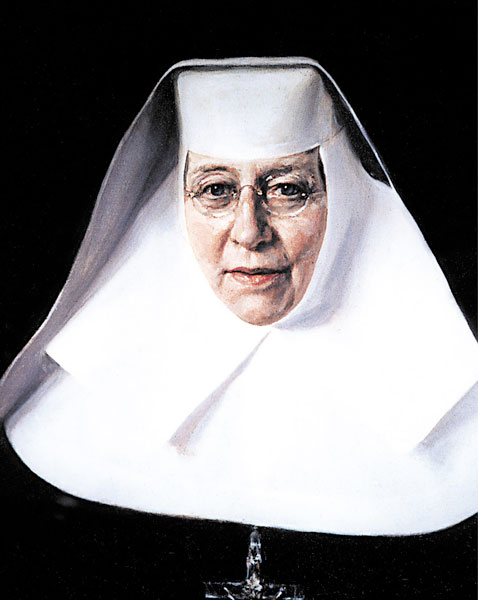 Father Tolton’s correspondence with her was a source of inspiration and comfort to him as he labored in Chicago, and she in the western States among Native Americans. She died in 1955 after an illness that left her immobile for a decade and a half and is celebrated as an American saint by the Catholic Church. She left a fourfold legacy: love of the Eucharist as the source of her perspective on the unity of all peoples, courage and initiative in addressing social inequality among minorities, her efforts to achieve quality education for all, and her selfless service for the victims of injustice. She is known as the patron saint of racial justice and of philanthropists. She is held up as an example by those who believe not all white people can be called racist simply by virtue of their skin color even as they remain mired in complicity with racism. St. Katharine Drexel made a conscious decision to act against the superiority her race and economic position conferred upon her in America.
In Rising to Common Ground, (Just Faith, 2006) Danny Collum indicates it is meaningless to call white people racist “until we choose to consciously act on the idea that white skin confers superiority.” Still he believes a personal conscious choice to reorient ones thinking and acting is necessary if white Catholics in America are going to live by the church’s teaching about race and injustice. He says that for Catholics to crawl “out of the social morass of white supremacy will not be simple.” It will take great spiritual effort to heal the psychological and social wounds racism has inflicted on both whites and persons of color in America.
The way through according to Father Bryan Massingale, a former president of the Catholic Theological Society of America, will depend on the ability of Catholics to examine the cultural roots of racism in America and the perceived threat to white identity of increasing integration of persons of color in leadership within the church and American society at large. As professor of theology at Marquette University, Father Massingale firmly argues that the church must very intentionally dialogue with black writers, commentators and theologians if it is going to understand and be able to counter the effects of racism. In fact, the church’s application of the Gospel to critical social issues over the last 200 years is being undercut by the same blindness that Brandt says afflicted Germans during the Second World War. They were blinded by racism, he says, which made them able to say they “did not know” about the plight of Jews and other minorities being persecuted because of their race. Similarly, American Catholics cannot take seriously the church’s teaching, Father Massingale says, unless they first begin to see how racism affects their own view of things.
Cardinal Francis George, archbishop of Chicago, addressed this topic in his pastoral letter, Dwell in MyLove (2001). He invited Catholics in his archdiocese to consider how their Catholic faith contains the remedy for racism in its four forms: spatial, institutional, internalized and personal. Spatial racism allows deterioration in areas of cities where the poor live, while the wealthy create gentrified communities, housing the privileged that are disproportionately white. The deteriorating areas by contrast disproportionately house persons of color and whites who are treated as less than fully privileged, as were the Irish in 1800s Philadelphia.
On the other hand, institutional racism is caused by ignoring the contributions of persons of color in the creation and maintenance of institutions such as the church, medical facilities, and universities. Institutional racism most often goes unrecognized because of the presumption that those in charge, most often whites, have more experience and know how at running institutions.
Internalized racism, the cardinal defines, is the way many blacks, Spanish speakers, and Native Americans “are socialized and educated in institutions which devalue the presence and contribution of people of color” by offering them “little or no information about their own history and culture.” One result of internalized racism, however, is the angry backlash of persons of color who have recognized the affect of institutional racism on their lives.
Individual racism is most frequently recognized as bigotry. It goes undetected in persons who have learned not to use reference to race, even though they continue to judge the trustworthiness or competence of others based on the color of their skin.
The cardinal called upon Catholics to understand what it means that they believe in the Trinity and how faith is the way to learn to dwell in love with persons of differing color and social status. In Catholic theology the Trinity is the way three divine persons (Father, Son and Spirit) uniquely and equally dwell in love as one God. In a similar way, Catholics as they celebrate the Eucharist, with all their differences of color and social status, constitute the one sacrament of church through which persons everywhere are able to share in the life of the Trinity.
Cardinal George called on Catholics everywhere in the United States to consider how they might respond in faith to racism in the society. The cardinal’s letter recalls Bishop Healy’s comment on race more than a century ago which paraphrased St. Paul, “We are of that church where there is neither Gentile nor Jew, circumcision nor un-circumcision, barbarian nor Scythian, slave nor freeman, but Christ is all and in all.”
It seems that long Catholic tradition agrees: when considered in the light of Christ, race is not real.