
Bishop Paprocki speaks to pope about political climate in Illinois
 VATICAN CITY (CNS) — When bishops come to the Vatican for their ad limina visits, they bring with them concerns and ideas that arise in their ministry and in the lives of their people.
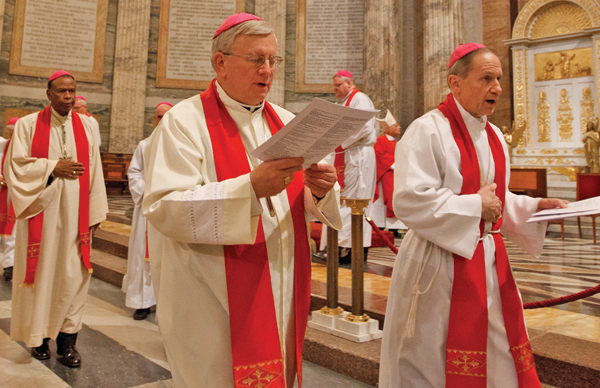
In addition to praying at the tombs of the apostles Peter and Paul and at the Basilicas of St. Mary Major and St. John Lateran, bishops from Indiana, Illinois and Wisconsin participated in meetings at all the major Vatican offices during their ad limina visits Feb. 9-17.
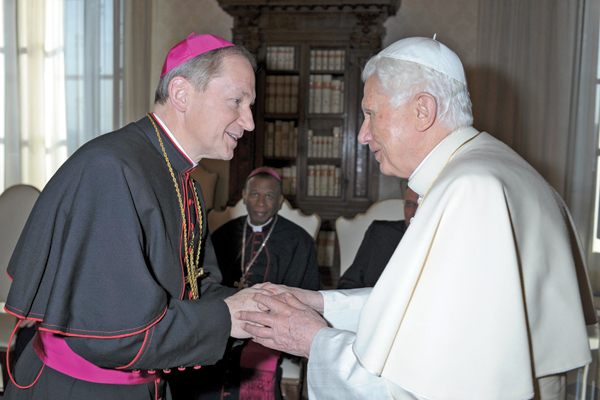
The highlight of an ad limina visit is the chance for bishops to visit personally with the pope and report on conditions in their diocese or regions. Bishop Thomas John Paprocki of the Springfield diocese said that since he was bishop of the state capital of Illinois, he was asked to speak to Pope Benedict XVI on issues involved in dealing with Catholic politicians.
"I told the Pope that it is a challenge when Catholic politicians take up positions that are contrary to the Catholic faith, such as supporting abortion and civil unions, and then invoke their conscience to defend their actions," Bishop Paprocki said in an email communication to his diocese. "I informed His Holiness of the action of our Catholic government officials that pushed Catholic Charities out of foster care and adoption services and I described for him the efforts we are making to continue serving the poor in other ways through Catholic Charities."
Bishop Paprocki said he summarized for the pope steps the state's Catholic bishops are taking to work with government officials through the Catholic Conference of Illinois. He also spoke of a recent meeting of the bishops with Illinois Gov. Pat Quinn and the Illinois bishops' efforts to educate the public through diocesan newspapers and other media.
 "The Holy Father expressed his gratitude for this information and his support for our efforts," Bishop Paprocki said.
The full text of Bishop Paprocki's email communication is available on the diocesan website at www.dio.org/blog/itemlist/tag/bishop-thomas-john-paprocki.html.
Cardinal Francis E. George of Chicago noted that it had been more than six years since the U.S. bishops had made an ad limina visit, "and practically all the heads of Vatican offices are now different."
While cardinals and some U.S. archbishops serve as members of Vatican congregations and councils, most U.S. bishops only get to meet and discuss issues with curial officials when they come for their ad limina visits, which church law requires of all diocesan bishops so they can report on Catholic life in their dioceses.
The face-to-face meetings, Cardinal George said, "are all very helpful in creating a unity of mind and heart and an atmosphere where the business of the church can be conducted to everyone's satisfaction."
The visits are known formally as ad limina apostolorum, which means "to the threshold of the apostles." Milwaukee Archbishop Jerome E. Listecki said the bishops gather before the tombs of Sts. Peter and Paul and "we profess or pledge our faith, usually reciting the Apostles' Creed."
The bishops make the visits in groups and follow a detailed program of pilgrimage, prayer and business meetings that give them and top Vatican officials an opportunity to ask questions and offer advice.
While Vatican officials may have items they want to emphasize with the bishops, the heads of dioceses also have suggestions, ideas and concerns to share with the curia.
Bishop Robert C. Morlino of Madison, Wis., told Catholic News Service, "I was looking to hear and to see something about the importance of beauty in the new evangelization," the church's effort to revive people's faith.
"I think beauty is what is going to attract others to us: the beauty of the truth of Christ, the beauty of the church," the bishop said. "When you go to these churches in Rome, you see the beauty and splendor of God, and as human beings we need that."
For Bishop Kevin C. Rhoades of Fort Wayne-South Bend, Ind., having the University of Notre Dame and four other Catholic colleges in his diocese means Catholic higher education is a special concern — and one he shared with Vatican officials.
"It's just so very important that we have deep communion between the local bishop — and the bishops as a whole — and our Catholic universities," he said.
Bishop Rhoades said he would rather have a Protestant who respects the church teach at a Catholic university than a "dissenting Catholic that actually does more harm to the mission" of the church, although he believes the majority of professors at Catholic universities should be Catholic.
Ad limina visits also can be time for a very Catholic type of lobbying: reminding the Congregation for Saints' Causes that there are U.S. candidates for sainthood waiting in the wings.
Last May Bishop Daniel R. Jenky of Peoria personally handed Pope Benedict XVI two thick tomes outlining why the church should recognize the holiness of the late Catholic televangelist Archbishop Fulton J. Sheen. The archbishop was born in Illinois in 1895 and died in New York in 1979.
The volumes given to the pope still have to be studied by Vatican officials, and Bishop Jenky said he used his ad limina visit to promote the cause a bit more.
Bishop Paprocki said that he and Cardinal George inquired about the cause for sainthood for Father Augustus Tolton, who became the first acknowledged African American Catholic priest. They were told that the congregation is continuing to gather more information about his personal history and a possible miracle attributed to his intervention.
Contributing to this story were Francis X. Rocca and Cindy Wooden at the Vatican and Kathie Sass from Catholic Times.