
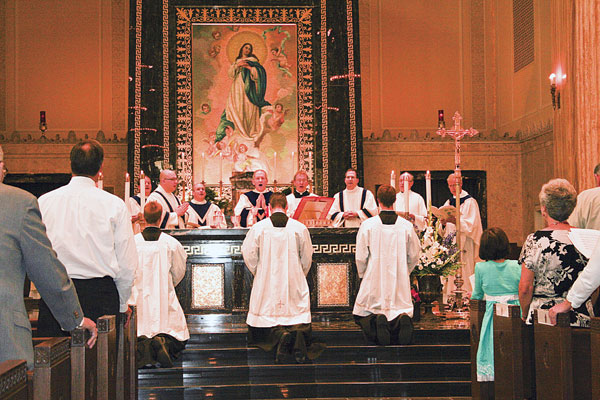
 On Saturday, April 28, Bishop Thomas John Paprocki ordained two third-year diocesan seminarians to the transitional diaconate during a 10:30 a.m. Mass at the Cathedral of the Immaculate Conception.
Friends and family of David Curtin and Hyland Smith gathered to support them as they received the sacrament of holy orders, by which they were ordained to the order of deacon as a transitional step toward being ordained diocesan priests in 2013. Also present and taking part in the liturgy were other transitional and permanent deacons, and a number of diocesan seminarians and priests.
In his homily, just prior to the ordination, Bishop Paprocki said although the men are called "transitional" deacons, that term is not something to be taken lightly. "To say that this is a 'transitional step' towards priesthood should not be taken to imply that this is temporary status that will be discarded like a booster rocket being jettisoned when you move on to the next stage.
"Under my chasuble I am wearing a deacon's dalmatic not only as a symbol of the fullness of holy orders that a bishop has received, but also as a reminder to me that the order of deacon that I received 35 years ago next Monday remains with me as part of my ministry," Bishop Paprocki said.
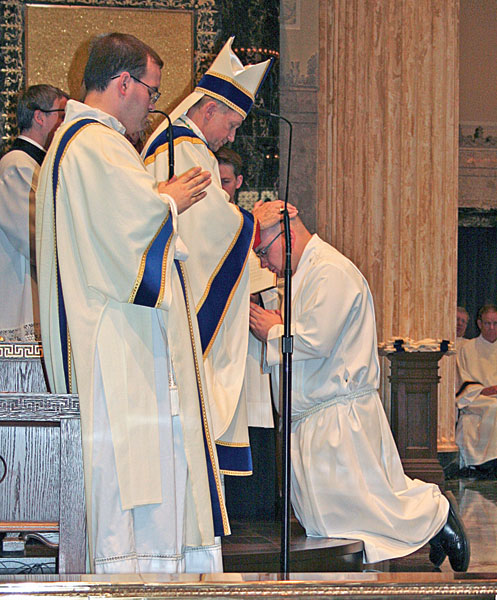 "After all, the sacrament of holy orders imparts an indelible character on the soul that does not disappear when a person receives another order," he said. "Rather than successive stages, each of the holy orders is a layer that builds on the preceding one and provides a foundation that supports the higher orders, but always remains an inseparable part of the whole fabric of ordained ministry in the church."
Bishop Paprocki said that the sacred stole the men were about to be vested with symbolizes the "yoke of Jesus Christ, the burden of authority that is gentle to bear because it is an authority of service." The dalmatic, which they were also to receive, "takes the form of a cross and is worn during the Sacrifice of the Mass as a reminder of Christ's passion, as well as his generous and loving action of self-giving."
He said that the word "deacon" comes from the Greek word diakonia, which means service. He cited several passages from the Bible that described work and service, but then added, "My dear sons in Christ, David and Hyland, I am not asking you to be workaholics, but the church is calling you to a labor of love to be engaged in with joyful zeal, enthusiasm and dedication."
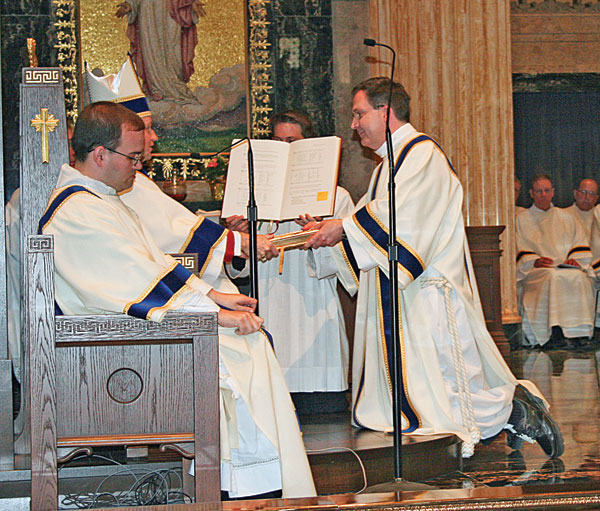 During the ordination Mass, the two men were given the assent of the assembly, made a commitment to celibacy, promised to follow their vows, were vested with the stole and dalmatic, and received The Book of the Gospels from Bishop Paprocki. Following the Mass a reception was held in the two new deacon's honor in the Cathedral atrium.
Deacon Curtin and Deacon Smith can now assist at liturgies, where they can proclaim the Gospel, preach at Mass and give the dismissal. They are also able to baptize, witness marriages, and preside at wake services and graveside services.