
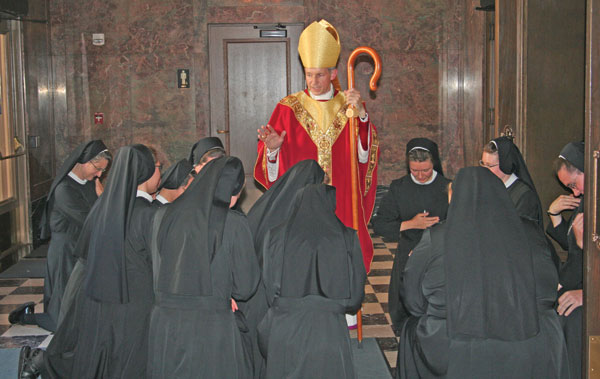
 The approximately 300 people who attended the Mass in Observance of the Fortnight for Freedom broke out in applause after Bishop Thomas John Paprocki concluded his homily at the Cathedral of the Immaculate Conception on June 22.
Fortnight for Freedom began June 21 and culminates on July 4. The purpose of the effort, as explained by Bishop Paprocki in his June 3 Catholic Times column, is to issue a nationwide call to defend religious liberty and to urge the laity to work to protect the first freedom of the Bill of Rights.
Bishop Paprocki concelebrated the Mass with his visiting friend, Bishop Eugene Cyrille Houndekon of Abomey, Benin Africa; Msgr. Carl Kemme, vicar general; and about 15 other priests of the Springfield diocese. Deacons were Deacon Larry Smith and Deacon Ben Hoefler; Father Daren Zehnle was master of ceremonies.
"It is good for us to be here to celebrate this Mass in observance of the Fortnight for Freedom on this feast of the holy martyrs, saints Thomas More and Cardinal John Fisher," Bishop Paprocki said in his homily. "This also happens to be the second anniversary of my installation as the ninth bishop of Springfield in Illinois. That might seem to be a coincidence but as Blessed John Paul II used to say, 'There are no coincidences, only God's Providence.'"
The connection between the various elements marked on June 22 had its beginning at the first meeting of the Ad Hoc Committee on Religious Liberty of the United States Conference of Catholic Bishops, which took place last November, Bishop Paprocki said.
"As our committee was discussing various ways and appropriate times during the year that we might involve the faithful of our country in public prayer and education about religious liberty, I thought of the feast day of my patron saints and namesakes, Ss. Thomas More and John Fisher. … As they were executed for refusing to obey an unjust law that contradicted their Catholic faith, these great martyrs would also provide much-needed inspiration."
Bishop Paprocki came up with the idea for Fortnight for Freedom and suggested it to his fellow bishops. "Mindful that our nation's Independence Day celebration follows their feast day within a couple of weeks, I quickly did the calculation in my head and figured that a two-week period, called a fortnight, would begin on June 21, the Vigil of Ss. Thomas More and John Fisher, and end on the Fourth of July.
"Making the connection between this two-week period and the civic observance of our nation's freedom, the phrase Fortnight for Freedom came to mind," he said. "The Ad Hoc Committee on Religious Liberty liked the suggestion and I'm glad that this theme has resonated with so many people of faith across our nation.
"Being the author of a suggestion puts one in a unique position of being able to describe its intended meaning," he said. "I have had people say to me that the bishops should use this Fortnight for Freedom to organize public rallies, protests and demonstrations. Others have said this is what the bishops intended to do for political purposes.
"That is not what I or the other members of the Ad Hoc Committee on Religious Liberty had in mind when we conceived this idea," he said. "Clearly our focus is on prayer and education."
During the Fortnight people should be praying for justice, truth, wisdom, goodness and peace, Bishop Paprocki said. He said, however, that the beneficial effects of prayers should "go beyond the walls of our churches."
"Again, the new translation of the Roman Missal makes clear that the Communion we share in the Eucharist is to have an effect on our lives, as the dismissal of the Mass proclaims, 'Go in peace, glorifying the Lord by your life.'"
Although he has been bishop of the Springfield diocese for only a relatively short period, Bishop Paprocki acknowledged that he has had his work cut out for him. "When I stood here two years ago today and preached the homily at my Mass of Installation as your bishop, I had no idea that within a year the State of Illinois would force Catholic Charities out of foster care and adoption services because of our religious beliefs about marriage and family life.
"I did not expect that in my second year we would be back in court seeking now to prevent the federal government from imposing a mandate on us that is contrary to Catholic teaching," he said. "I would prefer not to have to fight these cases in court, but that is where we are and that is what we must do. My job as your shepherd is to protect the flock, but we cannot and must not run away from the challenge."
Bishop Paprocki told the people he was pleased to be their bishop. "As we receive Christ into our hearts in this Eucharist, I give thanks for the graces that Almighty God has granted me by allowing me the privilege and joy of serving here as a successor of the apostles. I am very happy to be your bishop and I am confident that the Lord will provide for us in all our needs."
Finally, he extended his hands and blessed the people assembled there, saying, "As Pope John Paul II extended his hands over his people in their time of need, I now do the same and make his words my own, asking for God's graces to face the challenges of our time.
"… You must be strong my brothers and sisters! You must be strong with the strength that faith gives! You must be strong with the strength of faith! You must be faithful! … You must be strong with love which is stronger than death. … When we are strong with the Spirit of God, we are also strong with the faith of man. … There is therefore no need to fear. … So I beg you: Never lose your trust, do not be defeated, do not be discouraged. … Always seek spiritual power from him from whom countless generations of our fathers and mothers have found it. Never detach yourselves from him. Never lose your spiritual freedom.'"
So, the people accepted his blessing and then applauded their shepherd. "It was a very moving movement," Bishop Paprocki said later. "I was also pleasantly surprised that the Mass was so well attended."