
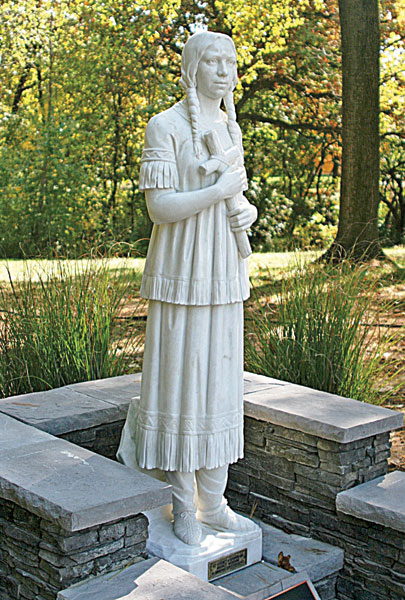
 A statue of the first Native American to be canonized a saint in the universal church was already standing in place on the grounds of the Franciscan Sisters' motherhouse near Springfield on Oct. 21, when Pope Benedict XVI canonized St. Kateri Tekakwitha in Rome.
The statue dates back to the 1930s, when Mother Magdalene Wiedlocher, a provincial superior of the Hospital Sisters of St. Francis, set out to foster a deeper awareness and devotion to Kateri among sisters of the American Province.
Mother Magdalene, a native of Springfield, commissioned a Chicago statuary company to make the statue, after consulting with the Tekakwitha Friary in Fonda, N.Y., and with the director of the Museum of Arts and Sciences in Rochester, N.Y., to authenticate the depiction of Kateri.
The statue shows Kateri in an Iroquois woman's dress — a coat-like tunic worn atop a deer-skin skirt, wearing front-laced leather moccasins on her feet. Her hair is braided in two long braids, brought to the front of her face, a sign of a woman before marriage.
In 1939, Mother Magdalene received a letter from a priest at the Tekakwitha Friary who was appealing to religious communities in the United States and Canada for monetary donations and to increase awareness of Kateri and promote her sainthood cause. Mother Magdalene sent a donation and wrote, "The statue of Tekakwitha which we have ordered for our cloister garden is nearing completion. We are under the impression that it will be the first one in this country."
A month later, Mother Magdalene wrote to her sister, Claire (Wiedlocher) Griffin, who agreed to donate funds for the statue. On July 29, 1940, the white Carrara marble statue was unveiled in a grotto on the east side of the St. Francis Convent's Lake of Our Lady. The plaque was inscribed: "In loving memory of Claire Griffin & her son, James 1939."
A few years later, Jan. 3, 1943, Pope Pius XII proclaimed Kateri venerable, an important step in the canonization process. She was beatified in 1980 by Pope John Paul II.
Last February, when Pope Benedict announced Blessed Kateri would be canonized later this year, the 72-year-old statue was removed from its original location on the motherhouse grounds. Tom Cunningham, a motherhouse employee, removed paint which had been applied to the statue as a protective measure over the years, only to discover the marble was discolored and stained. Cunningham applied a solution of hydrogen peroxide and baking soda over a 48-hour period, repeating the process eight times, until all stains were removed. The statue was then buffed and polished.
On Oct. 14, the statue was dedicated in its new location, near the entrance to the Chiara Center. A cross displayed behind the statue was created from ash wood, taken from a tree on the St. Francis Convent property.
At the canonization ceremony in Rome, Archbishop Charles J. Chaput of Philadelphia, who is of American Indian descent, told Catholic News Service, "I think many young people today are embarrassed about embracing the Catholic faith because they live in a secular culture that's hostile toward religious experience."
St. Kateri also "grew up in a place where there was great hostility toward Christianity," Archbishop Chaput said, but she resisted all efforts to turn her away from her faith, "so in some ways she would be a model of fidelity in the face of persecution on religious freedom grounds."
Archbishop Gerald Cyprien Lacroix of Quebec told CNS that the canonization of the first aboriginal of North America is "huge for us." St. Kateri, he said, is an excellent model for young people of "living a simple life, faithful to the Lord in the midst of hostility."
St. Kateri's life and canonization show that "saints don't have to do extraordinary things, they just have to love,' Archbishop Lacroix said.
CNS also interviewed Francine Merasty, 32, a Cree who lives in Pelican Narrows, Sask. "Kateri inspires me because she's an aboriginal woman," the wire service reported. "According to sociologists, aboriginal women are at the lowest (social) strata, and for the church to raise up to the communion of saints an aboriginal woman is so awesome and wonderful."
Brian Blasko from the Franciscan motherhouse, and Catholic News Service provided material for this story.