
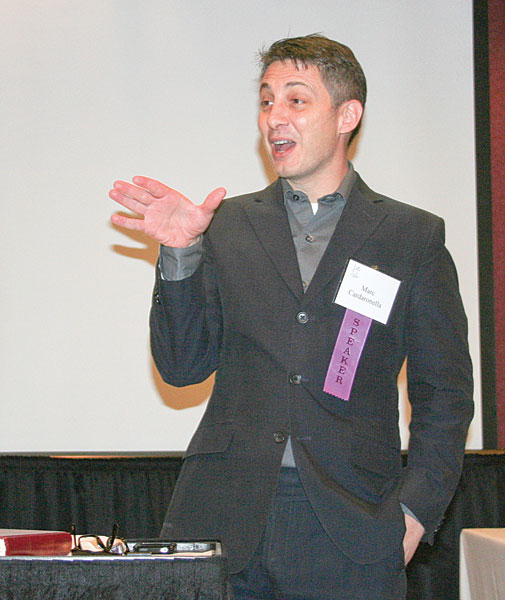
 In a DAEC presentation called "How Your Life Story Can Change Someone Else's: Using Personal Stories for Conversion and Catechesis" Marc Cardaronella admitted that he hasn't always been a fan of "putting himself out there" to help others grow in their faith. However, a mentor kept reminding him to tell stories about himself during catechetical presentations.
The director of religious education for Holy Cross Church in Champaign, Cardaronella said he finally followed the suggestion, "At first my stories were lame. But I would tell them and there would be a change," he said. After a while, he became more comfortable with helping others by telling them about his own faith journey. Now, he teaches on the subject.
"The story is about your personal journey from one perspective to another and how that made your life better," he said. "The story you tell illustrates the action you want them to take."
First, share an opinion, perspective, feeling or conviction from your past that listeners can identify with in their present situation, he advised. Then, tell them a story of how your perspective changed. Finally, tell them what a difference this new perspective made.
"Personal stories help you cover 'hot button' situations," said Cardaronella, who now uses his experience with coming to accept the Catholic view on avoiding contraceptives to candidates in the RCIA program. "In RCIA, one of the most difficult things to discuss is the sexual view of the Catholic Church. When I teach RCIA, these people have not been living as Catholics, so when I discuss this subject, they are sometimes squirming a little," he said.
Cardaronella said presentations by Scott and Kimberly Hahn called Life-giving Love helped him to fully understand the importance of married love. "When I first heard it years ago it was a set of three audio cassettes. Two of the presentations were by Scott and one was by Kimberly," he said. "I don't think they make it anymore, but they came out with a book of the same title (by Kimberly Hahn) years later."
No matter what the subject, "the level you go (in telling your stories) will be your level of comfort," Cardaronella said. For example, when sharing stories, any stories, with younger students, teachers have to be a little more careful. "With middle and high school students, don't get too personal," he warned and then chuckled. "Because they might use it against you."
Cardaronella offered these five questions to ask yourself when crafting a story:
-
What is the one thing I want them to take away?
-
How do I want them to change?
-
What does this topic mean to me?
-
Have I been changed by this in some way? How?
-
What experiences from my life exemplify the action I want them to take?
As a faithful Catholic, Cardaronella offered one last bit of advice for teachers who are wondering how they will help change someone's life. "Catechesis should enrich you almost as much as it enriches your students. You can pray about it to the Holy Spirit — and you have to search your heart."