
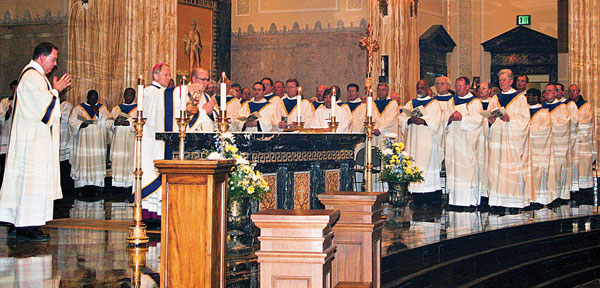
 Approximately 650 people were in attendance when Bishop Thomas John Paprocki concelebrated the chrism Mass at the Cathedral of the Immaculate Conception on the evening of March 26. Diocesan seminarians also served in various capacities during the liturgy, coming to the see city from their various seminaries.
The chrism Mass, held annually during Holy Week, is when the bishop consecrates the chrism and blesses the oils that are to be used during the upcoming year. The chrism is used to anoint the newly baptized, to seal the candidates for confirmation and to anoint the hands of priests and the heads of bishops at their ordination. Additionally, it is used in the dedication rites of churches and altars.
The oil of catechumens is used during the period of the catechumenate for those being trained and formed in the Christian life. The oil of the sick is used to bring comfort and support to those who are ill.
It is also during this Mass where priests, who gather with the bishop in the sanctuary to concelebrate, publicly renew their promises to the priesthood.
In his homily, Bishop Paprocki spoke on a variety of related topics; beginning with the new bells that replaced some poorly cast bells at the Cathedral of Notre Dame in Paris. Nine of the original bells — with the exception of the biggest bell named Emmanuel — were melted down and made into cannons and coins during the French Revolution.
"Here in Springfield at our Cathedral of the Immaculate Conception, our own bells were recently silenced when a part in the bell mechanism broke and it was difficult to find a replacement," he said.
"I know that I missed the ringing of the bells on the quarter hour, so I am glad that a replacement part has been found, so our cathedral bells are now gloriously ringing again, as are the new harmonious bells at the cathedral in Paris.
"It has long been said that the Catholic Church is renowned for its 'smells and bells,' which is perhaps why we miss the bells so much when they go silent. But as with so many things in the church, their use is not just functional, but also symbolic," he said.
Bells that ring in harmony are also a reminder of the harmonious way of life that Christians are called to live together in the community of faith, he said. The bells in sanctuary call attention to the moment of consecration.
"The bells that ring during Mass are a signal that something extraordinary is happening, something so important that draws us to put aside all distractions and focus on the miracle of bread and wine becoming the Body and Blood of Christ that we will receive in holy Communion," he said.
"The other part of the 'smells and bells' of course, is the smells," he said. "The sweet fragrance of burning incense signifies that sweetness of our prayers rising up to heaven. In our Mass today, I will also be blessing the holy oils … . One of those oils, called sacred chrism … is mixed with perfumed oil."
Catholics should do all they can to live a holy life that will be "so attractive to others that they will be burning with desire to live a life of virtue giving glory and worship pleasing to God," Bishop Paprocki said.
"This modeling of Christian life rooted in love is at the heart of the example being given to us so powerfully in just a few days by our new Holy Father, Pope Francis," he said, noting that the new pope has taken seriously his classical training in Ignatian spirituality. "… We would do well, both clergy and laity alike, to follow this example of our new Holy Father, our humble Pope Francis.
"Through this holiest week of the year, may all the Christian faithful grow deeper in faith, hope and love with the assistance of our Blessed Mother, the Immaculate Conception, patroness of our cathedral, our diocese and our country."
Following Mass, a reception was held in the Cathedral atrium and representatives from parishes around the diocese received the oils and the chrism to take back to parish churches and other religious institutions.