
 On Dec. 6, Catholics celebrate the feast of St. Nicholas, the patron of children and sailors as well as Russia, Sicily and Greece. Born in the fourth century in a province of Asia Minor — now known as Turkey — Nicholas was eventually named the bishop of Myra.
Nicholas was celebrated for his piety and his religious zeal. He is said to have been imprisoned during the Christian persecutions and to have been present at the Council of Nicaea.
It is written that Nicholas was both a wealthy and generous person. One legend says that he saved three young girls from slavery and prostitution by throwing gold for their dowries through their home’s window one night. When their father discovered that it was Nicholas who had come to their aid, he was naturally thankful.
“Do not thank me,” the young man is said to have replied. “Thank God that your prayers were answered. Do not tell others that it was me.”
After Nicholas died, people began to tell stories of the kind acts he had offered in God’s name. Sailors repeated those tales wherever they went, so the story of Nicholas spread around the world. In Greece, many ships set sail with an icon of Nicholas on board.
In 1087, Italian merchants stole those reputed relics of Nicholas and had them enshrined in Bari, Italy. That is why sometimes the good man is referred to as St. Nicholas of Bari.
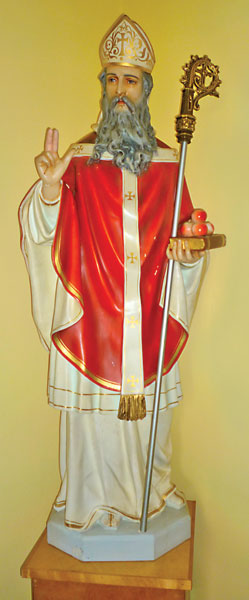
Northern Europeans have long represented St. Nicholas as a tall, kind-looking man with a long grey or white beard. He is often pictured or sculpted wearing the cape and miter of a bishop and carrying a crosier.
In some representations Nicholas rides a striking white horse and has a cart full of packages. Children of long ago were known to stuff hay in their shoes so the animal would have something to eat. St. Nicholas was said to leave small gifts and candy in thanks for feeding his horse.
Today, many children still place a shoe next to the door on the eve of St. Nicholas Day, hoping that the kind man will leave a sweet treat, a coin or a small present. This custom also takes place in Catholic preschool and elementary schools and in PSR classes. Of course, St. Nicholas was the predecessor to Father Christmas, or Santa Claus.
In the Diocese of Springfield in Illinois, one parish is named for the saintly man: St. Nicholas in Pocahontas founded in 1860. There in the entryway of the church, which is home to just fewer than 200 parishioners led by Father Chuck Edwards, stands a statue of St. Nicholas, dressed as a bishop.