
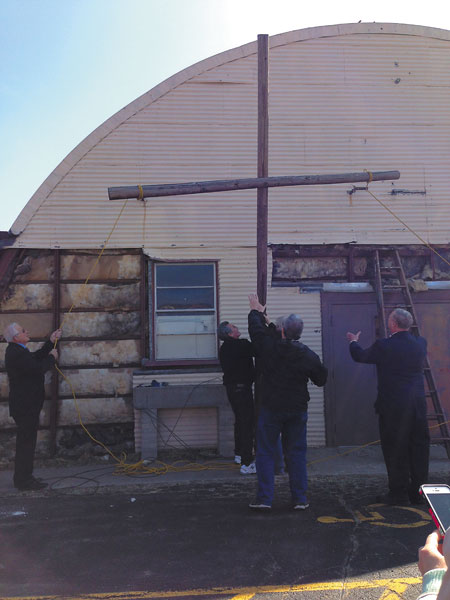
 Quonset huts are remnants of the past — structures made of corrugated galvanized steel that were manufactured during World War II. There were 150,000-170,000 of the buildings manufactured and after the war the Army sold the surplus huts to the public. There are a few Quonset huts around Springfield that are still in fairly good shape, but the structure at Little Flower was not one of them, said Msgr. Ossola.
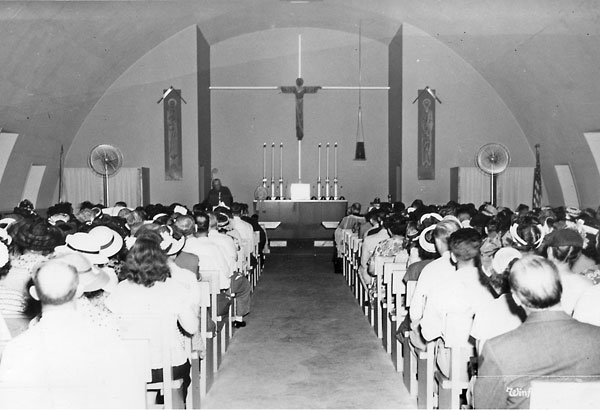
Historical news clippings from Catholic Times show that the Quonset hut had seating for 350 people with room for an additional 75 folding chairs. Sunday Masses were held at 6, 7:30, 8:30, 9:30, 10:30 and 11:30 a.m. The overcrowding at Sunday Masses caused the parish to require having simultaneous Masses in the school at the highly attended 9:30 and 10:30 a.m. liturgies.
Father Raymond O'Connor, pastor, and Father Charles Olshefsky, assistant, served the parish when the first Mass was held in the new church on Sunday, June 30, 1963. However the church wasn't formally dedicated by Bishop William A. O'Connor until Oct. 3, 1967, when the sanctuary and art work were finally completed. "I don't know — that would never happen today," said Msgr. Ossola.
 Msgr. Ossola said that both he and parishioners felt the time was right to remove the Quonset hut, which had for years been used to hold meetings for the men's and women's clubs and the Boy Scouts and Girl Scouts, as a sports facility for younger students, and to house the parish's annual craft fair.
Before the Little Flower Quonset hut was razed, it had to be emptied of office furniture, kitchen appliances, supplies and even plumbing fixtures. Some of the usable materials were donated to Habitat for Humanity, Msgr. Ossola said.
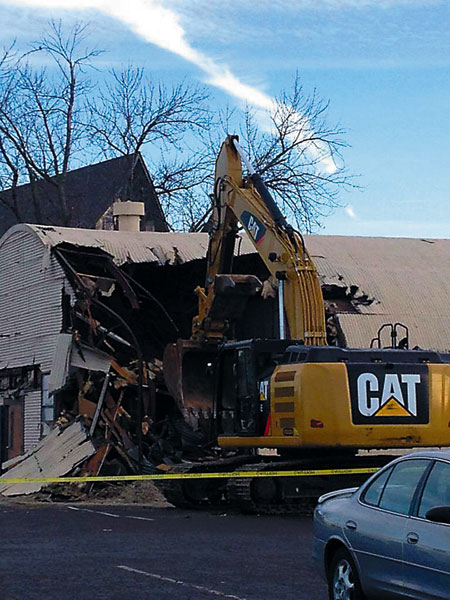 Weather held up the demolition for a while, but as the weather warmed up a little during the first week of March a couple of parishioners volunteered to remove some of the exterior metal siding. A few people had requested pieces of the siding and Msgr. Ossola is hoping that some of it might be used by an artist to make craft items.
The building was razed by the Operating Engineers Local 965, who annually trains new people to use large equipment by taking on demolition projects. "I knew that about them and we were able to get the work done at no cost," said Jim Stone, who is one of the co-chairs of the parish capital campaign. "So it was a win/win situation."
Now that the building is cleared away, Msgr. Ossola said there is room for a future parish center, which is in the very early planning stages. However, he knows that funds will have to be raised, so it "might be a while." "First we had to have the heating and air-conditioning replaced in the school and the church," he said. "Our parishioners have been very generous. I really appreciate how good they've been."
As for saying goodbye to a parish mainstay, Msgr. Ossola agrees that it "was time." "There has been talk of removing it for a while. But we did have people who used it, so of course we had to have meetings to decide what to do; we had to shuffle people around," he said. "But it has been here so long and it needed so many repairs, it was time to take it down."