
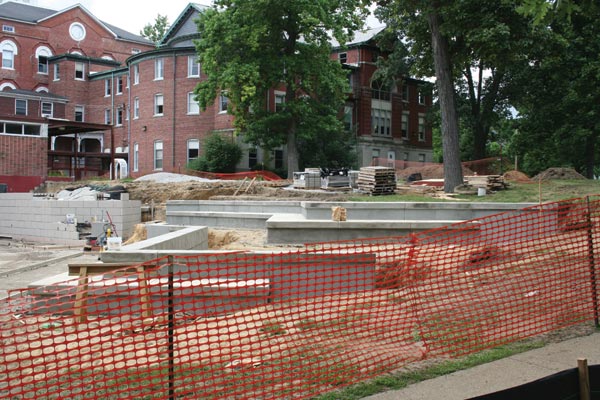
 Part of a college’s appeal lies in its aesthetics — and whether its campus provides students areas to socialize and relax. That is why Phase I of Benedictine’s upgrade includes an amphitheater for student events. The amphitheater, built into the side of a hill on the Sixth Street side of the campus adjacent to Angela Hall, will seat 125 people and has more space for a patio with tables and additional standing room. The space will have electrical power and a sound system.
Moreover, a half-court basketball area is being constructed nearby for students to play pick-up games. Finally, on the Fifth Street side of the campus, a driveway and parking area is being built and the walkway and lighting system is being modernized. The drive will include signage to direct visitors to different buildings and also has two handicapped parking spaces.
Of course, all this construction is costly, but Benedictine President Michael Bromberg said it is money well spent. “The million dollars we are expending this summer is a critical first step in our five-year plan to assure that we provide a safe and up-to-date learning environment as we prepare for projected enrollment growth,” he said.
It is too early to report enrollment numbers for the upcoming school year, according to Scott McCullar, marketing and communications manager and a member of the adjunct faculty for Arts and Letters. “As for our Fall 2014 enrollment numbers, we will be able to provide that new number in early October when we account for all of our various programs,” he said.
In Fall 2013, the university reported 860 total students at Benedictine. That number includes graduate and part-time students.
Harold O’Shea Builders is the contractor for the project, and Phase I is expected to be finished before Aug. 21, when student orientation weekend begins.
The next four years will mean more changes to Benedictine and will include bringing buildings up-to-date with handicapped access, adding air-conditioning units and upgrading the lighting system for the rest of the campus. Bromberg said the cost of the remaining phases of the project will be more than $6 million.