
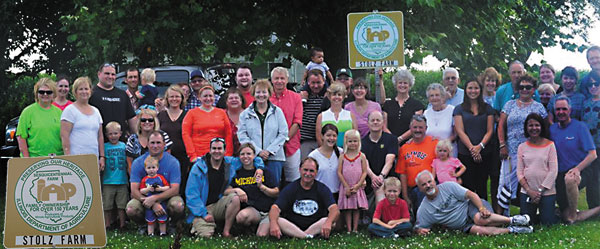
 That’s why members of several generations of the family were on hand July 12 to celebrate the 150th anniversary of the Stolz Family Farm, west of Paris. The family reunion was hosted by Bob and Shirley Stolz, parishioners at St. Mary Parish in Paris. Bob Stolz currently farms and owns a good portion of the land.
As part of the celebration, Father Joe Ring, a member of the family and pastor of Christ the King Parish in Springfield, celebrated Mass for the group at the original home site. With the farm fields surrounding them, the family took part in the liturgy and later had a ceremony to erect an official plaque from the Illinois Department of Agriculture, designating the land as a Sesquicentennial farm.
Father Ring’s mother, 87-year-old Evelyn Ring, still owns part of the farm and is also a member of St. Mary Parish. She grew up at the old home place, which she said “is now uninhabitable.” Years ago the home had a garden, orchard, barns, corn cribs and a chicken house. “Now there stands only a house, a rock garden and a few trees,” she said, adding that of course, there are a “whole lot of memories.”
 She explains the history of the farm this way: “The original ground was owned by William Waller Sr., who migrated from Germany. In his will he left his next generation of several children a plot of 120 acres of rich farm ground in Edgar County, approximately 10 miles west of Paris. This plot known as the Sesquicentennial farm was owned by Josephine Waller Stolz, later by her son Theodore, then by her grandson Richard and now great-grandson Bob Stolz, who currently farms it … .”
Evelyn is Theodore’s daughter. “I am the only surviving member of my generation,” she said.
Not surprisingly, she enjoys sharing her memories of life on the farm. “I was the youngest and lived in that house until I graduated from high school. … There was the cellar where the canned goods of the season were stored and a narrow staircase that led to the two unheated bedrooms. On hot summer nights, some retreated to the screened-in front porch across the front of the house for a more restful sleep.”
The home had a cook stove and a sink with a pump that drew water from the cistern. Windows frosted over in sub-zero weather, she said. “At a much later date, electricity came to country homes and a bathroom was added, but up to such a time, the famous privy was at the end of the sidewalk past the coal house and the warehouse,” Ring said. “Our city aunts who came to visit were appalled by the inconvenience.”
Land was tilled by horses named Ned and Fred and the very reliable Old Frank, she remembers. “They pulled the plow, the disc and the harrows. We didn’t have a tractor until the ’30s. The old-fashioned threshing machine made its rounds in the neighborhood for wheat and oat harvest. Cows were milked by hand and cream was sold in town.” Hogs were butchered for meat and the hams and sausages were smoked in the smoke house.
Children found fun where they could, Ring said. “Entertainment was a tree swing made of rope and old rubber tire, finding newborn kittens in the hayloft and catching fireflies in a jar on summer nights. Winter nights it was Lum and Abner on the radio and board and card games.”
Young Evelyn, her siblings and other children in the area attended one-room schoolhouses that dotted the countryside. “Children walked to and from the schools. There was a Catholic school in Paris, but the distance of 10 miles seemed insurmountable in the ’30s.”
Faith ran deep on the farm and beyond, Ring said. “We lived amidst other Catholic families, all who faithfully attended St. Mary’s Church in Paris, regardless of snow, ice or cold. There were no heaters in cars. Sunday catechism classes were held after Masses, which we were not permitted to miss.
“We prayed for safety and lit a blessed candle during violent thunderstorms,” she said. “We blessed our fields with holy water on rogation days. What today might be regarded as hardships was just our acceptable way of life. Life was good.”
According to the Department of Agriculture there are over 600 Sesquicentennial farms in Illinois. Like the Stolz Farm, all these farms have been held by descendants of the same family for 150 years or more.
Whether their land has a special designation or not, Ring contends that longtime farmers have many reasons to be both proud and thankful. “Although much has changed we are proud of our heritage and cherish memories of the past,” she said. “hardships and good times.”