
Two speakers at the Diocesan Adult Enrichment Conference offered sound advice on how parents and grandparents can provide their families a fine beginning by teaching them about their Catholic faith.
David O'Brien
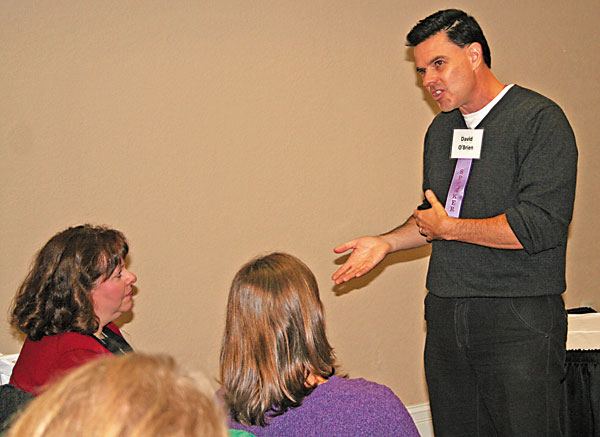 David O'Brien led the session "Faith in the Family" on both Sunday and Monday. O'Brien is a graduate fellow at Kroc Institute for Peace Studies at the University of Notre Dame and is sponsored by Loyola Press.
In his session he gave several "tools" for maintaining a healthy faith life: using music like the Scripture Rock CD; having a sacred space in the home; praying as a family; reading Catholic blogs; having a house filled with Scripture and regular family blessings; stopping by a church for adoration and prayer time; providing service to the community as a family; and taking family pilgrimages.
He recommended catechists and parents as well, use Catechist magazine or its on-line companion, www.catechist.com, to find ideas for bringing the Catholic faith into the family. "I especially like to use the section 'What's your Catholic IQ?' with my family," O'Brien said, lightheartedly demonstrating how things go in his home when they play the game. Younger children will naturally need some coaching, he said, but that is part of what makes Catholic IQ enjoyable.
"The key (to having a faith-filled family) is consistency," O'Brien said. "For example in family prayer, as life goes on and things get 'big' we can bring it to prayer." He also recommended celebrating not only family birthdays but also family feast days.
O'Brien lives what he teaches. He said he and his wife are the parents of five children, ages 10, 7, 5, 3 and one due in January. At one time, O'Brien, served in Uganda, bringing his wife and children with him. Upon returning from Uganda, his family then welcomed his parents, who are both in their 80s, to live in their home. Having the three generations living in one house has been good for the entire family, he said.
Bob Temme
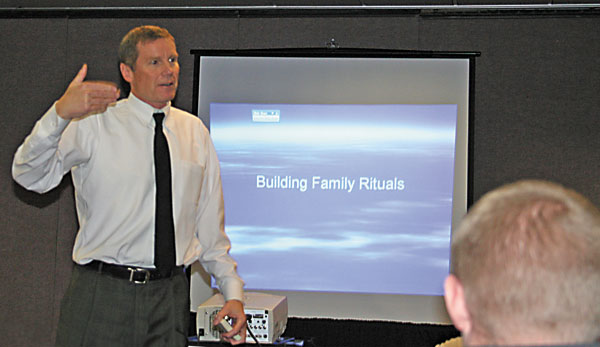 Bob Temme led a Nov. 17 workshop called "Building Family Rituals" that explored the value of establishing rituals in the family and some practical rituals for family milestones as well as seasonal and liturgical rituals.
A representative for the Pflaum Publishing Group, Temme hails from Indiana, where his wife is a school social worker. He has a master's degree in theology and has been a catechist and has worked at the parish level.
Temme said there are three key elements to every ritual celebration: music, telling stories and sharing a meal — something that happens at Mass as well. Rituals also have three stages: preparing and anticipating; experiencing; and integrating the ritual into life.
"Some things happen once a year (birthdays and holidays) but some happen once in a lifetime (reception of sacraments like first Communion or confirmation)," he said adding that the website www.pflaumweeklies.com is a good place to get teaching and celebration ideas.
The values of rituals are many, Temme said, but most importantly, they help make memories, help build identity, and give a person a sense of belonging.
"Remember, everyone has a spiritual need to feel connected, to feel they are making a difference and to feel loved," Temme said. "Rituals, when they are done right, touch the heart."