
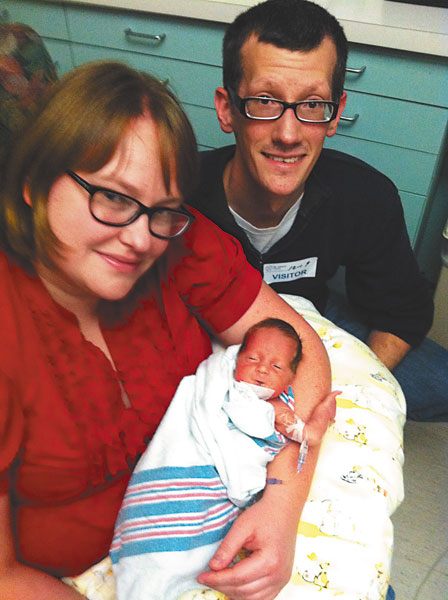
 Most parents look forward to celebrating their baby's first birthday, complete with photos, gifts and funny hats. However when your child has overcome several life-threatening conditions, that celebration becomes even more important; just ask Michele Levandoski and her husband Charlie McVay, who recently sang Happy Birthday to their baby, Theo.
It was just over a year ago, when Levandoski and McVay met their future adoptive son at St. John's Hospital in Springfield. Theo was just a few days old when his birthmother asked the couple to come to the hospital to see her premature baby who was born with gastroschisis, which means that his intestines were outside his tiny body.
When the couple met with the doctor who was taking care of the infant, he explained to them that most of Theo's intestines were "severely damaged" and that his future was very uncertain. "Basically, the doctor told us that they could not guarantee that he would live," says Levandoski, who is the archivist for the Diocese of Springfield in Illinois. Both she and her husband knew they had to make a difficult decision to either go ahead with the adoption or to decide against it — and that decision had to come quickly.
"We called our families to talk to them. I also called Father Chris House, for advice. I told him, 'I wish I'd given birth to him, because then we wouldn't have to decide, we'd just take care of him.' So Father House said he would talk to a moral theologian — and he repeated what I had said. The theologian told Father House, 'She just gave you her answer.' In other words, that theologian knew that truly we had already claimed Theo and that we should adopt him. We knew his prognosis was not good … but sitting in the hospital, we felt that Theo was meant to be with us."
So, it was with the true emotion of love for their soon-to-be son — and a huge leap of faith — that the couple moved ahead with the adoption proceedings. One of the first things they did was ask then-Msgr. Carl Kemme to baptize little Theodore Henry McVay, inviting Father House to be his godfather. "We wanted to adopt him as soon as we could," explains Levandoski. "We already loved him and we also wanted to be able to make medical decisions for him."
Unfortunately as it turned out, those medical decisions were both frequent and anguished-filled. Theo was transferred to Comer Children's Hospital in Chicago for his ongoing medical care. It was during that lengthy stay that the pint-sized fighter, over and over, defied the odds of survival.
Over the course of the next few months Theo had three surgeries that resulted in the removal of most of his small intestines. "The average length of a baby's intestines is 120 to 200 centimeters, but Theo has 37 centimeters," explains Levandoski. "So now what he has is called short bowel syndrome." In lay terms, Theo doesn't have enough short intestines to properly digest food.
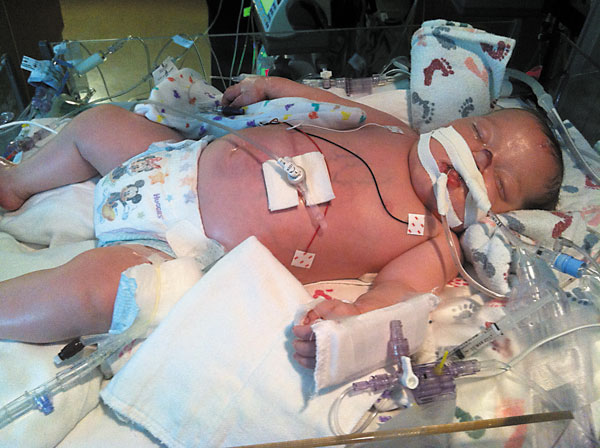 Theo's surgeries were difficult, but then came June: the baby's worst month ever. "He developed meningitis and a blood-born infection that went septic," Levandoski explains. "The sepsis made his stomach grow from 43 to 58 centimeters and caused his lung to collapse. At the same time, the PICC line (a peripherally inserted central catheter) in his leg broke through the vein, causing fluid to leak into his abdominal cavity. The leak was so big that it caused his organs to shift.
"When we found out that he had sepsis and meningitis, both illnesses that could have been fatal, we were sure we had lost him," she remembers, noting that Theo has had episodes where he has stopped breathing. "He was even on an oscillating ventilator — which is used when things are really bad — that kept him alive," she says.
At one point, heartbroken by all of their son's physical suffering, Levandoski spoke to her husband about telling Theo that it was OK to quit fighting for his life. "That night I stayed with Theo and I told him that we loved him and were so proud of him, but we understood that he had been through so much and that if he had had enough it was OK to let go.
"The thought of losing him was more than I could stand, but he needed to know he had a say in what was happening. He was looking me straight in the eye while I was talking and when I finished he moved his arm, just a little, but more than I had seen in two days. I knew then that he was choosing to fight."
Father's Day was difficult, Levandoski recalls with a voice that breaks in emotion. She had purchased gifts that her husband would be using when he would someday be caring for Theo at home. "Here I was, giving him gifts he might not ever get to use," she says. Fortunately Theo started to show improvement that day, which was the greatest gift both of his parents could have received. So once again the couple began to plan for the future.
"After Theo recovered in June, one of his doctors said, 'You really have to respect Theo,'" McVay says. "This was not the first time that Theo beat the odds. His intestines were so damaged at birth that the doctor didn't think he would live a week and a doctor told us there was no guarantee he would survive. Here we are a year later and he continues to amaze us."
Theo was in the hospital in Chicago for more than seven months. During all that time one of his parents were with him every single day, taking turns working in Springfield and staying at the hospital. He was released from the hospital in August but since that time he has been re-admitted to the hospital several times.
"At first when we brought him home, he seemed a little depressed," says Levandoski, explaining that Theo missed all the nurses and doctors. "The hospital was the only home he'd ever known."
His parents on the other hand, were under a great deal of stress, performing medical procedures they learned from the experts. (Levandoski took a several-week leave of absence from work and McVay resigned his management job and now is a stay-at-home father, working on weekends.) For two months they cared for Theo night and day, with the assistance of visiting nurses who checked in on them several times a week. Now they have a night nurse "so we can get some sleep," Levandoski says.
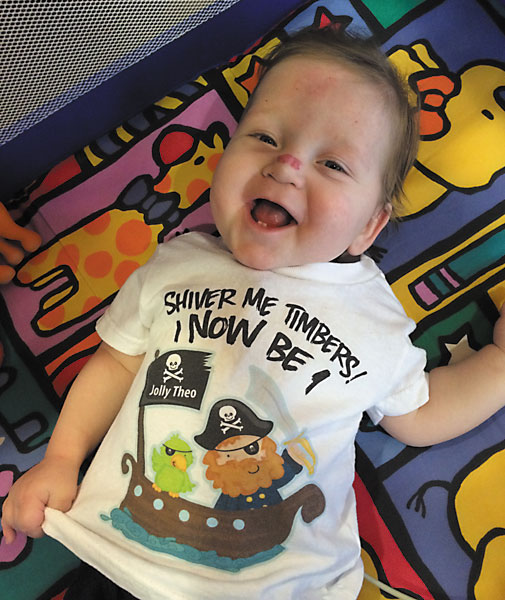 For now, Theo still has a Gastomy Tube (G-Tube) and a central line that allow him to grow and gain weight. He receives all of his nutrition through medical equipment but is slowly learning to take food by mouth. He's a chubby and tall baby with thick hair, bright eyes and an almost ever-present smile.
"To look at Theo, you wouldn't know he was sick. He is a little delayed but we work with a great physical therapist and several other people," Levandoski says. "He is learning to sit up and is rolling around and babbling. His equipment is all attached to a pole but eventually he may be able to use a little backpack that carries it all."
Because cold and flu season is such a threat to Theo, the family doesn't go out as often as others might. "We go to Mass at Blessed Sacrament as a family when Theo is well enough, but because so many infections start in the intestines, Theo is at a great risk. Even a little cold can mean Theo will end up in the hospital," Levandoski says. "But we don't want him to be isolated. It is important to us that he leads a normal life."
Throughout all of her son's ups and downs, Levandoski has kept in touch with Theo's birthmother, who is a young woman who lives in Illinois and has one other child. "People wonder why I do that; why I send her pictures and tell her how he is doing. They say she didn't want him; but that's not true," she says with real emotion in her voice. "She did want him but she knew she couldn't take care of him the way he needed to be cared for. So she gave him to us and we are so grateful for that."
Looking forward to a first Christmas at home with Theo, Levandoski recalls what happened last Christmas, when Theo's future was uncertain. "On Christmas Day last year we went to see Theo and then went to Mass at Blessed Sacrament. Father (Jeff) Grant (pastor at the parish) told a story of a little girl standing at the manger, asking where Jesus lived the rest of the year. Father Grant then went on to describe the places where Jesus could be found.
"He said that one time he got a sheet of people to visit in the hospital and one was just 'Baby Boy.' It was a premature baby and the parents weren't sure he was going to live. Father Grant described how when he visited he could see the doctors and nurses, but he also saw Jesus standing next to the baby so he could live.
"Charlie and I were in tears, because we knew that message was meant for us," she says. "I later asked Father Grant what inspired him to tell that story and he said he really didn't remember telling it! Clearly God was speaking through Father Grant for us."
McVay says he has been taken aback by "the overwhelming love and support we have received from family, friends, coworkers and complete strangers."
"Yes, the people at the diocese have been wonderful and so were Charlie's employers," Levandoski says, noting that diocesan staff have offered prayers and gifts, donated sick days and have provided funds to help pay for their extended stays at the Ronald McDonald House in Chicago. "Theo has been so sick and he has recovered. And thanks to the insurance and help from so many people, we've really had to pay very little of his medical bills, which are very high."
Over the past few months at home Theo has had good days and bad days, but he remains cheerful and resilient. "I have never seen so much fight and determination in anyone," McVay says. "We have been blessed to have him in our life. The name Theodore means 'a gift from God' and he truly is."
Levandoski says she and her husband both consider Theo a miracle in their lives. "Theo is so social and sweet natured, considering how sick he has been. He's strong and content and he looks you right in the eyes when you are talking to him," says Levandoski. "We figure that if he can go through all that he's been through and still be a happy baby, then we as parents certainly have nothing to complain about. We know that God meant for him to be with us and we are so lucky because he is just such a cool kid."