
Sister Marcelline Koch, OP, speaks about advocacy, what she found among displaced Christians, minorities
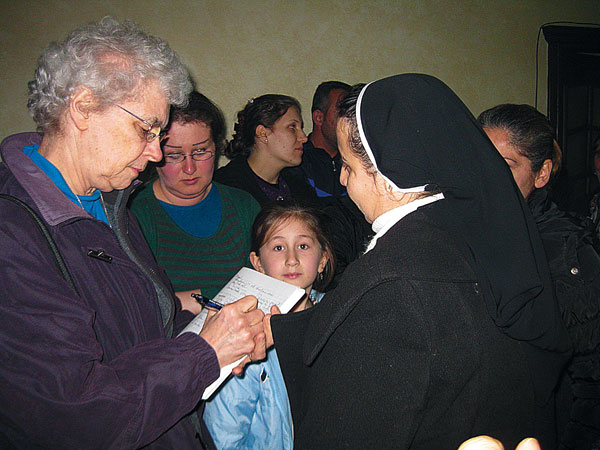 A delegation of three U.S. Dominican Sisters recently returned from a 10-day journey to Iraq that was meant to be a show of solidarity with their Iraqi Dominican counterparts. Not surprisingly, they came home with the determination to advocate — to speak out for displaced Christians and minorities in that country and also for refugees who are in Jordan and Syria.
Springfield Dominican Sister Marcelline Koch traveled with two other Dominican sisters — Sister Durstyne Farnan of Adrian, Mich., and Sister Arlene Flaherty of Blauvelt, N.Y. — and two Dominican friars. Sister Marcelline is co-promoter of social justice for the Dominicans in North America.
Last summer the Dominican Sisters in Iraq were displaced from their homes by the advances of the extremist group Islamic State of Iraq and the Levant (ISIL), Sister Marcelline says. The sisters were based in Qaraqosh, near Mosul but evacuated as ISIL approached from the west.
"This all began on Aug. 6," says Sister Marcelline, who resides in Springfield. "They were able to take their cars and were able to move into an already-established convent." That convent was occupied by some of their fellow Dominicans; and they are now living in Erbil, the capital city of the semi-autonomous Kurdistan region in northern Iraq.
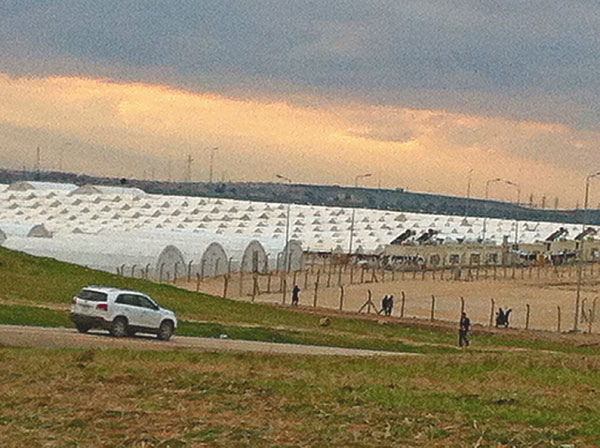
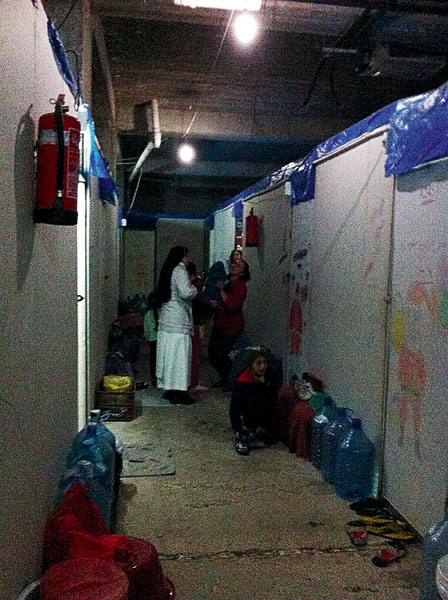 The Dominican Sisters and about 100,000 Iraqi Christians and other minority peoples are displaced, but are not technically refugees because they haven't left their home country. These individuals, who are referred to as Internally Displaced Persons (IDPs), now live in cinderblock houses, caravans and in an unfinished mall in a suburb of Erbil. In the Dohuk area, thousands of displaced Yazidi people live in tents, says Sister Marcelline.
The sisters learned of the displaced families' horror and humiliation, their resiliency and their resourcefulness, says Sister Beth Murphy, OP, who formerly worked and lived in Springfield, and has in the past traveled to Iraq on four separate occasions.
The sisters from the United States visited IDP camps in several distinct regions of the country, says Sister Beth. "They remarked on the creative and tireless service of their Iraqi sisters who work in collaboration with the local priests and bishop."
Sister Beth provides a partial list of the Iraqi sisters' ministries: they provide basic necessities like blankets and diapers to families with the assistance of the Catholic Near East Welfare Association (CNEWA); organize a health clinic in Erbil in collaboration with local clergy and financial support from CNEWA, the Vatican and other non-governmental organizations (NGOs); and provide activities and diversions for the hundreds of children living in unventilated containers and unheated tents who do not attend school; and they cooperate with Catholic Relief Services (CRS) in the city of Dohuk where they have had success in organizing refugees cooperatives and giving them a sense of stability.
Sister Marcelline says she worries about the destabilizing effect of illness on family systems. "Displacement is so very upsetting and disorienting," she says, noting that as many as three families sometimes live together in a "container" that measures 10 by 20 feet. "These are people who lived in a home like you or I and now they are living in these conditions.
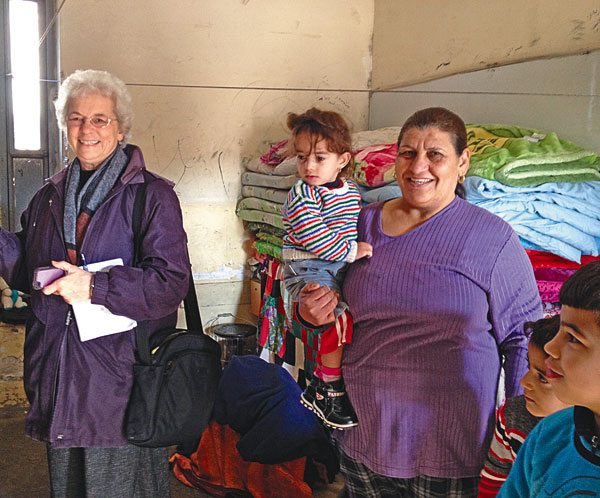 "They are doctors, lawyers and educators. Now there is this whole sense of lack of privacy and a loss of dignity," she says. "To be sick in the midst of that brings a greater burden — not only for the individual but the family as well."
She adds that one clinic coordinated by the sisters serves 350-400 people every day — people who are being treated by volunteers who are themselves displaced. "One of the Iraqi sisters along with a displaced priest started a health clinic right away. They found a tent and got help from those who were in the medical community," she says. "Now they are up to having seven medical containers."
As difficult as the situation is, it is made less chaotic and difficult by the close coordination that exists among the NGOs, church leaders and civil society. And despite the circumstances in Erbil, Sister Marcelline says she never felt as if she and her sisters were in danger. "I really think it was the grace of all the prayer that surrounded us as we were going," she says.
"You know, I think I felt more afraid for the sisters when I left," she says. "Will they continue to be safe? How long will they be able to stay where they are?"
Sister Marcelline says the Dominicans number about 40 (in the convent in Erbil) and range in age from young to very old. About seven or eight speak English. "You would be surprised about how you can communicate even without knowing the language," she says.
"Since they have been there in Iraq they have lost six sisters. One died shortly after we left. I had been sitting by her in the chapel every day that I was there," Sister Marcelline says in a voice that momentarily cracks with emotion.
 Recovering she says, "But, there are some young sisters there and three or four of them have advanced degrees. They have two candidates that were received last fall."
Sister Marcelline naturally became most worried about the children who are living in dark and dreary containers that are without indoor plumbing and with electricity that is sporadic at best. "I can't imagine how children would be safe there," she says noting once again that multiple families are crowded into single rooms, there is no work available and the children are not getting an education. Not surprisingly, she says the situation "is heartbreaking."
The Iraqi sisters are making progress in preparing to educate at least some of the little ones. "They have found a house and one of the sisters is a Montessori teacher," she says. The sisters now need permission from the Kurdistan government to set up the school, which they hope will accommodate 120 children.
Progress is slow, yet someone in Iraq said that the sisters "are making hope," Sister Marcelline says, admitting that hope is "hard to have in situations like these." She comments that the refugees said, "Just hear us out. Hear our story."
Sister Marcelline feels strongly about speaking out about what she and her fellow Dominicans have seen and experienced. She has written her story on Facebook (IHaveFamilyinIraq2015 at springfieldop.org), and has been interviewed for radio programs and by several secular newspapers. "Even my speaking changes the dynamic in some way," she says. She has taken to carrying a map of the area with her, knowing that it helps others to understand the lay of the land.
"We have to do something," Sister Marcelline says, adding that it is a very serious offense to people to make refugees out of them. "We are sharing our story with everyone that we can. We hope to do some advocacy with our own government. We can't leave people in limbo for years. We have to say, 'This cannot be.'"