
Editor's note — On the occasion of beginning his fifth year as bishop, I invited Bishop Thomas John Paprocki to reflect on five questions. His responses follow, edited only for space. SM
 CT — Five years at anything is an important marker. What are yours after five years as bishop?
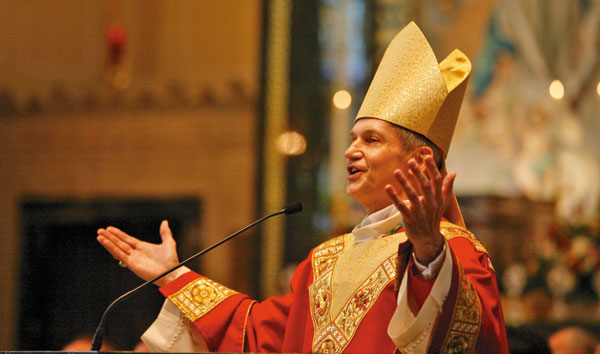
+TJP — My most significant ongoing activity has been visiting all 129 of our parishes. These visits have been wonderful occasions for me to get to know our parishioners and priests better and, I hope, for them to get to know me better. Our diocese is much more diverse than people may think, ranging from large urban parishes to small rural churches, towns that are predominantly Catholic and other areas where Catholics are a distinct minority. There are many very good things that are happening that give me great hope for the future of this diocese. Many of our parishes are vibrant and active, while others are in what I would call "maintenance mode." The occasion of a bishop's visit to a parish is often a cause for parishioners' anxiety, sometimes positive, sometimes negative. Positive anxiety arises on joyful occasions for the bishop's visit, such as a parish jubilee, when people are anxious that all will go well. But far too often, as I have visited parishes, people were nervous and that my visit may signal something ominous for their parish and greeted me by saying, "Bishop, please don't close our parish!" This is not entirely unexpected since our diocese was coming off a period of retraction prior to my arrival, i.e., parish closings and mergers. However, I still find that reaction surprising since it has not been my practice to close or merge parishes in the five years that I have been Bishop of the Diocese of Springfield in Illinois. The only exceptions have been in one parish that requested a merger in a small town with two parishes and two other places whose status was clarified as a church attached to another parish rather than a free-standing parish.
When I come to a parish, rather than people pleading with me not to close their parish, I would love for them to be boasting about all the good things that are happening in their parish and the phenomenal growth that they are experiencing. To help our parishes to do this, last year I published my first Pastoral Letter, Ars Celebrandi et Adorandi, On the Art of Celebrating the Eucharistic Liturgy Properly and Adoring the Lord in the Eucharist Devoutly. Celebrating Holy Mass properly, with a welcoming and caring community, good music, inspiring preaching, heartfelt prayer and an environment conducive to prayer, will attract people to participate and deepen their connection to God and the church. An unfriendly and uncaring community, bad music, poor preaching, insincere prayer and an environment distracting from prayer will turn people away. So we can say that growth in the church is fostered through beauty in the liturgy. I am also in the process now of drafting my second pastoral letter, which will specifically address the topic of building a culture of growth in the church.
CT — Scholars from Benedictine University last year released findings from a survey of active and inactive Catholics in central Illinois. Is it fair to say the results are at best, mixed?
 +TJP — Yes, in fact some responses were outright contradictory. One open-ended response said, "Liturgy without music is like going to the gym and not exercising." The very next response said, "I am 73 and was used to a silent Mass." This proves the adage that you can't please all of the people all of the time! Still, I think we learned a lot from these surveys. A sense of community or lack of it was a prominent factor mentioned both by active and inactive Catholics. Most of the active Catholic respondents indicated that a "sense of community was the most important reason why they attend their parish and what they most liked about their parish." Conversely, one of the main reasons "why individuals stopped attending Mass or distanced themselves was a lack of connection to the Catholic Church." Thus, we need to make sure that our parishes are communities with an inviting atmosphere where people feel a sense of connection and companionship as we walk our journey of faith.
CT — Among bishops of the church, you are at the forefront in speaking out about attacks on religious freedom. How have your views been received?
 +TJP – As I travel around the diocese, many people thank me for speaking out and being a strong defender of our faith. I am also encouraged that in almost every parish I visit someone will come up to me and say that they appreciate my column in the Catholic Times. It is good to know that people are reading my reflections. It inspires me to keep writing! At the same time, especially since my views in some cases have received national attention, I do receive letters of opposition and disagreement and sometimes even hate mail. In fact we as members of the Church stand for virtues and principles that are contrary to popular culture and that challenge the self-centered paths and comfortable ways of the world. In the words of Saint Ignatius of Antoich, a bishop and martyr whose image appears in one of the stained-glass windows in our Cathedral, "Our task is not one of producing persuasive propaganda; Christianity shows its greatness when it is hated by the world." This echoes what Jesus said to His apostles when He told them, "If you find that the world hates you, know that it has hated me before you" (John 15:18). Jesus also said, "You will be hated by all on account of me, but whoever who stands firm to the end will be saved" (Matthew 10:22).
CT – One may deduce that such attacks on religious freedom ended the diocese's foster care and adoption services. But with that, arose Catholic Charities Legal Services, modeled on what you started in Chicago. How's that going?
 +TJP – Our Catholic Charities Legal Services program is going very well. Our Pro Bono Coordinator, Amy Maher, has been very effective in connecting indigent clients with volunteer attorneys. We could always use more attorneys who are will to give of their time and expertise to help people in need. When the State of Illinois canceled the contract for our foster care and adoption services because we would not place children with same-sex couple, I reminded our Board and staff of Catholic Charities that Jesus said we had to take care of the poor, but never specified that it had to be through foster care and adoption services.
There are many other ways to help the poor and we are doing so through a variety of services in regional offices throughout our diocese, including food for the hungry, helping the sick and elderly to get assistance with their medical prescriptions, and providing legal services for people in need seeking justice. A silver lining on the loss of our state contract is that our Catholic Charities programs are much less dependent on government funding and are not tied to any government restrictions that come attached to government money. The converse is that we are in much greater need of private contributuions to keep our programs going.
CT – You have undertaken the goal to make stewardship a way of life in the diocese. What does that mean for the parishioner in, or not in, the pew?
+TJP – Stewardship is a theme that runs throughout the Scriptures. At the very beginning of creation, we hear how God entrusted man with the task of being a steward of all of creation (cf. Genesis 1:28). Saint Paul reminds us that we should all be regarded as "servants of Christ and stewards of the mysteries of God" (1 Cor. 4:1). As stewards, we must be conscious that what has been entrusted to us is not meant to be buried and remain unused, but rather, we are called to make good use of those gifts so that they can grow (cf. Matthew 25:14-30).
 A key part of stewardship in God's plan, then, is growth. All of the faithful must see themselves as a missionary disciple in assisting in the important work of growth in our parishes and in our diocese. This begins with gratefully recognizing that all that we have is a gift from the Lord, and out of that generosity, we respond with generosity by sharing those gifts with others and by supporting those services which assist the faithful to deepen their relationship with Christ so that they may become missionary disciples themselves, stewards of the gifts that they have received.
In order to breathe life and put flesh into this hope and vision, last December I announced that I was appointing Father Charles Edwards to be our new diocesan Director of Stewardship and Discipleship, effective January 1, 2015. At the same time, the word "stewardship" was taken out of the title of the Department of Financial Services, Stewardship and Development as well as from the title of the Office of Stewardship and Development. The reason for this change is that stewardship is not primarily about money or fundraising, but about a way of life based on a committed relationship as an intentional disciple of our Lord Jesus Christ. For that reason, I uncoupled the word "stewardship" from our fundraising and development efforts and paired it with the word "discipleship."
In giving Father Edwards the title "Director of Stewardship and Discipleship," I am emphasizing that stewardship, properly understood, flows from discipleship. It is Father Edwards' task as diocesan Director of Stewardship and Discipleship to promote the process of education and formation in the stewardship and discipleship way of life, working with the priests, deacons, religious and laity at both the diocesan and parish levels. No one can do this alone. We will all need to work together with the help of God's grace to succeed in these efforts.