
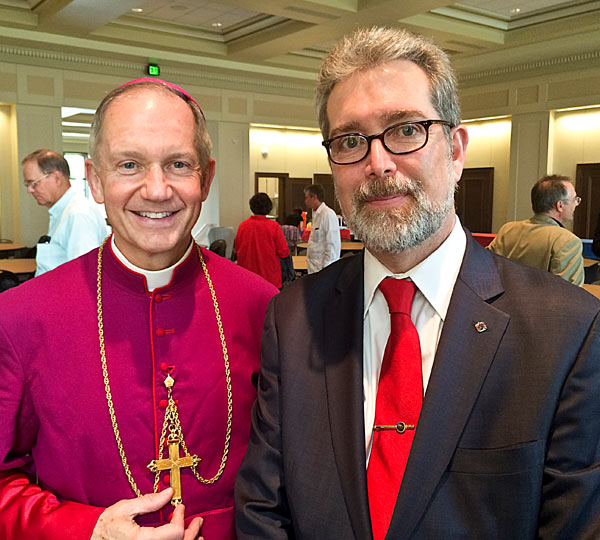
 "Around the world … the threat [to religious freedom] is immediate and deadly, as when the terrorists of the Islamic State murder Christian martyrs for an international audience," said Matthew J. Franck of the Witherspoon Institute in Princeton, N.J. "In other places the threat seems at first to be trivial by comparison … as when our Catholic Charities adoption services lose their state licenses because they will place children only with families headed by a married man and woman, or when the federal government threatens the Little Sisters of the Poor with crippling fines because they will not compromise their witness to the church's teaching on contraception."
That comparison from Franck began his Fortnight for Freedom lecture June 28 at the Cathedral Atrium in Springfield. The noted scholar and teacher compared two very different, yet competing origins of the birth of religious freedom — "one false but widely believed, the other true, but little appreciated."
Myth of the secular enlightenment
Franck calls the first the "Myth of the Secular Enlightenment" which holds that "following the violence in the name of religion that underlay the Thirty Years' War and the English Civil War, a hardy band of revolutionary thinkers, intent on achieving peace and stability, developed wholly new political principles that would reduce the chances of such conflict in the future." Championed by the likes of John Locke, the proper place for religion was best kept within the walls of a church, giving rise to the "no establishment" provision of the First Amendment as our most important constitutional principle.
Fast forward a few centuries and Franck suggests modern day politicians echoing the siren song of secularists who consider religion just another outlet for the similarly minded — that they can enter or exit as easily as they do a bowling league.
The religious basis
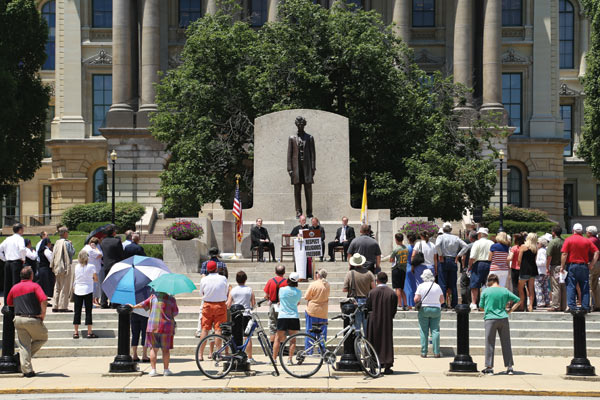 The second origin of the birth of religion — the correct one, Franck maintains — is the religious basis with roots long before the Enlightenment and the Protestant Reformation, rather the effort of the medieval church to gain independence from the kings of Europe. Again fast forward — this time millennia —Franck suggests the modern dilemma that the Little Sisters of the Poor face in standing firm in its beliefs against the federal Obamacare mandates, illustrates those who have stood up against the state based on their conscience. "These individual believers and their communities, not the secularists, are the heroes of religious liberty," said Franck, likening them with heroes of the past including St. John Neumann and African-American church leaders in the south.
From Franck's analysis, adherents to the false origin of secular enlightenment are forcing their will upon those that adhere to the religious basis for the "special" status that freedom of religion rightfully holds over the other freedoms: association, assembly and speech as detailed in the Constitution, and again centuries later in the U.N. Declaration of Human Rights.
Recent court action
Franck enumerated recent court decisions regarding religious freedom and the right of conscious:
- 2010 — Christian Legal Society lost 5-4 in the Supreme Court by requiring student officers conform to Christian ethical standards. The university insisted on an "accept all comers" policy.
- 2014 — Department of Health and Human Services Obamacare mandate that no owner of a for-profit corporation could claim any protection of religious freedom lost 5-4 in the Supreme Court Hobby Lobby case.
- 2015 — The June 26 Supreme Court in which all 50 states must license same-sex marriages. Two dissenting justices, Chief Justice Roberts and Justice Thomas, worried explicitly about the "ominous" and "potentially ruinous consequences for religious liberty" that the ruling represents. Justice Alito, also dissenting, said that the Court's ruling is bound to be "exploited by those who are determined to stamp out every vestige of dissent."
"Our task," concluded Franck, "in each annual Fortnight for Freedom ... is to tell the true story of religious freedom, to witness to the truth about the human person, and to defend the complete liberty of individuals, families, communities of faith, and their ministries to speak, to act, and to live the teachings of their faith in every corner of the public square as well as the private spaces they have a right to claim for themselves."