
Editor's note — Members of the diocesan Black Catholic Commission attended the Archbishop Lyke Conference held June 23-27 in San Antonio, Texas. The annual event addressed the liturgical needs of the black Catholic community. We invited them to reflect on their time together and the conference theme, "I am Black. I am Catholic. I am Here." The commission welcomes new members. Interested individuals can contact the diocesan office. SM
 The remarkable grounds of the Oblate School of Theology offered sites for prayerful contemplation of Our Lady, the Holy Family, the Last Supper and more.
The conference is named in honor of Archbishop James Patterson Lyke, OFM, Ph.D., an African-American Franciscan priest who worked to help black Catholics retain a sense of inclusion in the Catholic Church while guiding the church to recognize the richness and vitality of the black Catholic community. It offers an opportunity to reflect on where the black Catholic community is today within the Catholic Church and challenges us to become a more visible and viable reflection of the universality of the church within our parishes. Some suggested ways of doing this included becoming liturgical ministers, inspiring our youth spiritually and culturally, sharing music, art, history and rituals, promoting vocations and the sacrament of marriage with our parish families.
It is difficult to put into words what the experience of this conference was for me because it touched so many aspects of who I am and who I long to be as a black Catholic. It would be simple to say that people came from a number of different states to attend the conference. It would be important to say that the presenters for the workshops and services were more than accredited leaders, gifted speakers and inspirational. It would be significant to say I heard and felt music as a form of worship and prayer that I have not experienced in a long time.
It would be nearly impossible to help readers understand how remarkable it was to see people leaving Mass beaming with the joy of the Gospel and genuine fellowship with one another. It might even be impossible to explain the freedom of expression that rolled over me, through me and out of me in song and prayer. How strange to think, "Oh, so that's what Mass can be like, even if it's just once in a while."
This conference invited me to reflect upon the liturgy (the music) of the church and informed me of the rich and vibrant liturgy shared by black Catholics not often seen or heard among our brothers and sisters who are not African-American. We called upon our ancestors (St. Moses the Black, St. Monica, St. Augustine, Ss. Felicity and Perpetua, the black popes, modern day leaders, Father Augustus Tolton, Sister Thea Bowman, Sister Antona Ebo, Father Cyprian Davis, to name a few) to remind us of the roles they have played in the development of the Catholic Church, as we celebrated our identity as African-Americans and Catholics. We reflected on our rich and painful history as we venerated the cross, keeping our eyes on Jesus. We celebrated our spirituality with the Canticle of Simeon. We celebrated Mass knowing we had "come this far by faith."
I am Black! I am Catholic! I am Here! —more than ever. Authentically black and truly Catholic. — Elizabeth Williams, former diversity and inclusion coordinator, Sacred Heart-Griffin High School
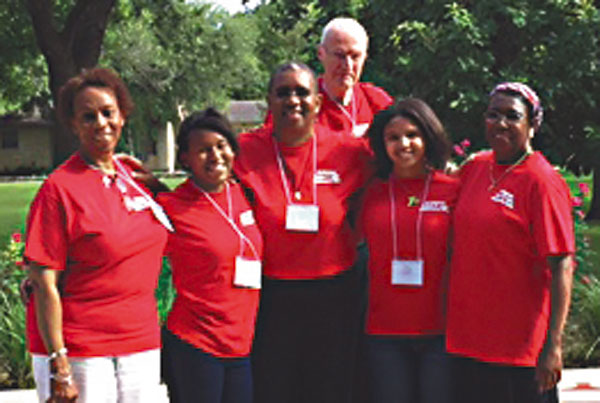 The title of the Lyke Conference this year was "I am Black. I am Catholic. I am Here!" Well, if that's not the story of my life, I don't know what is! I was born in the Springfield diocese, and have lived here most of my life. My mother, the granddaughter of a Presbyterian minister, became Catholic when she was sent to one of St. Katharine Drexel's schools for African American and Native American girls in Pennsylvania in the 1930s.
My siblings and I were among a handful of black students at St. Pat's and St. Teresa in Decatur in the 1950s and 60s. In school we stood out because we were black, and in our neighborhood, we stood out because we were Catholic.
In the summer of 1960, my sister and I visited family in Greenville, S.C. On Sunday morning, we walked down Gower Street to St. Anthony of Padua Catholic Church. As Mass began, I noticed something startling. Besides the priest, there was only one other white person in the church! That was the first time in my life that I recall feeling both black and Catholic at the same time — and it felt good!
"I'm Black, I'm Catholic, and I'm Here!" The Lyke Conference took me back to that feeling of being among family.
Being black and Catholic in Decatur in 1960 meant growing up on Gregorian chant, and rhythm and blues. But when the Mass changed from Latin to English, and the music changed from Gregorian chant, the music of the universal church, to music more reminiscent of American folk music — all of the sudden, it sounded like someone else's church — not my church.
One Sunday morning in the late '70s, Father Terrence Tracey, pastor of St. Thomas Parish, made a statement during the homily, "If we were all doing the job we should be doing of evangelizing, we would not be able to accommodate all of the people who would want to join the church." The thought that went through my mind at that moment was, "Humph — I don't even know why I'm here!"
I did not realize it at the time, but that was a prayer — and God heard it and answered it. Sister Patricia Mulkey, OSF, who was ministering at St. Thomas, introduced me to wonderful experiences such as Jesus Day sponsored by the Archdiocese of Chicago and workshops around the country sponsored by the National Office of Black Catholics and The National Black Catholic Congress. These wonderful experiences have fed my spirit over the last 40 or so years of my life.
When we were encouraged to pray for the canonization of Augustus Tolton during the Lyke Conference, I was reminded of attending a commemoration in Quincy in 1997 on the 100th anniversary of his death. When Katharine Drexel's name was called in the Litany of Saints, I was reminded that, were it not for her faithfulness in answering God's call, in all likelihood, I would not have known the blessing of receiving the Eucharist. When Sister Thea Bowman was spoken of with love and joy, I remember time spent with her on a visit she made to St. Thomas Parish in Decatur, and seeing her at workshops and congresses.
I was probably in my 30s before I met an African-American priest or sister. But through the Lyke Conference and others like it over the years, I have met, and listened to many black Catholic archbishops, bishops, priests, sisters, deacons, and committed black Catholic laity. Even though we don't see each other every day, I know that we are scattered from one end of this country to the other, going about the work of building up the body of Christ. I'm Black, I'm Catholic, and I'm Here — and I'm glad about it! — Renee Saunches, St. Thomas Parish, Decatur
Black Catholics have a problem. White Catholics say, "What are you doing in our church? You should be a Baptist or Methodist." Black Protestants say, "What are you doing in the Catholic Church? You don't belong there."
People don't know history. There have been black Catholics ever since the Ethiopian eunuch was baptized by the deacon Philip on the road to Gaza in Chapter 8 of the Acts of the Apostles. (The word "Ethiopian" comes from Greek words meaning "burnt face.") In this country, there have been black Catholics ever since the settlement of St. Augustine in Florida was founded in 1565.
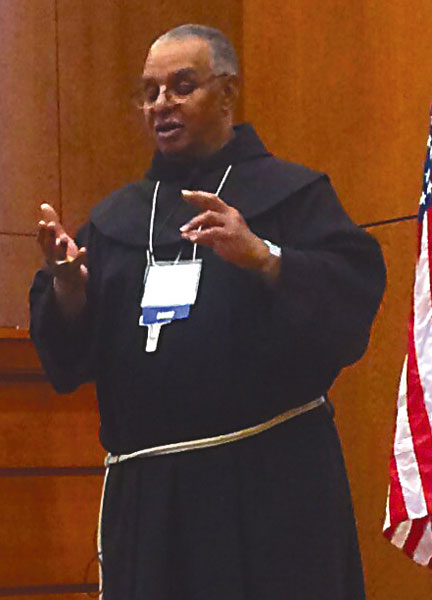
The theme of the conference was "I am Black. I am Catholic. I am Here." That's too tame. It was more like: "I am Black! I am Catholic! I am Here!" The theme was a shout.
The conference included prayer services, a closing Mass, as well as the usual displays for products appealing to participants, in this case, African art, clothing, music and literature. The liturgical events were characterized by what a 2012 report by the Center for Applied Research on the Apostolate described as, "Parishioners overall are more likely to report that their spiritual needs are being met when leaders personally encourage them to use their gifts in the parish; when the Mass allows for the expression of demonstrative behavior such as raising hands, clapping, and shouting 'Amen': and when the congregation is predominantly black."
One session I attended centered on hospitality. All of us, white and black, would do well to develop better skills at welcoming people to Mass, beginning in the parking lot. "Regulars" can feel comfortable with almost anything, but our church claims to be "catholic," for "everyone," and believes that everyone ought to share in its riches, which means that when newcomers join us, they ought to feel welcomed.
In our country, black Catholics, like white Catholics, are being eclipsed by Latino Catholics. But no matter how much they are eclipsed, they are black, they are Catholic, and they are here. — Father Joe Zimmerman, OFM, Holy Cross Friary, Quincy
I have to say that I really enjoyed the experience and it was really inspirational to me. I thought that the meetings and conferences were really helpful — they taught me so much. When I left San Antonio, Texas I felt inspired. I will definitely go next year. — Kiara Rienbolt, Sacred Heart-Griffin High School, Springfield
As a newcomer to the experience of the Lyke Conference, it was wonderful. As black Catholics from all over were disembarking, the combination of colors blended into a beautiful garden palate. The accents ranged from New York to Florida to California and worldwide showcasing our African diaspora. As we gathered together, we stood as one; one in brotherhood, strong and in unity as a force stating "I am Black! I am Catholic! I am Here!"
Impacted by the sight of so many representatives of different cultures of my black people communicating without strife in the Holy Spirit of Christ Jesus himself, our Lord and Savior more than deserved a reflective moment. I realized this should be how the world is in 2015. Now, what can I do to help make it a realty as it exists during the Archbishop Lyke Conference?
As a Catholic I highly valued the use of the original and primary order of the Latin Mass. The liturgy was right on point; however the delivery was familiar, yet with a different tone. There seemed to be a different "color" as the atmosphere of anticipatory black Catholics waiting to hear words of wisdom and knowledge from the Bible spoken by Bishop Ferd Cheri and other invigorating priests. That unique but familiar flair of the delivery of the homilies brought a release; a release from words learned through education and the struggle of assimilation to American society gave way to cultural speech. Readily embraced, easy on the ears, comprehension was effortless as God's word from heaven rained on us like manna from heaven! True to black culture, the temperature rose by way of the Holy Spirit as the worship began. It was expected, appreciated and even invoked from the presiding priest, assuring participation and understanding of the Word in God's presence. We responded with praises, devotions and shouts of pure joy.
I found my black Mass to be invigorating and vibrant, rich and deeply comforting because I was relieved. Relieved of being inferior. — Cathy Gwinn-Hines, Ss. James and Patrick Parish, Decatur