
 When Pope Francis declared 2016 the Jubilee Year of Mercy, he urged Catholic churches worldwide to keep their doors open to all.
The pope may not have envisioned how that would unfold at one church in particular in Springfield. The music ministry of Blessed Sacrament Church is keeping its doors open on a mission to unite, inspire, uplift, heal, comfort and challenge — by bringing people together in the creation and performance of time-honored works of music.
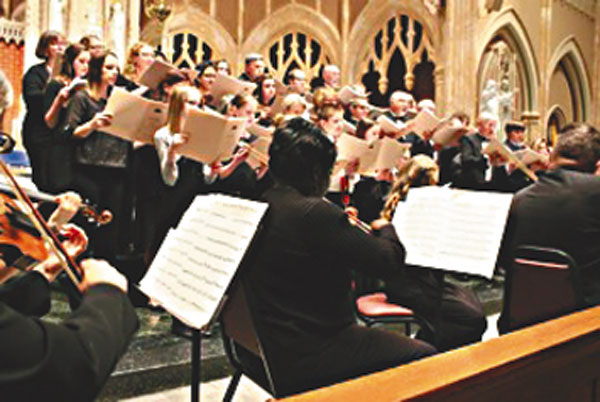
On Sunday, Feb. 21 at 4 p.m., three of Blessed Sacrament's choirs will present a Lenten concert featuring Fauré's Requiem and other works. Jubilate, the Choristers, and the Chorale will be accompanied by an instrumental ensemble, which includes professional and student musicians from the Illinois Symphony Orchestra and the Springfield Youth Symphony.
"It all begins with us as individuals," says Jody Kienzler, director of music at Blessed Sacrament Church. "The world has its troubles, but in this Lenten time of reflection, we can inspire all those who are seeking peace to pray through our music and be led to service."
Part of this music ministry's mission to unite is upheld by crossing many of the lines where boundaries may have previously existed. The performers in this group are multi-generational; professionals, amateurs and students; and inter-denominational. All are welcome if they are up to the challenge and are willing to commit to the time involved.
"Music brings people together from all backgrounds, religions, social classes and interests. It allows us to transcend our daily troubles," said baritone soloist Robert Mocharnuk, a Blessed Sacrament parishioner and an oncologist-hematologist at SIU School of Medicine. "It moves us in ways that the written word, the fine arts and other cultural experiences cannot. I believe that those things that affect our non-visual senses are most responsible for creating the lasting impressions in our lives. The complexity of choral music also challenges us intellectually as well as emotionally, and when a great piece is mastered, it gives one a sense of personal accomplishment … no matter when it is composed, its beauty will shine forth, as long as it is performed well."
 Tenor Dan Holland concurs. He is a retired ordained American Baptist minister and member of Central Baptist Church in Springfield who comes from a musical family and has been involved in music his whole life. He has sung with the choirs of Blessed Sacrament several times and enjoys Kienzler's "upbeat, joyous style."
"Music is very aptly described as a 'universal language,'" Holland said. "The feelings engendered are common to us all … music is a natural part of worship … thus music can fulfill both, praise and enjoyment."
The concert's featured work, Requiem in D Minor, Op. 48 by Gabriel Fauré (1845-1924) is a popular piece for performance during the Lenten season because it is a choral-orchestral setting of the shortened Catholic Mass for the Dead in Latin, which focuses on eternal rest and consolation. Its seven movements are scored for soprano and baritone soloists, mixed choir, orchestra and organ. It takes about 35 minutes to perform, and has been presented consistently throughout the world since 1890. Fauré was recognized as the leading French composer of his day. Some speculate that the death of his parents in the mid- to late-1880s may have given impetus to this composition, but in the composer's own words, he wrote it "for the pleasure of it."
Performers, young and old, find pleasure in it, too. "It is difficult to sing this music at first, but once you start to get it, it's really fun. Singing in another language challenges you" says Aili Sluga, age 11 and a sixth-grader at Blessed Sacrament School.
Says Holland, "Works like the Requiem and great hymns that span many denominations state what we believe; what is at the core of our lives. Great works do this with dramatic intensity, speaking — at least in my case — to all of me."
Alto Susan Harris, finds Blessed Sacrament's Chorale inviting, and the quality of music exceptional. She was a vocal music education major at Cornell College in Mount Vernon, Iowa and worked during college summers at the National Music Camp in Interlochen, Mich. She has sung for six decades, the last four of them at First Presbyterian Church in Springfield.
"Singing with the choir of Blessed Sacrament has been a great experience for me because of Jody's excellent musicianship, the quality of the music chosen, and the warm welcome of the choir. … I have always found singing sacred music more compelling and a sure pathway to faith," she says.
A convert to Catholicism from the Methodist church, music director Kienzler couldn't agree more. Her desire to share the inspiration she has experienced in the Catholic Church is her main focus as a music minister.
Every year for its major concerts, Kienzler invites musicians and singers, whom she affectionately calls "ringers," to participate in the performances. This year, close to half the group is comprised of outside talent.
Kienzler is also the founder and musical director of the five-woman vocal ensemble, Seraphim, which, in addition to the women of the Capital Chamber Singers will be featured in the concert. It was within their ranks that she met some of the Requiem performers. One of them is Beth Maxwell, an alto singer and local composer and arranger who has penned an arrangement of the venerable hymn What Wondrous Love Is This for the concert.
Maxwell is a 2002 graduate of Millikin University, where she majored in musical education (vocal emphasis).
"I have kept my musical interests going by singing in and arranging music for Seraphim … ," Maxwell says.
Another featured artist is Devorina Gamalova, a London-based, Bulgarian-German violinist and violist who plays and teaches around the globe.
When ringers, singers, and instrumentalists come together, it is seamless. There is no feeling that anyone is an outsider because their goals are the same: to make beautiful music and to share it with all who seek to experience great peace through great art.
Music is an effective way to open doors and to enhance worship, regardless of one's personal religious affiliation.
"Why would I not join with Roman Catholics to 'glorify God and enjoy him forever?'" says Holland. "I think I understand our differences very well, but the differences do not interfere with expressing, together, what we hold in common."
Erin Foley began her writing career in the film and television industry in Los Angeles. She has been a professional writer for 30 years, and has enjoyed singing in choirs since childhood.