
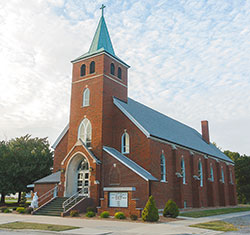
 BENLD — The people of St. Joseph Parish in Benld will celebrate the 100-year parish jubilee on Saturday, April 9. Bishop Thomas John Paprocki will celebrate Mass at 4 p.m. Msgr. Lawrence Auda, pastor emeritus; Father Michael Haag, pastor; Father Marianna Sathuluri, parochial vicar; Father Patrick Gibbons, Father Charles Edwards and Father James Neuman will be concelebrating. Father Brian Alford will be master of ceremonies at the Mass and Deacon Sean Caveny will serve as deacon. A dinner (requiring reservations) to be held at JoDanni’s Amore Restaurant in Benld will follow the Mass.
“The town was originally built around a coal mine, so that is very important to our history,” says Mary Ann Scopel, who is helping to organize the event. The village was named by Benjamin L. Dorsey, who combined the shortened version of his first name with his middle and last initial to come up with the name Benld. Many of the original townspeople were of Italian or Slavic descent, says Scopel.
Years after the town was established, Catholics of Benld were still traveling by buggy to Gillespie for Mass and the sacraments. When traveling wasn’t feasible, they worshipped in their homes. Father John Crosson, who had served as pastor of Ss. Simon and Jude Church in Gillespie since 1905, and a delegation of six men from Benld visited Bishop James Ryan, bishop of Alton, and received permission on April 6, 1915, to build a church at Benld.
Four lots were obtained on Central Avenue in the eastern section of the town. The cornerstone of the little clapboard church was laid Oct. 17, 1915, and the church was completed at a cost of $10,000. Father Crosson celebrated the first Mass in St. Joseph Church on April 14, 1916, and Sunday Mass was offered thereafter. He gave first Communion to the very first communicants on Aug. 19, 1916. The following year Father Michael J. Griffin was named assistant at St. Joseph, which enabled the people to have two Masses on Sundays.
 The parish ceased to be a mission in 1924 and built a rectory in 1927. According to the parish history, priests throughout the years were involved in local public affairs. For example, Father George Link established a lending library, organized Boy Scout and Girl Scout troops and formed a Dramatic Society.
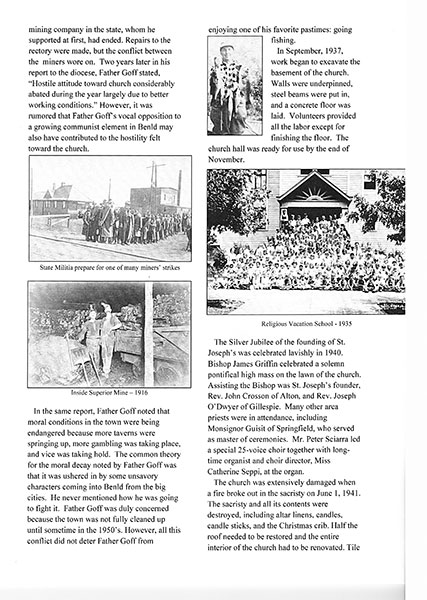
By the time the 1930s came around and Father John J. Goff was pastor, problems arose among those who worked in the coal mines. He tried to mediate the situation between miners, the union and the operators. However, in one of his reports to the diocese in 1932, Father Goff stated, “Parish much disrupted latter half of the year by trouble among the miners. Radical element very active.”
Violence ripped across the state’s mining towns. Of course, Bishop James A. Griffin and parish priests were aware that many towns in the diocese depended on working coal mines. Bishop Griffin spoke out in favor of the United Mine Workers of America and in a letter that was made public, described the “progressives” as irresponsible and “radical.”
A few days later, on Feb. 15, 1933, a bomb exploded on the front porch of the St. Joseph rectory, causing extensive damage to the front of the house. Father Goff, asleep in an upstairs bedroom, was not injured but the explosion was heard across the town and the house across the street lost its windows. In his annual report, Father Goff stated that he presumed the bomb was set by “radicals.” Repairs to the rectory were made, but the conflict between the miners wore on for several years.
However, by 1937, the UMWA had secured contracts at all the large mines and the coal miners’ war came to an end.
The parish suffered another setback when, on June 1, 1941, a fire broke out in the sacristy. The sacristy and all its contents were destroyed. Half of the roof had to be restored and the entire interior of the church was renovated.
Many Catholics came into the Benld parish in the 1940s and the church building received more renovations. Sixty adults were confirmed by Bishop Griffin in March 1947, in addition to 72 children. However, by the end of 1951, the parish started feeling the economic effects of the coal mines in the area shutting down. As jobs disappeared, people began moving to bigger cities where they could find steady work. St. Joseph lost as many as 70 families.
“So the closing of the mines had a huge impact on our parish,” said Cindy Saracco, another St. Joseph parishioner who is involved in organizing the 100-year celebration.
Still, by the time St. Joseph Parish celebrated its Golden Jubilee in 1965, records show that a total of 1,825 baptisms, 1,165 confirmations and 525 marriages had taken place. Of course, parish life has continued. In 1961 the white church received a brick veneer. In 1981 a shrine of the Blessed Virgin Mary was completed. Today about 1,500 people reside in Benld and approximately 370 of the people are parishioners at St. Joseph. Saracco says they are looking forward to the celebration.
Since its inception the church has been led by a number of priests; several of whom served the parish for many years. By far, the longest serving was Father Ralph Guido, who was pastor from 1942-1961 and then again from 1969 until he retired a few months before he died in 1987. Msgr. Auda served as pastor and then parochial administrator of the parish from 1988 until his retirement in 2014. Today he is pastor emeritus of St. Joseph and of Ss. Simon and Jude in Gillespie. Father Haag is pastor of St. Joseph, Ss. Mary and Joseph in Carlinville and Ss. Simon and Jude; and Father Sathuluri is parochial vicar at those same three parishes.
Three men from the Benld parish have entered the priesthood. Msgr. Auda was ordained in 1960 and of course, eventually went on to serve as pastor of his home parish for many years; and Father Gibbons, also a diocesan priest who is now pastor of St. Francis Xavier in Jerseyville and St. Patrick in Grafton, was ordained in 1991. Another priest, the late Father Rudolph Magnani, entered the priesthood later in life and was ordained in Rome in 1974. He did return to the United States to celebrate Mass at St. Joseph on July 7 of that year but then served the rest of his priesthood outside the diocese. Deacon Caveny is from the parish as well.
Moreover, at least five women from the parish entered the religious life. Two of those women were sisters: Sister M. Bernardine Kapusta, OP (now deceased) and Sister M. Stephanie Kapusta, OP, who lives at the Sacred Heart Convent Motherhouse in Springfield. Their sister, now Genevieve Ozanic, also entered the convent but chose to leave before taking vows to the religious life, says Scopel. She later married, raised eight children and lives in Mt. Olive. Scopel adds the other religious sisters from Benld were called Sister Mary Gerard, Sister Mary Marguerite and Sister Mary Michael.
All are welcome to attend the Mass and dinner celebrating the long history of St. Joseph Parish. Dinner reservations for the meal ($10 per person) must be made by March 31. For more information or to make dinner reservations, contact Cindy Saracco at (217) 835-2623, or email or by mail at 600 N. Hard Road, Benld, IL 62009
Note: Thanks to St. Joseph parishioners Mary Ann Scopel and Cindy Saracco for providing historical information for this article. Other information came from Come to the Water, The Diocese of Springfield in Illinois 1853-2003, A Sesquicentennial History by Sister Susan Karina Dickey, OP, and from Catholic Times historical files.