
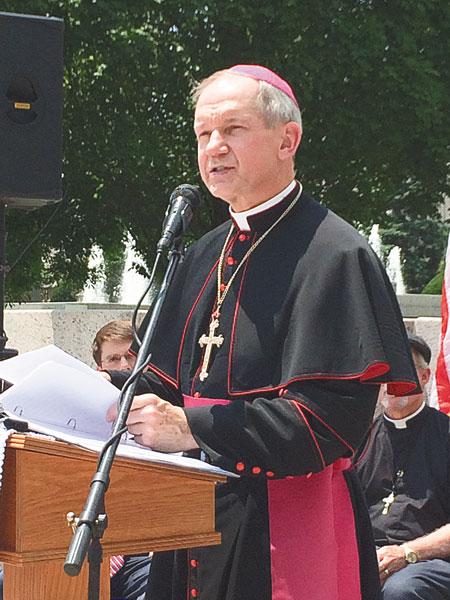
 Since 2012, Catholic dioceses throughout the United States arrange special obeservances and rallies to highlight the importance of defending religious freedom. This year, Fortnight for Freedom began on June 21 — the vigil of the Feasts of St. John Fisher and St. Thomas More — and concluded on July 4 — Independence Day. Bishop Thomas John Paprocki of the Diocese of Springfield in Illinois is largely credited with originating the concept of Fortnight for Freedom that was eventually adopted by the U.S. Conference of Catholic Bishops (USCCB).
The words quoted above the headline are from a speech in 1844 to fellow members of the Whig party in Springfield by one of its rising stars at the time, Abraham Lincoln. His view of the Constitution was resolute. But speaking in the shadow of his statue on the capitol grounds during Fortnight, Bishop Paprocki warned how just one supreme court justice, Anthony Kennedy, has put an ominous spin on the right of conscience. Citing his “mystery” passage in the 1992 Planned Parenthood v. Casey decision, Justice Kennedy wrote: “At the heart of liberty is the right to define one’s own concept of existence, of meaning, of the universe, and of the mystery of human life.”
If that is not unnerving enough,
Bishop Paprocki pointed to a similar, yet more threatening, decision penned by Justice Kennedy last year in the seminal Obergefell v. Hodges decision: “The Constitution promises liberty to all within its reach, a liberty that includes certain specific rights that allow persons, within a lawful realm, to define and express their identity.” Citing rather the “true freedom that we find in the Bible,” Bishop Paprocki takes the opposite view: “Freedom is not a license to do as one pleases, but the ability to live in accord with God’s law, free from external coercion from the state, big business, or anyone else.”
View from academia
Francis J. Beckwith, a professor of philosophy and church-state studies at Baylor University in Waco, Texas, followed Bishop Paprocki’s Fortnight for Freedom Mass on July 3 with a lecture to a gathering of diocesan faithful at the Cathedral Atrium.
In addressing what he calls “religious liberty in a skeptical age,” Beckwith said the challenge of religious liberty today is the result of a “general skepticism about the reasonableness of faith itself.”
Using the well-known “Hobby Lobby” case as an example, Beckwith recalled how the company’s owners challenged the Secretary of Health and Human Services’ mandate that contraceptive coverage must be provided to employee insurance coverage under the Affordable Care Act (ACA), also known as Obamacare. What surprises some scholars, and non-scholars alike, according to Beckwith, was that the mandate was not in the act as passed by Congress and signed by the president, rather the offending mandate was inserted by administrative agency rules. The HHS argued before the Supreme Court that enforcing the mandate served the “compelling government interest” to protect public health. When challenged that the mandate was not part of the ACA itself, the Obama administration’s lawyer had no answer.
The good news is that the mandate was found largely unconstitutional. But Beckwith warned that future legal tussles lie ahead as business owners who consider their right of conscience important will find the government willing to agressively exert its “compelling government interest.”