
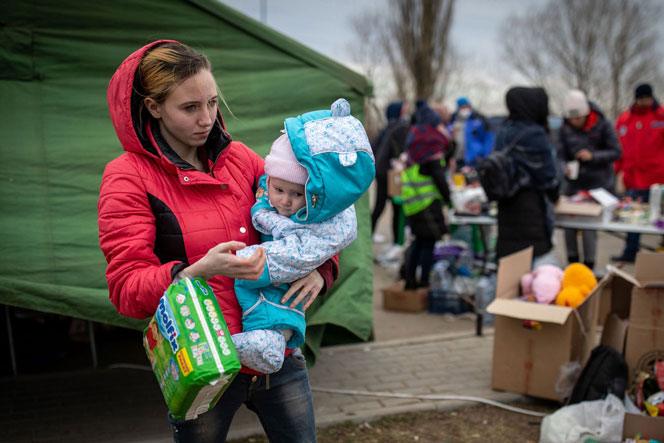
 Photo by Marijn Fidder/Caritas International. A former Springfield Blessed Sacrament student, parishioner living in Poland, who is taking in Ukrainian refugees, describes the scene at the border, the devastation happening to innocent families, and stories of heroism
By ANDREW HANSEN
Editor
POLAND — Children cling to their parents. Families desperately try to find safety. Lines of people wait for food. Ambulance sirens blare. News media rush around. Makeshift fires and big tents are set up to provide some reprieve from the cold. Loud announcements and cries of desperation fill the air.
This is the scene playing out in several cities in Poland along the Ukrainian border as more than 1.5 million Ukrainian refugees have fled their war-torn country. Despite the chaos, these cities in Poland have become beacons of hope for these refugees after Russian President Vladimir Putin had his country unjustly attack Ukraine, raging war on an innocent nation.
 “There’s no sense of time. Hours contract into minutes, and minutes stretch into hours. You arrive to pick someone up at 15:00 and they don't come through the border until after 21:00. You drive through the middle of the night, and still there is traffic all around, big buses, full of people, or empty, on the return trip to get more people. The sense of the place is warped as well. You’re in Poland, but mostly hear Russian, Ukrainian, Polish, English, German.”
Those are the thoughts of a former Springfield resident who attended Blessed Sacrament School and Parish and graduated from Springfield High School and who has been living in and out of Poland since 2014. She wished to remain anonymous. She is one of countless of people who is performing heroic acts of love and charity, compassionately taking in some refugees.
For the past several weeks, she has driven to Hrebenne, Poland, which sits on the border. There, tens of thousands of Ukrainian people have poured in. This is one of just many sites where one can witness true grace. This former capital city resident is one of many who are showing courage in the face of calamity, compassion in the face of chaos, and unending generosity in the face of uncertainty — a perfect of example of putting on the face of Christ.
 Photo by Marijn Fidder/Caritas International. “I've done something as simple as playing with children while exhausted mothers rest and also helping transport people from the border to destinations in Poland,” she said. “I've hosted refugees as well. Right now, I have a mother and her two daughters staying with me. The girls are 8 years old and 14 months. They fled Ukraine with less than $100 and their only possessions were the clothes on their backs. So, the past few days I've focused a lot on making them feel welcome, finding clothes and things for them like diapers, trying to organize school for the 8-year-old, and helping them navigate the situation in Poland.”
She has also helped organize community wide donation drives of medical supplies, clothes, toys, bedding, and things for babies, and she has helped coordinate accommodation, transportation, and assistance for Ukrainians once in Poland, such as finding legal services, opening a bank account, and arranging transportation out of Poland.
“Most Poles I know are hosting or have hosted a Ukrainian refugee family,” she said. “Business-owners, lawyers, journalists, and teachers — people from the most humble to the most exclusive echelons of Polish society, everyone has an open bed, a spare room, or a free flat that they are offering right now. Still, people keep coming, and coming. This massive inflow of people is especially visible at the train stations, where there are masses of people, bundles of clothes for donation, free food, and people sleeping on the floor, waiting for accommodation or for their train. Not all Ukrainians stay in Poland. Some go on to countries in the European Union, like Germany or Sweden. Many Ukrainians fear Putin and Russia will strike Poland next, so they don't want to stay too long.”
 Even for Ukrainians who are able to escape the physical danger, their mental anguish remains. Thoughts of family members trapped back in Ukraine, fearing family members will be killed fighting the Russians, the devastation of their home country, and loved ones being lost to an unjust war. Men over 18 cannot leave Ukraine. They have to stay behind to serve in Ukraine’s territorial defense forces, something these men take pride in doing, with some Ukrainian men in Poland and throughout Europe returning on their own initiative to protect their country.
“There are terrible reports of Russian military strikes on civilians,” she said. “At the beginning of March, Russia struck a maternity hospital. Entire families have been wiped out from attacks on civilian cars as people are fleeing. Families have been gunned down while walking through what was supposed to be a humanitarian corridor. Russian news is determined to pretend like these things did not happen, or that they were justified in happening. So, the Ukrainian people are suffering immediate harm of their country being invaded without provocation, the second harm of intentional attacks on civilians, and on top of that, those attacks are denied or justified. It is awful. Because of all this, when talking to refugees, I don't ask questions about their experience. But if they talk, I will listen and listen.”
Some of those stories she has learned has touched her profoundly, as she has several friends from Ukraine. One of her friends had their father missing. Later, it was discovered he died, killed under Russian fire while was crossing the street to buy groceries in the city where he's lived all his life. Another friend is a young man. He finished his studies and was excited about his new job. Now, he is spending most of his time in a bunker and making Molotov cocktails. Another friend is a neurosurgeon, as is her husband. She fled with her children, and the father stayed, to serve as a medic in the military.
 Photo by Marijn Fidder/Caritas International. She also has Russian friends, who she describes as “very frightened.” Some have fled, but others remain. Russia has cracked down mercilessly on war protest and dissent. At the beginning of March, the Russian legislature voted unanimously to outlaw anything other than the official Russian government reports of the "operations in Ukraine,” including making it illegal to call it a "war." People can be punished with a prison sentence of up to 15 years.
“A lot of coverage in the U.S. is using a U.S. or NATO-centric lens, but that lens ignores the history of these places and the words coming from Putin's mouth,” she said. “To a large degree, this war is about history and about Putin's legacy. Putin sees Ukraine as irrevocably part of Russia, to the extent of claiming that Ukraine as a state doesn't exist. From that mindset, he sees the separation of Russia and Ukraine as a mistake that needs to be rectified. He is willing to go to great lengths to bring the space and the people of Ukraine back under Russian control. But that is not what Ukrainians want. Ukraine is a sovereign country, and Ukrainians have the right to choose their country's direction.”
 Photo by Marijn Fidder/Caritas International.The chaotic scene playing out in the border city of Hrebenne comes on the backdrop of what happened about 80 years ago in Bełżec, Poland, about 15 minutes away from Hrebenne. Bełżec was the site of one of the worst extermination camps operated by Nazi Germany during World War II. This site was not a concentration camp. The camp’s only purpose was to kill. There are still lines of sinister-looking train tracks marking the camp's former sight. Those who pass through Bełżec describe it as a place where you can feel the history in the air, which mixes with the deep apprehension of the present. In this part of Poland, with the wood and coal smoke in the air, old homes, and large tracts of farming land, if feels like you’ve stepped backward a century, to pre-war Poland.
“Given the circumstances that bring everyone to the border, it is hard not to reflect on the horrors that happened there, hard not to think about as we pass bus upon bus full of people fleeing, that once upon a time, this place saw train car after train car of people arriving, sentenced to death, judged, and condemned for their personhood, who they were. There are a lot of thoughts that come from the juxtaposition of the two situations.”
There is also the best spiritual weapon we have as people of faith, which Bishop Thomas John Paprocki wrote about in his March 6 Catholic Times column: “Our strongest weapon, and the most important thing we can do is to pray, asking our Blessed Mother, the Queen of Peace, and her son Jesus, the Prince of Peace, to bring a peaceful end to this dire conflict.”