
Diocesan Administrator Account
Eucharistic miracles of the world display available for your parish/school at no cost

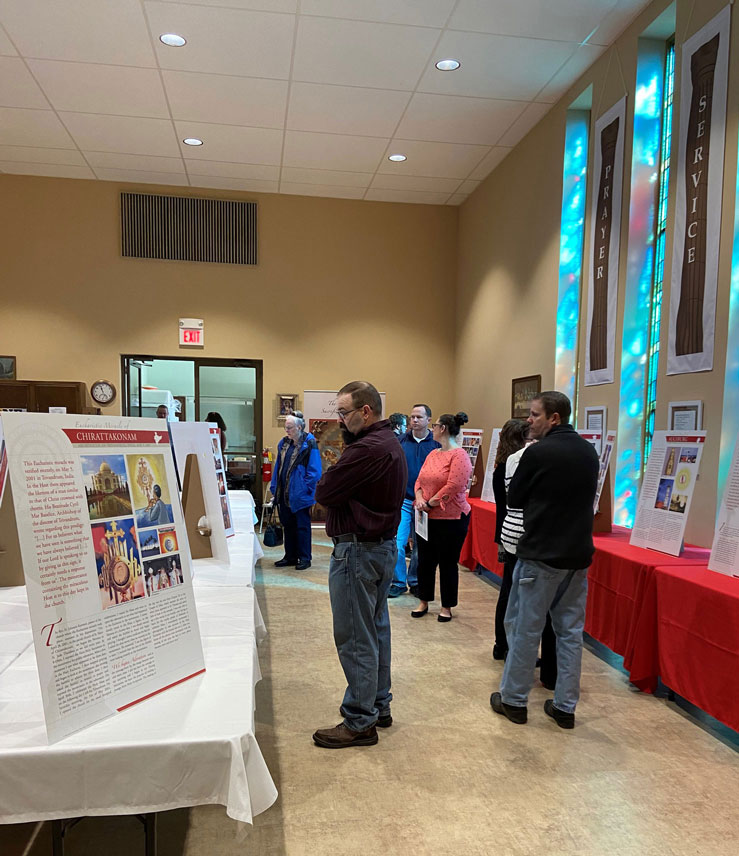
Catholics from across the diocese have been wowed to read and view 151 true eucharistic miracle stories from across the world over the centuries, depicted through photographs and historical descriptions on panels temporarily set up in parish centers, gyms, and vestibules. Several parishes in our diocese have already hosted this display, called The Vatican Eucharistic Miracles of the World exhibit. This exhibit was gifted to the Diocese of Springfield in Illinois and is available to parishes and schools in the diocese free of charge.
The exhibit presents some of the principal Eucharistic miracles that took place throughout the ages in various countries of the world and which have been recognized by the Catholic Church. By means of the panels, one can “virtually visit” the places where the miracles took place.
To request all or some of the panels at your parish or organization, contact Cindy Callan at the Diocese of Springfield in Illinois at 217-698-8500, ext. 137 for further information. Or email her at . When requesting panels for a showing, please consider sufficient lead time.

When God feels distant - How the Eucharist teaches us that God is never far away

 By Melissa Presser
Special to Catholic Times
“And he came down with them and stood on a stretch of level ground.”
Luke 6:17
Sometimes God just seems so far away. We may be praying for or about something with hearts broken and pierced and wondering where Jesus is. Does He hear me? Does He even know I am here? And even amongst good friends and family, we still feel alone because the cry of our hearts has gone unanswered. We may question God, wondering why Christ who came down to become man and stand among us feels a million miles away.
The Lord reminds us that we cannot trust in human beings to do what only He can do. He reminds us that human beings are not God and that we must put our trust and hope in Him alone, even when we feel we are in a spiritual drought. This is why He came down on a level plain, so He could be right there with us, in the midst of our greatest problems and tragedies. Christ is an accessible God who walks with us and among us. He is never far away.
When I think about Christ on a level plain, I think about a God who came down as man. He became attainable, touchable, reachable. He is the God who hears me, sees me, and knows me. God is not far off or someone I can’t reach out for. In fact, I reach out for Him every Sunday when I receive Him in the Eucharist.
I may “feel” that He is far off, but these feelings are deceptive. Having the sacraments with me reminds me that He is in fact on level ground with me - touchable, reachable, and attainable.
If you are feeling alone, misled, in grief, or rejected, know that whether you feel it or not, God is with you. He came down as man in the person of Jesus Christ to be accessible to you. As you receive Him in Holy Communion, take a moment to meditate on that level plain. He is right next to you, beside you, intimately involved in every detail of your life.
Remember that on this side of heaven, you have the keys to the Kingdom in the Eucharist, the closeness of God here on earth.
This article originally appeared in www.missiodeicatholic.org, reprinted with permission. Missio Dei was founded by Phillip Hadden, parishioner of St. Alexius in Beardstown
Adoration of the Eucharist teaches us to reverence humanity

 By Kelly Ann Tallent
Special to Catholic Times
“God created man in His own image… male and female he created them” (Gen 1:27). This verse taken from Sacred Scripture is used by the Catholic Church to proclaim the universal truth that all mankind is created equal. “We are one human family whatever our national, racial, ethnic, economic, and ideological differences. We are our brothers and sisters keepers, wherever they may be.” This teaching can be difficult for some, but this should not be difficult for Christians because God has given us the ability to see with more than our eyes.
As Catholic Christians, we are given seven beautiful ways of seeing through the eyes of faith, but in this article, we will only focus on two: The Sacrament of Baptism and the Sacrament of Communion. A Sacrament, “which is a visible sign of an invisible reality,” gives humanity a tangible means (something that can be seen, touched, heard, smelled, or tasted) and fuses it with the faith which God has commanded. For instance, in the Sacrament of Baptism, the water is the visible sign of the truth that “we are freed from sin and reborn as sons of God… members of Christ… incorporated into the Church and made sharers in her mission” (CCC 1213).
The Sacrament of Communion has a specific correlation to the above-mentioned verse, and it is here where we will draw an even deeper understanding of this call to see with more than our eyes. The bread and the wine, which is the visible sign, is transubstantiated into the body and blood of Christ. No one can see this happen, just as no one can see the invisible reality of Baptism, yet we have the faith that this visible sign has become what Christ proclaimed: “Take it; this is my body. This is my blood of the covenant, which will be shed for many” (Mk 14:22-24).
When we believe this truth, and spend time adoring Christ in the Eucharist, adoring Christ in others is how we share in God’s way of seeing Christ in us. We no longer see national, racial, ethnic, economic, and ideological differences, we see Christ. We see the image of God (Jn 14:9). Just as Christ sees us and we see Him, so too can we truly see others and treat them with the love in which Christ showed us when He carried His cross to Calvary.
This article originally appeared in www.missiodeicatholic.org, reprinted with permission. Missio Dei was founded by Phillip Hadden, parishioner of St. Alexius in Beardstown
Easter Sunday Mass times throughout diocese
Holy Week starts April 10
What is the Triduum?
During Holy Week, which beings on Palm Sunday (April 10), Lent comes to an end before the Mass of the Lord’s Supper on Holy Thursday, which is the beginning of the Easter Triduum. The three chronological days are liturgically one day and from what the United States Conference of Catholic Bishops call “the summit of the Liturgical Year.”
These three days witness the most exalted liturgical celebrations of the year and help us to remember Christ’s Paschal Mystery: His passion, death, and Resurrection.
The liturgical services that take place during the Triduum are: the Mass of the Lord’s Supper on Holy Thursday (April 14), the Liturgy of the Lord’s Passion on Good Friday (April 15), and the Mass of the Resurrection of the Lord (Easter Vigil) on Holy Saturday (April 15). On Easter Sunday (April 16), the Church continues to celebrate the Resurrection and triumph of the Lord.
The Triduum is concluded liturgically with Evening prayer in the late afternoon or early evening on Easter Sunday. This is the beginning of the Easter season, which is the 50 days from Easter Sunday until Pentecost.
Triduum schedule around the diocese
The following parishes returned a request from Catholic Times for a listing of their Triduum schedule:
SPRINGFIELD
Cathedral of the Immaculate Conception
Holy Thursday, 6:30 p.m.
Good Friday, 3 p.m.
Easter Vigil, 8 p.m.
Easter Sunday, 7 a.m., 10 a.m.
Blessed Sacrament
Holy Thursday, 7 p.m.
Good Friday, 5:30 p.m.
Easter Vigil, 8 p.m.
Easter Sunday, 7 a.m., 8:30 a.m., 10:30 a.m.
Christ the King
Holy Thursday 5:30 p.m. (Adoration until 10 p.m.)
Good Friday, 5:30 p.m. (Stations of the Cross, noon)
Easter Vigil, 8 p.m.
Easter Sunday, 8 a.m., 10 a.m.
Little Flower
Holy Thursday, 6:30 p.m. (Adoration until 10 p.m.)
Good Friday, 6:30 p.m.
Easter Vigil, 8 p.m.
Easter Sunday, 7:45 a.m., 10 a.m.
St. Agnes
Holy Thursday, 5:30 p.m. (Adoration 6:30-8:30 p.m.)
Good Friday, 5:30 p.m.
Easter Vigil, 7:30 p.m.
Easter Sunday, 9 a.m., 11 a.m.
St. Aloysius
Holy Thursday, 7 p.m.
Easter Vigil, 7 p.m.
Easter Sunday, 7 a.m., 11 a.m.
St. Frances Cabrini
Good Friday, 6 p.m.
Easter Sunday, 9:30 a.m.
St. Joseph
Holy Thursday, 5:30 p.m.
Good Friday, 5:30 p.m.
Easter Vigil, 8 p.m.
Easter Sunday, 9:30 a.m.
St. Katharine Drexel
(all at Sacred Heart Church unless noted otherwise)
Holy Thursday, 7 p.m. (Adoration until midnight)
Good Friday, 3 p.m. (Divine Mercy Novena and confessions to follow)
Easter Vigil, 8 p.m.
Easter Sunday, 7 a.m., 9 a.m. (St. Patrick Church), 10:30 a.m. (Latin), 12:30 p.m. (Spanish)
ALEXANDER
Visitation of the Blessed Virgin Mary
Holy Thursday, 6:30 p.m.
Easter Sunday, 11 a.m.
ALTAMONT
St. Clare
Holy Thursday, 6:30 p.m.
Easter Vigil, 7 p.m.
Easter Sunday, 10 a.m.
ALTON
St. Mary
Holy Thursday, 7 p.m.
Good Friday, 3 p.m. (Living Stations of the Cross, 7 p.m.)
Easter Vigil, 8 p.m.
Easter Sunday, 6:30 a.m., 8 a.m., 9:30 a.m., 11 a.m., 6 p.m.
Ss. Peter and Paul
Holy Thursday, 7 p.m. (Adoration until 11 p.m.)
Good Friday, 3 p.m.
Easter Vigil, 8 p.m.
Easter Sunday, 8 a.m., 10 a.m.
ARCOLA
St. John the Baptist
Holy Thursday, 7:30 p.m.
Good Friday, 7:30 p.m.
Easter Sunday, 10 a.m.
ARENZVILLE
St. Fidelis
Easter Sunday, 8 a.m.
ASHLAND
St. Augustine
Holy Thursday, 6:30 p.m. (Adoration until midnight)
Good Friday, 6:30 p.m.
Easter Sunday, 9 a.m.
ASSUMPTION:
Assumption of the Blessed Virgin Mary
Holy Thursday, 6 p.m.
Easter Sunday, 7:45 a.m.
ATHENS
Holy Family
Holy Thursday, 6 p.m.
Good Friday, 6 p.m.
Easter Sunday, 10 a.m.
AUBURN
Holy Cross
Holy Thursday, 7 p.m. (Adoration until 10 p.m.)
Easter Sunday, 8 a.m. (overflow in parish center)
BEARDSTOWN
St. Alexius
Holy Thursday, 7:30 p.m. (bilingual)
Good Friday, 6:30 p.m. (bilingual)
Easter Vigil, 6 p.m. (trilingual)
Easter Sunday, 11:30 a.m. (Spanish), 4:30 p.m. (French)
BENLD
St. Joseph
Good Friday, 3 p.m.
Easter Sunday, 7:45 a.m.
BELTREES
St. Michael
Easter Sunday, 8:30 a.m.
BETHALTO
Our Lady Queen of Peace
Holy Thursday, 7:30 p.m.
Good Friday, 7:30 p.m.
Easter Vigil, 7:30 p.m.
Easter Sunday, 8:30 a.m., 10:30 a.m.
BETHANY
St. Isidore
Easter Sunday, 8 a.m.
BRUSSELS
St. Mary
Easter Sunday, 6:30 a.m.
CAMP POINT
St. Thomas
Holy Thursday, 5:30 p.m.
Good Friday, 5:30 p.m.
Easter Sunday, 10 a.m.
CARLINVILLE
Ss. Mary and Joseph
Holy Thursday, 7 p.m.
Good Friday, 7 p.m.
Easter Sunday, 9 a.m.
CARROLLTON
St. John the Evangelist
Easter Vigil, 8:15 p.m.
CHARLESTON
St. Charles Borromeo
Good Friday, 7 p.m.
Easter Vigil, 8 p.m.
Easter Sunday, 8:30 a.m.
EIU Newman Center
Holy Thursday, 7 p.m.
Good Friday, noon
Easter Sunday, 11 a.m.
CHATHAM
St Joseph the Worker
Holy Thursday, 6:30 p.m.
Good Friday, 5:30 p.m.
Easter Vigil, 7 p.m.
Easter Sunday, 8 a.m., 10:30 a.m.
COLLINSVILLE
Ss. Peter and Paul
Holy Thursday, 7 p.m.
Good Friday, 3 p.m.
Easter Vigil, 8 p.m.
Easter Sunday, 8 a.m., 10:30 a.m.
DECATUR
Holy Family
Holy Thursday, 6:30 p.m.
Good Friday, 3 p.m.
Easter Vigil, 8 p.m.
Easter Sunday, 8 a.m., 10 a.m.
Our Lady of Lourdes
Holy Thursday, 7 p.m.
Good Friday, 3 p.m.
Easter Vigil, 8 p.m.
Easter Sunday, 7:30 a.m., 9:30 a.m., 11:30 (Spanish)
Ss. James and Patrick
Holy Thursday, 6 p.m. (St. James)
Good Friday, 3 p.m. (St. Patrick)
Easter Vigil, 8 p.m. (St. Patrick)
Easter Sunday, 8:30 a.m. (St. James), 10:15 a.m. (St. Patrick)
St. Thomas
Holy Thursday, 6 p.m.
Good Friday, 6 p.m.
Easter Vigil, 8 p.m.
Easter Sunday, 10 a.m.
DIETERICH
St. Isidore
Holy Thursday, 7:30 p.m. (at both St. Aloysius Church & St. Joseph Church), adoration following in the hall
Good Friday, 3 p.m. (St. Aloysius Church), 7:30 p.m. (St. Joseph Church), Living Stations, 7 p.m. (St. Aloysius Church)
Easter Vigil, 7:30 p.m. (St. Aloysius Church)
Easter Sunday, 8 a.m. (St. Aloysius Church), 10 a.m. (St. Joseph Church)
EDGEWOOD
St. Anne
Easter Sunday, 8 a.m.
EDWARDSVILLE
St. Boniface
Holy Thursday, 7 p.m.
Good Friday, 3 p.m.
Easter Vigil 8 p.m.
Easter Sunday, 8:15 a.m., 10:15 a.m., 12:15 p.m.
St. Mary
Holy Thursday, 7 p.m.
Good Friday, 7 p.m.
Easter Vigil, 8 p.m.
Easter Sunday, 8 a.m., 10:30 a.m.
EFFINGHAM
Sacred Heart
Holy Thursday, 7 p.m. (adoration until 10 p.m.)
Good Friday, 6 p.m. (Stations of the Cross, 12:10 p.m.)
Easter Vigil, 8 p.m.
Easter Sunday, 8:30 a.m., 10:30 a.m., 5 p.m. (Spanish)
St. Anthony of Padua
Holy Thursday, 7 p.m.
Good Friday, 3 p.m.
Easter Vigil, 8 p.m.
Easter Sunday, 7:30 a.m., 9:15 a.m., 11 a.m.
FARMERSVILLE
St. Mary
Good Friday, 7 p.m.
Easter Sunday, 8 a.m.
FIELDON
St. Mary
Easter Sunday, 9:30 a.m.
FRANKLIN
Sacred Heart
Easter Sunday, 8 a.m.
GILLESPIE
Ss. Simon and Jude
Holy Thursday, 5:30 p.m.
Easter Vigil, 8 p.m.
Easter Sunday, 10:30 a.m.
GIRARD
St. Patrick
Good Friday, 7 p.m.
Easter Sunday, 9:30 a.m.
GLEN CARBON
St. Cecilia
Holy Thursday, 7 p.m. (Adoration, 8 p.m.)
Good Friday, 3 p.m.
Easter Vigil, 8 p.m.
Easter Sunday, 8:30 a.m., 11 a.m.
GODFREY
St. Ambrose
Holy Thursday, 5:30 p.m.
Good Friday, 5:30 p.m.
Easter Vigil, 8 p.m.
Easter Sunday, 8 a.m., 10:30 a.m.
GRAFTON
St. Patrick
Easter Sunday, 8 a.m.
GRANITE CITY
Holy Family
Easter Sunday, 8:30 a.m.
St. Elizabeth
Holy Thursday, 7 p.m. (adoration until midnight, Night Prayer, 11:45 p.m.)
Good Friday, 3 p.m. (Stations of the Cross, 2:30 p.m., Divine Mercy Novena following 3 p.m. liturgy)
Easter Vigil, 8 p.m. (Divine Mercy Novena, 3 p.m., Blessing of Easter foods, 10 a.m.)
Easter Sunday, 8 a.m., 10:30 a.m.
GRANTFORK
St. Gertrude
Good Friday, 7 p.m.
Easter Sunday, 8 a.m.
GREENFIELD
St. Michael the Archangel
Good Friday, 7 p.m.
Easter Sunday, 8 a.m.
GREENVILLE
St. Lawrence
Holy Thursday, 7 p.m.
Good Friday, 7 p.m.
Easter Vigil, 8 p.m.
Easter Sunday, 8 a.m., 10 a.m.
HARDIN
St. Norbert
Easter Sunday, 9:30 a.m.
HIGHLAND
St. Paul
Holy Thursday, 7 p.m.
Good Friday, 3 p.m., 7 p.m.
Easter Vigil, 8 p.m.
Easter Sunday, 7 a.m., 8:30 a.m., 10 a.m.
HILLSBORO
St. Agnes
Good Friday, 6:30 p.m.
Easter Vigil, 8 p.m.
Easter Sunday, 10:30 a.m.
HUME
St. Michael
Easter Sunday, 8 a.m.
ILLIOPOLIS
Resurrection
Holy Thursday, 6:30 p.m.
Good Friday, 6:30 p.m. (Stations of the Cross, 6 p.m.)
Easter Vigil, 8 p.m.
Easter Sunday, 10:15 a.m.
JACKSONVILLE
Our Saviour
Holy Thursday, 7 p.m.
Good Friday, 7 p.m.
Easter Vigil 8 p.m.
Easter Sunday, 8:30 a.m., 10:30 a.m.
JERSEYVILLE
Holy Ghost
Holy Thursday, 7 p.m.
Good Friday, 7 p.m.
Easter Vigil, 7:30 p.m.
Easter Sunday, 8 a.m., 11:15 a.m.
St. Francis Xavier
Holy Thursday, 7 p.m.
Good Friday, 3 p.m.
Easter Vigil, 8 p.m.
Easter Sunday, 10:15 a.m., 5 p.m.
KAMPSVILLE
St. Anselm
Holy Thursday, 6:30 p.m.
Good Friday, 6:30 p.m.
Easter Vigil, 8 p.m.
KINCAID
St. Rita
Easter Sunday, 8 a.m.
LIBERTY
St. Brigid
Easter Vigil, 8 p.m.
Easter Sunday, 7:30 a.m.
LITCHFIELD
Holy Family
Holy Thursday, 6:30 p.m.
Easter Sunday, 8:30 a.m.
MADISON
St. Mary and St. Mark
Holy Thursday, 6 p.m.
Good Friday, 3 p.m.
Easter Vigil, 7 p.m.
Easter Sunday, 10 a.m.
MARINE
St. Elizabeth
Holy Thursday, 7 p.m.
Good Friday, 3 p.m.
Easter Vigil, 7 p.m.
Easter Sunday, 9:30 a.m.
MATTOON
Immaculate Conception
Holy Thursday, 7:30 p.m.
Good Friday, 7 p.m.
Easter Sunday, 6:30 a.m., 8 a.m., 10:30 a.m.
MARYVILLE
Mother of Perpetual Help
Holy Thursday, 6 p.m.
Good Friday, 6 p.m. (Stations of the Cross, noon)
Easter Vigil, 8 p.m.
Easter Sunday, 8 a.m., 10:30 a.m.
MENDON
St. Edward
Good Friday, 7 p.m.
Easter Sunday, 10:30 a.m.
MEPPEN
St. Joseph
Easter Sunday, 8 a.m.
MICHAEL
St. Michael
Easter Sunday, 11 a.m.
MONTROSE
St. Rose of Lima
Holy Thursday, 7 p.m.
Good Friday, 3 p.m.
Easter Vigil, 8 p.m.
Easter Sunday, 9 a.m.
MORRISONVILLE
St. Maurice
Holy Thursday, 7 p.m.
Easter Sunday, 10 a.m.
MOWEAQUA
St. Francis de Sales
Good Friday, 3 p.m.
Easter Sunday, 9 a.m.
MT. OLIVE
St. Pope John Paul II
Easter Sunday, 10:30 a.m.
MT. STERLING
Holy Family
Holy Thursday, 7:30 p.m.
Good Friday, 7:30 p.m.
Eater Vigil, 8 p.m.
Easter Sunday, 6:30 a.m., 8 a.m.
MT. ZION
Our Lady of the Holy Spirit
Holy Thursday, 6:30 p.m. (Adoration until midnight)
Good Friday, 3 p.m.
Easter Vigil, 8:30 p.m.
Easter Sunday, 10:30 a.m.
NEW BERLIN
St. Mary
Easter Vigil, 7 p.m.
NEWTON
St. Thomas
Holy Thursday, 7 p.m.
Good Friday, 7 p.m.
Easter Vigil, 8 p.m.
Easter Sunday, 7 a.m., 10 a.m.
PANA
St. Patrick
Holy Thursday, 6 p.m.
Good Friday, 6 p.m.
Easter Vigil, 7:30 p.m.
Easter Sunday, 9 a.m., 10:30 a.m.
PARIS
St. Mary
Holy Thursday, 7 p.m.
Good Friday, 5:30 p.m.
Easter Vigil, 8 p.m.
Easter Sunday, 8:30 a.m., 11:15 a.m.
PETERSBURG
St. Peter
Good Friday, 3 p.m.
Easter Vigil, 7 p.m.
Easter Sunday, 8 a.m.
PIERRON
Immaculate Conception
Easter Vigil, 8 p.m.
Easter Sunday, 10 a.m.
PITTSFIELD
St. Mary
Holy Thursday, 7 p.m.
Good Friday, 7 p.m.
Easter Vigil, 7 p.m.
Easter Sunday, 8:30 a.m.
POCAHONTAS
St. Nicholas
Holy Thursday, 7 p.m.
Easter Sunday, 8 a.m.
QUINCY
Blessed Sacrament
Holy Thursday, 7 p.m.
Good Friday, 3 p.m.
Easter Vigil, 8 p.m.
Easter Sunday, 8 a.m., 10 a.m.
St. Anthony
Holy Thursday, 6:30 p.m.
Good Friday, 6:30 p.m.
Easter Vigil, 8 p.m.
Easter Sunday, 8 a.m., 10:30 a.m.
St. Francis Solanus
Holy Thursday, 7 p.m.
Good Friday, 3 p.m.
Easter Vigil, 8 p.m.
Easter Sunday, 7 a.m., 9 a.m., 11 a.m.
St. Joseph
Holy Thursday, 7 p.m.
Easter Sunday, 9 a.m.
St. Peter
Holy Thursday, 7 p.m.
Good Friday, 7 p.m.
Easter Vigil, 8 p.m.
Easter Sunday, 8 a.m., 9:30 a.m., 11 a.m.
St. Rose of Lima
Holy Thursday, 7 p.m.
Good Friday, 12:30 p.m. (Stations of the Cross at noon)
Easter Vigil, 10:30 p.m.
Easter Sunday, 11 a.m.
RAMSEY
St. Joseph
Holy Thursday, 7 p.m.
Easter Sunday, 8 a.m.
RAYMOND
St. Raymond
Easter Vigil, 8 p.m.
Easter Sunday, 8 a.m.
RIVERTON
St. James
Holy Thursday, 6:30 p.m.
Good Friday, 6:30 p.m.
Easter Vigil, 8 p.m.
Easter Sunday, 8:30 a.m.
ROBINSON
St. Elizabeth
Holy Thursday, 6 p.m.
Good Friday, 6 p.m.
Easter Vigil, 6 p.m.
Easter Sunday, 7:30 a.m., 10:30 a.m.
ROCHESTER
St. Jude
Holy Thursday, 6:30 p.m.
Good Friday, 6:30 p.m.
Easter Vigil, 7:30 p.m.
Easter Sunday, 8 a.m., 10:30 a.m.
SAINTE MARIE
St. Mary of the Assumption
Holy Thursday, 5 p.m.
Good Friday, 3 p.m.
Easter Sunday, 8:30 a.m.
SHELBYVILLE
Immaculate Conception
Good Friday, 5 p.m.;
Easter Vigil, 7 p.m.;
Easter Sunday, 10:30 a.m.
SHERMAN
St. John Vianney
Holy Thursday, 6 p.m.
Good Friday, 6 p.m.
Easter Vigil, 8 p.m.
Easter Sunday, 8 a.m.
STAUNTON
St. Michael the Archangel
Holy Thursday, 7 p.m.
Good Friday, 3 p.m.
Easter Vigil, 7:30 p.m.
Easter Sunday, 8 a.m.
ST. ELMO
St. Mary
Good Friday, 6:30 p.m.
Easter Sunday, 6 a.m.
ST. JACOB
St. James
Easter Sunday, 9:30 a.m.
STONINGTON
Holy Trinity
Easter Sunday, 9:30 a.m.
SULLIVAN
St. Columcille
Holy Thursday, 5:30 p.m.
Good Friday, 3 p.m.
Easter Vigil, 8 p.m.
TAYLORVILLE
St. Mary
Holy Thursday, 7 p.m.
Good Friday, 7 p.m.
Easter Vigil, 8 p.m.
Easter Sunday, 11 a.m.
TEUTOPOLIS
St. Francis of Assisi
Holy Thursday, 7 p.m.
Good Friday, 1 p.m.
Easter Vigil, 8 p.m.
Easter Sunday, 6:30 a.m., 8:30 a.m., 10:30 a.m.
TROY
St. Jerome
Holy Thursday, 7 p.m.
Good Friday, 3 p.m.
Easter Vigil, 8:30 p.m.
Easter Sunday, 8 a.m., 11 a.m.
TUSCOLA
Forty Martyrs
Holy Thursday, 5:30 p.m.
Good Friday, 5:30 p.m.
Easter Vigil, 7:30 p.m.
Easter Sunday, 8 a.m.
VANDALIA
Mother of Dolors
Good Friday, 7 p.m.
Easter Vigil, 8 p.m.
Easter Sunday, 10 a.m.
VILLA GROVE
Sacred Heart
Holy Thursday, 7 p.m.
Good Friday, 7 p.m. (Stations of the Cross, 3 p.m.)
Easter Vigil, 8 p.m.
Easter Sunday, 10 a.m.
VIRDEN
Sacred Heart
Easter Vigil, 8 p.m.
Easter Sunday, 11 a.m.
VIRGINIA
St. Luke
Holy Thursday, 5:30 p.m.
Good Friday, 3 p.m.
Easter Sunday, 9:30 a.m.
WAVERLY
St. Sebastian
Good Friday, 6 p.m.
Easter Sunday, 9:30 a.m.
WHITE HALL
All Saints
Holy Thursday, 7 p.m.
Easter Sunday, 10 a.m.
WINCHESTER
St. Mark
Good Friday, 5 p.m.
Easter Sunday, 10:30 a.m.
WOOD RIVER
Holy Angels
Holy Thursday, 7 p.m.
Good Friday, 3 p.m.
Easter Vigil, 8 p.m.
Easter Sunday, 8 a.m., 10:30 a.m.
Hey, Father! What is the history of no meat on Friday?

When I was growing up, one could not eat meat on Fridays at all, even outside of Lent (Editor’s note: This was Church law before 1966). If one did, that was sinful. Yet now, one can eat meat on Fridays, except in Lent. Since God is well aware of future laws and events, did He forgive those folks who did not abstain from meat on all Fridays?
- Margaret of Springfield
The obligation to abstain from meat is found in the Code of Canon Law. Canon 1251 states: “Abstinence from meat, or from some other food as determined by the Bishops’ Conference, is to be observed on all Fridays unless a solemnity should fall on a Friday. Abstinence and fasting are to be observed on Ash Wednesday and Good Friday.” The law of abstaining from meat on Fridays “binds those who have completed their fourteenth year” (canon 1252).
For the last several decades, we have been accustomed to abstain from meat on the Fridays of Lent, but not necessarily on the other Fridays of the year. This is because canon 1253 allows the Conference of Bishops to determine another form of penance to be observed. In 1966, the United States Catholic Conference (now the United States Conference of Catholic Bishops) ended the obligation to abstain from meat on the Fridays outside of Lent if some other form of penance or work of charity was done; they kept in place the obligation to abstain from meat on the Fridays of Lent (and on Ash Wednesday and Good Friday) under pain of sin.
The reason the bishops can make such a law is because of the power to bind and loose that Christ Jesus entrusted to the Apostles and their successors (see Matthew 16:19 and 18:18). The religious authorities in first century Judaism frequently spoke of the power of binding and loosing as the authority to make enforceable laws. Jesus, himself a devout Jew, gave this same authority to make enforceable laws for his Church to the Bishops.
The Church does not oblige people to future laws; she obliges them to laws in force at a particular time. If someone willfully and knowingly chose to eat meat on a Friday at a time when he or she was obliged to abstain from meat under pain of sin, and if he or she knew at the time the act of doing so was mortally sinful, he or she committed a mortal sin. Such a sin would not be later forgiven simply because the law changed. For a mortal sin to be forgiven, sincere repentance must precede a sacramental confession or a perfect Act of Contrition with the intention of making a sacramental confession.
Father Daren Zehnle is pastor at St. Augustine Parish in Ashland and is the director for the Office of Divine Worship and the Catechumenate for the Diocese of Springfield in Illinois.
Popular Totus Tuus program gears up for another summer of faith, fun

By ANDREW HANSEN
Editor
After another year of the pandemic, children are probably itching to get out of the house, socialize, and have fun. Parents are probably just as eager to have their children try some new experiences. This summer, the Office for Youth and Young Adult Ministry for the Diocese of Springfield in Illinois is excited to have Totus Tuus, a fun and faith-filled experience, coming once again to several parishes across the diocese in June and July.
Totus Tuus is a weeklong Catholic youth program dedicated to sharing the Gospel and promoting the Catholic faith through evangelization, catechesis, Christian witness, and eucharistic worship. The program inspires in young people a true longing for holiness, a deep desire for daily conversion, and an openness to their vocation.
A team of four college-aged teachers are traveling to different parish each week, hosting a five-day catechetical program for grades 1-12. The week is filled with faith, fun, and friendship. There are messy games and crazy skits, in addition to prayer, learning, and the sacraments. The college-age teachers also provide an authentic witness to the students.
June schedule:
- June 12-17: Our Lady of Lourdes, Decatur
- June 19-24: St. Boniface, Edwardsville
- June 26-July 1: Holy Family, Granite City
July schedule:
- July 10-15: St. Isidore, Dieterich
- July 17-22: St. Katharine Drexel, Springfield
- July 24-29: St. Peter, Quincy
Costs vary by parish. For more information and to sign up your child, call the parish office that is hosting Totus Tuus near you.
Cutline:
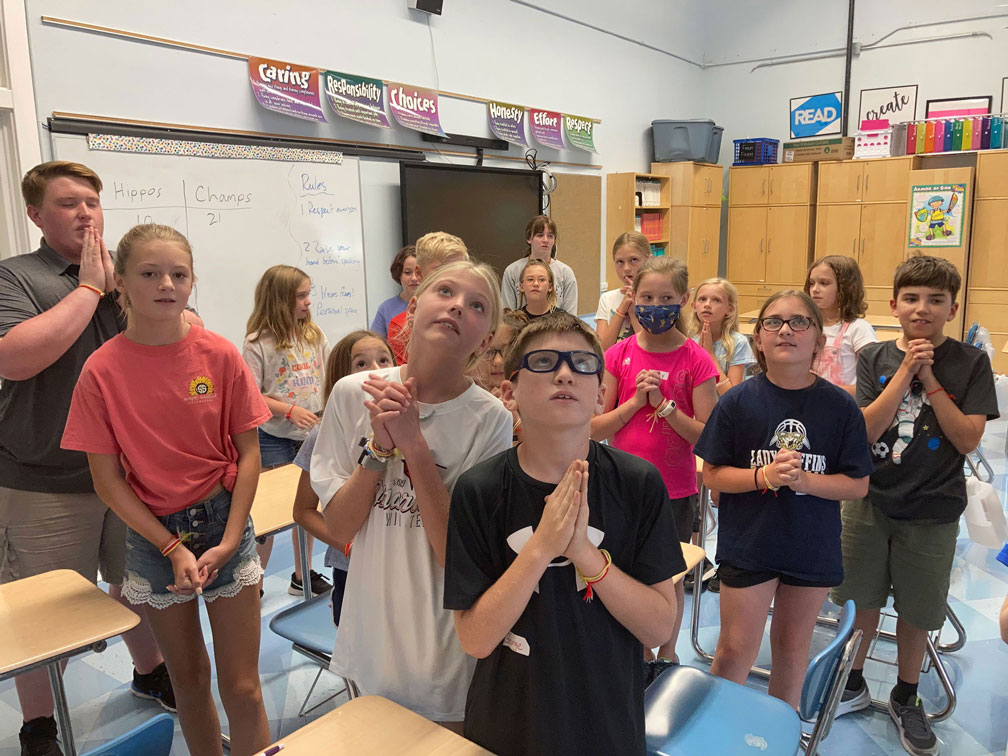
Students attending Totus Tuus at St. Boniface Parish last year pray after competing in a Catholic trivia game with their student leader, Joe Niemerg, at left. Totus Tuus is returning across the diocese this summer. Sign up at a parish near you.
Submitted photo
‘There is so much to love and always something new to learn within the faith’

 Shelby Barth of Highland shares her conversion story
By ANDREW HANSEN
Editor
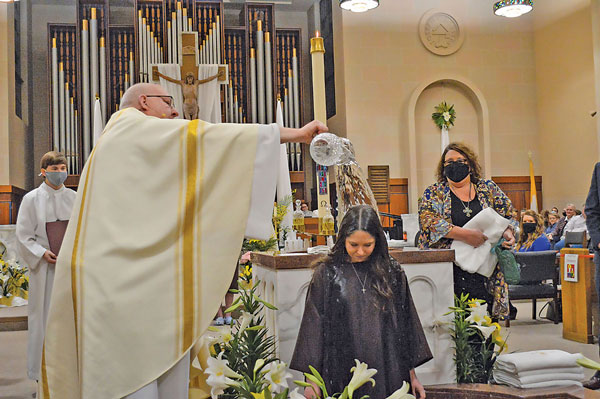
HIGHLAND — Growing up, 26-year-old Shelby Barth attended a non-denominational Christian church but was never baptized. Then God put someone in her life who changed everything. Little did she know that a man named Abe would not only become her husband but would also be the inspiration in her becoming Catholic last year.
Barth, now a parishioner at St. Paul Parish in Highland, shared her story with Catholic Times Editor, Andrew Hansen.
As you grew up a non-Catholic, what did you think about the Catholic faith?
As someone who was not raised Catholic, I had a lot of questions about everything that happened during the Mass and the meaning/history behind it. I felt like there was so much to learn and a bit out of my element, but that also led me to want to learn more and gain a deeper understanding.
The Catholic witness of your now husband, Abe, played a major role, you could say even inspired you to become Catholic?
Early on in our relationship, I could see how important Abe’s faith and upbringing was to him. So, I do feel as though his faith has inspired me from the beginning. He often invited me to attend Mass with him. From then on, our discussion of faith grew. I made the decision to join the Church shortly after our engagement but had been discerning the call to the Catholic faith for quite some time by thenHow often would you and Abe talk about the faith and answer your questions?
Before beginning the RCIA process, I was told that I would end up knowing more about the faith than Abe would, so I must say, I stumped him on a few questions! However, the RCIA process really did open a lot of doors to discussion of faith on a deeper level within our relationship.
 Was there anything about the teachings of our faith that you struggled with and if so, how did you overcome that?
I don’t specifically remember struggling with any of the teachings, but more so needing to gain a deeper understanding. My sponsor, Angie Rinderer, and the rest of the RCIA team were always willing to answer our questions and go more in depth of the teachings.
Is there a saint you fell in love with, asking him or her for their intercession and if so, which saint and why?
St. Brigid of Kildare was the patron saint that I chose for confirmation. She is best known for her generosity. Her selflessness is something that has inspired me and a saint I would pray to for intercession.
Last Easter, you were what the Church calls a Catechumen, someone who was unbaptized. On that day, you were baptized, and you received confirmation and first Communion, officially becoming part of our faith. What was that day like?
It was a night filled with so much meaning and the cultivation of my RCIA journey. The Easter Vigil Mass will forever hold a special place in my heart. I look forward to attending this Mass in the future to remember my commitment and support others as they make their own.
When you look back over your journey to our faith, what stands out?
I cannot speak highly enough of the RCIA process at St. Paul (Highland). The team and sponsors showed such determination and devotion throughout the weekly sessions. The team and my sponsor have truly helped me to grow spiritually in a foundation of faith. It is heartwarming to know the support and prayers the parish offered during my journey.
What do you love most about our faith?
There is so much to love and always something new to learn within the faith. I especially enjoyed learning about the sacraments. St. Augustine had described a sacrament as a visible sign of God’s invisible grace, and that really put the sacraments into perspective.
Compassion during a crisis

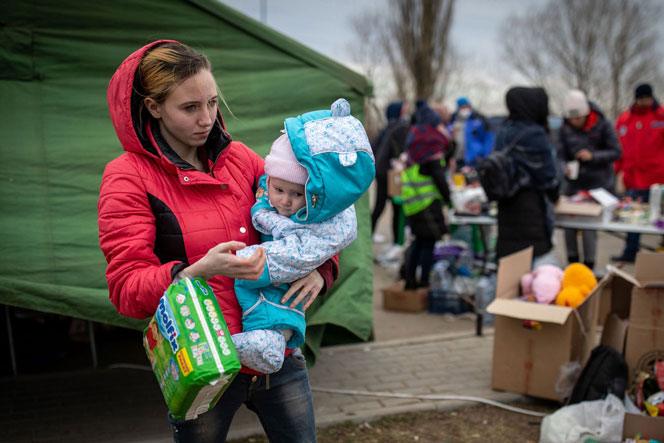 Photo by Marijn Fidder/Caritas International. A former Springfield Blessed Sacrament student, parishioner living in Poland, who is taking in Ukrainian refugees, describes the scene at the border, the devastation happening to innocent families, and stories of heroism
By ANDREW HANSEN
Editor
POLAND — Children cling to their parents. Families desperately try to find safety. Lines of people wait for food. Ambulance sirens blare. News media rush around. Makeshift fires and big tents are set up to provide some reprieve from the cold. Loud announcements and cries of desperation fill the air.
This is the scene playing out in several cities in Poland along the Ukrainian border as more than 1.5 million Ukrainian refugees have fled their war-torn country. Despite the chaos, these cities in Poland have become beacons of hope for these refugees after Russian President Vladimir Putin had his country unjustly attack Ukraine, raging war on an innocent nation.
 “There’s no sense of time. Hours contract into minutes, and minutes stretch into hours. You arrive to pick someone up at 15:00 and they don't come through the border until after 21:00. You drive through the middle of the night, and still there is traffic all around, big buses, full of people, or empty, on the return trip to get more people. The sense of the place is warped as well. You’re in Poland, but mostly hear Russian, Ukrainian, Polish, English, German.”
Those are the thoughts of a former Springfield resident who attended Blessed Sacrament School and Parish and graduated from Springfield High School and who has been living in and out of Poland since 2014. She wished to remain anonymous. She is one of countless of people who is performing heroic acts of love and charity, compassionately taking in some refugees.
For the past several weeks, she has driven to Hrebenne, Poland, which sits on the border. There, tens of thousands of Ukrainian people have poured in. This is one of just many sites where one can witness true grace. This former capital city resident is one of many who are showing courage in the face of calamity, compassion in the face of chaos, and unending generosity in the face of uncertainty — a perfect of example of putting on the face of Christ.
 Photo by Marijn Fidder/Caritas International. “I've done something as simple as playing with children while exhausted mothers rest and also helping transport people from the border to destinations in Poland,” she said. “I've hosted refugees as well. Right now, I have a mother and her two daughters staying with me. The girls are 8 years old and 14 months. They fled Ukraine with less than $100 and their only possessions were the clothes on their backs. So, the past few days I've focused a lot on making them feel welcome, finding clothes and things for them like diapers, trying to organize school for the 8-year-old, and helping them navigate the situation in Poland.”
She has also helped organize community wide donation drives of medical supplies, clothes, toys, bedding, and things for babies, and she has helped coordinate accommodation, transportation, and assistance for Ukrainians once in Poland, such as finding legal services, opening a bank account, and arranging transportation out of Poland.
“Most Poles I know are hosting or have hosted a Ukrainian refugee family,” she said. “Business-owners, lawyers, journalists, and teachers — people from the most humble to the most exclusive echelons of Polish society, everyone has an open bed, a spare room, or a free flat that they are offering right now. Still, people keep coming, and coming. This massive inflow of people is especially visible at the train stations, where there are masses of people, bundles of clothes for donation, free food, and people sleeping on the floor, waiting for accommodation or for their train. Not all Ukrainians stay in Poland. Some go on to countries in the European Union, like Germany or Sweden. Many Ukrainians fear Putin and Russia will strike Poland next, so they don't want to stay too long.”
 Even for Ukrainians who are able to escape the physical danger, their mental anguish remains. Thoughts of family members trapped back in Ukraine, fearing family members will be killed fighting the Russians, the devastation of their home country, and loved ones being lost to an unjust war. Men over 18 cannot leave Ukraine. They have to stay behind to serve in Ukraine’s territorial defense forces, something these men take pride in doing, with some Ukrainian men in Poland and throughout Europe returning on their own initiative to protect their country.
“There are terrible reports of Russian military strikes on civilians,” she said. “At the beginning of March, Russia struck a maternity hospital. Entire families have been wiped out from attacks on civilian cars as people are fleeing. Families have been gunned down while walking through what was supposed to be a humanitarian corridor. Russian news is determined to pretend like these things did not happen, or that they were justified in happening. So, the Ukrainian people are suffering immediate harm of their country being invaded without provocation, the second harm of intentional attacks on civilians, and on top of that, those attacks are denied or justified. It is awful. Because of all this, when talking to refugees, I don't ask questions about their experience. But if they talk, I will listen and listen.”
Some of those stories she has learned has touched her profoundly, as she has several friends from Ukraine. One of her friends had their father missing. Later, it was discovered he died, killed under Russian fire while was crossing the street to buy groceries in the city where he's lived all his life. Another friend is a young man. He finished his studies and was excited about his new job. Now, he is spending most of his time in a bunker and making Molotov cocktails. Another friend is a neurosurgeon, as is her husband. She fled with her children, and the father stayed, to serve as a medic in the military.
 Photo by Marijn Fidder/Caritas International. She also has Russian friends, who she describes as “very frightened.” Some have fled, but others remain. Russia has cracked down mercilessly on war protest and dissent. At the beginning of March, the Russian legislature voted unanimously to outlaw anything other than the official Russian government reports of the "operations in Ukraine,” including making it illegal to call it a "war." People can be punished with a prison sentence of up to 15 years.
“A lot of coverage in the U.S. is using a U.S. or NATO-centric lens, but that lens ignores the history of these places and the words coming from Putin's mouth,” she said. “To a large degree, this war is about history and about Putin's legacy. Putin sees Ukraine as irrevocably part of Russia, to the extent of claiming that Ukraine as a state doesn't exist. From that mindset, he sees the separation of Russia and Ukraine as a mistake that needs to be rectified. He is willing to go to great lengths to bring the space and the people of Ukraine back under Russian control. But that is not what Ukrainians want. Ukraine is a sovereign country, and Ukrainians have the right to choose their country's direction.”
 Photo by Marijn Fidder/Caritas International.The chaotic scene playing out in the border city of Hrebenne comes on the backdrop of what happened about 80 years ago in Bełżec, Poland, about 15 minutes away from Hrebenne. Bełżec was the site of one of the worst extermination camps operated by Nazi Germany during World War II. This site was not a concentration camp. The camp’s only purpose was to kill. There are still lines of sinister-looking train tracks marking the camp's former sight. Those who pass through Bełżec describe it as a place where you can feel the history in the air, which mixes with the deep apprehension of the present. In this part of Poland, with the wood and coal smoke in the air, old homes, and large tracts of farming land, if feels like you’ve stepped backward a century, to pre-war Poland.
“Given the circumstances that bring everyone to the border, it is hard not to reflect on the horrors that happened there, hard not to think about as we pass bus upon bus full of people fleeing, that once upon a time, this place saw train car after train car of people arriving, sentenced to death, judged, and condemned for their personhood, who they were. There are a lot of thoughts that come from the juxtaposition of the two situations.”
There is also the best spiritual weapon we have as people of faith, which Bishop Thomas John Paprocki wrote about in his March 6 Catholic Times column: “Our strongest weapon, and the most important thing we can do is to pray, asking our Blessed Mother, the Queen of Peace, and her son Jesus, the Prince of Peace, to bring a peaceful end to this dire conflict.”
Hey, Father! Is intinction allowed?

In my last parish, I was told that intinction was not allowed. Our parish priest does do intinction when he receives the Body and Blood of Our Lord. Is intinction OK for priests but not lay people?
Christine
For those unfamiliar with the practice, intinction is the dipping of the consecrated host into the Precious Blood and then receiving the “intincted” host in holy Communion.
According to the GIRM (General Instruction of the Roman Missal), the detailed document that governs the celebration of Mass, the Precious Blood may be distributed in a number of ways: by drinking directly from the chalice, intinction, or by means of a spoon or tube. Receiving by spoon or tube, however, is not customary in the Latin Rite dioceses in our country.
Yet both the GIRM and the U.S. Bishops allow reception by intinction by both clergy and lay faithful when certain protocols are followed to ensure proper respect for the Precious Blood.
For priests, the GIRM specifies that after the principal celebrant has received Communion in the usual way, the concelebrating priests wishing to receive by intinction “approach the altar one after another, genuflect, and take a particle, dip it partly into the chalice, and, holding a purificator under their chin, consume the intincted particle. They then return to their places as at the beginning of Mass” (249).
Concerning the laity, the GIRM instructs: “If Communion from the chalice is carried out by intinction, each communicant, holding a Communion-plate under the mouth, approaches the Priest who holds a vessel with the sacred particles, with a minister standing at his side and holding the chalice. The Priest takes a host, intincts it partly in the chalice and, showing it, says, The Body and Blood of Christ. The communicant replies, Amen, receives the Sacrament in the mouth from the Priest, and then withdraws” (287).
Notice what is required: a purificator for priests and a communion-plate under the mouth of the laity, as well as the imperative to receive the intincted host in the mouth. Both seek to prevent irreverences like the Precious Blood dripping onto the altar, floor, or one’s hands. Also, it is always the priest who intincts and distributes the host; neither deacons nor the lay faithful are to intinct the host themselves and self-communicate.
So, in answer to your question, yes, intinction is allowed for both priests and laity when the appropriate prescriptions are followed. Yet, receiving directly from the chalice has been and remains the customary way of receiving the Precious Blood in the Roman Rite.
Father Seth Brown is pastor of Mother of Dolors Parish in Vandalia and St. Joseph Parish in Ramsey. He is also chaplain of Our Sorrowful Mother’s Ministry, chaplain of the Vandalia Correctional Center, and research theologian for the Diocesan Curia.
Woman living as consecrated virgin expresses joy of her unique vocation

 By DIANE SCHLINDWEIN
Managing Editor
EDWARDSVILLE — For nearly 19 years, Theresa Howard of Edwardsville has been in a unique vocation — she is a consecrated virgin living in the world. That means she has taken vows to live “consecrated to God, mystically espoused to Christ and dedicated to the service of the Church” (Canon 604). In short, she has taken a vow of living in perpetual virginity and is responsible to pray the Liturgy of the Hours, receives the sacraments, and is faithful to private prayer.
Howard took her vows at St. Mary Church in Alton, with then-Bishop George Lucas consecrating her to this form of religious life on May 4, 2003. She was the first consecrated virgin the Diocese of Springfield in Illinois. She is not known as “Sister,” and lives in her own home and is responsible for her own material needs. She does not wear a veil or any special clothing, but she does wear a special ring, which is her a symbol of her mystical marriage to Christ.
Looking back on her spiritual journey, Howard, who is now a parishioner at Mother of Perpetual Parish in Maryville and a member of the United States Association of Consecrated Virgins, says she really had no idea God would lead her to this vocation, but she is sure she is living life exactly the way God had planned for her. “As I look back at my childhood, I can see God at work through my mother who taught me about Jesus and Mary,” she said. “By her words and actions, she taught me how to pray and how to live my life for God.”
As she grew to adolescence, Howard, like many young women, went out on dates. “I dated in high school and a little bit afterwards, but I had no idea when I was younger, that God had a beautiful vocation set aside for me,” she said.
 In these photos, taken May 4, 2003, Theresa Howard makes her vows as a consecrated virgin living in the world to then-Bishop George Lucas at St. Mary (Immaculate Conception) Parish in Alton.
However, by the time Howard was in her early 20s she began to hear God’s call. So, for many years she lived a private promise of perpetual virginity — long before she sought consecration. “For many years I searched and discerned where God was calling me to serve Him,” she said. “For many years I heard nothing but silence and yet I knew He wanted me to give my life to Him. During this time, I also worked, helped out with my parents before they died, attended college, volunteered in a couple of organizations in the community, was active in parish ministries, and went to the adoration chapel for prayer before the Blessed Sacrament.”
During the 1980s, Howard visited religious communities and by late in that decade, after spending time for about a year in one community, she talked to the vocation director. “The vocation director told me that they would like for me to enter that Aug. 1, upon completion of the psychological testing and a physical,” she said. However, that was when the unexpected happened.
“On my way home, I was in a near-fatal accident and ended up on life support. When I woke up, I asked God what He was trying to tell me. Was He telling me no to this community? Was He telling me no to religious life? Was He telling me no for now? I was so confused and later told the vocation director that I needed more time for discernment and would not be entering the community. Also, due to internal injuries and learning how to walk, it took me a year to recuperate.”
As Howard recovered, she began to search for her calling once again. “I served as a lay Dominican associate for one year,” she said. “I then started preparation to the Secular Franciscan Order — my profession ceremony was Jan. 12, 1997. The evening before my profession, I felt that God was asking more of me.”
The next year, Howard went on to join St. Mary (Immaculate Conception) Parish in Alton. “In October of that year my new spiritual director mentioned the vocation of consecrated virginity,” she said. “I pushed that aside until some time later when another priest asked me if I had ever looked into that vocation. As I was driving home that day I thought ‘Why would God call me to that life?’ Upon arriving home, I heard God say, ‘Check it out.’”
That’s when Howard’s journey to her present vocation began in earnest. With the assistance of her spiritual director, she studied and prepared for her consecration. She was under the guidance of Bishop Lucas and had meetings with a Franciscan religious with the Sisters of St. Francis of the Martyr St. George in Alton. Her mentor was a consecrated virgin in Mexico, Mo.
Howard, who is now 70 years old, retired and a church volunteer, says she has had many challenges and opportunities to grow closer to God over the past 18-plus years. “All of those years that I spent searching for God’s will in my life were not wasted. The joy, peace, and freedom I experienced on my wedding day have grown these past years.”
Although some people don’t understand Howard’s vocation, she is comfortable explaining it this way: “Since my consecration, people have asked me what I didn’t enter the convent or why I chose this vocation. I simply smile and tell them that God wanted me in the world. Also, God chose me to be His bride.”
More about the vocation of consecrated virgins
The rite of the vocation of consecrated virgins traces its origins to Jesus’ words in the Gospel of Matthew that some people renounce marriage for the sake of the Kingdom of God. The ancient Church had a liturgy for women who made this commitment. However, over time most women who were committed to chastity joined the many religious orders.
On May 30, 1970, Pope Paul VI re-instituted the rite.
Today, there are just over 250 consecrated virgins living in the United States and about 4,000 of these women worldwide. In the United States, consecrated virgins today include teachers, social workers, businesswomen, librarians, accountants, nurses, physicians, a fire fighter, a dance teacher, women employed in a variety of Church positions, retired women, women with disabilities, women dedicated to prayer, or devoted to the care of a family member, those dedicated to volunteer work, as well as other professions.
Consecrated virgins hold much in common with one another. Their common spirituality is that of living as a bride of Christ, the spirituality of the Church herself, and of the Blessed Mother. Some members also follow preferred Franciscan, Benedictine, Carmelite or Ignatian spirituality.
Catholic Times file photo