
Diocesan Administrator Account
700 from across diocese give voice to the voiceless in Springfield March for Life

 By Andrew Hansen
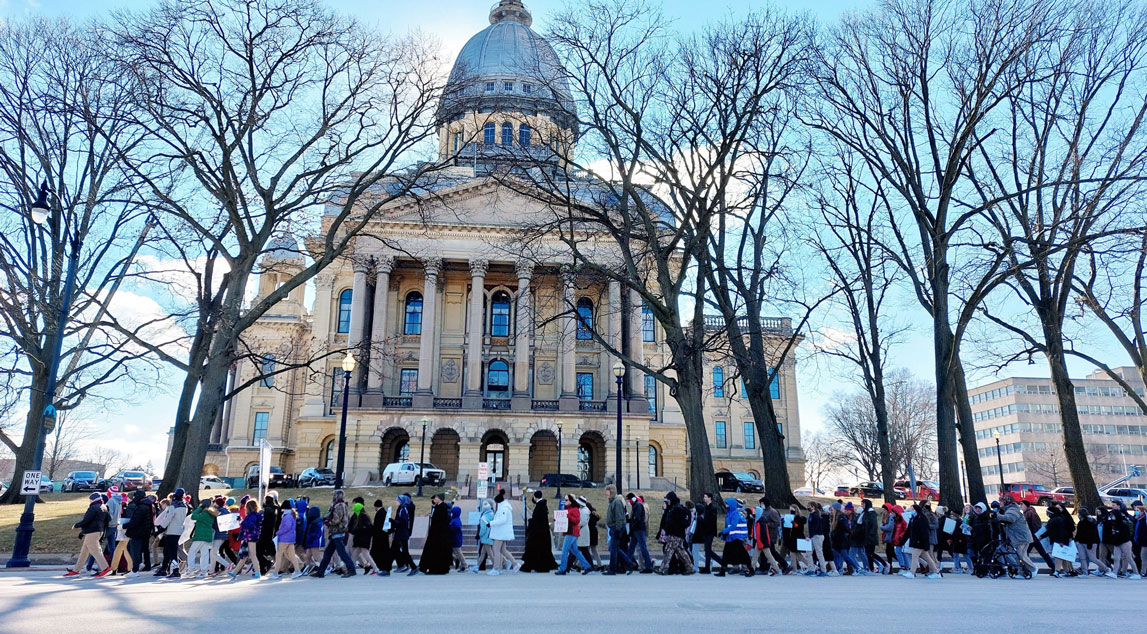
 They came from every corner of our diocese to pray together, worship together, receive the Eucharist together, and march together — all for one purpose: for the protection of human life.
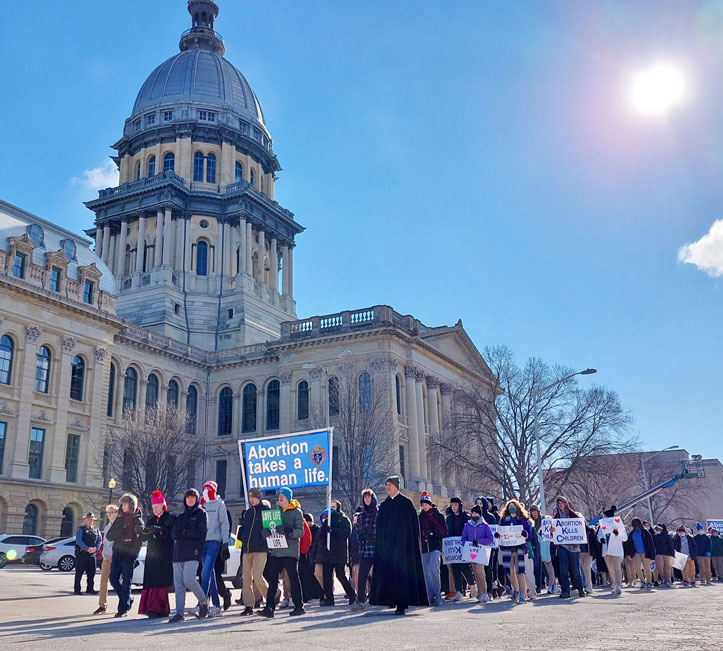
About 700 clergy, religious, teachers, students, and other lay Catholics from across the Diocese of Springfield in Illinois packed the streets of downtown Springfield to participate in the Springfield March for Life Jan. 21, raising their voices in prayer for the unborn and most vulnerable and protesting unjust laws that attack the dignity of human life. Marching past the Statehouse, Illinois Supreme Court building, and Governor’s Mansion, Bishop Thomas John Paprocki led the group in peacefully praying the rosary for an end to abortion and a greater respect for human life. This year marked the 49th anniversary of Roe v. Wade, the Jan. 22, 1973 U.S. Supreme Court decision that legalized abortion.
“Life begins at conception, so we should protect it and fight for that,” said Audrey Lasarge, a student at Sacred Heart School in Effingham.
“Babies can’t defend themselves,” said Ella Farris, a student at Mattoon High School. “They’re completely defenseless. They need someone to fight for them. That’s us. We’re here to fight for the lives that can’t fight for themselves.”
 “Especially with our culture today, they want to really silence us, and they want to make us think that we don’t have a group, and that we don’t have enough numbers,” said Jacob Mizera, a student at Sacred Heart Griffin High School in Springfield. “I think we do. That’s proved in the march as we have 700 people, and it’s really exciting to make our voices heard and show people that this is a popular idea (fighting for life), and this is the truth.”
The day began with Catholics first joining together for a Life Mass at 10 a.m., celebrated by Bishop Paprocki at the Cathedral of the Immaculate Conception in Springfield. Concelebrating with the bishop were 14 priests from across the diocese. The Mass was also livestreamed on the diocese’s YouTube and Facebook channels so schools who could not make the trip could participate virtually.
In his homily, Bishop Paprocki reminded the faithful to stay hopeful and continue to act and speak up for life.
 “Most mothers and fathers who consider aborting their children do so because they are afraid,” Bishop Paprocki said. “They are afraid they will not be able to care for their children. We in the pro-life movement must expand our already extensive efforts through our women’s centers, our pregnancy centers, and our Catholic Charities programs to offer life affirming and healing services to women in crisis, either by helping them to have access to the resources they need to care for their babies or if they are not able to do so, to assist them in giving up their children for adoption to the many adoptive parents that are ready, willing, and able to care for them. These are just some of the ways that we are called to end the scourge of abortion with the help of God’s grace.”
After the Mass, most everyone bundled up but did their best to embrace the below freezing temperatures to participate in the prayer march in downtown Springfield. While praying the rosary, the marchers prayed for vulnerable mothers contemplating having an abortion, those who work in the abortion industry, mothers who are struggling financially or emotionally, for lawmakers to enact laws that defend the sanctity of human life, and for a greater respect for life, including an end to abortion. The march in Springfield passed buildings of each branch of government before returning to the Cathedral of the Immaculate Conception for Benediction.
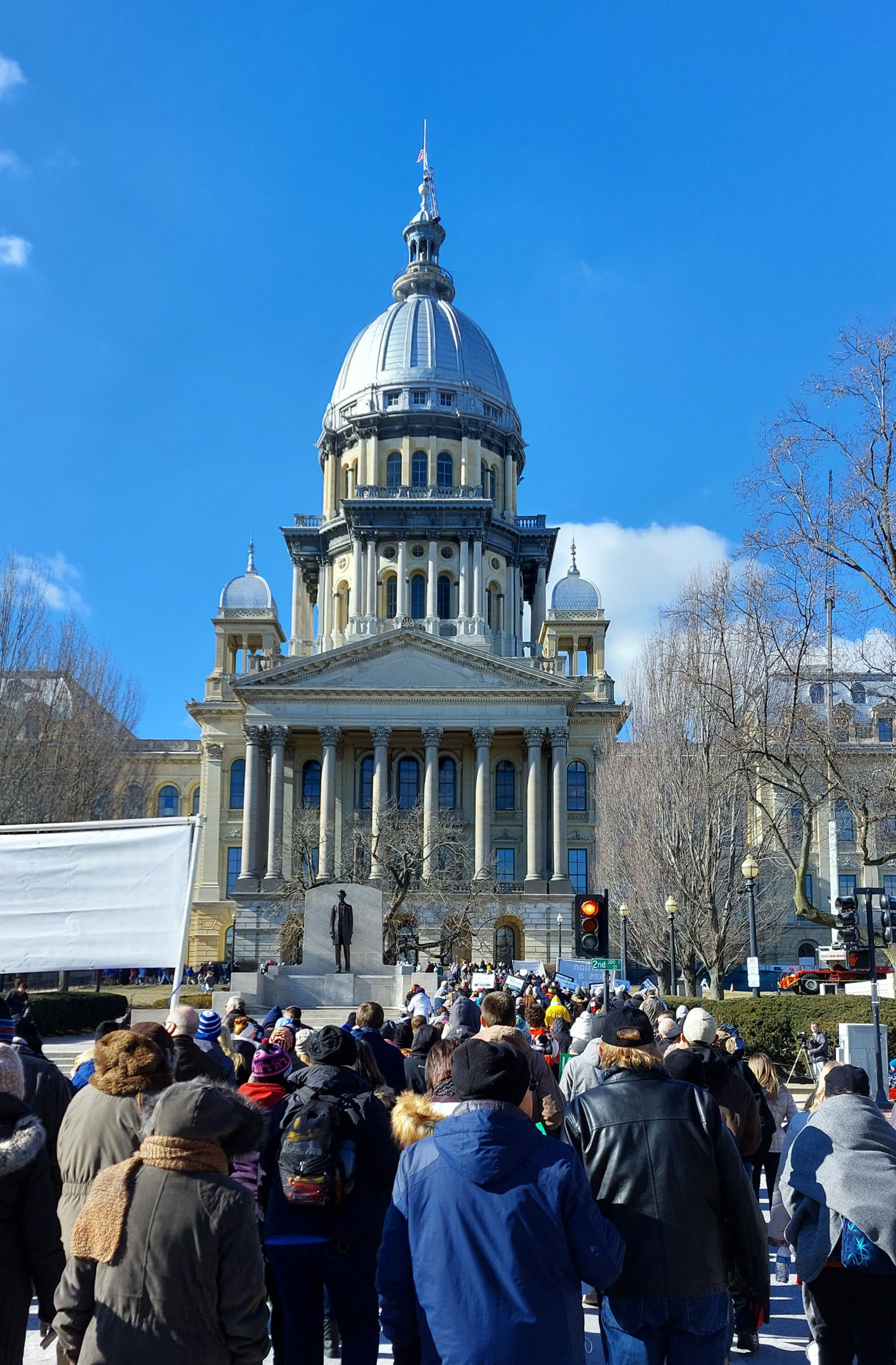 “I believe in being pro-life, and I want to protect everyone who can’t be protected,” said Gracie Harman, a student at Sacred Heart School in Effingham said. “It makes me proud that there is a group where we all believe in the same thing.”
“We are the prolife generation, and I think having a really large turnout for events like these really helps impress upon everyone that we’re going to make sure that we’re going to have a positive impact in getting rid of abortion,” said Rick Wright, a student at Southern Illinois University Edwardsville.
Those attending the Mass and Springfield March for Life came from schools across the diocese including St. Anthony High School in Effingham, Sacred Heart School in Effingham, Sacred Heart Griffin High School in Springfield (student choir sang at Mass), Christ the King School in Springfield, and Father McGivney Catholic High School in Glen Carbon.
Parishes sending students and/or adult lay Catholics included St. Isidore in Dieterich, Immaculate Conception in Mattoon, Our Lady of Lourdes in Decatur, Blessed Trinity in Brussels, St. Mary in Alton, St. Charles Borromeo in Charleston, Mother of Perpetual Help in Maryville, St. Francis Xavier in Jerseyville, St. Brigid in Liberty, St. Francis Solanus in Quincy, St. Raymond in Raymond, St. Alexius in Beardstown, Our Lady of the Holy Spirit in Mt. Zion, St. Luke in Virginia, St. Paul in Highland, Annunciation in Shumway, St. Joseph the Worker in Chatham, and Mother of Dolors in Vandalia.
The Eastern Illinois University Newman Center also had students participate as well as sisters from the Sisters of St. Francis of the Martyr St. George in Alton.
Celebrating Catholic Schools Week: How our schools are building up the Kingdom of God

Catholic schools in the Diocese of Springfield in Illinois are coloring the world with their gifts, talents, prayers, generosity, sacrifice, and love. See how each school in our diocese is building up the Kingdom of God as we celebrate Catholic Schools Week Jan. 30 - Feb. 5.
Click here to see how each school is building up the Kingdom of God
Seven months in — life as a deacon

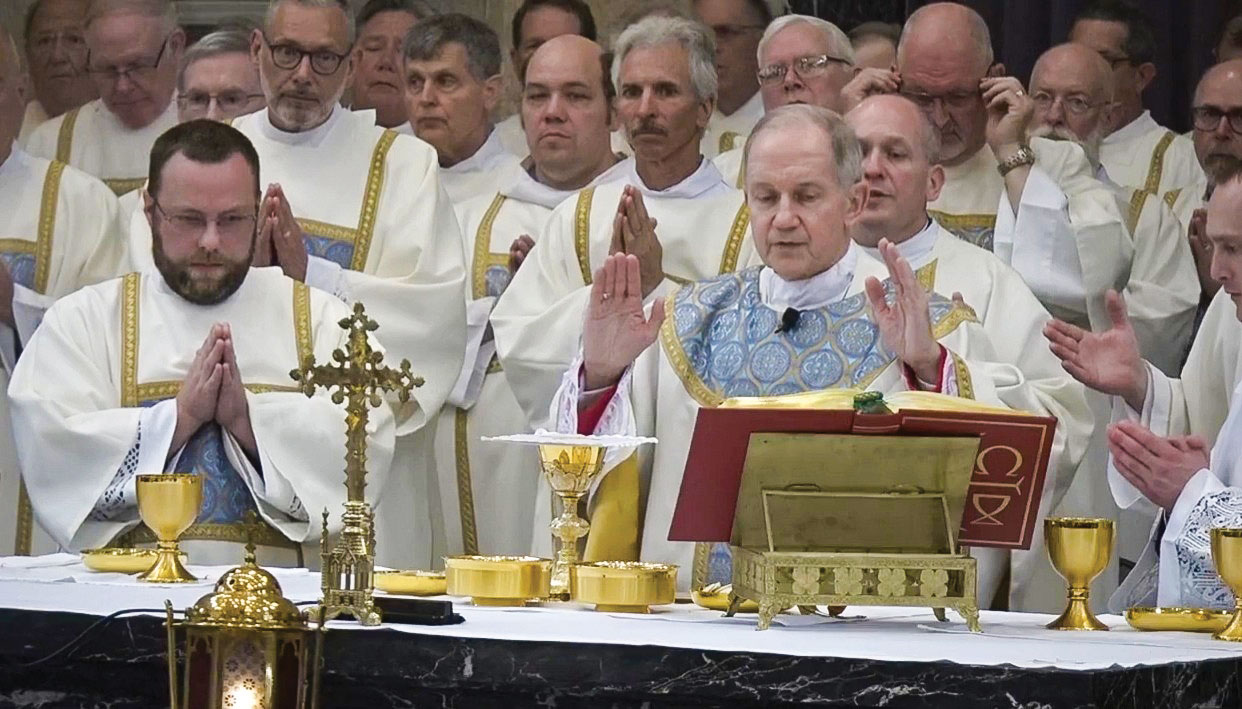 ‘Bringing Jesus to the people is a wonderful feeling and something that is at the very heart of the diaconate’
By DEACON ADAM COX
Special to Catholic Times
MARYVILLE — When I was lying face down on the marble floor of the Cathedral seven months ago, I had no idea what the life of a deacon was going to look like. My very first time serving as an ordained deacon was with Bishop Thomas John Paprocki on ordination day. I have never been more nervous in my life, but he is very understanding, and I got through it. In a short period of time, I have become more confident in my role at Mother of Perpetual Help, my home parish in Maryville, and so far, becoming a deacon has been spiritually rewarding.
It would be misleading to say that everything is always easy, but God continues to provide me strength and bless me abundantly. Some things that I do as a deacon were the same things I did prior to ordination, like helping distribute holy Communion, and while I don’t lector anymore, I do proclaim the Gospel to the people. I also get to do new things such as give homilies, offer blessings, assist with baptisms, and was recently interviewed by a family for a school project. I’m grateful for all the opportunities that have been offered since ordination, but nothing compares to distributing holy Communion to the people of the parish inside and outside the church.
Bringing Jesus to the people is a wonderful feeling and something that is at the very heart of the diaconate. The reverence that I see from the people has been very humbling. It always brings a smile to my face and joy to my heart. Shortly after ordination I was given the opportunity to take Communion to someone at their home and God showed me what true love of the Eucharist is. This person was unable to speak and was very weak, but as I said the words “the Body of Christ,” I could see the love in this person’s eyes. My heart was so moved by this expression, and I could feel the love of Christ in the room with us, a truly indescribable moment, one that I will never forget! I realized at that moment, in a new way, the joy of being used by God to help minister to the people.
I’m still new in my life as a deacon, but I have many years ahead of me, and I hope God continues to use me in my life of service to others. I could have never imagined the peace that my heart feels in my new role and the journey of getting to this point was a learning experience. I’m often reminded that the learning experience and journey are ongoing, but hopefully I can use this in helping me not grow stale in my ministry to others.
It was easy to think during formation that eventually I would be ordained, and the formation would stop or at least slow down, but that is not the case. I’m finding that the formation has grown more intense, and I appreciate it more than ever. I also realize this is true for other aspects of my life: my marriage, my relationship with my kids, and the relationships with the people at my parish. I must continue to let God form me. When formation stops, I stop growing spiritually, emotionally, and intellectually. To be effective in my ministry to others, I need to be open, honest, and be willing to adapt to where people are at in their lives, not mine. Seven months ago, I had no idea what the life of a deacon would look like, and I don’t think I’m any closer now, but my formation is only beginning and always changing.
Deacon Adam Cox serves at Mother of Perpetual Help Parish in Maryville.
Thinking about becoming a deacon?
Applications for the permanent diaconate in our diocese are being accepted at this time. Permanent diaconate formation begins in the fall of 2022.
“My advice to men is pray and discern,” said Deacon Dave Sorrell, director of the Office for the Diaconate. “I know there are many men discerning a call to vocation. I simply ask them to continue their prayer of discernment if God is calling them to a vocation as a permanent deacon.”
Deacon Sorrell also says that in addition to prayer and perhaps most importantly, men should include their wife and family in their prayer and have an open and candid discussion. They should also consult their pastor and if a deacon is ministering in the parish, seek him out as well. The pastor and deacon will be most helpful in the discernment process. The deacon and wife will be very helpful in identifying the blessings and challenges of formation and ordained life.
The permanent diaconate is open to men between the ages of 32 and 57, who are active in the practice of our faith, and who desire to grow in their relationship with God and in their service to the Church. If interested, email Deacon Sorrell: . You can also visit dio.org/diaconate.
What is the difference between mortal and venial sin?

The Catechism of the Catholic Church defines sin as “the failure in genuine love for God and neighbor caused by an attachment to certain goods. Sin wounds the nature of man and injures human solidarity.”
Translation: Sin is when you miss the mark — when you choose something of lesser importance over God, another person, or your true self.
It doesn’t take much reflection to understand that not all sin is the same. Intentionally taking someone else’s life and being short tempered with someone are not morally equivalent. The First Letter of St. John says that all wrongdoing is sin, but not all sin is deadly. That is a distinction that the Church still holds today in distinguishing between mortal and venial sin.
Venial sin is present when you act against the moral law, even in small ways such as when you slack off at work, when you binge watch Netflix and still claim you are too busy to call and check in on loved ones. We all know this list could go on.
Mortal sin is more serious. For a sin to be mortal, three conditions have to be met. First, it has to entail “grave matter,” which means that the act itself is serious (serious according to God’s criteria, not ours!). Secondly, you have to have full knowledge that what you are doing is grave matter. Third, you have to give complete consent to the act.
Mortal sin is a deliberate decision, by which you are saying, “I know this is a bad thing to do, and I am going to freely choose in this moment to do it anyway.” Mortal sin requires a sacramental confession to be forgiven (and so you can receive the Eucharist).
A quick case study: John knows Catholics cannot eat meat on Fridays during Lent. He thinks about this while at lunch and says, “I know what the Church says, but who cares?” Then, he proceeds to eat a hamburger. All criteria seem to be met for mortal sin. On the other hand, Jane also knows the Church’s Lenten observances but honestly doesn’t think about it being Friday until after her hamburger. She did not give her complete consent to the act, so it is not a mortal sin. It was just a mistake.
Always remember, whether sin is mortal or venial, it is bad for us and is not good enough for our hearts and the plans of love God has for us. If you have mortal sin on your conscience, come to confession, the sacrament of mercy. Nothing is bigger or stronger than God’s mercy. If you have no mortal sin, it is still important to ask forgiveness for our venial sins, even small ones. Make a regular practice of confession.
Think of it like a car wash. If you have gone mudding (mortal sin), get to the wash right away. If your vehicle gets dirty ever so often (venial sin), it is still good to get it washed every three or four months!
Father Rob Johnson is pastor of Mother of Perpetual Help Parish in Maryville and chaplain of Southern Illinois University at Edwardsville.
Why do I have to go to a priest for God to forgive my sins? Why can’t I just tell God directly?

One of Jesus’ key ministries was the forgiveness of sins, something He often associated with simultaneous miracles of physical healing. See Lk 5:17-26, where Jesus forgives the paralytic his sins, and then heals his paralysis. Every time He forgave, Jesus personally, intimately, and life-changingly encountered the person suffering from their sins, and this is something He wants to do for us as well! By His death and resurrection, Christ has redeemed us, conquering sin and death, and He wanted this healing and forgiving ministry to continue, so he entrusted it to the Apostles and consequently, to the Church.
One Scripture basis for the sacrament of penance is John 20:19-23, when on Easter night, Jesus breathed the Holy Spirit on the Disciples and told them, “Whose sins you forgive are forgiven them, and whose sins you retain are retained.” The words of absolution said by the priest in the sacrament are rooted in this Scripture. “God, the Father of mercies, through the death and resurrection of his Son, has reconciled the world to himself and sent the Holy Spirit among us for the forgiveness of sins; through the ministry of the Church, may God give you pardon and peace, and I absolve you from your sins, in the name of the Father, and of the Son, and of the Holy Spirit.” (Rite of Penance, 46.)
The priest in the confessional, in the sacrament of penance, is in persona Christi, in the person of Christ, as in all sacraments. It is Christ who absolves. It is Christ who baptizes. It is Christ who offers himself on the altar at Mass. So, when penitents come to the sacrament, they are in fact confessing to God, Christ Jesus, in and through the person of the priest. This is going directly to God, as you say in your question.
Why is this manner of confessing helpful? Here we return to the bedrock truth of the Christian faith. God became one with us in the flesh, in His incarnation. God did not just will our redemption and accomplish it by thinking it. He sent his Son, in the flesh, to personally encounter us, to save us by his death and resurrection.
So, think of it in terms of your marriage. You did not become married just by thinking it. You said your intentions publicly, out loud to your spouse. Your words, your consent, your two-become-one, make the sacrament. It is incarnational; you are husband and wife in the flesh. When there is a rift in your marriage, when you wronged your spouse, you need to say, “I am sorry.” Sure, you can think of how sorrowful or remorseful you are, and you can presume your spouse’s forgiveness, but the rift is not really healed until words of sorrow are expressed and you hear the words, “I accept your apology and forgive you.” It is a personal, direct encounter. It is sorrow incarnated.
The way that God created our humanity — body, soul, mind, and strength — means that we need to outwardly, verbally express both our love and our sorrow. I encourage you to go to confession so you can name your sins and express sorrow to Jesus in the person of the priest and hear his healing words of mercy.
Father Joe Ring is pastor at Our Saviour Parish in Jacksonville. This originally appeared in Catholic Times in 2019.
It has been a long time since I have been to confession. Before I even go, what should I do first?

From my experience as a confessor and one who also goes to confession regularly, a good preparation before confession is the key to making a good confession. Think about any time you have had to have a serious conversation with somebody, especially one that might be difficult. There is no way you would go into that conversation unprepared. The anxiety of the situation could seriously compromise your ability to get your points across. But, if you prepare ahead of time, even though the nerves are there, you will be in a much better position to communicate your message.
We all know how nervous we can get when we go to confession, so preparing ahead of time will enable us to better confess our sins despite our anxiety. Furthermore, the Church asks us that we make an integral confession, which means making as complete of a confession as possible. Just trying to think of some sins a minute or two before confession is not sufficient.
So how does one prepare, especially if it has been a while? The first thing to do is to say a prayer to the Holy Spirit, asking Him to shed light on those areas of your life where you need forgiveness. Then, it can be helpful to use an Examination of Conscience guide to help you identify and name your sins. You can look one up on the internet or check out the one on page 10. Make a good preparation and come receive God’s mercy in your nearest confessional!
Father Brian Alford is rector of the Cathedral of the Immaculate Conception in Springfield and is the vocations director for the Diocese of Springfield in Illinois.
Going to confession. A step-by-step instruction

1. PREPARATION: Before going to confession, take some time to prepare. Begin with prayer asking the Holy Spirit to shine His light into your heart. Ask that you can see yourself, and your life, since your last confession as He sees you. Then ask yourself whether you have — in your thoughts, words, and actions — neglected to live Christ’s commands to “love the Lord, your God, with all your heart, with all your soul, and with all your mind,” and to “love your neighbor as yourself” (Mt 22:37, 39)?
As a help with this examination of conscience, you might review the Ten Commandments or the Beatitudes (Ex 20:2-17; Dt 5:6-21; Mt 5:3-10; or Lk 6:20-26). Or review an Examination of Conscience guide you can find online or on page 10 in this edition of Catholic Times. If you need to, you can jot down some notes to keep from forgetting anything that has surfaced during your examination but finish your examination either way with a prayer of gratitude to God and be at peace as you head to the confessional. When you enter the confessional, you can choose to say your confession behind the screen or face-to-face depending on whichever way will best allow you to encounter God’s mercy in the sacrament.
2. GREETING: The priest might say words of welcome to you; he may say a short blessing or read a Scripture passage. More often than not, however, he will go right to step
#3. THE SIGN OF THE CROSS: Together, you and the priest will make the Sign of the Cross. You may then begin your confession with these or similar words: “Bless me, Father, for I have sinned. It has been [give days, months, or years] since my last confession.” Note, some priests may not say anything at all at the beginning. If that is the case, do not hesitate to begin with that and say “Bless me, Father, for I have sinned. It has been [give days, months, or years] since my last confession.”
4. CONFESSION: Confess all your sins to the priest. Try to be as specific as possible. If you are unsure what to say, ask the priest for help and know that if he would like more clarity on something, he will gently ask you for more details. When you are finished, conclude with these or similar words: “I am sorry for these and all my sins.” Note, you can write down your sins on paper and read them if that helps you. However, after confession, you are to destroy the paper as soon as possible as these sins have been forgiven and are no longer part of your life.
5. PENANCE: The priest may first counsel you on how to better live a Christian life and may ask you some questions. Then, he will offer to you some act of penance. It might be prayer, a work of mercy, or an act of charity. You will know this step because the priest will say, “For your penance … .” Just remember to do your act of penance!
6. ACT OF CONTRITION: After the priest has given you your penance, he will ask you to pray an Act of Contrition out loud. A suggested Act of Contrition you can pray is below but know that you can also simply pray from your heart a prayer expressing sorrow for your sins and resolving to sin no more.
“My God, I am sorry for my sins with all my heart. In choosing to do wrong and failing to do good, I have sinned against you whom I should love above all things. I firmly intend, with your help, to do penance, to sin no more, and to avoid whatever leads me to sin. Our Savior Jesus Christ suffered and died for us. In his name, my God, have mercy.” (Rite of Penance, no. 45)
7. ABSOLUTION: The priest will extend his hands over your head and pronounce the words of absolution. He will say:
“God the Father of mercies, through the death and resurrection of his Son has reconciled the world to himself and sent the Holy Spirit among us for the forgiveness of sins; through the ministry of the Church may God give you pardon and peace, and I absolve you from your sins in the name of the Father, and of the Son and of the Holy Spirit.” You respond, “Amen.”
8. PRAISE: The priest may then praise the mercy of God and will invite you to do the same. For example, the priest may say, “Give thanks to the Lord for he is good.” And your response would be, “His mercy endures forever” (Rite of Penance, no. 47). Note, some priests omit this, or may use another phrase to offer God thanks for His mercy.
9. DISMISSAL: The priest will conclude the sacrament, often saying, “Your sins are forgiven. Go in peace.” You can thank the priest.
10. PENANCE: After confession, spend time in quiet prayer in the church, especially if given a penance of prayer. Thank God for His unconditional love and forgiveness!
This list is reprinted with permission from the USCCB. See more information and resources about confession at usccb.org/confession.
‘Burden lifted.’ Three things to keep in mind that can help alleviate your fear of going to confession

My sophomore year of college, a fraternity buddy invited me to a retreat, and I begrudgingly said “yes.” I am really glad I went, because I went to confession for the first time in a long time. After confessing all my sins and by the grace of God holding nothing back, I remember a brief silence. Was the priest mad? Was he going to tell me I should leave the retreat? I still remember looking up and him smiling, then he said, “Burden lifted” and offered me penance and absolution. That encounter with God’s mercy changed the whole direction of my life. I wanted to get to know Jesus after that, and I wanted others to know him and His mercy.
Here are a few things I think we all need to be reminded of from time to time about going to confession:
- Be direct and totally honest: You will not scandalize or startle a priest, no matter what you bring to the confessional. My favorite description of a priest is “God’s garbage man.” Name your sins specifically and tell the priest how many times they happened. You are good and created in God’s image, let the garbage man take care of the sins.
- The priest will never reveal your sins. Ever. Every Catholic priest is bound by what is called the seal of confession. He would go to jail or even give his life before he revealed anything said in confession. Under no circumstances is the seal permitted to be broken.
- Think of confession like a car wash. If you ever take your car through the mud, you get it to the wash right away. Or, if it has just been a while, it is still good to take it to the wash. If you believe yourself to be in a state of serious sin, be brave and go to confession right away. Or if it has been several months (or years!), it is still good to go and totally appropriate to bring smaller things as well, what are called venial sins. Just be sure to confess anything you know to be seriously sinful.
God wants to offer us His mercy, He literally died to do so. Go to confession, do not worry about doing it perfectly. I try to go every couple weeks, and honestly, I still get nervous most the time, so I just take a deep breath and remember Father saying, “Burden lifted.”
Father Rob Johnson is pastor at Perpetual Help in Maryville, chaplain at Southern Illinois University at Edwardsville, and associate director for the Office for Vocations for the Diocese of Springfield in Illinois.
I am discouraged that I confess the same sins over and over when I go to confession. What advice do you have for me?

First, we look for God’s grace. As sin tends to shame us into silence and then convince us to quit the spiritual struggle altogether, that you acknowledge discouragement and ask for help prove God is already subverting the cycle of sin you mention.
Second, it is vital we familiarize ourselves with our ascetic tradition. By closely reading the Scriptures and vigilantly observing the human person, the Church has developed means to accurately diagnose and interrupt the progress of temptation.
For example, early Christian ascetics identified five progressive stages of evil as well as possible remedies to halt their advancement. Memorizing both the stages and their remedies will assist us immensely when tempted. They are:
1. Suggestion: Our first contact with the image, fantasy, or urge to do evil always presents itself in a pleasing manner. We cannot rid ourselves of these fleeting thoughts, but we choose whether to let them pass by or to entertain them. Remedy: Ignore them. Busy yourself with something else and they will depart. “Keep your mind warm with holy thoughts,” counsels St. Ephraim. “If the soup is hot, the fly won’t land in it.”
2. Conversation: But we do not always ignore them. Instead, we converse with the suggestion as Eve did with the serpent. We let ourselves be provoked by it and then begin reflecting on it. All day long we may consider the person who wronged us that morning. If there is no decision, there is no sin. But much time and vital energy has been wasted on these inner dialogues. Remedy: Continue the dialogue but change partners; instead of talking to yourself, talk to Christ. Reveal the conversation to Him and see where the discussion goes.
3. Struggle: A suggestion grown through conversation has wormed its way into the heart and is now a struggle. It will not be easily dispelled, but with much exertion it can be done. Remedy: Hold firm and prayerfully repeat: “Jesus, you do not want this for me; neither do I. I freely decide the opposite.” Or “God come to my assistance; Lord, make hast to help me!”
4. Consent: If the will surrenders to the struggle and consents to the suggestion of evil, one sins. Remedy: Make an Act of Contrition. Go to confession if necessary. Let God love you in this moment of weakness.
5. Passion: The final and most tragic stage, passion indicates the continual consent to evil which weakens both the will and the character of the person. Sin becomes something like an addiction, and the sinner a slave to it. Remedy: The will needs to be re-awoken. Devote yourself to prayer, the sacramental life of the Church, and seek help if needed. Some passions can’t be overcome alone.
God desires our freedom from sin. Knowing the cycle of evil and patiently sabotaging it at every step will go a long way in living into that freedom.
Father Seth Brown is pastor of Mother of Dolors in Vandalia and St. Joseph in Ramsey. He is also chaplain of Our Sorrowful Mother’s Ministry, chaplain of the Vandalia Correctional Center, and research theologian for the Diocesan Curia
A view from the other side of the screen. What priests think when hearing a confession

I had been a priest for a very short time when I was in the old-style confessional on a Saturday afternoon. A young family came in and the mother and the father went into the two side doors. Their young son, who had received his first Communion recently, not knowing quite what the procedure was, opened the middle door. And there I was! We began the ritual, and I was overwhelmed by his childlike innocence and complete trust in God’s mercy and love. That child opened my heart to love this sacrament more than ever.
The Father invites us to come, sit in his lap, and experience his love and mercy. As a priest, I am there not to judge or to reprimand, but to forgive in God’s name and on behalf of the Church. When I am in the confessional, I experience peace as penitents are reconciled. It fills my heart with joy. Some come to confession carrying heavy burdens of sin and guilt. In the words of absolution all that melts away. The words, “I absolve you from your sins” are powerful and affirming. There is nothing else like it.
I am humbled by the power bestowed on me in my priesthood ordination. I can still feel the coolness of the marble at the Cathedral as I lay prostrated during the Litany of Saints. I still feel the strong hands of Bishop Joseph McNicholas on my head. I still can smell the sweetness of the sacred chrism as my hands were anointed for service. I still feel the warmth of the embraces as my fellow priests welcomed me. But most of all I remember were the tears that flowed for three days as my heart was so full of joy that I thought it would burst. I was a priest! I had the privilege and the power to be able to stand at the altar for the rest of my life as I would take bread in my hands and say, “This is my body,” and take the cup of wine and say, “This is my blood.” I had the privilege and the power to welcome sinners and declare, “I absolve you.”
The gift of being able to confect the Eucharist and to absolve sins as an alter Christi, another Christ, still brings tears to my eyes. The ability to hold in my hands the very body and blood of Jesus and to extend my hands over a penitent in absolution continues to make me shudder at the power of God working through me. I stand in awe!
I know that it is hard to admit that I am a sinner, especially to another person. Frequent confession and a regular confessor have helped me. Several years ago, I received a young woman into the Catholic Church at the Easter Vigil. She is a dentist and told me, “You know Father, confession is like flossing your teeth. You hate to do it, but afterward you feel so much better.” She is my dentist to this very day. Such insight!
Someone asked me one time if hearing all these sins depressed me or if it changed the way I viewed someone. I told them that I focus not on the sins, but rather on the mercy and love of God. I listen to the sins since there might be something that we need to discuss, but what I really listen for is sorrow for sin, and what I experience again and again is the overwhelming power of Divine Mercy.
A couple of years ago I was sitting at the bedside of a dear friend as she was dying. She was surrounded by family and friends. At one point she asked them all to leave so that she could talk to me privately. When she asked me to hear her confession the tears started as I realized that I was in a grace filled moment of a death bed confession. I was overwhelmed by her childlike innocence and her complete trust in God’s mercy and love. A few hours later she breathed her last, at peace with God. It is very humbling to be able to be part of such incredible moments.
The incredible moments continue to happen as people come with their burdens trusting in God. I always give thanks to God for his love as I stand in awe before such a powerful and beautiful sacrament. The grace given on that first Easter Sunday in the upper room when Jesus said, “Whose sins you forgive, they are forgiven,” continues to give life to the Church.
Father Donald Wolford is pastor at Holy Angels Parish in Wood River.